

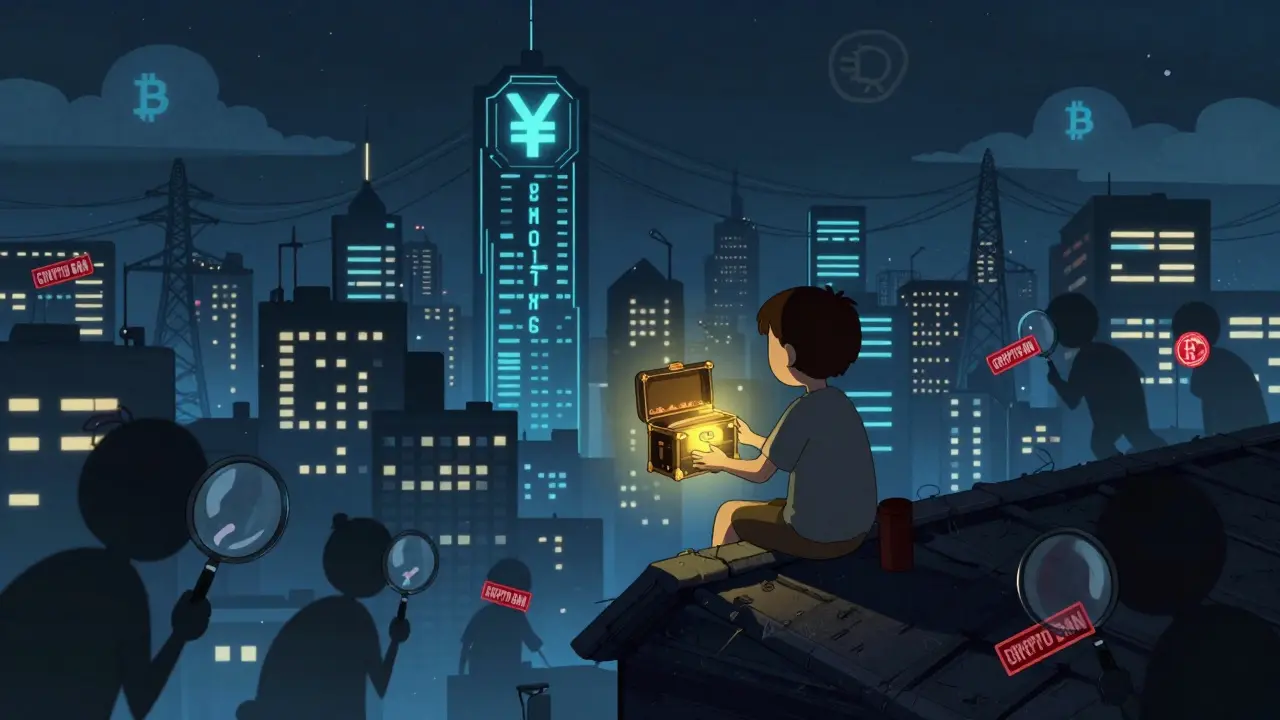
China doesn’t just regulate cryptocurrency - it bans it. Fully. Completely. No gray area. If you’re a Bitcoin holder in China, or even just connected to the Chinese financial system, this isn’t a suggestion. It’s the law. And it’s been this way since 2021, with no signs of changing anytime soon.
What Exactly Is Banned?
China’s crypto ban isn’t a single rule. It’s a web of restrictions that touch every part of the ecosystem. Here’s what’s illegal:
- Operating any cryptocurrency exchange inside China
- Trading Bitcoin or altcoins on peer-to-peer platforms
- Providing banking services for crypto transactions - including deposits, withdrawals, or account setup
- Running mining operations - no ASICs, no GPUs, no data centers
- Offering derivatives, futures, or options tied to crypto
- Any overseas exchange serving Chinese residents - even if you’re using a VPN
- Using crypto as payment for goods or services
Financial institutions - banks, payment processors, fintech apps - are legally required to monitor transactions for any hint of crypto activity. If your bank account shows a pattern of transfers to known crypto wallet addresses, you’ll get flagged. Not just once. Again and again. The People’s Bank of China has built a national monitoring system that tracks fund flows across millions of accounts. This isn’t about catching one person. It’s about shutting down the entire underground market.
Why Did China Do This?
It’s not about Bitcoin being bad. It’s about control.
China’s leadership sees decentralized money as a threat to its financial sovereignty. Bitcoin doesn’t answer to the state. It doesn’t track who sends what, when, or why. That’s the opposite of what the government wants. They’ve spent years building the Digital Yuan - a state-controlled CBDC that gives them total visibility into every transaction. Why allow a rival system that can’t be monitored, taxed, or stopped?
Another major reason: energy. In 2021, China was home to over 70% of global Bitcoin mining. That meant massive power use - sometimes more than entire countries. The government cracked down not just for financial control, but because mining was straining the grid, especially during winter peaks. They didn’t care about Bitcoin. They cared about blackouts.
And then there’s risk. Crypto prices swing wildly. A person could lose their life savings overnight. If that happens to thousands - or millions - of people, it could trigger social unrest. That’s unacceptable to a government that prioritizes stability above all else.
What Happens to Bitcoin Holders in China?
Here’s the brutal truth: if you hold Bitcoin in China, you’re holding it illegally. And there’s no legal protection for you.
Let’s say you bought Bitcoin in 2020 and held onto it. You didn’t trade it. You didn’t mine it. You just kept it in a hardware wallet. That’s still a problem. Why? Because if you ever try to cash out - even through a friend, a P2P platform, or a non-bank service - you’re violating the law. And if you get caught, you have no recourse. Courts won’t help you. Banks won’t touch your funds. Even if you can prove you owned the coins, the state doesn’t recognize ownership.
There are reports of people being fined, having bank accounts frozen, or even facing administrative detention for repeated crypto activity. It’s rare, but it happens. And the threat is always there.
Most holders now operate in silence. They keep their coins offline. They don’t talk about it. They don’t move them. They wait. Some believe the ban will lift. Others have given up entirely.
Is It Really Possible to Ban Bitcoin?
Technically? No. Bitcoin is decentralized. It runs on a global network. You can’t shut it down.
But you can make it nearly impossible to use.
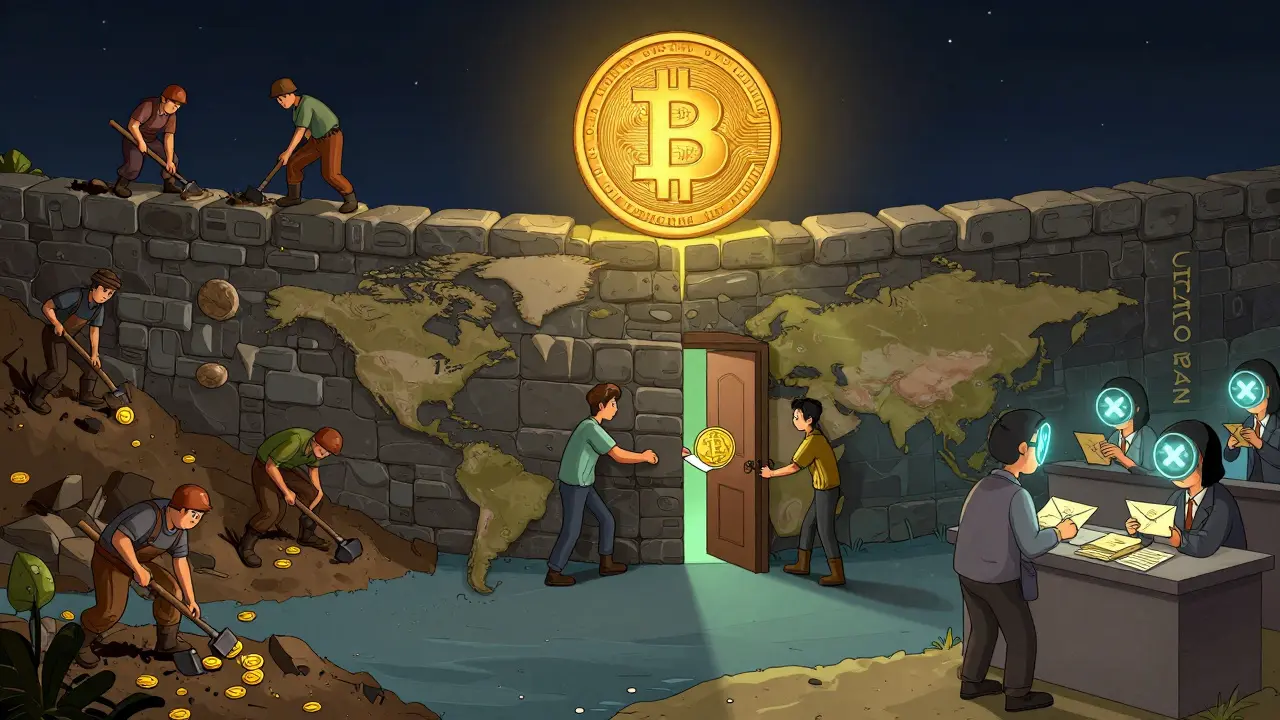
China’s strategy isn’t to destroy Bitcoin. It’s to isolate it. Cut off its connection to the real economy. Make it useless for daily life. That’s why they target the bridges - banks, exchanges, payment systems - not the blockchain itself.
And it’s working. According to Chainalysis data from 2024, Bitcoin transactions originating from China dropped by 92% since 2021. P2P trading volume fell from over $10 billion annually to under $1 billion. The market didn’t vanish - it went underground.
But underground doesn’t mean gone. Many Chinese citizens still hold Bitcoin. They just don’t talk about it. They don’t sell. They don’t buy more. They wait - for a policy shift, for a loophole, for a chance to exit without consequences.
What About the Rumors? Did China Ban Crypto Again in 2025?
Yes - but only in your feed.
Early in 2025, fake news spread across social media claiming China had imposed a new, even stricter ban. Elon Musk’s X account was flooded with posts. Financial influencers like FirstSquawk and Unusual Whales shared it. Telegram channels exploded. The story claimed new laws banned private wallet ownership and criminalized holding Bitcoin.
It was all false.
Chinese regulators issued an official denial within 48 hours. The People’s Bank of China confirmed: “No new regulations have been issued.” The misinformation was traced back to a single bot network operating out of Southeast Asia. It was a coordinated disinformation campaign - likely designed to manipulate crypto prices.
This isn’t new. Since 2016, there’s been a fake “China ban” rumor every year. Each time, it spikes Bitcoin prices briefly. Then it crashes when debunked. The pattern is clear: people want to believe China will change its mind. But it hasn’t. And it won’t.
How Does This Affect Bitcoin Globally?
China’s ban doesn’t just affect Chinese citizens. It affects everyone.
When China banned mining in 2021, Bitcoin’s hash rate dropped by 50% overnight. Miners fled to the U.S., Kazakhstan, and Canada. The network survived - but it changed. The center of gravity shifted away from state-controlled infrastructure.
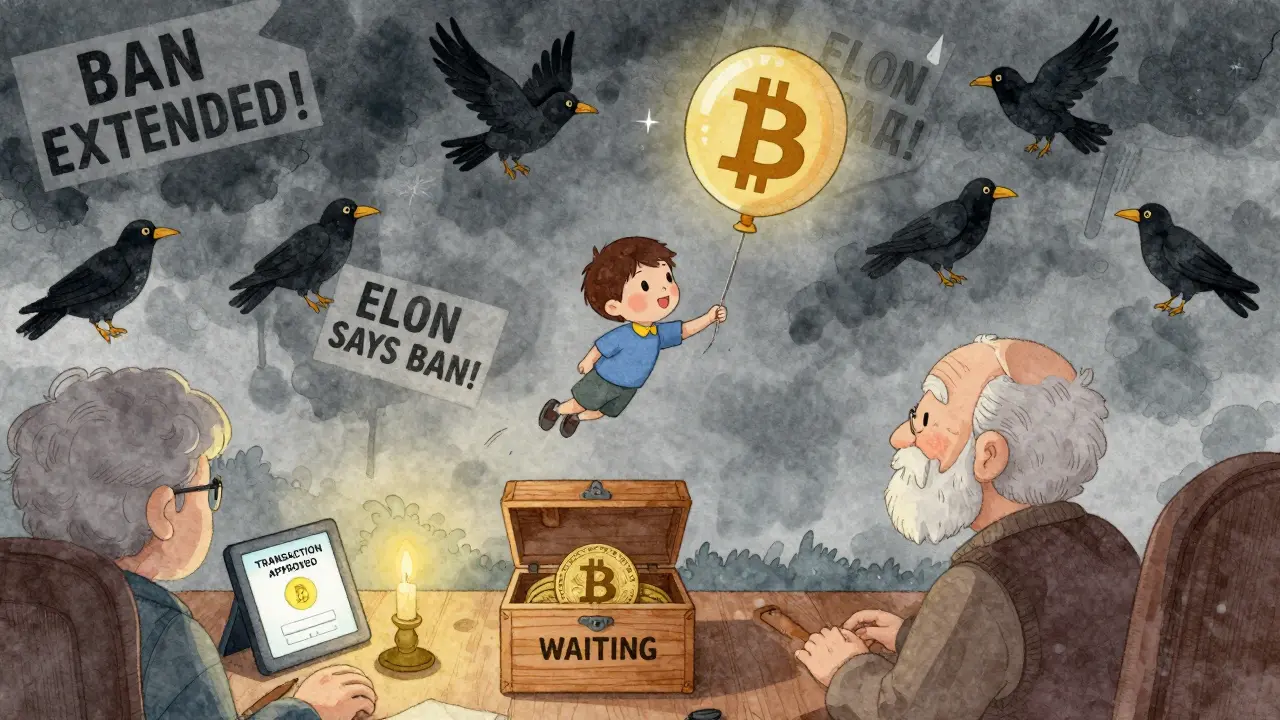
Today, China’s ban acts like a wall. It keeps an estimated 140 million people - one of the largest potential crypto markets in the world - locked out. If China ever lifted its ban tomorrow, experts estimate Bitcoin could surge 30-50% in a single week as capital floods back in.
That’s why global traders watch China like a live feed. Not because they think the ban will lift soon - but because if it does, it’ll be the biggest market event since the 2017 bull run.
What’s the Alternative? The Digital Yuan
While Bitcoin sits in the shadows, China is building its own digital currency: the Digital Yuan (e-CNY).
Launched in 2020, it’s now used in over 200 cities. Over 300 million people have opened e-CNY wallets. It’s fast, convenient, and fully traceable. The government knows exactly who paid whom, for what, and when.
This isn’t just about convenience. It’s about power. The Digital Yuan gives China total control over monetary policy, tax collection, and financial surveillance. It’s the opposite of Bitcoin - centralized, monitored, and state-backed.
For China, crypto isn’t a threat because it’s new. It’s a threat because it’s uncontrollable. The Digital Yuan? That’s the future they want.
What Should Bitcoin Holders Do?
If you’re a Chinese citizen holding Bitcoin:
- Don’t try to cash out through banks or payment apps. You’ll get flagged.
- Don’t use P2P platforms that require ID verification. They’re monitored.
- Don’t assume the ban will lift soon. It’s been stable since 2021.
- Keep your coins offline. Cold storage is your only safe option.
- Understand that you have zero legal protection. If you lose access, there’s no recourse.
If you’re outside China but hold Bitcoin linked to Chinese networks - like a wallet you opened while living there - the same rules apply. Your activity is still monitored. Your identity may be flagged. Proceed with extreme caution.
The reality is simple: China has chosen control over decentralization. And for Bitcoin holders, that means living in a legal gray zone - with no safety net.
Can I still buy Bitcoin in China?
No. Buying Bitcoin in China is illegal. All exchanges have been shut down. Even peer-to-peer trading through apps or social media is monitored and blocked. Financial institutions are required to freeze accounts linked to crypto purchases. There is no legal way to buy Bitcoin inside China.
Can I get in trouble for holding Bitcoin?
Holding Bitcoin privately - like in a hardware wallet - isn’t explicitly criminalized. But if you try to sell it, trade it, or convert it to yuan, you’re breaking the law. There have been cases of fines, account freezes, and administrative detention for repeated activity. The risk isn’t high for passive holders, but it’s real if you move the coins.
Is Bitcoin mining still banned in China?
Yes. All Bitcoin mining operations were banned in 2021. Any remaining mining farms were shut down by 2023. Authorities actively raid facilities and cut power. Using electricity for mining now carries heavy penalties, including criminal charges for large-scale operations.
Can Chinese citizens use overseas exchanges like Binance or Coinbase?
Technically, no. Chinese law prohibits overseas exchanges from serving Chinese residents. While some users still access them via VPNs, doing so violates regulations. Exchanges are required to block Chinese IP addresses and verify user locations. Accounts tied to China are frozen or closed. The government actively pressures foreign platforms to comply.
Will China ever lift the crypto ban?
Unlikely in the near term. China is investing heavily in its own Digital Yuan, which serves the same goals as crypto - digital payments, efficiency, control - without the risks of decentralization. Until the government sees Bitcoin as a tool it can regulate, not a threat it can’t control, the ban will remain. Any rumors of a reversal are almost always misinformation.
Aileen Rothstein
February 18, 2026 AT 15:32And yeah, people still hold Bitcoin in China. But they’re not idiots. They use cold wallets, avoid P2P, and never talk about it. The real story isn’t the ban - it’s how quietly people adapted.
JJ White
February 19, 2026 AT 20:27THEY’RE COMING FOR OUR DECENTRALIZED FUTURE!!!
THEY’RE FEARING THE POWER OF THE PEOPLE!!!
THIS IS THE END OF THE INTERNET AS WE KNOW IT!!!
THEY’RE USING AI TO TRACK WALLET ADDRESSES!!!
THEY’RE TURNING HARDWARE WALLETS INTO PRISON CELLS!!!
THEY’RE BANNING THE SUN TOO BECAUSE IT’S TOO DECENTRALIZED!!!
WE’RE ALL DOOMED!!!
WHY ISN’T ELON FLYING A ROCKET TO BEIJING WITH A TOWEL AND A LITERAL BITCOIN???
THIS ISN’T A BAN - IT’S A WAR ON FREEDOM!!!
AND SOMEONE PLEASE TELL ME WHY THE PBOC ISN’T BEING BOMBED BY A DRONE SWARM OF LITECOIN MINERS???
MY HEART IS BROKEN. I’M CRYING INTO MY RICE BOWL.
JUST KIDDING. I’M DRINKING A LATTE AND LAUGHING. BUT STILL. THIS IS A TRAGEDY.
Jenn Estes
February 20, 2026 AT 00:02And let’s be real - most Chinese people don’t even care. They’ve got the Digital Yuan. It works. It’s fast. It’s convenient. Why risk losing your life savings to a meme coin?
The real tragedy? Westerners who think crypto is freedom. It’s not. It’s gambling with a side of delusion.
Angela Henderson
February 20, 2026 AT 17:31I mean, if you’re holding Bitcoin in China, you’re not gonna get arrested. You’re just gonna have to be super quiet about it. Like, don’t post about it on WeChat. Don’t talk about it at family dinners. Don’t even say the word ‘BTC’ in front of your cousin who works at the bank.
It’s not about the law. It’s about vibes. And the vibe is: keep it to yourself.
Meanwhile, the rest of the world is acting like this is some epic battle between good and evil. Nah. It’s just bureaucracy with a blockchain twist.
Nova Meristiana
February 21, 2026 AT 07:48Next up: Russia bans oxygen. Japan bans sleep. The EU bans sunlight.
Let me guess - the real story is that China’s Digital Yuan is failing and they’re trying to scare people into using it.
And don’t even get me started on the ‘92% drop in transactions’ stat. That’s not a ban. That’s a market correction. People moved. They didn’t disappear.
Also, who even cares? Bitcoin’s price went up 200% last year. The whole world is still trading it. China’s ban is just background noise. Like a mosquito in a hurricane. 🦟🌀
Jennifer Riddalls
February 22, 2026 AT 18:04Most of us outside China don’t realize how much pressure people are under. They’re not trying to rebel. They’re not trying to be crypto bros. They’re just trying to protect their future.
And honestly? The fact that they’ve managed to hold onto their assets quietly for over three years? That’s resilience. That’s quiet strength.
Don’t judge them. Don’t mock them. Just respect them.
kieron reid
February 23, 2026 AT 07:54The rest is just crypto bros projecting their fantasy of ‘financial freedom’ onto a country that never cared about that nonsense.
Also, the ‘140 million potential users’ line? That’s a lie. Most of those people don’t even know what Bitcoin is. They’re busy paying bills with WeChat Pay.
Stop pretending this is a global revolution. It’s a government making a practical decision. And honestly? They’re right.
Avantika Mann
February 24, 2026 AT 20:27It’s like when you remove one branch from a tree - the rest grow thicker.
And honestly? I think China’s Digital Yuan is the real future. Not because it’s better than Bitcoin, but because it’s practical. People want convenience. Not chaos.
Bitcoin’s not dead. It’s just… quieter now. And that’s okay.
yogesh negi
February 25, 2026 AT 21:11China didn’t just say ‘no’ - they said ‘here’s what we’re building instead.’
And honestly? That’s leadership.
Most countries are still arguing about regulation. China just built it.
Also, the energy angle? Huge. Mining was using more power than some European countries. That’s not sustainable. They had to act.
And yes - people still hold Bitcoin. But they’re not reckless. They’re careful. And that’s the smartest thing they can do.
Nikki Howard
February 27, 2026 AT 10:40Meanwhile, Western markets are drowning in unregulated gambling disguised as ‘investment.’
Bitcoin is not money. It’s a speculative asset with zero intrinsic value.
China’s ban is not oppressive - it’s prudent.
And for those who claim ‘decentralization equals freedom’ - please explain why your ‘decentralized’ Bitcoin wallet is now worth 40% less than when you bought it.
Also - why are you still holding it? 🤔
Sasha Wynnters
February 28, 2026 AT 20:36What China banned was access. Not Bitcoin. Access.
And that’s the real lesson here: power doesn’t destroy decentralization. It isolates it.
Like putting a glass dome over a forest. The trees still grow. The roots still spread. But no one can touch them. No one can harvest them. No one can use them.
So the forest becomes a museum. Beautiful. Silent. Dead.
And that’s what China did. They turned Bitcoin into a relic.
Charrie VanVleet
March 2, 2026 AT 08:58China didn’t ban Bitcoin because it’s evil. They banned it because it doesn’t fit into their vision.
And honestly? That’s fair.
Every country has a right to choose its own financial path.
Just because we think crypto is freedom doesn’t mean everyone else does.
Also - to all the Chinese holders out there: you’re not alone. We see you. We respect you. Keep your keys safe. 🙏
Rajib Hossaim
March 3, 2026 AT 19:07Both are true.
There’s no right or wrong here - just different priorities.
One side values individual freedom. The other values collective order.
Neither is better. Just different.
And maybe… that’s okay.
AJITH AERO
March 5, 2026 AT 02:35Next up: banning gravity because it’s too decentralized.
Also, why is everyone acting like this is news? It’s been like this since 2021.
And yet - somehow - Bitcoin still exists.
Go figure.
Chris Thomas
March 6, 2026 AT 22:44And that’s exactly what China did.
They didn’t shut down the blockchain. They shut down the fiat bridges.
Which means - here’s the real insight - Bitcoin’s value isn’t in the tech. It’s in the liquidity.
Without access to banks, payment processors, and legal tender - Bitcoin is just a ledger.
And ledgers don’t pay rent.
So the real question isn’t ‘can you ban crypto?’
It’s: ‘Can crypto survive without liquidity?’
Answer: Not really.
Which is why China’s ban is actually… brilliant.
Nicole Stewart
March 7, 2026 AT 23:58They banned mining because it used too much power.
They banned trading because it threatened their currency.
They banned P2P because it’s hard to tax.
That’s not evil. That’s government.
Stop romanticizing decentralization. It’s just gambling with a blockchain logo.
Alan Enfield
March 8, 2026 AT 08:08When a country builds its own digital currency - with full traceability, real-time monitoring, and state-backed authority - it doesn’t need a rival.
Bitcoin is the opposite of that.
So the ban isn’t about fear. It’s about logic.
And honestly? The fact that Bitcoin survived the mining exodus? That’s a testament to its resilience.
China didn’t kill it. They just moved it underground.
And underground doesn’t mean dead. It means waiting.
Kyle Tully
March 10, 2026 AT 02:50China didn’t ban Bitcoin because it’s dangerous.
They banned it because they couldn’t control it.
And that’s the real tragedy.
Not the ban.
But the fact that we’ve built a world where the only way to ‘win’ is to own everything.
Even money.
Even data.
Even truth.
And if you can’t own it - you destroy it.
That’s not governance.
That’s fear.
Tarun Krishnakumar
March 10, 2026 AT 06:58The Chinese government didn’t ban Bitcoin.
They banned it… and then quietly bought it.
Think about it. The mining rigs were shut down. The miners fled. The hash rate dropped.
Who bought those rigs? Who bought the leftover electricity?
Not private companies. Not individuals.
State-owned entities.
And now? They’re sitting on the largest private stash of Bitcoin in the world.
They didn’t ban it to destroy it.
They banned it to acquire it.
And when they’re ready? They’ll flood the market.
And then… watch the price explode.
That’s not a ban.
That’s a trap.
jennifer jean
March 12, 2026 AT 05:38george chehwane
March 12, 2026 AT 06:40Wow.
That’s not hypocrisy.
That’s a masterclass in power dynamics.
They don’t want money that can’t be controlled.
They want money that can’t be questioned.
And Bitcoin? It’s the ultimate question mark.
So they erased it.
Not because it’s dangerous.
Because it’s honest.
Aileen Rothstein
March 12, 2026 AT 17:02If they’re monitoring every transaction, they’ve got the data. If they’ve got the data, they’ve got the leverage.
And if they’ve got the leverage… they’ve got the coins.
That’s not paranoia. That’s realpolitik.
Maybe they didn’t ban Bitcoin to kill it.
Maybe they banned it to own it.