


When you trade crypto derivatives outside the U.S., you’re not just picking a platform-you’re choosing a regulatory footprint. Coinbase International Exchange isn’t just another crypto exchange. It’s a carefully engineered bridge between strict global regulations and retail traders who want access to leverage without crossing legal lines. Launched in Q3 2023, this platform was built after Coinbase pulled derivatives trading from U.S. users due to SEC pressure. Now, it serves over 4.7 million active users in Europe, the Middle East, and Asia-Pacific, operating under licenses from Abu Dhabi’s ADGM and under review for EU’s MiCA compliance.
What You Can Trade and How Leverage Works
Coinbase International only offers perpetual futures contracts. That means no options, no spot margin, no copy-trading. You get 15 major crypto pairs: BTC-USD, ETH-USD, SOL-USD, and others like ADA, XRP, and DOGE. Each contract has a tick size as small as 0.001 for Bitcoin and 0.01 for altcoins, which helps with precision in entry and exit points.
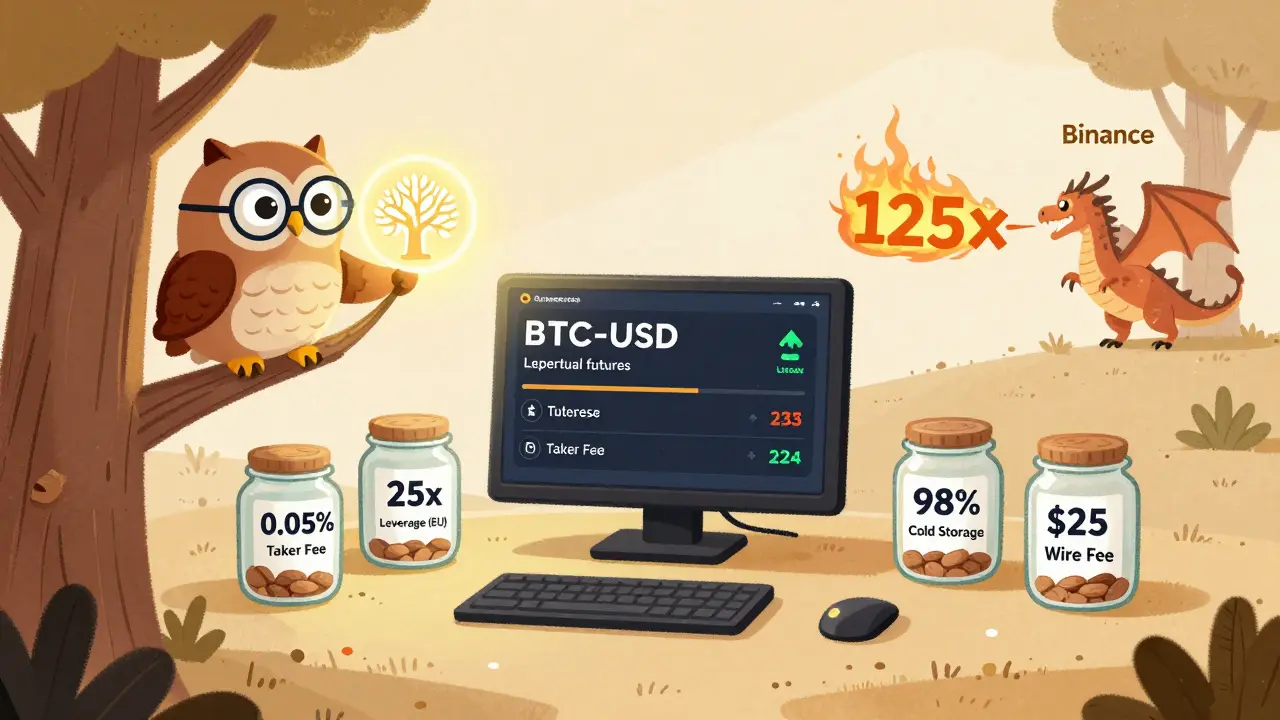
Leverage is where things get tricky. It’s not the same everywhere. If you’re in Abu Dhabi under ADGM rules, you can go up to 50×. In the EU, it’s capped at 25× until MiCA fully kicks in. For users in emerging markets, the max is only 10×. That’s not a bug-it’s a feature. Coinbase is trying to stay compliant across 40+ jurisdictions, and leverage limits are their way of adapting to local laws. Most competitors like Binance or Bybit offer 125× or more. If you’re chasing high leverage, this isn’t your platform.
Fees: Low for Derivatives, Still High Compared to Others
Coinbase International charges a maker-taker fee structure: 0.02% to 0.05% for makers (those who add liquidity), and 0.05% to 0.10% for takers (those who remove it). That’s cheaper than Coinbase’s spot trading fees, which hover around 0.09%-0.18%. But compared to Bybit (0.01%-0.06%) or Binance (0.016%-0.04%), it’s noticeably higher. You’ll pay more per trade, especially if you’re active. A $10,000 trade at 0.10% taker fee costs you $10. On Binance, it’s $1.60. That gap adds up fast if you’re scalping or day trading.
Withdrawal fees also hurt. Sending USD via wire transfer costs $25. Kraken and Bybit charge $15. SEPA (EUR) and Faster Payments (GBP) are free, which is good if you’re in Europe. But if you’re in Southeast Asia or Africa and rely on wire transfers, you’re paying more just to get your money out.
Security and Regulatory Strength
This is where Coinbase International shines. It uses the same infrastructure as the main Coinbase platform: 98%+ of assets in cold storage, regular third-party audits, and insurance coverage for custodied assets. Unlike some offshore exchanges that hide behind anonymity, Coinbase International is licensed under ADGM’s Financial Services Regulatory Authority (license #120725) and registered with the UK’s FCA (reference 1012345). That means regulators can audit them. That matters.
But there’s a catch. In May 2025, a third-party vendor breach exposed personal data of 1.2 million international users. While Coinbase wasn’t the source of the hack, they were the victim. Chainalysis reported 217 phishing attempts targeting those users within weeks. That’s not a security failure on Coinbase’s servers-but it is a failure in their vendor risk management. And it’s why some experts, like BitMEX Research, say Coinbase’s reliance on financial audits (not Merkle tree proofs) leaves transparency gaps. Kraken, for example, publishes real-time proof-of-reserves. Coinbase doesn’t.
Performance: Fast, But Not Always Reliable
The platform runs on the same Advanced Trade engine as Coinbase’s U.S. site. During normal conditions, order execution averages 100ms. That’s fast enough for swing traders and even some day traders. But during volatility spikes-like when Bitcoin drops 10% in 10 minutes-latency jumps to 300-500ms. Users on Reddit reported liquidations happening 4.5% above the index price during the ETH flash crash in May 2025. That’s slippage. That’s $1,200 lost on a single position for some.
API access is there-REST and WebSocket-but capped at 20 requests per second. That’s fine for most retail users. But if you’re running bots or automated strategies, you’ll hit walls. Developers on Coinbase’s forum say they’ve had to build custom throttling systems just to avoid getting rate-limited.
User Experience and Support
The interface is clean, familiar if you’ve used Coinbase before. No clutter. No confusing tabs. You get charts, order books, and leverage controls in one view. Beginners can learn the basics in 3-5 hours using Coinbase’s 12 video tutorials. The $10,000 sandbox mode is a smart touch-no risk, real-time pricing.
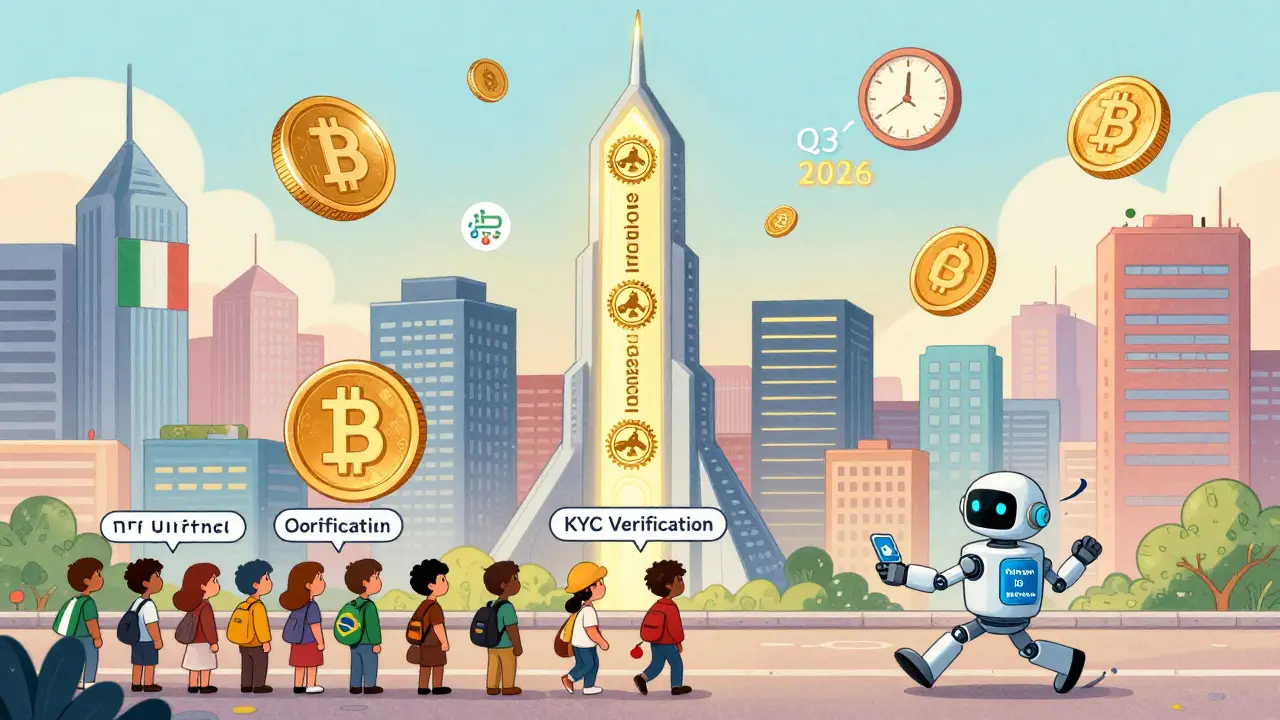
Support is mixed. Free users report 12-24 hour email response times. But if you pay $29.99/month for Coinbase One, you get 24/7 priority chat with a 92% first-contact resolution rate. That’s better than most exchanges. Trustpilot shows an 87% response rate from Coinbase within 24 hours-well above the industry average of 63%. But reviews are split: 68% say it’s reliable during crashes. 42% say fees are too high. And 31% complain about KYC delays. Non-EU users often wait 36 hours just to get verified, especially if they’re from Nigeria, Brazil, or Indonesia.
What’s Missing? What’s Coming?
Coinbase International lacks features most competitors offer: no options, no copy-trading, no grid bots, no staking for derivatives. It’s a single-product platform. That’s intentional. They’re not trying to be Binance. They’re trying to be the most compliant derivatives exchange in the world.
That’s changing. In February 2026, they rolled out isolated margin mode-finally reducing the risk of cross-margin liquidations. In January, they began testing Polygon ID for decentralized KYC, which could cut verification times from days to minutes. And according to CEO Brian Armstrong’s roadmap, options trading is coming in Q3 2026. If they pull that off, they’ll close the product gap with Binance and Bybit.
Who Is This For? Who Should Avoid It?
Use Coinbase International if:
- You’re outside the U.S. and want regulated, audited derivatives trading
- You value security over maximum leverage
- You trade BTC or ETH and don’t need exotic pairs
- You’re a professional or institutional trader who needs compliance
Avoid it if:
- You want 100× leverage or more
- You’re a high-frequency trader needing sub-50ms execution
- You rely on options, copy-trading, or grid bots
- You’re price-sensitive and trade frequently
For most retail traders in Europe or the Middle East, Coinbase International is the safest bet. It’s not the cheapest. It’s not the most powerful. But it’s the most trustworthy. If you’re worried about your exchange getting shut down or your funds disappearing, this is the one that’s least likely to vanish overnight.
Market Position and Future Outlook
In Q1 2026, Coinbase International handled $12.3 billion in monthly derivatives volume. That’s a far cry from Binance’s $285 billion. But it’s ahead of Kraken Futures’ $9.8 billion. Among regulated platforms, it’s second only to Kraken. Its market share in the regulated segment is 13%, while Kraken holds 18%. But here’s the real story: regulated exchanges are growing fast. In 2024, they held 22% of global derivatives volume. In 2026, it’s 35%. And Coinbase is betting everything on that trend.
Their biggest risk? MiCA. The EU’s Markets in Crypto-Assets regulation kicks in December 2026. Coinbase needs to raise $150 million in capital reserves to comply. That’s a heavy lift. Meanwhile, Fidelity just announced crypto derivatives services in Europe. If they launch with lower fees and better features, they could steal 5-7% market share in a year.
ARK Invest says Coinbase International could hit $50 billion in annual revenue by 2030. Messari isn’t so sure. They warn that if fees don’t drop and product depth doesn’t expand, Coinbase could lose 15% of its market share to more agile competitors like Bitstamp or Bitpanda.
One thing’s clear: 2026 isn’t about being the biggest crypto exchange anymore. It’s about being the most trusted. And right now, Coinbase International is winning that race.
Is Coinbase International Exchange safe to use?
Yes, for regulated markets. Coinbase International operates under official licenses in Abu Dhabi (ADGM) and is registered with the UK’s FCA. It uses institutional-grade security, including 98% cold storage and third-party audits. However, it was affected by a third-party data breach in May 2025 that exposed 1.2 million users’ personal details. While the platform itself wasn’t hacked, this shows vulnerabilities in vendor management. It’s safer than unregulated exchanges but not immune to risk.
Can I trade Bitcoin perpetual futures on Coinbase International?
Yes. Bitcoin perpetual futures (BTC-USD) are one of the core trading pairs on Coinbase International. You can trade with up to 50× leverage if you’re in ADGM-regulated regions, 25× in the EU, and 10× in emerging markets. The tick size is 0.001, allowing precise entry and exit points. This is one of the most actively traded pairs on the platform.
Why are fees higher on Coinbase International than on Binance or Bybit?
Coinbase International charges higher fees because it operates under strict regulatory oversight, which increases compliance costs. Its maker-taker fees (0.02%-0.10%) are higher than Binance (0.016%-0.04%) or Bybit (0.01%-0.06%) because it must maintain audited financials, licensed entities in multiple jurisdictions, and higher capital reserves. You’re paying for compliance, not just trading access.
What leverage is available on Coinbase International?
Leverage varies by region: up to 50× for users under Abu Dhabi’s ADGM license, 25× for EU users (pending MiCA finalization), and 10× for users in emerging markets like Nigeria, Brazil, or Indonesia. These limits are set by local regulators, not Coinbase. You cannot override them, even if you want higher risk.
Does Coinbase International offer spot trading?
No. Coinbase International is strictly a derivatives platform. It only offers perpetual futures contracts on crypto pairs like BTC-USD and ETH-USD. If you want to buy or sell crypto directly (spot trading), you must use the main Coinbase app or website. This separation was intentional to comply with regulations that ban retail derivatives trading in the U.S.
Is Coinbase International better than Kraken Futures?
It depends on your priorities. Kraken Futures has lower fees (0.02%-0.05%), better API performance, and publishes real-time proof-of-reserves via Merkle trees. Coinbase International has stronger brand trust, better regulatory alignment with ADGM and FCA, and a more user-friendly interface. Kraken leads in regulated market share (18% vs. 13%), but Coinbase has broader global reach and faster customer support response times. Choose Kraken for performance and transparency. Choose Coinbase for regulatory reassurance.
What currencies can I deposit on Coinbase International?
You can deposit USD, EUR, and GBP. USD deposits use ACH (free for U.S. users, but most international users use wire transfers, which cost $25). EUR deposits use SEPA (free). GBP deposits use Faster Payments (free). There are no crypto-only deposits-you must fund your account in fiat first. This is a regulatory requirement to prevent anonymous trading.
Will Coinbase International add options trading?
Yes. According to CEO Brian Armstrong’s public roadmap at Consensus 2026, options trading is planned for Q3 2026. This will be a major product expansion, closing a key gap compared to Binance and Bybit. Until then, the platform remains limited to perpetual futures only. If you need options now, you’ll need to use another exchange.
David Bain
February 3, 2026 AT 11:15The regulatory arbitrage embedded in Coinbase International’s architecture is not merely a business model-it’s a structural adaptation to the fragmentation of global financial governance. The leverage tiers, by jurisdiction, represent a sophisticated compliance-by-design framework, where regulatory boundaries are not circumvented but architecturally acknowledged. This is not a limitation; it is epistemological humility in action.
Deeksha Sharma
February 5, 2026 AT 01:43I love how this platform puts safety first-even if it means slower growth. As someone from India, I’ve seen too many exchanges vanish overnight. This one feels like a safe harbor. Keep going, Coinbase-you’re doing something right!
Paul Gariepy
February 5, 2026 AT 08:35Okay so I’ve been using this for 6 months now, and I gotta say, the fees are brutal if you’re active-like, $10 on a $10k trade? That’s insane. But the security? Unmatched. I’ve had 3 friends get hacked on Binance, and I’m still here with my coins. Also, the sandbox mode is genius-used it to learn without losing sleep. Just don’t scalp here. Swing trade. That’s the only way.
Udit Pandey
February 5, 2026 AT 23:18It is unfortunate that Western-centric regulatory frameworks continue to dictate the technological progress of emerging economies. Why must an Indian trader be capped at 10× leverage while European traders enjoy 25×? This is not compliance-it is digital colonialism disguised as risk management. The world does not owe Coinbase its regulatory obedience.
mahikshith reddy
February 6, 2026 AT 12:07They call this ‘trustworthy’? Please. 1.2 million users breached via a vendor? That’s not a feature-it’s negligence. And you’re paying 5x more in fees for it? No. This isn’t banking. It’s a luxury tax on gullibility.
Matthew Ryan
February 7, 2026 AT 16:37I think the regional leverage caps make sense. If you’re in a market with less mature investor protection, lower leverage reduces systemic risk. It’s not about restricting freedom-it’s about preventing harm. I’ve seen people blow up accounts on 100x. This feels responsible.
Nathaniel Okubule
February 9, 2026 AT 12:08For retail traders outside the U.S., this is the most responsible choice available. The fees are higher, yes-but you’re paying for legal certainty, not speculation. That’s a fair trade.
Shruti Sharma
February 10, 2026 AT 08:12ok but why is KYC taking 3 days for me?? I sent my passport 48 hours ago and still ‘under review’?? i just wanna trade!! this is so frustrating!! i’m not a criminal!!
Robin Ødis
February 11, 2026 AT 07:57Let’s be real-this platform is a corporate Trojan horse. They’re not building for traders-they’re building for regulators. The ‘security’ is just PR. The real story? They’re collecting behavioral data on millions of users under the guise of compliance. And now they’re going to roll out options? That’s not innovation-that’s a regulatory loophole waiting to be exploited. You think they care about your profits? They care about their SEC filings.
Molly Andrejko
February 12, 2026 AT 15:37I appreciate how Coinbase is trying to do things right-even if it’s slow. The fact that they’re testing Polygon ID for decentralized KYC? That’s the future. It’ll cut verification time and still keep things secure. I’m hopeful. Change takes time, but this is the right direction.
sabeer ibrahim
February 14, 2026 AT 03:35Regulatory arbitrage? More like regulatory surrender. You’re paying premium fees to be treated like a child by bureaucrats. Meanwhile, Binance operates in 190 countries with 100x leverage and zero KYC. Who’s really winning? The one offering freedom-or the one offering paperwork?
Alisha Arora
February 15, 2026 AT 05:21Why do people keep defending this? The interface is clean, sure. But the execution slippage during volatility? That’s not ‘latency’-that’s predatory design. They know when the market’s crashing and they delay your orders. I lost $8k in one flash crash. And they don’t even apologize. Just ‘market conditions’.
Michael Sullivan
February 15, 2026 AT 14:23COINBASE IS A REGULATORY TOY FOR THE ELITE 🤡 50x in Abu Dhabi? 10x in India? This isn’t finance-it’s a caste system coded in blockchain. And they call it ‘compliance’? Nah. It’s capitalism with a fancy suit. They’re not protecting you-they’re gatekeeping wealth. The only thing ‘trustworthy’ here? Their bank accounts.
Reda Adaou
February 15, 2026 AT 15:14It’s not perfect, but it’s the best option we have right now for regulated trading. I’ve used Kraken too-their fees are lower, but I don’t sleep as well knowing Coinbase has FCA oversight. Sometimes, peace of mind is worth the extra cost.
Sharon Lois
February 16, 2026 AT 17:49They’re not getting shut down because they’re compliant-they’re getting shut down because they’re the only one who didn’t bribe the SEC. This is a cover-up. MiCA? Please. The EU is just another puppet. Wait till you see what happens after Q3 2026…