

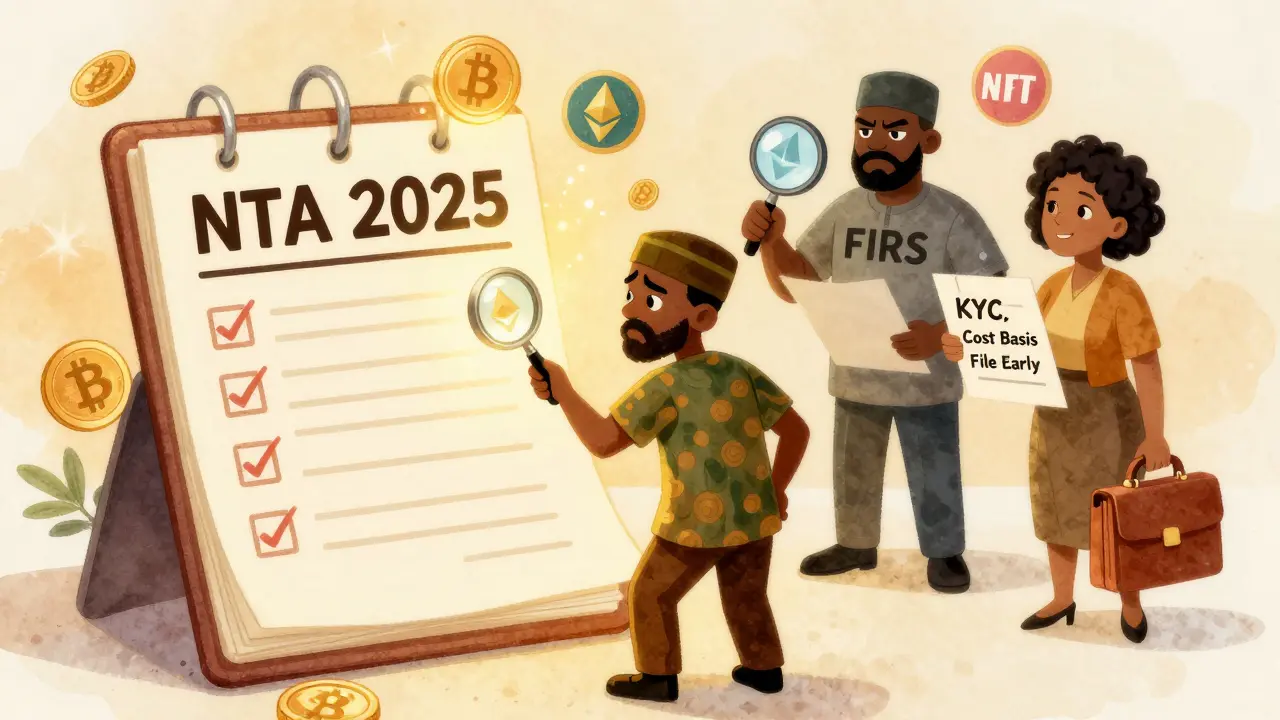
Before January 2026, owning Bitcoin or Ethereum in Nigeria was legal - but taxing it? That was a gray area. Banks wouldn’t touch crypto businesses. The government didn’t clearly say whether you owed taxes on your gains. Now, everything has changed. With the Nigeria Tax Act 2025 (NTA 2025) in full effect, crypto is no longer a legal loophole. It’s a taxable asset - and the rules are strict, clear, and enforceable.
What’s Actually Taxable Now?
The NTA 2025 doesn’t just say "crypto is taxable." It breaks it down. Every time you sell, trade, or spend your digital assets, you trigger a taxable event. That includes:
- Selling Bitcoin for Naira
- Trading Ethereum for Solana
- Using BNB to pay for a service
- Receiving crypto as payment for work or goods
- Cashout from staking rewards or mining
It doesn’t matter if you made a profit or not. The tax is on the value at the time of disposal. If you bought 0.5 BTC for ₦2.5 million in 2023 and sold it for ₦6 million in 2026, you owe capital gains tax on the ₦3.5 million difference. No exceptions.
The law also covers tokens, NFTs, and utility coins. If it’s a digital asset and you moved it, it’s taxable. The SEC classifies all these under the Investments and Securities Act 2025 as securities - meaning they’re treated like stocks or bonds, not just digital collectibles.
Who Has to Pay? Individuals and Businesses
If you’re an individual trading crypto on your own, you’re still on the hook. The Federal Inland Revenue Service (FIRS) now has direct access to transaction data from licensed exchanges. They’re not guessing anymore - they’re tracking. If you made ₦500,000 in gains last year and didn’t report it, you’re at risk of penalties, interest, and audits.
Businesses face even tighter rules. Any company that accepts crypto as payment - whether it’s a tech startup paying devs in USDT or a retail shop taking Dogecoin - must record those transactions in their accounting books. Payroll in crypto? That’s taxable income for employees. Crypto bonuses? Same thing. Companies must now file quarterly reports with the SEC and FIRS showing all crypto inflows and outflows.
And if you run a crypto business - like a local exchange, wallet provider, or DeFi platform - you’re required to be a licensed Virtual Asset Service Provider (VASP). Unlicensed operators are being shut down. The Central Bank of Nigeria (CBN) is working with the SEC to freeze accounts and block domains of non-compliant platforms.
How the Government Is Tracking You
Back in 2023, the CBN banned banks from dealing with crypto firms. That made tracking nearly impossible. Now, that ban is gone - and it was intentional.
In December 2023, the CBN issued new VASP guidelines that required banks to open accounts for licensed crypto businesses. That meant every transaction - deposits, withdrawals, transfers - now flows through regulated financial channels. Banks report these to FIRS automatically. No more anonymous wallets hiding in offshore exchanges.
Local exchanges like Busha are now the only legal gateways for most Nigerians. They’re required to collect KYC data, report transaction volumes, and flag suspicious activity. If you’re using Binance, KuCoin, or Bybit to trade and cash out, you’re not just breaking CBN rules - you’re putting yourself on a tax evasion watchlist.
The FIRS has also rolled out a digital tax filing portal for crypto users. You can now upload your transaction history from your wallet or exchange and auto-calculate your gains. The system cross-references your data with bank records and exchange reports. If there’s a mismatch, you’ll get a notice - and it won’t be polite.

What Happens If You Don’t Comply?
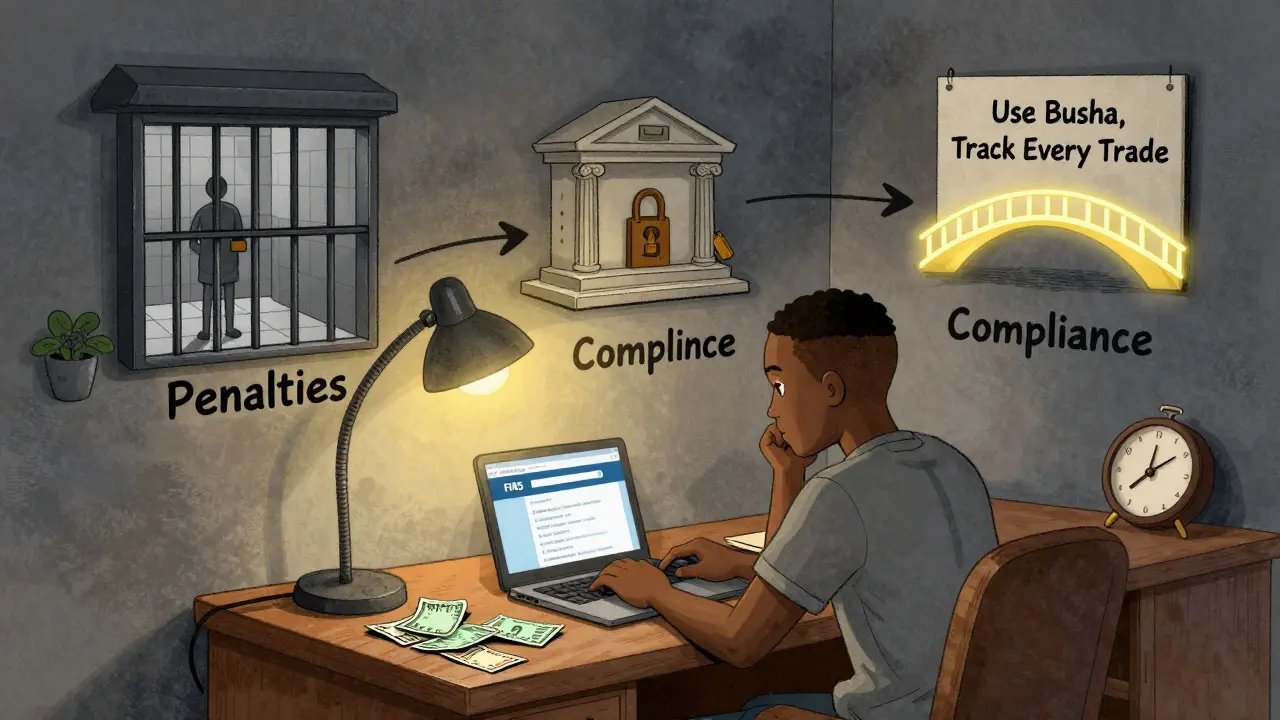
The penalties aren’t small. Failure to report crypto gains can lead to:
- A 10% penalty on the unreported amount
- Monthly interest at 12% on unpaid taxes
- Freezing of bank accounts linked to crypto activity
- Legal action for tax fraud - including possible imprisonment
There have already been cases. In January 2026, FIRS audited 37 high-volume crypto traders. One individual had ₦142 million in unreported gains from trading between January and October 2025. They were hit with ₦28 million in penalties and interest. Their bank account was frozen for 90 days. The case is still ongoing.
Businesses that don’t register as VASPs face fines up to ₦50 million or shutdown. The SEC has already revoked licenses from 12 unregistered platforms. If you’re running a crypto-related business and haven’t applied for a VASP license, you’re already in violation.
How to Stay Compliant
You don’t need to be an accountant to get this right. Here’s what to do:
- Use only licensed Nigerian exchanges (like Busha, Yellow Card, or Coinmama Nigeria)
- Keep records of every transaction - date, amount, value in Naira, purpose
- Track your cost basis (what you paid for each asset)
- Use the FIRS crypto tax portal to file your annual gains
- Consult a tax advisor who understands digital assets - don’t rely on generic accountants
If you’re a business, get your VASP license. Update your accounting software to include crypto. Train your finance team. Don’t treat crypto like cash. Treat it like a financial instrument - because now, it legally is.
What About Foreign Exchanges?
You might still be able to access Binance or Coinbase. But here’s the catch: if you withdraw your crypto profits to a Nigerian bank account, that withdrawal is flagged. The bank reports it. FIRS matches it with your tax return. If you didn’t declare it - you’re caught.
Even if you keep your funds offshore, the law still applies. If you’re a Nigerian resident, you owe tax on your global crypto income. The NTA 2025 follows the OECD’s global standards on tax residency. So even if you’re living in Dubai or London, if you’re a Nigerian citizen or tax resident, your crypto gains are taxable in Nigeria.
The government isn’t trying to stop crypto. It’s trying to bring it into the light. The goal isn’t to punish users - it’s to stop tax avoidance by big players and ensure everyone plays by the same rules.
The Bigger Picture
Nigeria isn’t alone. Countries like the UK, Japan, and Australia have similar frameworks. What’s different here is the speed and clarity. In just 18 months, Nigeria went from crypto being ignored to crypto being fully regulated. The integration of the SEC, CBN, and FIRS created a system that’s hard to evade.
For investors, this means more stability. For businesses, it means legitimacy. For the government, it means billions in new revenue - and a chance to fund public services with crypto taxes instead of borrowing.
One thing is clear: crypto isn’t going away in Nigeria. But the days of flying under the radar are over. If you’re holding crypto, you’re now part of the formal economy. And with that comes responsibility - and consequences.
PIYUSH KOTANGALE
March 12, 2026 AT 09:01vishnu mr
March 13, 2026 AT 12:22Anshita Koul
March 13, 2026 AT 14:00Grace van Gent-Korver
March 14, 2026 AT 10:36Zephora Zonum
March 16, 2026 AT 03:26Anthony Marshall
March 17, 2026 AT 18:55Lindsay Girvan
March 19, 2026 AT 14:25Mara Alves Mariano
March 20, 2026 AT 14:07Adam Ashworth
March 22, 2026 AT 02:20Sherry Kirkham
March 23, 2026 AT 06:05Jennifer Pilot
March 24, 2026 AT 10:40Sharon Tuck
March 25, 2026 AT 05:21Julie Tomek
March 27, 2026 AT 00:49Brandon Kaufman
March 27, 2026 AT 17:55Craig Gregory
March 29, 2026 AT 18:10Douglas Anderson
March 31, 2026 AT 17:11Tina Keller
April 1, 2026 AT 21:45