


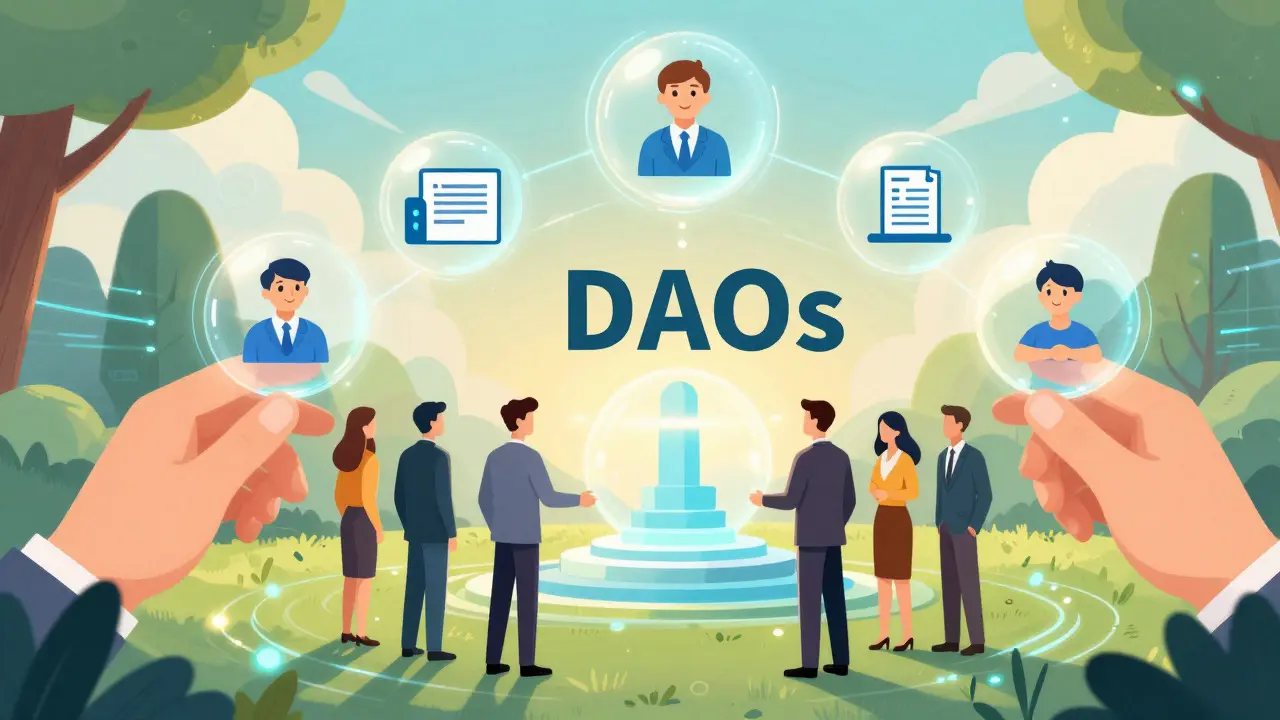
Imagine an organization where every dollar spent is visible to everyone, decisions are made by the community rather than a single CEO, and anyone on Earth can join without asking permission. That is the promise of a Decentralized Autonomous Organization (DAO), which is a blockchain-based entity governed by smart contracts and collective decision-making rather than centralized leadership. Since their conceptual debut with The DAO project in 2016, these entities have evolved from experimental curiosities into sophisticated structures managing billions of dollars. But as we move through 2026, the reality is more nuanced than the hype suggests. While DAOs offer unprecedented transparency and global access, they also struggle with slow decision-making and power imbalances that traditional corporations handle with ease.
The Core Advantages of Decentralized Governance
The primary draw for many participants is radical transparency. In a traditional corporation, financial records are often opaque, accessible only to auditors or board members. In contrast, a DAO operates on a public ledger. According to a February 2025 study by Harvard Business Review, 100% of financial transactions in DAOs are publicly verifiable, compared to just 12-18% in traditional firms. This level of openness builds trust, especially in digital-native contexts like protocol parameter adjustments. For example, Chainlink’s oracle network upgrades have seen a 98% success rate because stakeholders can verify every change before it goes live.
Global accessibility is another significant benefit. Traditional companies usually operate within specific geographic boundaries, limiting their talent pool to 40-60 countries at most. DAOs, however, span 187 countries. This permissionless participation allows individuals to contribute based on merit rather than location. A notable case is 'CryptoNinja,' a 19-year-old developer from Nigeria who earns $120,000 annually through contributions to Gitcoin DAO. He doesn’t need a visa or a corporate job offer; he just needs a laptop and a wallet. This model eliminates intermediaries, reducing overhead costs and allowing contributors to keep a larger share of the value they create.
Automated rule enforcement also reduces human error. Smart contracts execute agreements exactly as written, removing the risk of misinterpretation or bias in financial distributions. Platforms like Juicebox allow real-time funding allocation, making it easy for stakeholders to see exactly where money is going. This automation is particularly effective in DeFi protocols, where speed and precision are critical for yield generation and treasury management.
Where DAOs Fall Short: Key Limitations
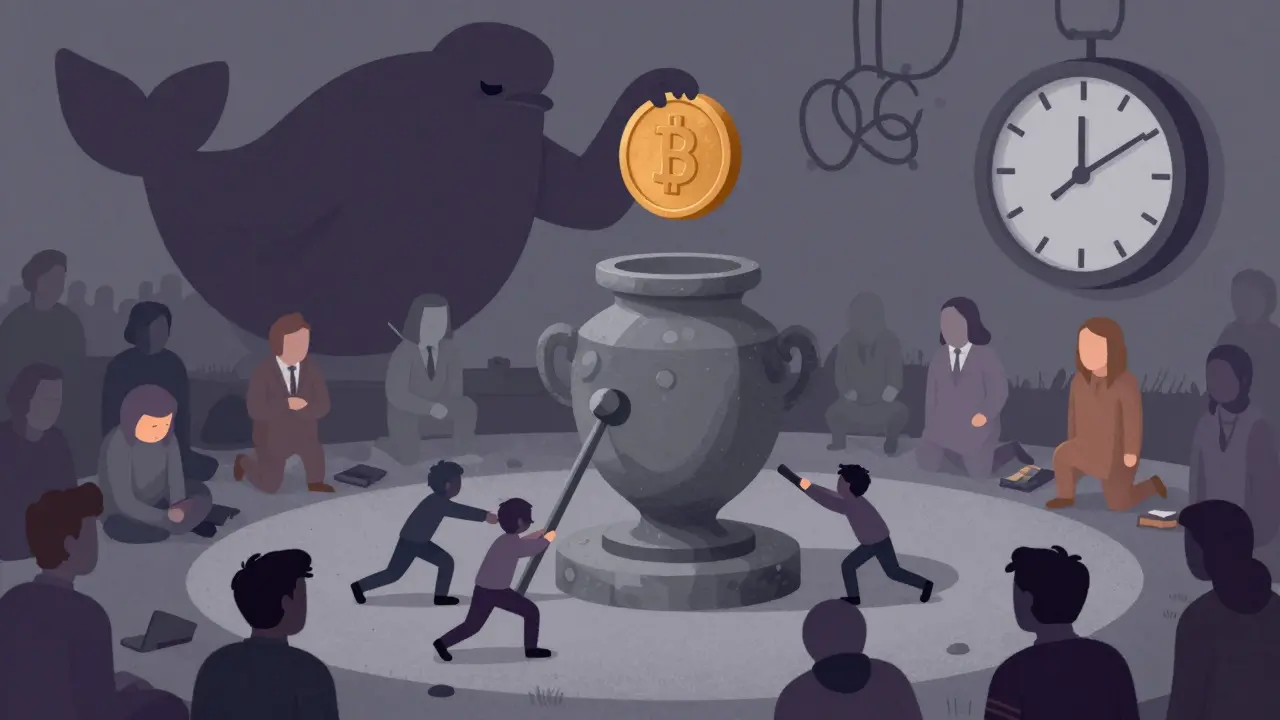
Despite these strengths, DAOs face significant hurdles. The most common complaint is voter apathy. Most DAOs report participation rates below 18%, meaning that a small fraction of token holders makes decisions for the entire community. This lack of engagement can lead to demoralization among active members who spend weeks drafting proposals only to see them ignored by the majority. One user on Reddit’s r/DAO subreddit noted spending three months on a proposal that received votes from only 4.7% of holders, describing the experience as "completely demoralizing."
Power concentration is another critical issue. While DAOs are marketed as democratic, empirical data shows that whale dominance is prevalent. In Uniswap’s Q2 2025 governance analysis, 78% of governance tokens were held by the top 15-20% of holders. This creates a de facto plutocracy where large investors can sway outcomes, contradicting the ideal of equal representation. Dr. Primavera De Filippi, a senior researcher at the Harvard Berkman Klein Center, argues that the myth of perfect decentralization has been debunked by this very data.
Decision speed is also a major bottleneck. While a traditional corporate board might approve a strategic shift in 2-3 days, the average DAO requires 14-21 days for proposal execution. Top-performing DAOs like MakerDAO can implement decisions within 72 hours, but this is the exception, not the rule. This lag becomes dangerous in time-sensitive crisis management. In 2023, Nouns DAO lost $1.2 million due to delayed response to a security threat, highlighting how slow consensus mechanisms can be exploited.
Comparing DAOs to Traditional Organizations
To understand the trade-offs, it helps to compare DAOs directly with traditional corporate structures. The table below highlights key differences in transparency, speed, and legal standing.
| Metric | DAO | Traditional Corporation |
|---|---|---|
| Financial Transparency | 100% Publicly Verifiable | 12-18% Publicly Verifiable |
| Geographic Reach | 187 Countries | 40-60 Countries |
| Average Decision Time | 14-21 Days | 2-3 Days |
| Legal Recognition (US/EU) | Limited (Wyoming LLC, MiCA) | Fully Recognized |
| Setup Cost | ~$50,000 | ~$250,000 |
This comparison reveals that while DAOs win on transparency and cost-efficiency, they lose on speed and legal clarity. Only 12 US states and 3 countries have specific DAO legal frameworks as of mid-2025. This regulatory limbo means that 73% of DAOs operate without clear legal status, exposing participants to potential liability risks. SEC Commissioner Hester Peirce warned in 2024 that regulators are catching up, and participants may face unexpected obligations.
Technical and Operational Challenges
Beyond governance, technical constraints limit scalability. Most DAOs function optimally with fewer than 5,000 active members. Beyond this threshold, coordination overhead increases significantly, leading to slower processes and higher communication costs. Gas fees on networks like Ethereum can range from $0.50 to $5.00 per governance action, which adds up quickly for frequent voters. While Layer 2 solutions like Arbitrum and Polygon have reduced these costs, they introduce additional complexity for new users.
Security remains a persistent concern. Despite improvements, smart contract exploits continue to drain funds. In 2025 alone, DAO-related losses from smart contract vulnerabilities reached $90 million. To mitigate this, 42% of DAOs now use formal verification tools, and third-party audits from firms like OpenZeppelin are becoming standard practice. However, no system is foolproof, and the decentralized nature of DAOs makes incident response harder than in centralized firms.
Onboarding is another friction point. New members typically require 3-6 months to become effective participants. Understanding tokenomics, navigating complex interfaces like Snapshot (used by 78% of DAOs), and grasping gas fee mechanics create a steep learning curve. While 82% of major DAOs offer mentorship programs, documentation quality varies widely. Aragon’s documentation scores highly for clarity, while other platforms lag behind, leaving newcomers confused and frustrated.
The Future Trajectory: Hybrid Models and AI Integration
As we look toward the end of the decade, the industry is shifting toward hybrid models. Pure on-chain voting is being supplemented with off-chain deliberation to improve efficiency. Vitalik Buterin, co-founder of Ethereum, advocated for hybrid reputation systems in an April 2025 research update, acknowledging that current token-based voting models are flawed. These systems aim to balance power by considering contribution history alongside token holdings.
AI integration is also transforming DAO operations. By 2025, 47% of DAOs implemented AI-powered governance assistants that summarize proposals and predict voting outcomes. These tools reduce the cognitive load on participants, helping them make informed decisions faster. Legal structuring innovations, such as the DAO 3.0 framework combining Wyoming LLCs with on-chain governance, are providing clearer pathways for compliance. With BlackRock announcing a $500 million DAO investment fund in 2025, institutional interest is growing, signaling that DAOs are moving from the fringes to the mainstream.
However, challenges remain. McKinsey predicts that DAOs will govern 15% of Web3 projects by 2030 but fewer than 5% of traditional enterprises. The key to long-term viability lies in solving the voter participation crisis and addressing power imbalances. Without these fixes, DAOs risk becoming plutocratic shells of their original vision. For now, they remain a powerful tool for specific use cases-particularly in digital-native communities-but not a universal replacement for traditional organizational structures.
What is the main advantage of a DAO over a traditional company?
The main advantage is radical transparency. In a DAO, 100% of financial transactions are publicly verifiable on the blockchain, whereas in traditional corporations, only about 12-18% of financial data is public. This allows stakeholders to track every dollar spent and hold the organization accountable in real-time.
Why do some people say DAOs are not truly democratic?
Critics argue that DAOs suffer from "whale dominance," where a small percentage of token holders control most of the voting power. For instance, in Uniswap, the top 15-20% of holders controlled 78% of governance tokens in 2025. Additionally, low voter turnout (often below 18%) means that decisions are frequently made by a tiny, active minority rather than the broader community.
How long does it take to set up a DAO?
Setting up a functional DAO typically takes several months and costs around $50,000 on average. This includes smart contract development ($15,000), legal structuring ($12,000), and community building tools ($23,000). The timeline depends on the complexity of the smart contracts and the size of the initial team involved in development.
Are DAOs legally recognized everywhere?
No, legal recognition is fragmented. As of 2025, only 12 US states (like Wyoming) and 3 countries have specific legal frameworks for DAOs. Many jurisdictions still view DAOs as unincorporated associations, which can expose members to personal liability. Regulations are evolving, with the EU's MiCA regulations providing partial clarity, but global standards are not yet established.
Can anyone join a DAO?
Most DAOs are permissionless, meaning anyone with a cryptocurrency wallet can participate. However, effective participation often requires a learning curve of 3-6 months to understand tokenomics, governance tools, and blockchain mechanics. Some specialized DAOs may have entry requirements or reputation-based permissions, but the core structure remains open to global participation.
Calliope Clio
August 22, 2026 AT 09:55Oh, how refreshing to see someone actually read a paper before typing their two cents 🙄. Most people just skim the title and start screaming 'SCAM' or 'FUTURE', but no, we have nuance here! The part about voter apathy is just so... painfully accurate. I remember spending weeks on a proposal that got ignored by 90% of the holders. It was like shouting into a void, but a very expensive, gas-fee-charging void 😩.