


DeFi Money Legos are modular financial components that let developers combine protocols like LEGO bricks. This concept, known as composability, allows simple DeFi protocols to snap together into more complex financial services. Unlike traditional finance, where systems are siloed, DeFi Money Legos operate on open blockchains where anyone can build on top of existing protocols.
How DeFi Money Legos Work
At their core, DeFi Money Legos rely on smart contracts - self-executing code on blockchains like Ethereum. These contracts define how protocols interact. For example, when you deposit ETH into MakerDAO, it generates DAI, a stablecoin. That DAI can then be used as collateral in Aave to borrow other assets. Each step is a Lego block that another protocol can plug into.
Developers don’t need to build everything from scratch. They can choose existing blocks from categories like payments, lending, or exchanges, then layer them together. This creates new financial tools faster and cheaper. For instance, a developer might combine Uniswap’s liquidity pool with Aave’s lending to create a new yield farming strategy.
Real-World Examples
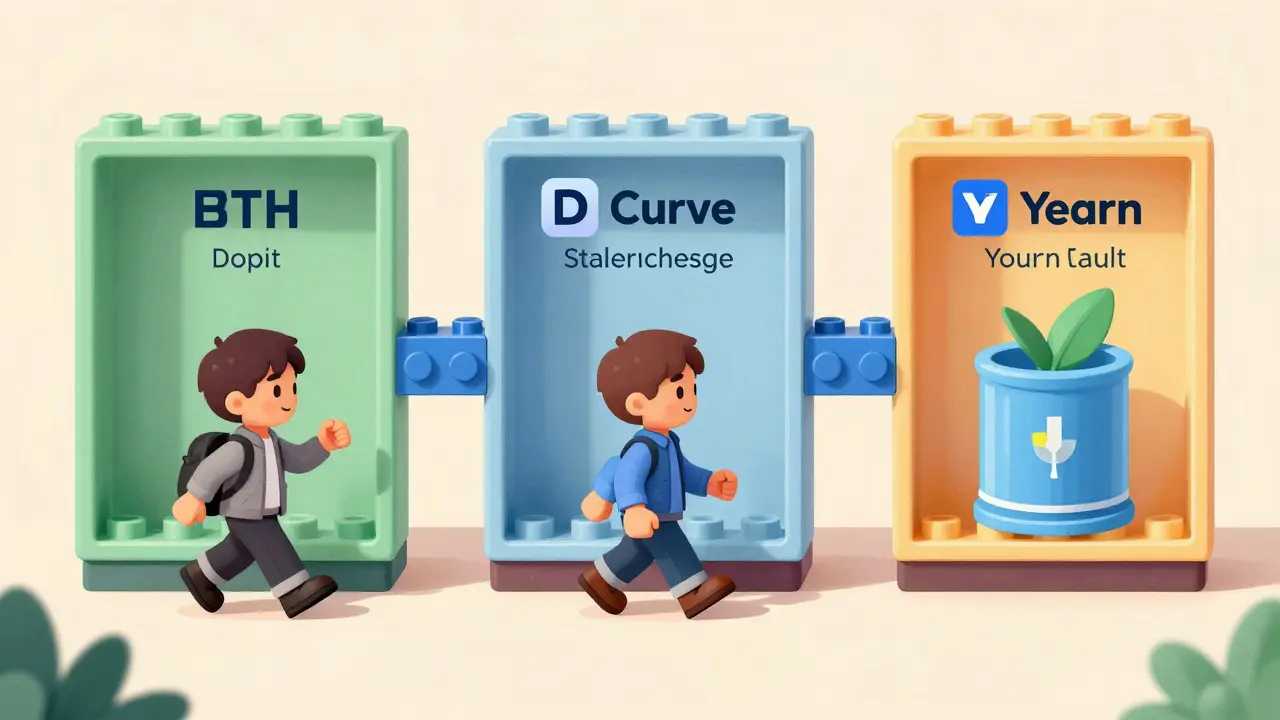
One of the most common use cases is a multi-step financial strategy. Imagine a user:
- Deposits ETH as collateral on Aave to borrow DAI
- Uses half the DAI to trade on Curve for stablecoin swaps
- Deposits the other half into Yearn to earn yield
- Later withdraws all assets, pays back the Aave loan, and pockets the profit
This entire process happens in minutes via smart contracts. Platforms like Furucombo let users test these combinations without coding. The beauty is that any of these steps can be swapped - Curve could be replaced with Uniswap, or Yearn with Compound - creating infinite possibilities.
Key Protocols in the Ecosystem
Most DeFi Money Legos operate on Ethereum due to its mature infrastructure. However, cross-chain solutions are growing. Here are some major players:
| Protocol | Primary Function | Role in Money Legos | Blockchain |
|---|---|---|---|
| MakerDAO | Stablecoin issuance | Provides DAI, the most widely used stablecoin in DeFi | Ethereum |
| Aave | Lending and borrowing | Enables collateralized loans and flash loans for other protocols | Ethereum |
| Compound | Lending and borrowing | Offers variable-rate interest pools for various assets | Ethereum |
| Curve | Stablecoin trading | Optimized for low-slippage swaps between stablecoins | Ethereum |
| Yearn | Yield farming | Automates strategies across lending protocols to maximize returns | Ethereum |
| Synthetix | Synthetic assets | Allows trading of assets like gold or stocks on-chain | Ethereum |
| Uniswap | Decentralized exchange | Provides liquidity pools for token swaps | Ethereum |
| Hubble Protocol | Crypto-backed stablecoin | Creates USDH on Solana for cross-chain DeFi | Solana |
Benefits for Developers and Users
For developers, DeFi Money Legos eliminate the need to build complex systems from scratch. They can integrate existing protocols into new applications. This accelerates innovation - projects that would take months to build solo can launch in days. For example, a new lending platform might plug into Aave’s lending pool and Curve’s stablecoin swaps.
Users benefit too. They can create sophisticated financial strategies without technical skills. Platforms like Zapper or DeFi Saver let users combine protocols through simple interfaces. This democratizes access to advanced financial tools that were once only for institutional investors.

Cross-Chain and Future Evolution
While Ethereum remains the primary home for DeFi Money Legos, cross-chain solutions are emerging. Protocols like RenVM and LayerZero enable assets to move between blockchains. For example, a user might deposit ETH on Ethereum, convert it to wrapped BTC on Bitcoin, then use it in a Solana-based DeFi protocol.
This interoperability is key to DeFi’s future. As more blockchains connect, Money Legos will span entire ecosystems. Imagine using a stablecoin from one chain to borrow assets on another, all within a single transaction. The possibilities are endless.
FAQs
What are DeFi Money Legos?
DeFi Money Legos are modular financial building blocks that combine protocols like LEGO bricks. This composability allows developers to create complex financial services by connecting existing DeFi protocols. For example, using MakerDAO’s DAI in Aave for loans or Curve for stablecoin swaps.
How do DeFi Money Legos differ from traditional finance?
Traditional finance relies on siloed systems where banks and institutions control each service. DeFi Money Legos operate on open blockchains, allowing protocols to interconnect freely. Anyone can build on top of existing services, creating transparent, permissionless financial tools without intermediaries.
Can I use DeFi Money Legos without coding knowledge?
Yes. Platforms like Zapper, DeFi Saver, and Furucombo let users combine protocols through simple interfaces. You don’t need to write code - just select pre-built strategies or create your own with drag-and-drop tools. For example, you can easily set up a yield farming strategy that uses Aave and Curve with a few clicks.
What are the risks of using DeFi Money Legos?
Risks include smart contract bugs, impermanent loss in liquidity pools, and market volatility. Since protocols are interconnected, a problem in one can affect others. Always research protocols before using them, and only invest what you can afford to lose. Many platforms offer insurance options or audits to mitigate risks.
How does composability drive innovation in DeFi?
Composability allows developers to build on existing protocols instead of starting from scratch. This accelerates innovation - new projects can launch in days instead of months. For example, a simple lending platform might integrate with Uniswap for liquidity and Aave for borrowing. This modular approach has led to hundreds of DeFi applications in just a few years.
laura mundy
February 5, 2026 AT 13:06DeFi is a house of cards. Period.
Paul Jardetzky
February 6, 2026 AT 13:30Risks exist, but so do solutions. Many DeFi protocols now have insurance funds and rigorous audits. It's not all doom and gloom! 🌟💪
sachin bunny
February 7, 2026 AT 21:36The whole DeFi thing is a scam. Big banks control blockchain. They want your money. 🤔
Michelle Anderson
February 9, 2026 AT 21:21DeFi is transparent. Every transaction is public. Banks aren't controlling it. Your conspiracy theories are baseless. 💁♀️
Ajay Singh
February 10, 2026 AT 22:35DeFi is the future. Modular finance is unstoppable. Simple. Powerful. 🔥
Jim Laurie
February 11, 2026 AT 11:34Totally agree! DeFi's modular nature is a game-changer. It's like building with LEGOs but for finance. The possibilites are endless! 😄
Matt Smith
February 11, 2026 AT 23:51DeFi money legos? More like financial dominoes. One collapse and everything falls. It's a disaster waiting to happen. 😂
Kieren Hagan
February 13, 2026 AT 07:06While there are risks, DeFi protocols have robust risk management. Smart contracts are audited thoroughly. It's not as fragile as it seems. 📚
David Bain
February 13, 2026 AT 15:56Composability in DeFi represents a paradigm shift in financial architecture. The modular nature allows for unprecedented innovation while maintaining transparency. It's a fundamental evolution of monetary systems.
Mrs. Miller
February 13, 2026 AT 17:25Paradigm shift? More like a fancy term for 'connecting the dots'. But hey, if it works, who cares about the jargon. 🤷♀️
Katie Haywood
February 14, 2026 AT 17:28DeFi legos are cool but sometimes it feels like playing with fire. One wrong move and your funds vanish. Still, it's wild how much you can build. 😅
Paul Jardetzky
February 16, 2026 AT 05:40Exactly! Always do your research and only use what you can afford to lose. Safety first! 🔒
sabeer ibrahim
February 17, 2026 AT 23:34DeFi is all hype. Real finance has regulations. This is just gambling with crypto. Smart contracts are insecure. 😤
Freddie Palmer
February 19, 2026 AT 03:49Regulations are important, but DeFi is evolving! Many protocols now have insurance and audits. It's not just gambling; it's a new financial ecosystem. 🌐
Olivette Petersen
February 19, 2026 AT 19:13DeFi is the future of finance! It's amazing how you can combine protocols to create new opportunities. No need for banks! 🚀
Ryan Chandler
February 20, 2026 AT 15:34Absolutely! The innovation here is revolutionary. It's like the internet for money-democratizing finance for everyone. 💫
Danica Cheney
February 21, 2026 AT 14:55DeFi money legos are cool but risky. Smart contracts can fail. But maybe it's the future. idk.
Alex Garnett
February 21, 2026 AT 23:42idk? You should know better. DeFi is not for the uneducated. It's a sophisticated system. Learn before you play.
Mendy H
February 23, 2026 AT 06:34DeFi Money Legos? More like financial legos with a side of chaos. The whole concept is overhyped. Real finance is more stable. 🤷♀️