

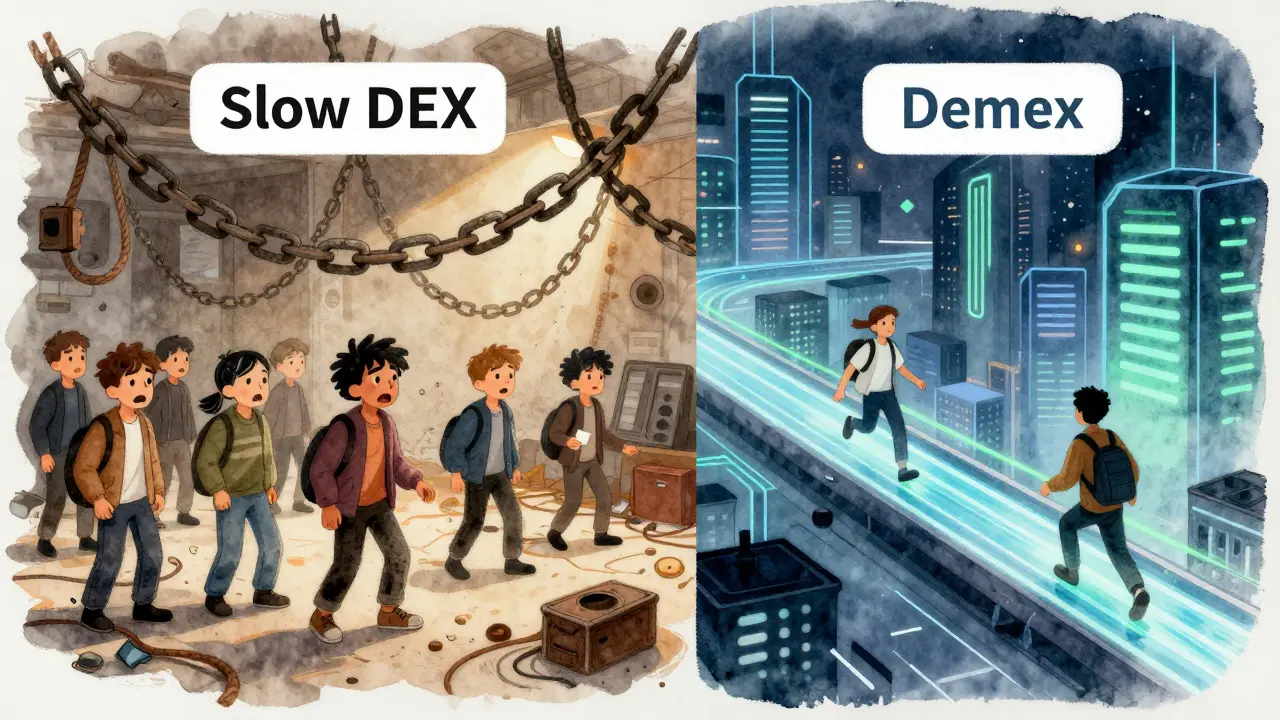
Trading on a decentralized exchange usually feels like a compromise. You get the security of keeping your own keys, but you pay for it with slow speeds, high fees, and messy user interfaces. Or, you go to a centralized giant like Binance for speed, but you hand over control of your funds. For years, that was the only choice. But what if you could have CEX-like speed without giving up custody? That is the promise behind Demex, a decentralized Layer 1 platform built by the team behind Switcheo. It claims to offer 50,000 orders per second and MEV-resistant trading, bridging the gap between traditional finance and DeFi. But does it actually deliver, or is it just another buzzword-heavy project?
Key Takeaways
- High Performance: Built on the Carbon blockchain, Demex offers 1.6-second block finality and supports up to 50,000 orders per second.
- Advanced Trading: Supports spot, perpetuals, and futures with leverage up to 50x, plus upcoming options trading.
- MEV Resistance: Unique consensus mechanism ensures fair pricing by preventing front-running and sandwich attacks.
- Not for Beginners: The interface is powerful but complex; expect a steep learning curve compared to simple DEXs like Uniswap.
- Ecosystem Integration: Uses the $SWTH token for governance and staking rewards from transaction fees.
What Is Demex and How Does It Work?
At its core, Demex is a decentralized exchange (DEX) designed to handle sophisticated financial instruments typically found only on centralized platforms. Unlike most DEXs that run as smart contracts on Ethereum or Solana, Demex operates on its own dedicated Layer 1 blockchain called Carbon. This architectural choice is critical. By building a custom chain, the developers bypassed the congestion and high gas fees that plague shared networks.
The Carbon blockchain uses a modified version of CometBFT consensus. This isn't just a minor tweak; it’s engineered specifically for financial throughput. The result is a network that processes transactions in under two seconds. To put that in perspective, Ethereum’s mainnet can take minutes to finalize a trade during peak times. Demex aims for 1.6 seconds. Why does this matter? In derivatives trading, latency kills profits. If you are trying to exit a leveraged position during a market crash, every millisecond counts.
The platform splits its functionality into two main areas: Trade and Earn. The Trade section handles spot markets, perpetual swaps, and futures. The Earn section allows users to provide liquidity or stake assets to generate yield. This dual structure means you aren’t just swapping tokens; you’re participating in a broader financial ecosystem where your capital can work harder through lending, borrowing, and liquidity provision.
Performance and Technical Specifications
Let’s look at the numbers, because in crypto, specs tell you a lot about usability. Demex claims a capacity of 50,000 orders per second (OPS). While some third-party sources cite lower figures like 10,000 TPS for the underlying Carbon network, the official documentation emphasizes the order-matching engine’s capability. Regardless of the exact ceiling, the real-world performance is significantly faster than legacy chains.
| Feature | Demex | dYdX | Uniswap V3 |
|---|---|---|---|
| Block Finality | 1.6 seconds | ~1-2 seconds (StarkEx) | 12+ seconds (Ethereum L1) |
| Max Leverage | 50x | Up to 90x (varies by asset) | N/A (Spot only) |
| MEV Protection | Built-in (Consensus level) | Limited (Off-chain matching) | Vulnerable (Public mempool) |
| Asset Types | Spot, Perps, Futures, Options (planned) | Perpetuals primarily | Spot only |
| Custody | Non-custodial (Self-hosted) | Non-custodial (Account abstraction) | Non-custodial |
The standout feature here is MEV (Maximal Extractable Value) resistance. On public chains like Ethereum, bots often see your pending transaction and place their own trades before yours, pushing the price against you-a tactic known as front-running or sandwiching. Demex’s proprietary oracle protocol updates asset data feeds within one second, and all trades in a block are matched at a single clearing price. This means no bot can jump ahead of you. For active traders, this alone can save significant amounts of money over time.

Trading Instruments and Market Depth
If you are a casual trader who just wants to buy Bitcoin and hold it, Demex might be overkill. This platform is built for those who want to trade actively. Currently, Demex supports around 100 markets for perpetual contracts. These include major pairs like BTC/USDⒼ and ETH/USDⒼ, but also popular altcoins and even memecoins like Popcat and Bonk. The use of USDⒼ (a synthetic dollar pegged to the USDT/USDC basket) as the quote currency adds stability and reduces reliance on a single stablecoin issuer.
You can trade with leverage up to 50x. This is a double-edged sword. High leverage amplifies gains but also magnifies losses. One wrong move can liquidate your entire position. However, the platform is rolling out cross-margin and multi-collateral features. This is a game-changer for capital efficiency. Instead of isolating margin for each trade, you can use your entire portfolio balance to support multiple positions simultaneously. If you hold ATOM and OSMO, you might soon be able to use both as collateral for a BTC short, maximizing your exposure without needing to convert assets first.
Beyond perpetuals, Demex offers spot trading for NEP-5 tokens (like BTC, ETH, LINK on Cosmos) and ERC-20 tokens (like ATOM, JUNO from Ethereum). The plan includes expanding into options trading, bonds, and synthetic assets. This breadth makes it one of the few DEXs attempting to replicate the full suite of traditional financial instruments on-chain.
User Experience and Interface
Let’s be honest: most DEX interfaces are clunky. They require connecting wallets, approving transactions, waiting for confirmations, and praying the gas fee doesn’t spike. Demex tries to fix this with a modern, web-based UI that feels closer to a centralized exchange. You connect a compatible wallet like Keplr or Leap, deposit funds, and start trading. There is no need to wrap tokens or bridge them manually across chains in most cases-the platform handles the cross-chain complexity under the hood.
The interface includes customizable charts, one-click trading buttons, and real-time notifications. For mobile users, there is an optimized view, though serious chart analysis is still better suited for desktop. The "Newsreel" feature keeps you updated on market movements without leaving the dashboard. However, don’t expect simplicity. The sheer number of tools-order types, leverage sliders, risk management settings-can overwhelm beginners. If you are new to crypto, you might find Kraken or Coinbase easier to navigate. Demex assumes you understand concepts like liquidation prices and funding rates.
Security and Trust Model
In DeFi, trust is code. Demex is non-custodial, meaning you never give up control of your private keys. Your funds stay in your wallet until the moment they are used for a trade. This eliminates the risk of exchange hacks where millions of dollars vanish overnight, as seen with FTX or Mt. Gox.
The platform has undergone audits by firms like QuillAudits. Every transaction is recorded transparently on the Carbon blockchain. You can verify any trade yourself. Additionally, the validation system is decentralized, with over ten non-team validators securing the network. This prevents a single entity from censoring transactions or manipulating the ledger. While no system is immune to bugs, the open-source nature and regular audits provide a strong safety net compared to opaque centralized entities.
Pros and Cons: Who Should Use Demex?
No platform is perfect. Here is a breakdown of where Demex shines and where it falls short.
- Pros:
- Extremely fast execution with low slippage.
- Native MEV protection saves traders money.
- Wide range of advanced instruments (perps, futures).
- Non-custodial security model.
- High capital efficiency with upcoming cross-margin.
- Cons:
- Steep learning curve for novice users.
- Limited fiat on-ramps (you must already have crypto).
- Smaller liquidity pool compared to giants like Binance.
- Requires specific wallets (Keplr/Leap), which may confuse Ethereum-only users.
Demex is ideal for experienced traders who demand speed, security, and advanced tools. It is less suitable for passive investors or those looking to buy crypto with a credit card. If you are comfortable managing your own keys and understanding leverage, Demex offers a compelling alternative to centralized exchanges.
How to Get Started on Demex
Getting set up is straightforward if you have the right tools. Follow these steps:
- Install a Wallet: Download Keplr or Leap browser extension. These are the standard wallets for the Cosmos ecosystem.
- Fund Your Wallet: Acquire supported tokens like ATOM, OSMO, or BTC. You can buy these on other exchanges and transfer them to your Keplr address.
- Connect to Demex: Visit the Demex website and click "Connect." Select your wallet provider.
- Deposit Assets: Navigate to the "Earn" or "Trade" tab and deposit your tokens into the Demex vaults. This locks your assets in a smart contract to enable trading.
- Start Trading: Choose a market, select your order type (limit or market), set your leverage, and execute the trade.
Remember to start small. Test the interface with minimal amounts before committing significant capital. Familiarize yourself with the liquidation mechanics to avoid unexpected losses.
Is Demex safe to use?
Yes, Demex is considered safe because it is non-custodial. You retain control of your private keys, and the platform has been audited by independent firms. However, always exercise caution with smart contract risks and ensure you are using the official website.
Can I buy crypto with fiat on Demex?
No, Demex does not currently offer direct fiat on-ramps. You must acquire cryptocurrency on another platform and transfer it to your wallet before trading on Demex.
What is the minimum amount to trade?
There is no strict minimum deposit, but practical trading requires enough capital to cover fees and meet initial margin requirements for leveraged positions. Small trades may be inefficient due to fixed costs.
Does Demex charge high fees?
Fees are competitive with other DEXs and generally lower than centralized exchanges for large volumes. Trading fees vary by market and tier, but there are no hidden withdrawal fees since you keep custody of your assets.
Is Demex available on mobile?
Yes, Demex has a responsive web interface that works well on mobile browsers. While there is no dedicated app yet, the mobile experience is optimized for quick trades and monitoring positions.