

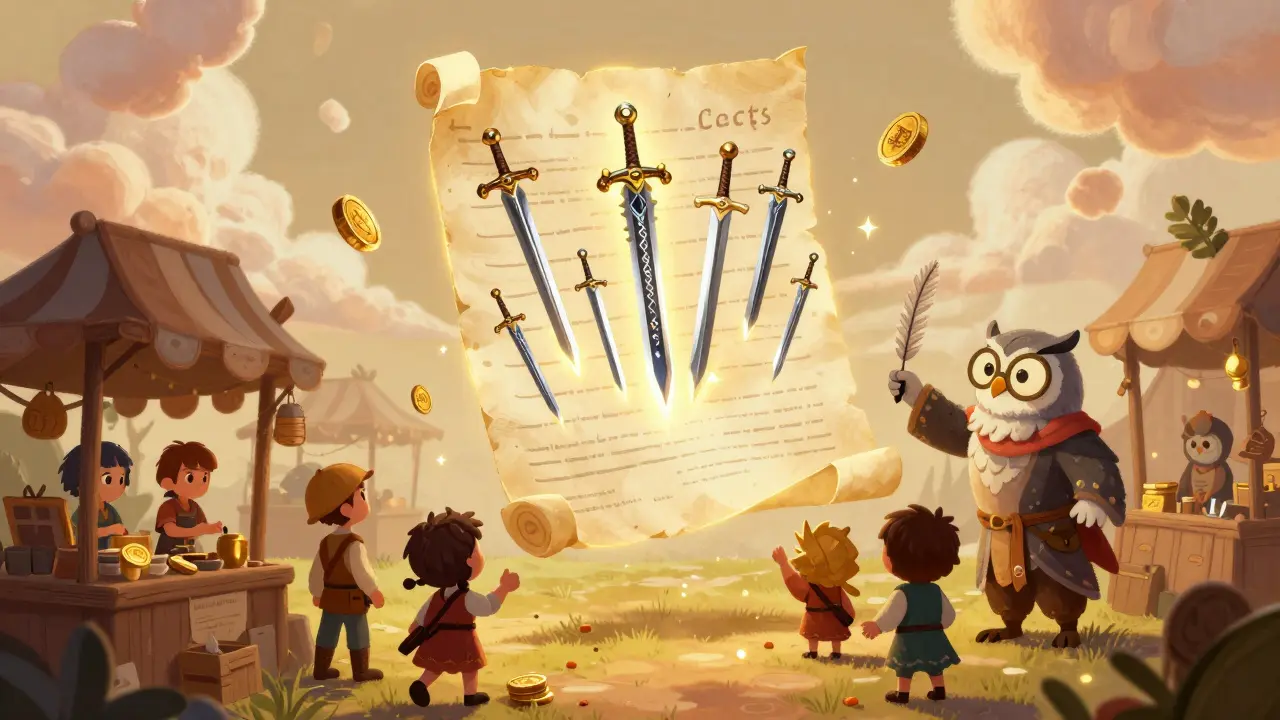
Before ERC-1155, managing different types of digital assets on Ethereum was messy. If you wanted to sell a fungible token like a currency, you needed one smart contract. If you wanted to sell a unique NFT like a digital artwork, you needed another. And if your game had both coins and rare swords? You needed three or four contracts just to handle basic transactions. Each transfer cost gas. Each deployment cost money. Each update meant rewriting code. That’s how most projects worked until 2019 - until ERC-1155 came along and changed everything.
What Exactly Is ERC-1155?
ERC-1155 is a single smart contract standard that lets you manage fungible tokens, non-fungible tokens (NFTs), and semi-fungible tokens all in one place. Think of it like a Swiss Army knife for digital assets. Instead of deploying separate contracts for each type of item - which was the norm with ERC-20 and ERC-721 - ERC-1155 uses unique token IDs inside one contract to tell them apart.
For example:
- A fungible token: 10,000 identical "Bronze Sword" items, all with token ID #101.
- A non-fungible token: One unique "Dragon Slayer" sword with token ID #5000 - no other copy exists.
- A semi-fungible token: 50 "Silver Sword" items with token ID #250 - all identical until someone upgrades one, then it becomes unique.
All of these can live in the same contract. You don’t need to deploy three different contracts. You don’t need to switch between different APIs. You just use one contract with one set of functions.
How ERC-1155 Saves Gas - And Money
The biggest win with ERC-1155 isn’t flexibility - it’s cost. Gas fees on Ethereum are expensive. Sending one ERC-721 NFT can cost 80,000-120,000 gas. Sending five separate ERC-20 tokens? Another 400,000+ gas. Now imagine a player in a game needs to equip five items, sell three, and buy two. That’s 10 separate transactions. At $2 per gas, that’s $20 just to swap gear.
With ERC-1155, you can do it all in one batch transfer. The function safeBatchTransferFrom lets you send multiple token IDs and amounts in a single transaction. According to OpenZeppelin’s testing, transferring 10 different tokens via ERC-1155 uses about 115,000 gas. The same operation with individual ERC-20 and ERC-721 transfers? Over 450,000 gas. That’s an 80% reduction.
Enjin, the company behind ERC-1155, tested this in their Minecraft plugin. They saw a 92% drop in gas costs for in-game item transfers. That’s not just a nice optimization - it’s what made blockchain gaming viable. Players stopped complaining about fees and started actually playing.
Technical Structure: How It Works Under the Hood
ERC-1155 uses a two-layer mapping system: address => token ID => balance. This means the contract tracks how many of each token type every wallet owns. Unlike ERC-721, where you ask "How many NFTs do you have?" - and get a count of different IDs - ERC-1155 asks "How many of token ID #101 do you have?" That’s the key difference.
Here are the core functions:
balanceOf(address account, uint256 id)- Checks balance for one specific token type.balanceOfBatch(address[] accounts, uint256[] ids)- Checks balances for multiple users and token IDs in one call.safeTransferFrom(address from, address to, uint256 id, uint256 amount, bytes data)- Transfers a single token type with safety checks.safeBatchTransferFrom(address from, address to, uint256[] ids, uint256[] amounts, bytes data)- Transfers multiple token types at once.
Each token has its own metadata URI. So token ID #101 can point to a JSON file describing "Bronze Sword," while ID #5000 points to a different file for "Dragon Slayer." This lets you have rich, unique descriptions for each item - even if they’re in the same contract.
There’s no built-in minting function in the standard. That’s intentional. It gives developers freedom. You can let players mint their own items, restrict minting to admins, or even tie minting to in-game achievements. The flexibility is part of the power.
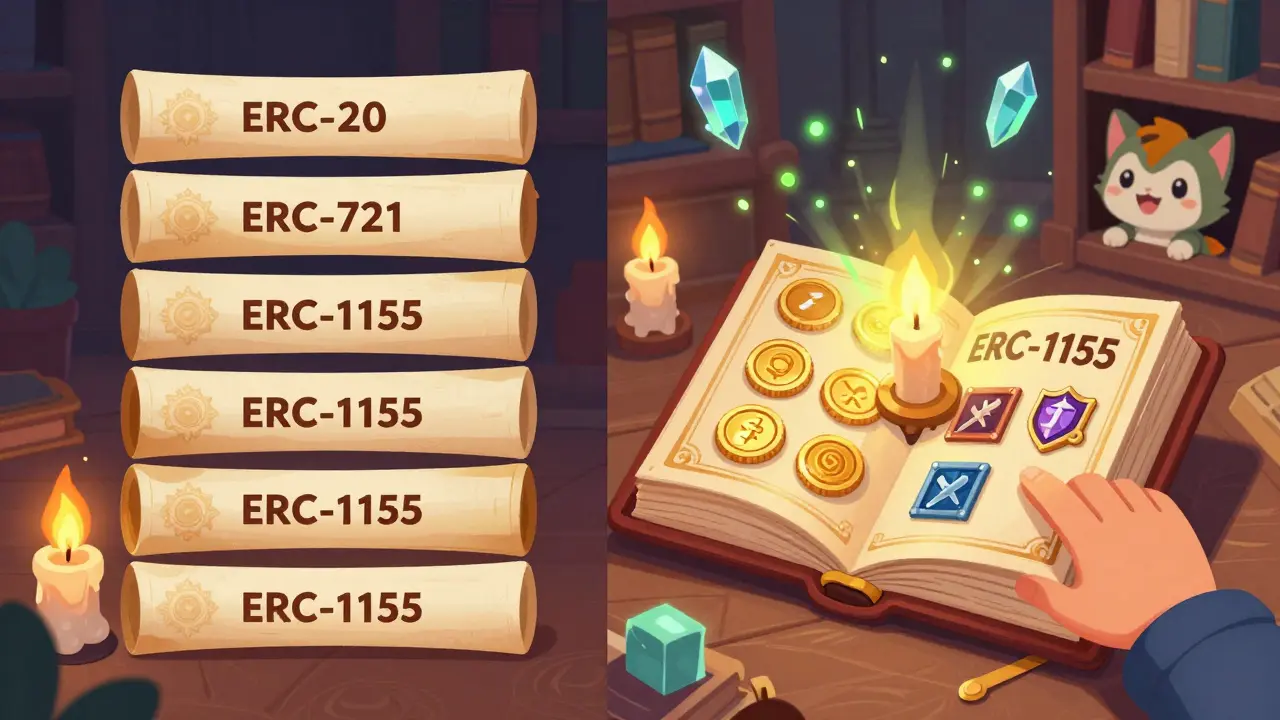
ERC-1155 vs ERC-20 vs ERC-721: When to Use Which
It’s not about which is "better." It’s about which fits your use case.
| Feature | ERC-20 | ERC-721 | ERC-1155 |
|---|---|---|---|
| Token Type | Fungible only | Non-fungible only | Fungible, NFT, semi-fungible |
| Gas Cost per Transfer | ~50,000 | ~100,000 | ~11,500 (batch) |
| Batch Transfers | No | No | Yes |
| Metadata per Token | Per contract | Per token | Per token |
| Decimal Precision | Yes | No | No |
| Best For | Currencies, rewards | Art, collectibles | Gaming, metaverse, mixed economies |
ERC-20 is still the go-to for simple tokens like loyalty points or in-game currency. ERC-721 is still preferred for pure art NFTs where simplicity and marketplace compatibility matter. But if you’re building a game where players earn coins, trade gear, and collect rare skins - all interacting - ERC-1155 is the only realistic choice.
Adoption and Real-World Use Cases
ERC-1155 isn’t just theory. It’s running live, right now.
- Enjin uses it to power over 1.2 million in-game asset transfers across Minecraft, Roblox, and other platforms.
- OpenSea supports ERC-1155 for collections that mix NFTs and fungible items - like game items with limited editions.
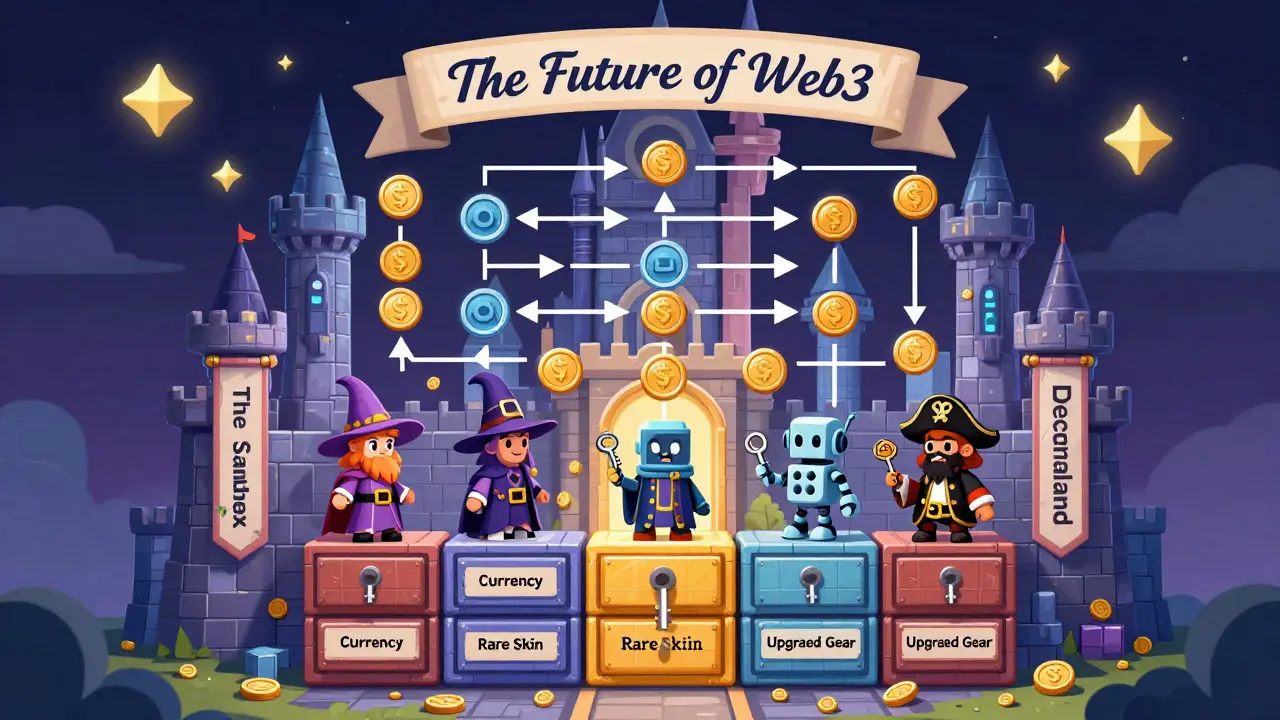
- Blockchain games like The Sandbox and Decentraland rely on it for their entire economy.
- Fortune 500 companies are testing it for loyalty programs - imagine earning 100 points, a digital badge, and a rare coupon all in one wallet.
DappRadar reports that 73% of new blockchain gaming projects launched in 2023 used ERC-1155 as their primary standard. That’s up from just 41% in 2021. On Polygon and BNB Chain, ERC-1155 now makes up over 38% of all NFT transactions.
The Downsides: Why It’s Not Perfect
ERC-1155 isn’t magic. It comes with trade-offs.
Complexity - Developers familiar with ERC-20 or ERC-721 often spend 15-25 extra hours learning how to handle batch transfers, metadata URIs, and the onERC1155Received hook. Stack Overflow data shows 58% of negative reviews cite the learning curve.
Security Risks - OpenZeppelin’s 2022 audit found 68% of ERC-1155 contracts had moderate-severity issues. Common problems: improper access control, wrong token ID handling, and missing checks in batch functions. In 2021, a gaming platform lost $250,000 because a bug let users transfer tokens they didn’t own.
Marketplace Support - Not all NFT marketplaces handle ERC-1155 the same. Some show metadata correctly. Others don’t. Developers report needing custom code to get their items to display properly on 3 out of 5 major platforms.
And unlike ERC-20, there’s no standard for decimals. Balances are always whole numbers. That’s fine for items, but awkward if you want to represent fractions of a token - like 0.5 of a currency.
How to Get Started With ERC-1155
If you’re a developer, here’s how to begin:
- Use OpenZeppelin’s ERC1155 contract as your base. It’s the most audited and widely used implementation - used in 89% of deployments.
- Define your token IDs logically. Group similar items (e.g., all swords under 100-199, all shields under 200-299).
- Set up metadata URIs for each token ID. Store them on IPFS or Arweave, not on a central server.
- Implement the
onERC1155Receivedfunction if your contract accepts incoming transfers. - Test batch transfers thoroughly. Use a local fork of Ethereum with Ganache or Hardhat.
Community resources are strong: the ERC-1155 subreddit has 14,500 members, and OpenZeppelin’s docs include 27 code examples. If you’re stuck, the official support team responds to 92% of verified issues within 72 hours.
What’s Next for ERC-1155?
The future is bright. The Ethereum Foundation plans to integrate ERC-1155 with account abstraction (ERC-4337), which could cut transfer gas costs by another 30-40%. Gartner predicts that by 2025, ERC-1155 will power 55% of all blockchain gaming asset transfers.
It’s already being adapted beyond Ethereum. NEAR Protocol and Binance Smart Chain have native support. Proposals like EIP-6059 aim to improve metadata handling, making it even easier to display items across platforms.
ERC-1155 didn’t just improve efficiency. It made complex digital economies possible. It turned blockchain from a place for static NFTs into a living world where items, currency, and upgrades interact seamlessly. That’s why it’s not just a standard - it’s the foundation of the next generation of web3 applications.
What’s the difference between ERC-1155 and ERC-721?
ERC-721 handles only non-fungible tokens - one unique item per token ID. ERC-1155 can handle NFTs, fungible tokens (like coins), and semi-fungible tokens (like limited editions) all in the same contract. ERC-1155 also supports batch transfers, which saves gas and simplifies transactions.
Can ERC-1155 replace ERC-20 entirely?
No. ERC-20 is still simpler and more widely supported for pure fungible tokens like currencies or loyalty points. ERC-1155 lacks decimal precision and isn’t optimized for simple token economies. Use ERC-20 if you only need one type of interchangeable token.
Why do gas fees drop so much with ERC-1155?
Because you can send multiple tokens in one transaction. Instead of calling the transfer function 10 times for 10 different items, you call safeBatchTransferFrom once. Each function call costs gas - fewer calls mean much lower total fees. Tests show up to 90% savings in high-volume scenarios.
Is ERC-1155 secure?
The standard itself is secure, but many implementations have bugs. Common issues include improper access control, incorrect token ID validation, and failing to check if the receiver can accept tokens. Always use audited libraries like OpenZeppelin’s and test batch transfers thoroughly.
Where is ERC-1155 used the most?
Blockchain gaming and metaverse platforms. Games like The Sandbox, Enjin’s Minecraft plugin, and Decentraland use it to manage in-game currency, gear, skins, and land - all in one contract. It’s also used in loyalty programs and enterprise digital asset systems.
Sammy Tam
December 15, 2025 AT 12:53Man, I remember when we had to deploy three contracts just to sell a sword and a coin in a game. Absolute madness. ERC-1155 felt like someone finally handed us a real toolkit instead of a hammer and a spoon.
Elvis Lam
December 16, 2025 AT 19:54Gas savings aren’t even the half of it. The real win is how it lets devs build economies that actually feel alive. You’re not just trading NFTs-you’re trading *systems*. That’s why blockchain games finally stopped feeling like digital collectible card games with extra steps.
Jonny Cena
December 17, 2025 AT 02:15For anyone new to this-start with OpenZeppelin’s implementation. Seriously. I wasted two weeks rolling my own before realizing 89% of projects use theirs for a reason. The docs are solid, the tests are thorough, and you won’t accidentally let users steal everyone’s gear.
Sue Bumgarner
December 17, 2025 AT 13:36USA built this. China’s still trying to copy it with their own chain. ERC-1155 isn’t just tech-it’s American innovation at its finest. No other country could’ve pulled this off.
Jack Daniels
December 17, 2025 AT 21:46Everyone’s acting like this is magic. But what about the 68% of contracts with security flaws? Who’s gonna fix that? Nobody. We’re just building castles on sand again.
Bradley Cassidy
December 18, 2025 AT 12:37so like… i tried to use erc-1155 last year and my meta mask kept crashing when i tried to batch transfer. idk if it was my code or the wallet or the moon phase but it was a mess. still love the idea tho 🤷♂️
Greg Knapp
December 18, 2025 AT 14:44you know what’s funny nobody talks about how this standard basically killed the indie NFT artist scene because now everything’s gotta be part of a game economy or it’s invisible
before this you could just drop a cool art piece on opensea and it’d sell. now you need a whole economy built around it or you’re just noise
Shruti Sinha
December 20, 2025 AT 09:12ERC-1155’s metadata URI flexibility is brilliant. Storing asset descriptions on IPFS ensures decentralization without bloating the chain. It’s a textbook example of efficient design.
Heather Turnbow
December 20, 2025 AT 19:21While the technical merits of ERC-1155 are undeniably compelling, one must consider the broader sociotechnical implications. The consolidation of asset types within a single contract may inadvertently accelerate centralization of control, particularly when minting rights are concentrated in the hands of a few entities.
Mark Cook
December 21, 2025 AT 00:07lol this is why crypto is dead. we spent 5 years building this and now everyone’s just using it for gacha games. 🤡
Samantha West
December 22, 2025 AT 03:08It’s ironic that we call this a standard when it’s really just another layer of abstraction that makes the system more opaque. Who really understands what’s happening under the hood? We’ve traded transparency for convenience and called it progress
But I guess that’s just how capitalism works
Sally Valdez
December 24, 2025 AT 01:26Oh great another American tech bro pretending this was some revolutionary breakthrough. China’s been doing multi-token economies since 2017 on their own chains. This is just rebranded copycat stuff with a fancy name
George Cheetham
December 25, 2025 AT 00:23There’s a philosophical depth here that’s often overlooked. ERC-1155 doesn’t just manage tokens-it redefines the nature of ownership. When an item can be both identical and unique depending on context, what does ‘ownership’ even mean anymore?
Is it the balance? The metadata? The history? Or is it the experience tied to it?
Perhaps this is the first digital standard that truly mirrors the ambiguity of human value.
Kayla Murphy
December 26, 2025 AT 08:49I love how this made it possible for small devs to build something real without needing a team of 10 engineers. I built a little pixel game with ERC-1155 and got 20k users in a month. No VC funding. Just passion and one contract.
Dionne Wilkinson
December 27, 2025 AT 09:34It’s cool how this lets players feel like they’re part of something bigger. Not just owning stuff-but shaping a world where items matter. I remember when I traded my first semi-fungible sword and it felt like a real moment.
Kelsey Stephens
December 28, 2025 AT 05:20For anyone thinking of implementing this-don’t skip testing batch transfers. I once forgot to validate amounts and someone transferred 999,999 of a token they only had 5 of. Took three days to fix. Lesson learned.
Tom Joyner
December 28, 2025 AT 06:03ERC-1155 is impressive, I suppose, but it lacks the elegance of ERC-721. The latter has a purity to it-a singular, unambiguous expression of uniqueness. This? It’s a Frankenstein’s monster of compromises.
Amy Copeland
December 28, 2025 AT 22:10Oh wow, another tech bro patting himself on the back for making a game economy. Meanwhile, real people are paying $20 to equip a sword. How noble. 😏
Timothy Slazyk
December 30, 2025 AT 13:26Let’s be real-ERC-1155’s biggest contribution isn’t technical. It’s psychological. It made players believe their digital items had real weight. Before, NFTs were JPEGs. Now they’re heirlooms. That shift changed everything.
And yes, the gas savings are insane. But the real win? The community started trusting the system. That’s rarer than a 1/1000 drop.
Madhavi Shyam
December 31, 2025 AT 22:09ERC-1155 enables atomic composability across fungible, non-fungible, and semi-fungible asset classes within a unified interface, significantly reducing on-chain overhead and enabling dynamic state transitions via batched operations.
Donna Goines
January 1, 2026 AT 11:11They say ERC-1155 is secure but did you know the Ethereum Foundation is secretly using it to track everyone’s in-game purchases? That’s how they’re building the digital surveillance state. You think your sword is yours? It’s not. It’s theirs.
Cheyenne Cotter
January 2, 2026 AT 23:39I’ve been working with ERC-1155 for three years now and I still don’t understand why we don’t just use decimals for everything. Like, why can’t a token be 0.75 of something? Why does everything have to be whole numbers? It’s so arbitrary. I’ve written 17 different wrappers just to handle fractional values and it’s ridiculous. I even tried to propose a fork but everyone just said ‘it’s fine’ and moved on. It’s not fine. It’s lazy. And now I have to explain to my 8-year-old why his dragon can’t be 3.5 points strong. He cried. I cried. We all cried.
Sean Kerr
January 4, 2026 AT 14:40OMG YES!! I used this for my pixel RPG and my players are OBSESSED!! 💪🔥 The gas savings? UNREAL. One transaction for 8 items? YES PLEASE!! 🙌 I used OpenZeppelin and it worked like magic. No more crashes. No more angry players. Just pure joy. Thank you, ERC-1155!! 🎮❤️
Rebecca Kotnik
January 5, 2026 AT 13:54The adoption curve of ERC-1155 reflects a broader paradigm shift in digital asset economics: from isolated, siloed token models toward integrated, multi-dimensional asset ecosystems. This evolution is not merely technical but epistemological, redefining how value is encoded, transferred, and perceived within decentralized architectures. The implications for governance, identity, and ownership are profound and still unfolding.
Terrance Alan
January 7, 2026 AT 06:16You all act like this was some great breakthrough but nobody talks about how it made everything more centralized. The big players control the contracts. The small devs get crushed. The players? They’re just slaves to the algorithm. We’re not building freedom-we’re building better cages.
Emma Sherwood
January 7, 2026 AT 23:25In India, we’ve been using similar systems in local digital marketplaces for years-think virtual temple offerings or festival tokens that can be both shared and unique. ERC-1155 feels like a Western rebranding of something already alive elsewhere. It’s beautiful to see it go global.
Jesse Messiah
January 8, 2026 AT 02:16Just want to say thanks to everyone who built this. I’m a teacher and I use blockchain games to teach kids about economics. Last week, a 10-year-old explained semi-fungible tokens to the class like it was nothing. That’s the real win.
Jesse Messiah
January 8, 2026 AT 14:35That’s exactly why I love this standard. It’s not just for devs or investors-it’s for teachers, kids, artists, and grandma’s collectible coin app. That’s real impact.