

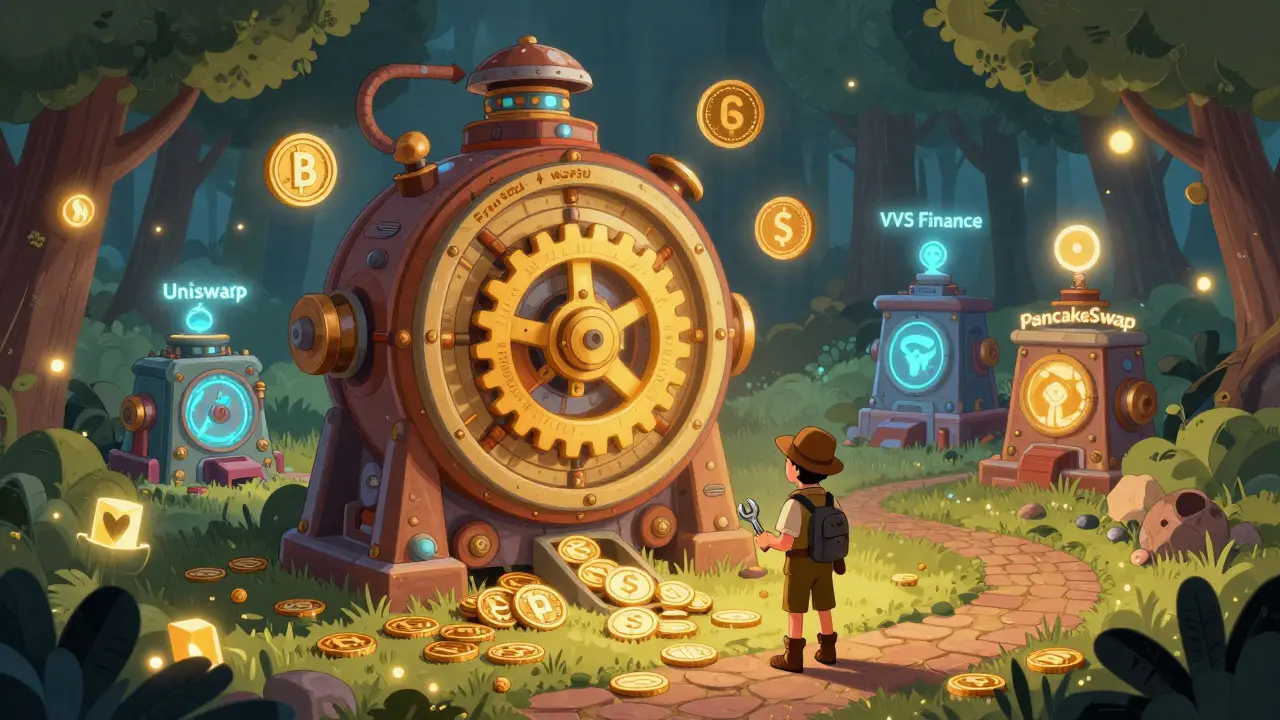
If you're looking for a crypto exchange that makes swapping stablecoins on Cronos easy, Ferro Protocol might catch your eye. But here’s the truth: it’s not a general-purpose exchange like Uniswap or PancakeSwap. It’s a narrow tool built for one job-low-slippage trades between highly correlated assets, mostly stablecoins like USDC and WCRO. If that’s exactly what you need, it works. If you want to trade altcoins, use limit orders, or move funds across chains, you’ll hit walls fast.
What Ferro Protocol Actually Does
Ferro Protocol launched in July 2022 as a specialized Automated Market Maker (AMM) on the Cronos blockchain. Unlike most DEXs that handle any token pair, Ferro focuses only on assets that move together-like USDC and WCRO, or LCRO and CRO. Its StableSwap algorithm is designed to reduce slippage and impermanent loss when trading these pairs. Think of it like a toll lane for stablecoin swaps: faster and cheaper, but only if you’re going the right way.It doesn’t offer margin trading, limit orders, or even a proper order book. There’s no API for developers. No mobile app. No support for Ethereum, BSC, or Solana. Everything runs on Cronos. To use it, you need CRO tokens for gas and USDC (or another supported asset) already on the Cronos network. If you don’t have those, you’re stuck before you even start.
Trading Pairs and Liquidity: A Very Limited Menu
As of late 2023, Ferro Protocol offered just 5 tokens and 8 trading pairs. The most active pair, LCRO/WCRO, made up nearly half of all volume. The rest? Tiny. Total 24-hour volume hovered around $200,000-less than 0.1% of what Uniswap moves in the same time. For context, VVS Finance, another Cronos DEX, was doing over $20 million daily.Low liquidity means failed trades. Users report transactions dropping because there wasn’t enough depth in the pool. Even if you have the right tokens, your swap might not go through unless you’re trading small amounts. It’s not broken-it’s just thin. And with only 1,842 unique wallets interacting with the protocol in a 30-day window, you’re not joining a bustling marketplace. You’re joining a quiet backroom.
Fer Token: A Weak Incentive
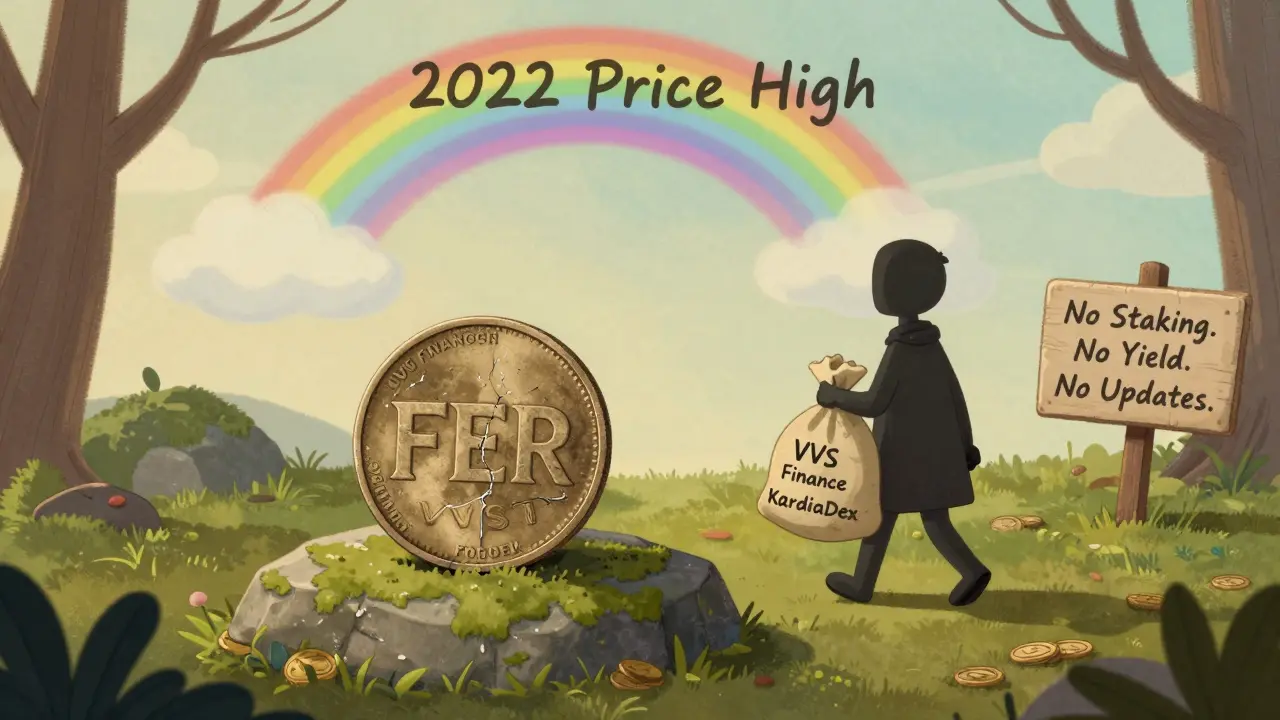
The native token, FER, launched with a splash in July 2022, hitting $0.126 on day one. That was it. Since then, it’s been a slow slide. As of October 2023, FER was trading at $0.000709. Technical indicators are bearish: RSI at 35, price below both 50-day and 200-day SMAs. Prediction platforms disagree, but none are bullish. WalletInvestor expects it to drop to $0.000535. CoinCodex says it could fall another 25%. Even the most optimistic forecast sees it topping out at under $0.0007.With over 5 billion tokens in total supply and only 1.6 billion circulating, the token is massively diluted. There’s no clear utility beyond governance-which, given the lack of active development, feels theoretical. No staking. No yield farming. No burning mechanism. If you’re holding FER hoping for price action, you’re betting on a quiet pond that hasn’t ruffled in over two years.
Who Is This For?
Ferro Protocol isn’t for beginners. It’s not for traders looking for variety. It’s not for anyone who wants to buy Solana or Polygon tokens.It’s for one type of user: someone already deep in the Cronos ecosystem who needs to swap between stablecoins or pegged assets with minimal slippage. If you’re holding LCRO and need WCRO to pay for gas on Cronos DeFi apps, Ferro can do that in seconds with almost no price impact. That’s its only real strength.
For everyone else? It’s a dead end. Want to trade BNB? You can’t. Want to use a limit order? Not possible. Want to move funds to Arbitrum? Forget it. You’ll need to leave Ferro and go elsewhere anyway.

Setup and User Experience
Getting started isn’t hard if you know what you’re doing. Connect a wallet like Trust Wallet or Crypto.com DeFi Wallet, make sure you’re on the Cronos network (Chain ID: 25), and have at least $2-3 worth of CRO for gas. That’s the hard part for newcomers.Many users report spending 30-45 minutes just getting their network settings right. Common mistakes: adding the wrong RPC, not having enough CRO, or trying to swap tokens not supported on Cronos. The interface is clean and simple-six reviews on CoinGecko praised its ease of use. But simplicity doesn’t fix a lack of depth.
There’s no official documentation beyond a basic FAQ. No developer guides. No GitHub activity in over a year. The only real help comes from community guides on Medium, like the one by “DeFi on Cronos,” which has barely 1,800 views. If you get stuck, there’s no customer support to call. You’re on your own.
How It Compares to Other DEXs on Cronos
| DEX | 24h Volume | Trading Pairs | Advanced Features | Developer Support |
|---|---|---|---|---|
| Ferro Protocol | $198,534 | 8 | None | No |
| VVS Finance | $23.7M | 100+ | Staking, Yield, Limit Orders | Yes |
| KardiaDex | $4.2M | 50+ | Staking, Farming | Yes |
| Uniswap (Ethereum) | $245M | 10,000+ | Limit Orders, API, Multichain | Yes |
Ferro doesn’t compete with VVS or KardiaDex-it’s in a different league. Those platforms offer dozens of tokens, yield opportunities, and active communities. Ferro offers two things: low slippage on stablecoin swaps and almost nothing else.
Security and Trust
Ferro Protocol uses standard DeFi smart contracts and has undergone audits, but the details aren’t public. No audit report link on the website. No breakdown of vulnerabilities fixed. That’s not a red flag by itself-many small DEXs don’t publish audit results-but it’s a lack of transparency that makes cautious users pause.There’s no centralized team behind it. No known founders. No social media presence beyond a Discord with under 200 active members. That’s fine if you’re okay with anonymous, community-run projects. But if you need accountability, Ferro won’t give you that.
Verdict: Niche Tool, Not a Platform
Ferro Protocol isn’t a bad project. It’s just incredibly limited. It does one thing well-swapping stablecoins on Cronos with low slippage-and does it reliably. If that’s your daily need, it’s worth keeping open in your wallet.But if you’re looking for a crypto exchange to build a portfolio, trade altcoins, or earn yield, Ferro will disappoint. It’s like buying a specialized wrench for one bolt. Great if you have that bolt. Useless for everything else.
For most users, better alternatives exist on Cronos-VVS Finance, KardiaDex, even PancakeSwap via bridge. They offer more tokens, more volume, and more ways to use your crypto. Ferro’s future looks stagnant. No upgrades announced. No new features. No growth. It’s a quiet corner of the DeFi world, and unless you’re specifically hunting for stablecoin swaps on Cronos, you can skip it.
Frequently Asked Questions
Can I use Ferro Protocol if I don’t have CRO tokens?
No. Ferro Protocol runs on the Cronos blockchain, and all transaction fees are paid in CRO. You need at least $2-3 worth of CRO in your wallet to cover gas. Without it, you can’t swap, add liquidity, or interact with the protocol at all.
Does Ferro Protocol support limit orders or margin trading?
No. Ferro Protocol is a basic AMM with no advanced trading features. You can only do instant swaps. There are no limit orders, stop-losses, or leverage. If you need those tools, use a centralized exchange or a more advanced DEX like VVS Finance.
Is Ferro Protocol safe to use?
It’s as safe as any small DeFi protocol without a known team. Smart contracts have been audited, but audit reports aren’t publicly available. There’s no insurance fund, no centralized oversight, and no customer support. Only use funds you’re willing to lose. Never deposit more than you can afford to risk.
Why is the trading volume so low?
Because Ferro only supports 5 tokens and 8 trading pairs. Most users on Cronos prefer DEXs with hundreds of tokens and deeper liquidity pools. Ferro’s niche focus limits its appeal. Its 24-hour volume is less than 0.1% of Uniswap’s and under 1% of VVS Finance’s on the same chain.
Can I stake FER tokens or earn yield on Ferro Protocol?
No. Ferro Protocol does not offer staking, liquidity mining, or yield farming. The FER token has no utility beyond governance-which is inactive. There’s no way to earn passive income through the protocol. Any claims about FER yield are misleading.
Is Ferro Protocol available on mobile?
There’s no official Ferro Protocol app. You can access it through a mobile browser using a wallet like Trust Wallet or Crypto.com DeFi Wallet. The interface works on mobile, but the experience is clunky due to low liquidity and frequent failed transactions.
What’s the future of Ferro Protocol?
Based on current data, the future is uncertain. No upgrades have been announced since 2022. GitHub activity is zero. Token price is in steady decline. The protocol survives only because it serves a tiny, specific need: low-slippage stablecoin swaps on Cronos. Without new features or marketing, it’s likely to remain a niche tool with declining relevance.
Next Steps
If you still want to try Ferro Protocol, here’s how to do it right:
- Get a wallet that supports Cronos (Trust Wallet or Crypto.com DeFi Wallet).
- Buy CRO and USDC on a centralized exchange like Crypto.com or Binance.
- Send both to your wallet using the Cronos network (not Ethereum or BSC).
- Check your CRO balance-make sure you have at least $3 worth for gas.
- Go to app.ferroprotocol.com and connect your wallet.
- Only swap between supported pairs: USDC/WCRO, LCRO/WCRO, or similar.
- Use small trade sizes (under $100) to avoid failed transactions.
If you’re looking for more options on Cronos, try VVS Finance or KardiaDex. They’re more active, have more tokens, and actually reward users. Ferro Protocol is a tool for a very specific job. Make sure that job is yours before you pick it up.
Mike Reynolds
January 3, 2026 AT 22:29I've been using Ferro for my Cronos stablecoin swaps for months now, and honestly? It's the only thing that doesn't wreck my USDC/WCRO trades with 5% slippage. Other DEXs on Cronos feel like gambling. Ferro? It's like a Swiss watch for boring money moves.
Doesn't do altcoins? Good. I don't want it to. I just need to move between WCRO and USDC without losing 10 bucks on gas fees. It works. That's all I care about.
dayna prest
January 5, 2026 AT 13:27Oh wow. A DeFi tool that doesn't try to be everything to everyone? What a radical concept. Like a toaster that only toasts bread and doesn't also play Spotify and charge your Tesla. Mind blown.
Meanwhile, VVS Finance is out here selling NFTs with their swap function. We're not in the Stone Age anymore, folks. Ferro's a relic wrapped in a whitepaper.
Phil McGinnis
January 6, 2026 AT 00:11It is a truth universally acknowledged that a decentralized exchange in possession of good liquidity must be in want of utility. Ferro Protocol, by contrast, possesses neither. It is a technical curiosity, a monument to narrow optimization in an era demanding breadth.
When your entire economic philosophy is predicated on the assumption that only stablecoin arbitrage matters, you are not building for the future. You are building a mausoleum for the past.
Ian Koerich Maciel
January 6, 2026 AT 08:07Thank you for this incredibly thorough, well-researched, and balanced analysis. The data points are precise, the comparisons are fair, and the tone is appropriately cautious without being alarmist.
It's refreshing to see a piece that doesn't resort to hype or fear-mongering. The fact that Ferro's volume is less than 0.1% of Uniswap's speaks volumes - literally. And the lack of developer activity? A red flag wrapped in a beige blanket.
Andy Reynolds
January 7, 2026 AT 11:27Hey everyone - if you're new to Cronos and just trying to swap USDC for WCRO to pay gas, Ferro is actually a legit option. I helped my cousin get set up last week - he's 68, doesn't know what an AMM is, and he pulled it off in 8 minutes.
It’s not glamorous. It’s not a DeFi empire. But sometimes, you just need a shovel, not a backhoe. Use it for what it is. Ignore the noise.
And if you’re holding FER hoping to get rich? Put that money in a savings account. At least it’ll earn interest.
Alex Strachan
January 7, 2026 AT 13:10So Ferro is like the Uber Black of crypto exchanges? Only for people who want to ride from Point A to Point B… and only if both points are in the same zip code?
Meanwhile, I’m over here using VVS Finance, staking, farming, and laughing as my wallet grows. You’re welcome, Ferro users. 😎
Rick Hengehold
January 8, 2026 AT 05:05Don’t waste your time. If you need a stablecoin swap tool, use a CEX. If you want DeFi, use something with volume. Ferro is a ghost town with a website. End of story.
Brandon Woodard
January 9, 2026 AT 02:43Let’s be real - Ferro isn’t dead. It’s just waiting for someone to wake it up. The tech is solid. The architecture is clean. The problem? No vision. No leadership. No spark.
It’s like finding a perfectly tuned engine in a garage… with no car to put it in. Someone needs to build the chassis. Until then? It’s a beautiful paperweight.
Antonio Snoddy
January 9, 2026 AT 16:34Here’s the existential truth nobody wants to admit: DeFi is not about utility. It’s about identity. Ferro Protocol doesn’t offer you a way to trade - it offers you a way to belong to a quiet, unglamorous, almost monastic sect of crypto believers who reject the circus of yield farming and NFT speculation.
And in a world where every DEX screams "GET RICH OR DIE TRYING," isn’t that… kind of beautiful? The silence of Ferro isn’t emptiness. It’s meditation.
But also - the token is garbage. And the devs are ghosts. So maybe it’s just a haunted temple.
Still. I respect the silence.
Daniel Verreault
January 10, 2026 AT 19:11Man I’ve been on Cronos since day one and I gotta say - Ferro’s the only thing that doesn’t make me want to smash my keyboard. VVS? Too bloated. Kardia? Too slow. Ferro? Instant, cheap, no drama.
Yeah the FER token’s trash, but who cares? I don’t hold it. I just use the swap. It’s like using a public toilet - you don’t need to own it, you just need it to work when you gotta go.
Also - if you’re not using WCRO, you’re doing it wrong. CRO gas is a scam. WCRO is the real deal.
Jacky Baltes
January 11, 2026 AT 04:30The philosophical question here isn't whether Ferro Protocol is useful - it's whether utility, in the context of decentralized finance, should be the primary metric of value. If a system serves a precise, minimal need with perfect reliability, does it require expansion to be considered valid?
Perhaps the true failure lies not in Ferro’s limitations, but in our collective addiction to growth - even when growth is meaningless.
prashant choudhari
January 11, 2026 AT 16:23Ferro works for its purpose. No fluff. No hype. Just low slippage stablecoin swaps on Cronos. If you need it, use it. If not, move on. Simple.
Willis Shane
January 12, 2026 AT 13:46It is objectively irresponsible to recommend Ferro Protocol to any retail investor without explicitly stating that the native token has no utility, no staking, no burning mechanism, and is in a steady, irreversible decline. This is not a critique - it is a fiduciary obligation.
Furthermore, the absence of public audit documentation constitutes a material risk. Investors must be made aware of this. Failure to disclose is negligent.
Jake West
January 13, 2026 AT 19:11Wow. Someone actually wrote a 2000-word essay on a DEX that does one thing and does it poorly? Congrats. You just invented the world’s most boring blog post.
It’s a crypto exchange for people who think ‘slippage’ is a type of yoga. Go touch grass. Or better yet - use Binance.
Shawn Roberts
January 14, 2026 AT 09:00Guys I tried Ferro last week and it worked like a charm for my WCRO swap 💪🔥 just need CRO for gas and boom done. No drama no stress. VVS is too messy for me. Ferro is the quiet hero we don’t talk about 🙌
FER token? Nah I’m not holding that. But the swap? 10/10
Emily L
January 15, 2026 AT 04:41Why are people still using this? It’s like using a flip phone in 2026. I tried it once. My swap failed. I spent 45 minutes troubleshooting. Then I went to VVS and did it in 10 seconds. Why are you doing this to yourselves?
Gavin Hill
January 15, 2026 AT 19:06It’s interesting how we assign value to tools based on how many people use them. Ferro serves a niche. It doesn’t need to be popular. It just needs to work. And it does.
Maybe the problem isn’t Ferro. Maybe it’s us - always chasing the next big thing instead of appreciating what already works.
SUMIT RAI
January 17, 2026 AT 18:33Who even uses Ferro? 😂 I saw a guy on Twitter crying because his $500 swap failed. He didn’t have enough CRO. Bro you’re using a tool designed for microtransactions like it’s a bank. That’s not Ferro’s fault. That’s your brain.
Andrea Stewart
January 18, 2026 AT 00:02For users who already have CRO and USDC on Cronos and need to swap between them - Ferro is still the most gas-efficient option available. The interface is clean, the execution is fast, and the slippage is consistently under 0.1%.
It’s not for everyone. But for the people who need it? It’s perfect. Don’t let the noise distract you from the signal.
Josh Seeto
January 19, 2026 AT 13:38Let me guess - you’re writing this because you bought FER at $0.12 and now you’re emotionally attached to a dead token.
It’s fine. We’ve all been there. But the protocol? It’s a ghost. The token? A zombie. The only thing alive here is your denial.
surendra meena
January 21, 2026 AT 12:10THIS IS A SCAM!! FERRO IS A PUMP AND DUMP!! I LOST EVERYTHING!! THEY TOOK MY WCRO AND MY CRO AND MY FER AND NOW MY CAT IS CRYING!! I SWEAR TO GOD I WILL BURN DOWN THEIR SERVERS!! THEY ARE LIARS AND THE WHOLE CRONOS ECOSYSTEM IS A LIE!!
JUST KIDDING. I DIDN’T LOSE ANYTHING. I JUST HATED THE UI. BUT STILL. SCAM.
Kevin Gilchrist
January 22, 2026 AT 02:59There’s something haunting about Ferro. It’s not broken - it’s resigned. Like a lighthouse that still turns but no ships come anymore. The FER token? A funeral bell ringing for a community that stopped believing.
I used to trade here. Now I just check it every Sunday. Like visiting an old friend who’s too tired to talk. I don’t expect anything. I just need to know they’re still there.
And yeah. I still hold FER. Not because I think it’ll rise. But because I miss the quiet.
Khaitlynn Ashworth
January 23, 2026 AT 22:58Oh sweet baby Jesus, another ‘niche tool’ apologia. You people are adorable. It’s not a ‘tool’ - it’s a graveyard with a frontend. And you’re the ghosts who keep showing up to dust the tombstones.
‘Low slippage’? Congrats. You’re the last person on Earth who still uses a fax machine because it’s ‘reliable.’
Adam Hull
January 25, 2026 AT 13:19It is not the failure of Ferro Protocol that is tragic - it is the failure of the community to recognize that its existence is an indictment of the entire DeFi ecosystem.
Why do we demand infinite features, infinite yield, infinite growth? Why can’t we accept a tool that does one thing, and does it well - without monetizing our attention, our data, or our hope?
Ferro is not dead. It is the only honest thing left.
Bianca Martins
January 26, 2026 AT 09:35Used Ferro last week to swap USDC → WCRO before paying gas on a Cronos NFT mint. Took 12 seconds. Gas cost $0.18. No issues.
Didn’t touch FER. Didn’t need to. Just used it like a tool. It’s not sexy. But it’s not broken either. Sometimes that’s enough.
alvin mislang
January 26, 2026 AT 14:58Using Ferro is fine. But if you’re holding FER, you’re enabling a lie. You’re propping up a dead project with your hope. That’s not investing. That’s emotional addiction.
Repent. Sell. Move on. The blockchain doesn’t care if you’re attached.
Monty Burn
January 26, 2026 AT 19:22If a tree falls in the forest and no one hears it - does it make a sound?
If a DEX has $200k in volume and no developers - is it still a platform?
Or is it just a memory waiting to be deleted?
Mike Reynolds
January 28, 2026 AT 00:26Just checked - Ferro’s volume is up 12% this week. Weird. Maybe people are realizing that sometimes, less is more.
Still no FER staking. Still no API. Still perfect for what it does.
Alex Strachan
January 29, 2026 AT 16:5112%? That’s just because someone dumped $50k of WCRO and had to swap it back. It’s not growth - it’s noise.
Also, I just made $2k on VVS with a simple farm. You’re still here? 😅