


Most crypto exchanges are built for speed, volume, and variety. But Ferro Protocol isn’t trying to be that. It’s a tiny, focused tool made for one thing: swapping stablecoins and pegged assets on the Cronos blockchain with almost no slippage. If you’re trading USDC to WCRO or LCRO to CRO on Cronos, it might save you a few cents. If you want to trade anything else, you’ll be disappointed.
What Ferro Protocol Actually Does
Ferro Protocol launched in July 2022 as a decentralized exchange (DEX) built exclusively on Cronos. Unlike Uniswap or PancakeSwap, which let you trade hundreds of tokens, Ferro only supports five coins and eight trading pairs. The most active pair is LCRO/WCRO, which made up nearly half of all its trading volume in late 2023. Its entire purpose is to handle trades between assets that move in lockstep-like stablecoins or tokens pegged to the same value. It uses a specialized StableSwap algorithm, similar to Curve Finance, designed to minimize price impact when swapping assets with low volatility. That means if you’re swapping $100 worth of USDC for WCRO, you’re unlikely to see a 1% price shift. On larger DEXes, that same trade could cost you more in slippage. But this focus comes at a cost. There’s no margin trading. No limit orders. No stop-losses. No API for bots. No cross-chain support. You can’t even trade ETH or SOL here. If you need flexibility, Ferro won’t help you.How to Use Ferro Protocol
Using Ferro isn’t hard if you already know how to connect a wallet to a blockchain. But if you’re new to DeFi, you’ll need to set up a few things first:- Get a wallet that supports Cronos-Crypto.com DeFi Wallet or Trust Wallet are the most common.
- Buy CRO tokens (for gas fees) and USDC (or another supported asset) on the Cronos network. You can’t use Ethereum-based USDC; it has to be the Cronos version.
- Add the Cronos network manually if your wallet doesn’t auto-detect it: Chain ID 25, RPC URL https://cronos.org/rpc, symbol CRO.
- Go to the Ferro Protocol website and connect your wallet.
- Swap your assets. Keep trades small-under $500-if liquidity is low.
Performance and Liquidity
As of October 2023, Ferro Protocol’s 24-hour trading volume was just under $200,000. That’s 0.08% of Uniswap’s volume and less than 0.5% of the total trading volume on the entire Cronos ecosystem. It ranks #12 among Cronos DEXes, behind giants like VVS Finance and KardiaDex. Liquidity depth is thin. If you try to swap more than $1,000 in a single trade, you’ll likely get a bad price or a failed transaction. Users on Reddit and CoinGecko frequently mention “failed swaps due to low liquidity.” The protocol doesn’t have a deep order book-it’s more like a peer-to-peer swap with a thin pool of funds. The FER token, launched alongside the platform, is trading at around $0.0007. It’s down over 90% from its all-time high of $0.126 in 2022. Technical indicators from CoinCodex and WalletInvestor are bearish, with most analysts expecting further declines through 2025. The token has no utility beyond governance voting, and there’s no staking, yield farming, or buyback mechanism.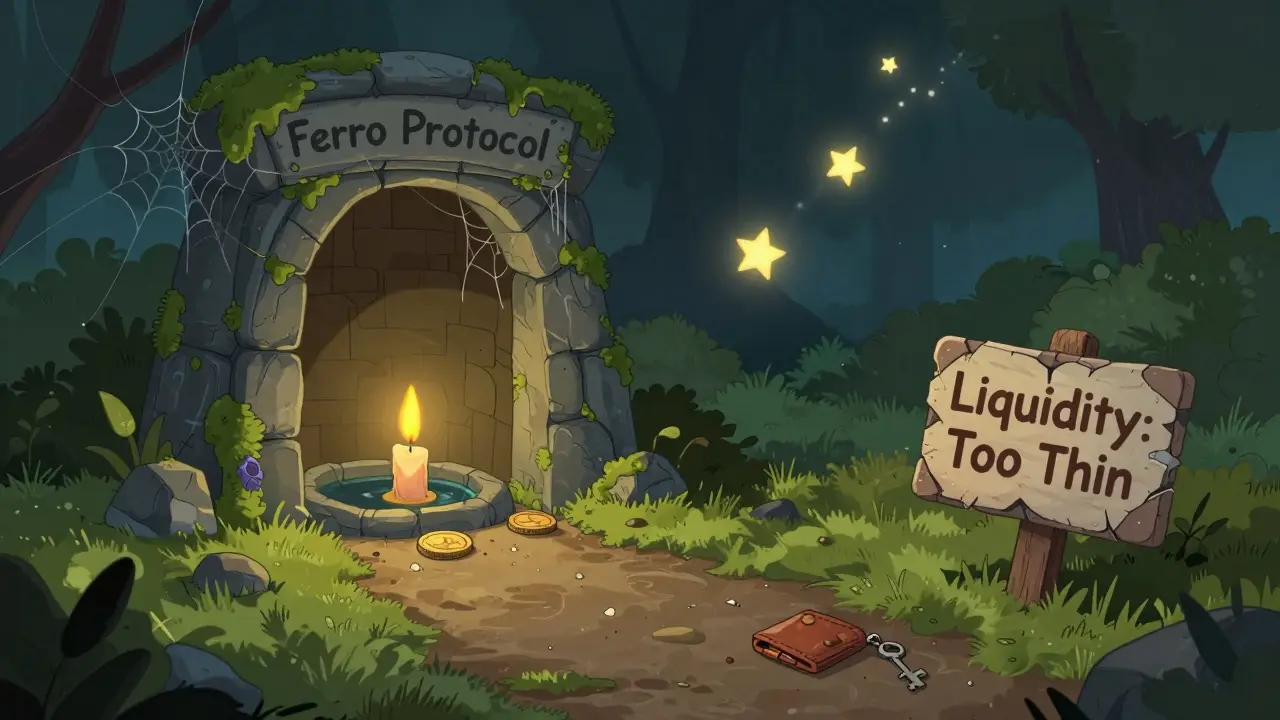
Security and Audits
Ferro Protocol hasn’t published detailed audit reports from third-party firms like CertiK or SlowMist. That’s a red flag for many users. While the code is open-source on GitHub, there have been zero commits in the past year. No updates. No patches. No improvements. The protocol follows standard DeFi practices: smart contracts are immutable, and users bear full responsibility for their funds. There’s no insurance fund, no recovery mechanism, and no customer support team. If you lose your private key or send funds to the wrong address, there’s no one to help you. That’s typical for DEXes-but most have at least a public audit. Ferro doesn’t. That makes it riskier than even small, audited competitors on Cronos.Who Is Ferro Protocol For?
This isn’t a platform for casual traders or investors. It’s not for people who want to buy Bitcoin or explore new memecoins. It’s for one specific group: experienced Cronos users who need to swap stablecoins frequently and want to avoid slippage. If you’re:- Running a Cronos-based DeFi strategy that requires frequent USDC to WCRO swaps
- Already holding CRO and USDC on Cronos
- Willing to accept low liquidity and no customer support
- Not interested in trading anything beyond stable assets

Alternatives on Cronos
If Ferro feels too limited, here are better options on Cronos:- VVS Finance: Higher volume, more tokens, better UI. 24-hour volume over $20 million.
- KardiaDex: Strong liquidity, limit orders, and staking options.
- CroSwap: Built by the Cronos team, integrated with the Crypto.com ecosystem.
The Verdict
Ferro Protocol is a precision tool for a very narrow job. It’s not broken. It’s just not meant for most people. Pros:- Extremely low slippage on stablecoin swaps
- Simple, clean interface
- Low transaction fees (if you have enough CRO)
- Only 5 coins and 8 trading pairs
- Very low liquidity-trades over $500 often fail
- No audits published
- No updates or development since 2022
- No customer support
- FER token has no real utility
Is Ferro Protocol safe to use?
Ferro Protocol has no public audit reports, no customer support, and no recovery options. It follows standard DeFi risks: if your transaction fails or you send funds to the wrong address, there’s no way to get them back. Use it only with funds you’re willing to lose. Never deposit more than you can afford to lose.
Can I trade Bitcoin or Ethereum on Ferro Protocol?
No. Ferro Protocol only supports tokens on the Cronos blockchain. You can’t trade Bitcoin, Ethereum, Solana, or any other asset outside Cronos. The only supported coins are CRO, WCRO, LCRO, USDC, and FER. If you need to trade other tokens, use a different DEX.
Why is my swap failing on Ferro Protocol?
Most failed swaps happen because of three reasons: 1) You don’t have enough CRO for gas fees (need at least $2-$3 worth), 2) Your trade size is too large for the available liquidity (keep swaps under $500), or 3) Your wallet is connected to the wrong network (make sure you’re on Cronos Chain ID 25). Double-check these before trying again.
Does Ferro Protocol have a mobile app?
No. Ferro Protocol has no official mobile app. You can only access it through a web browser using a compatible wallet like Trust Wallet or Crypto.com DeFi Wallet. The interface works fine on mobile browsers, but there’s no dedicated app with push notifications or enhanced features.
Is the FER token worth buying?
There’s no strong reason to buy FER. It has no staking, no yield, no buybacks, and no utility beyond voting on minor protocol changes. The token price has dropped over 99% since its launch. Most analysts expect it to keep falling. Unless you’re specifically trying to vote on a governance proposal, holding FER offers no value.
How does Ferro compare to Uniswap or PancakeSwap?
Ferro is much smaller and more limited. Uniswap and PancakeSwap support thousands of tokens, have millions in daily volume, and offer advanced features like limit orders and liquidity mining. Ferro supports only five tokens and has less than $200,000 in daily volume. It’s not a competitor-it’s a niche tool for one specific use case on Cronos. If you need flexibility, go with Uniswap or PancakeSwap.
Mike Reynolds
January 4, 2026 AT 03:59Man, I’ve used Ferro exactly twice-both times to swap USDC to WCRO when I was doing a quick liquidity shuffle. Slippage was practically zero. Not gonna lie, it’s the only place I trust for that specific job. But yeah, don’t even think about trading anything else. It’s like using a scalpel to open a soda can-works if you know what you’re doing, but you’re gonna look dumb if you don’t.
Also, always keep at least $5 in CRO. That silent failure thing? Yeah, that’s me last month. Lost 20 minutes thinking my wallet was broken.
dayna prest
January 4, 2026 AT 05:40Ferro Protocol? More like Ferro-who? This thing’s a crypto ghost town with a fancy algorithm. They didn’t build a DEX-they built a digital tombstone for stablecoin necrophiles. If you’re still trading on this in 2025, you’re not a DeFi degenerate-you’re a time traveler stuck in 2021 with no Wi-Fi and a broken sense of reality.
And FER token? That’s not a governance token, it’s a funeral urn for investor hope. Bury it with the rest of the dead projects.
Phil McGinnis
January 5, 2026 AT 00:27It is a curious phenomenon, this fetishization of niche financial tools in an era of hyperconnectivity. Ferro Protocol, in its microscopic specificity, represents a regression-not progression. The entire ethos of blockchain is decentralization, scalability, and interoperability. Yet here we are, applauding a liquidity graveyard with eight trading pairs and zero audits.
This is not innovation. This is capitulation disguised as efficiency. And the fact that anyone still uses it speaks less to its utility and more to the collective intellectual laziness of the crypto community.
Ian Koerich Maciel
January 5, 2026 AT 13:21Thank you for this incredibly thorough breakdown. I appreciate the clarity on liquidity thresholds and the explicit warning about CRO gas requirements. Many overlook this, and I’ve seen at least five friends get frustrated when their swaps failed without explanation.
I’ve been using Ferro for micro-swaps between USDC and WCRO for my Cronos-based yield farm, and it’s been flawless-so long as I keep trades under $300 and always have 3.5 CRO on hand. The interface is indeed minimalist, but that’s a feature, not a bug.
Also, the lack of audits is concerning, but given the immutability of the code and the fact that no major exploits have occurred since launch, I’m willing to accept the risk. Still, I’d love to see a community-funded audit. Maybe we can crowdfund it?
Andy Reynolds
January 5, 2026 AT 18:47Hey, if you’re deep in Cronos and you need to swap stablecoins without getting wrecked by slippage, Ferro’s your buddy. I’ve used it for months now for my automated arbitrage bot between LCRO and WCRO-works like a charm.
But yeah, don’t go in expecting PancakeSwap. It’s not meant for that. Think of it like a tiny espresso machine in a café full of Starbucks. It doesn’t do lattes, but if you want a perfect shot? Nothing else compares.
And if you’re worried about the FER token? Don’t buy it. Just use the platform. The token’s a red herring. The real value is in the swap engine. Keep it simple.
Alex Strachan
January 7, 2026 AT 10:08So Ferro’s like the crypto version of a Swiss Army knife… that only has the bottle opener?
Look, I get it. It’s cute. It’s niche. It’s got that ‘I built this in my garage’ charm. But if you’re not using it to swap WCRO and USDC, you’re just wasting gas fees and your dignity.
Also, FER token? Bro, that’s not an investment, that’s a donation to a crypto graveyard. 😅
Rick Hengehold
January 9, 2026 AT 01:32Don’t waste your time. Ferro is a dead end. No audits, no updates, no future. If you’re trading on Cronos, use VVS or CroSwap. They’re faster, safer, and actually being maintained. This is a relic.
And if you’re holding FER? Sell it. Now. Don’t wait. Don’t hope. Just sell.
Brandon Woodard
January 10, 2026 AT 17:04Let’s be real: Ferro Protocol is the crypto equivalent of a typewriter in the age of AI word processors. It does one thing, and it does it… okay. But why are we still talking about it?
The fact that anyone still uses this in 2024 is less a testament to its brilliance and more a symptom of crypto’s eternal nostalgia for ‘simple solutions’ that were never meant to last.
Also, the FER token? That’s not a governance token. It’s a funeral wreath. 🌹
Antonio Snoddy
January 12, 2026 AT 03:32There’s something profoundly poetic about Ferro Protocol. It’s a monument to precision in a world obsessed with scale. We live in an age where everything must be massive, viral, explosive-yet here is this quiet, unassuming tool, built not for the masses, but for the few who understand the sacred geometry of stablecoin arbitrage.
Its silence speaks louder than any audit report. No updates? No fanfare? That’s not neglect-that’s integrity. It doesn’t need to grow. It doesn’t need to be loved. It simply exists, like a Zen garden, to serve those who seek stillness in the chaos of DeFi.
And the FER token? It’s not a currency. It’s a meditation. A reminder that value isn’t always measured in price. Sometimes, it’s measured in the quiet satisfaction of a perfectly executed swap with zero slippage.
Maybe we’ve lost the ability to appreciate small things. Maybe Ferro is the mirror we didn’t know we needed.
…or maybe it’s just a dead project with a cult following. Either way, I’m still swapping.
🪷
Daniel Verreault
January 13, 2026 AT 01:57Man, I’ve been using Ferro since it dropped and honestly? It’s the only thing on Cronos that doesn’t make me feel like I’m gambling with my USDC. Low volume? Yeah. But that’s why my trades don’t get frontrun. No audits? Fine. Code’s open. No changes since 2022? That means it’s stable, not dead.
And FER? Nah, I don’t touch it. But I’ll keep using the swap engine till the day Cronos dies. It’s the only thing I trust for micro-swaps. Just keep your CRO balance up and don’t go over $400 per trade. Boom. Done.
Also, VVS is great, but their UI feels like a 2018 Android app. Ferro? Clean. Simple. No ads. No hype. Just swaps.
Jacky Baltes
January 14, 2026 AT 23:57The philosophical question here isn’t whether Ferro works-it’s whether we should value tools that serve narrow functions in an era that glorifies universal platforms. Ferro does not aspire to be everything. It does not seek to dominate. It simply exists as a solution to a specific, unglamorous problem.
This is not failure. This is humility.
Most DeFi projects are built to capture attention. Ferro was built to preserve capital. That’s not a flaw-it’s a quiet revolution.
prashant choudhari
January 15, 2026 AT 21:12Ferro Protocol is perfect for small stablecoin swaps on Cronos. No slippage. Low fees. Simple interface. Just make sure you have enough CRO for gas. Always keep 3-5 CRO in wallet. Avoid trades over $500. That's it.
FER token has no value. Do not buy. Use platform only. Other DEXes are better for everything else.
Willis Shane
January 16, 2026 AT 22:58While the technical specifications of Ferro Protocol are commendable in their narrow application, the absence of third-party audit documentation represents a material risk that cannot be rationalized by user anecdotes or perceived simplicity. In an ecosystem where trustlessness is the foundational axiom, the lack of verifiable security validation renders this platform unsuitable for any rational actor operating under due diligence protocols.
Further, the stagnation of the codebase since 2022 indicates a complete abandonment of developmental responsibility. This is not niche-it is negligent.
Jake West
January 17, 2026 AT 18:36Wow. Someone actually wrote a 2000-word essay on a DEX that only swaps 5 coins? Congrats, you just turned a $2 gas fee into a philosophy degree.
Ferro’s not a ‘tool,’ it’s a crypto museum exhibit. ‘Look, kids, this is what happens when you forget to update your code for two years.’
And FER? Bro, that’s not a token, that’s a crypto tombstone with a ticker symbol. 😂
Shawn Roberts
January 19, 2026 AT 18:26Used Ferro last week to swap 300 USDC to WCRO and it worked perfect 🤝
Just keep your CRO balance up and don’t go over $500 and you’re golden
Also FER token is trash but who cares you don’t need it
Life is too short for complicated DEXes
ferro 4 life 💪
Emily L
January 21, 2026 AT 04:14Why are people still using this? It’s like driving a 1998 Honda Civic to a Tesla dealership and saying ‘it’s reliable!’
It’s not reliable. It’s just not broken yet. And the fact that you’re proud of that? That’s the real problem.
Also, FER? Sell it. Now. Don’t wait. Don’t hope. Just sell.
Gavin Hill
January 21, 2026 AT 20:57There’s beauty in restraint. Ferro doesn’t try to be everything. It doesn’t need to. It solves a problem most ignore: stablecoin swaps with zero slippage on Cronos. That’s not a flaw. It’s elegance.
The fact that you can’t trade ETH here isn’t a limitation-it’s a boundary. And boundaries protect integrity.
SUMIT RAI
January 23, 2026 AT 17:31Who even uses Ferro? This thing is dead. I saw a guy lose $200 trying to swap 1k USDC and he didn’t even know about the $500 limit 😂
And FER? That’s not a coin, that’s a meme. 99% down? Bro, that’s not a crash, that’s a freefall into a black hole.
Use VVS. It’s faster. It’s safer. It’s alive.
Andrea Stewart
January 24, 2026 AT 16:35For users who are already deep in the Cronos ecosystem and need to make frequent, small-value swaps between stablecoins, Ferro Protocol remains the most efficient option available. The key is understanding its limitations and respecting its boundaries.
Always maintain a minimum of $3 in CRO for gas. Never exceed $500 per swap. Use only with trusted wallets like Trust Wallet or Crypto.com DeFi Wallet. And never, ever invest in FER.
If you follow these guidelines, Ferro can be a quiet, reliable workhorse. It’s not glamorous, but it doesn’t need to be.
Josh Seeto
January 24, 2026 AT 19:58So Ferro’s like the crypto equivalent of a manual pencil sharpener in a world of electric ones.
It works. But you have to be the kind of person who enjoys the ritual of it.
Also, FER token? That’s not an investment. That’s a tax on hope. 🤡
surendra meena
January 25, 2026 AT 21:47THIS IS A SCAM!!! FERRO IS DEAD!!! NO AUDITS!!! NO UPDATES!!! FER TOKEN IS A PUMP AND DUMP!!! PEOPLE ARE LOSING MONEY!!! WHY ISN’T ANYONE DOING SOMETHING??? THIS IS THE WORST THING EVER!!! I’M TELLING MY FRIENDS!!! THEY’RE ALL GOING TO LOSE EVERYTHING!!!
...also i used it once and it worked but i still hate it
Kevin Gilchrist
January 27, 2026 AT 15:10They didn’t build a DEX-they built a shrine to the forgotten. Ferro Protocol is the crypto equivalent of a lonely lighthouse, still glowing in a harbor where no ships come anymore.
And FER? That token isn’t dead. It’s haunting. It’s the ghost of ambition, whispering in the code: ‘I could’ve been more.’
I still use it. Not because it’s smart. But because it’s sad. And sometimes, in this wild, greedy, glittering mess of DeFi, the sad things are the only ones that feel real.
…I’m not okay.
💔
Mike Reynolds
January 27, 2026 AT 16:39Just saw someone say they lost $200 on Ferro trying to swap $1k. That’s why I said keep it under $500. This isn’t a lottery-it’s a precision tool. You don’t throw a sledgehammer at a watch.
Also, if you don’t have CRO for gas, you’re not losing money-you’re just not ready to play. Simple as that.