


The crypto derivatives market isn’t just growing-it’s rewriting the rules of finance. In 2025, monthly trading volume hit $8.94 trillion, dwarfing most traditional asset classes in speed and scale. This isn’t speculative hype. It’s institutional demand, regulatory shifts, and technological innovation colliding in real time. What’s happening now will define how money moves for the next decade.
Bitcoin and Ethereum Dominate, But Altcoins Are Catching Up
Bitcoin and Ethereum together account for 68% of all crypto derivatives volume. That’s not surprising-they’re the most liquid, most understood assets in the space. But the real story isn’t just who’s leading; it’s who’s rising.
Open interest in Bitcoin options crossed $4 billion in multiple quarters last year. Ether options saw a 65% jump in daily volume between 2024 and 2025. More exchanges now offer options on Solana, Avalanche, and even smaller-cap tokens with weekly expiries and granular strike prices. Liquidity is tightening. Bid-ask spreads are narrowing. That’s the mark of a maturing market.
Deribit remains the largest options exchange, handling over half of all crypto options volume. But behind the scenes, institutional players like Paradigm are quietly backing 33-36% of that volume. These aren’t retail traders. These are hedge funds, market-making firms, and asset managers hedging multi-billion-dollar portfolios.
The U.S. Just Changed Everything
Before January 2025, crypto derivatives operated in a gray zone. Regulators in the U.S. were split. The SEC was suing DeFi protocols. The CFTC was chasing exchanges. Traders had to move offshore to access leverage.
Then came Executive Order 14178. Within days of President Trump’s inauguration, the federal government declared its intent to make the U.S. the global hub for digital assets. The SEC dropped its appeal against a court ruling that overturned the controversial ‘Dealer Rule’-a move that saved DeFi liquidity providers from being classified as unlicensed brokers. Suddenly, protocols like dYdX and Uniswap weren’t just surviving-they were thriving.
On top of that, the U.S. created a strategic Bitcoin reserve. Digital assets were approved for inclusion in 401(k) plans. And on January 30, 2025, the SEC approved Bitwise’s combined Bitcoin-Ethereum ETF. That wasn’t just a product launch-it was a signal. Institutions that sat on the sidelines for years are now building allocation models around crypto derivatives.

DeFi Derivatives Are No Longer a Niche
Decentralized exchanges like dYdX and Hyperliquid aren’t just alternatives-they’re becoming primary venues for institutional-grade trading. Why? Because they don’t hold your funds. No KYC. No counterparty risk. No withdrawal delays.
Perpetual swaps on dYdX now handle over $1.2 billion in daily volume. That’s more than some traditional futures exchanges. And the innovation isn’t stopping. Protocols are experimenting with ‘everlasting options’-derivative contracts with no expiry date, funded by automated premium collection. It’s a radical departure from Wall Street’s 30-day expiry cycles.
Even traditional firms are adapting. Goldman Sachs and JPMorgan now route institutional orders through DeFi liquidity pools via private APIs. They’re not building their own blockchain. They’re borrowing the infrastructure. Why? Because it’s cheaper, faster, and more transparent.
New Products Are Redefining Risk and Reward
Derivatives aren’t just futures and options anymore. The market is inventing new tools to solve real problems.
Crypto.com launched UpDown options-simple binary bets on price direction with fixed payouts. Luxor Technology introduced Hashprice NDFs, letting miners hedge their hash rate revenue without owning hardware. FalconX created staking yield swaps, allowing investors to lock in future staking rewards as a tradable asset.
These aren’t gimmicks. They’re financial instruments tailored to crypto’s unique dynamics. Miners need to hedge power costs. Stakers want liquidity without locking up coins. Traders need exposure without custody risk. The market is answering each need with precision.
Security Breaches and Liquidations Still Haunt the Market
Despite all the progress, crypto derivatives remain volatile-and dangerous.
In late January 2025, Phemex lost $70-85 million in a hack. The Lazarus Group, linked to North Korea, exploited a hot wallet vulnerability. Withdrawals froze for days. Panic spread. Other exchanges scrambled to move funds offline.
Then came the February 3 crash. Geopolitical tensions triggered a cascade of liquidations. $2.2 billion in positions were wiped out in 24 hours. Bitcoin futures saw $409 million in liquidations. Ethereum futures lost $600 million. Margin calls didn’t just hit retail traders-they hit institutional accounts with leveraged positions.
The lesson? Even with better infrastructure, risk management is still lagging. Most traders still use 10x-50x leverage. Most platforms still rely on centralized order books. And most risk models haven’t adapted to crypto’s 24/7, 10% daily volatility.
What’s Next? Three Trends That Will Shape 2026 and Beyond
First: ETFs will drive derivatives adoption. With Bitcoin and Ethereum ETFs now live, institutional inflows are accelerating. Every dollar flowing into these ETFs creates demand for hedging tools. Expect more hybrid products-like ETF-linked futures with daily settlement.
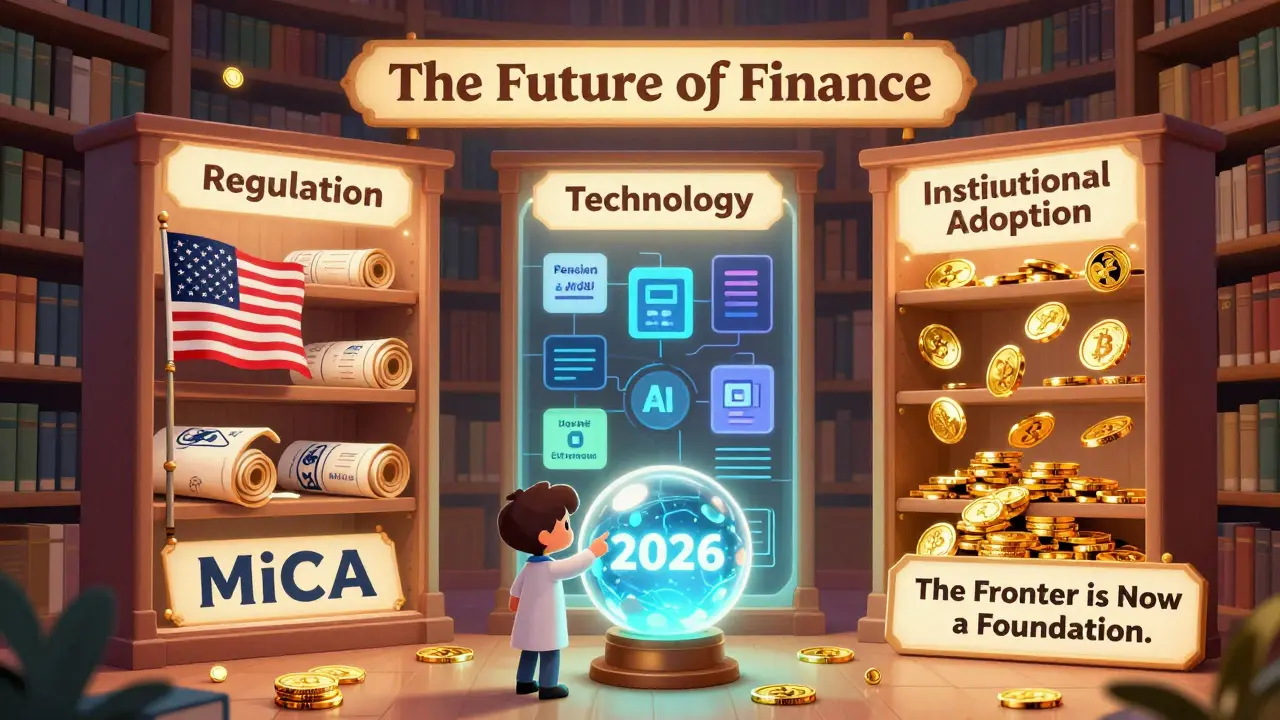
Second: Regulation will split the world. The U.S. is going all-in. Europe is moving toward MiCA compliance. Asia is fragmented-Singapore is open, China is banned, Japan is cautious. This means trading volume will migrate. Exchanges that don’t adapt to local rules will die.
Third: AI-driven pricing will replace old models. Traditional finance uses Black-Scholes. Crypto doesn’t fit that model. New algorithms now factor in on-chain data, social sentiment, miner behavior, and macro news spikes. Firms like Chainalysis and CoinMetrics now sell pricing analytics to derivatives platforms. The best traders aren’t just watching price-they’re reading blockchain.
The future of crypto derivatives isn’t about bigger leverage or flashier interfaces. It’s about maturity. Institutions are in. Technology is robust. Regulation is catching up. The market is no longer a wild frontier. It’s becoming a core part of global finance.
Are crypto derivatives legal in the U.S. now?
Yes, as of early 2025, crypto derivatives are fully legal and actively regulated in the U.S. The SEC dropped its appeal against the Dealer Rule, removing a major threat to DeFi platforms. CME offers Bitcoin and Ethereum futures. The U.S. government has created a strategic Bitcoin reserve and allowed crypto assets in retirement plans. Exchanges operating in the U.S. must comply with AML and reporting rules, but trading is no longer restricted.
Can I trade crypto derivatives without KYC?
Yes, on decentralized platforms like dYdX, Hyperliquid, and GMX, you can trade derivatives without KYC. These platforms use smart contracts and non-custodial wallets. However, centralized exchanges (like Binance or Coinbase) require identity verification. The trade-off is simplicity vs. control. DeFi gives you full custody but requires more technical knowledge. CeFi is easier to use but holds your funds.
Why are Bitcoin and Ethereum options so popular?
Bitcoin and Ethereum have the deepest liquidity, the most reliable price data, and the widest institutional adoption. Traders use their options to hedge long-term holdings, speculate on volatility, or create structured payouts. With open interest exceeding $4 billion for Bitcoin options, there’s enough volume to support large trades without slippage. Altcoins lack that depth-so even though they’re listed, most volume stays with BTC and ETH.
How do staking yield swaps work?
Staking yield swaps let you trade the expected future rewards from staking crypto. For example, if you stake 10 ETH and expect 5% annual yield, you can sell that yield to someone else for a fixed upfront payment. The buyer gets the rewards; you get cash now. FalconX and other firms have built these as non-deliverable contracts, meaning no actual ETH changes hands-just the value of future rewards. It’s like selling an interest rate future, but for staking.
What’s the biggest risk in crypto derivatives right now?
The biggest risk isn’t price movement-it’s systemic fragility. Most platforms still use centralized order books, hot wallets, and opaque liquidation engines. A single hack, exchange failure, or sudden regulatory crackdown can trigger cascading liquidations. The $2.2 billion crash in February 2025 showed how quickly things can spiral. Risk management tools are improving, but most traders still don’t use stop-losses, position limits, or stress-testing. The market is growing fast-but not all participants are growing with it.
Brian T
March 8, 2026 AT 00:40So we’re just pretending this isn’t a glorified casino with blockchain glitter? Institutions? Please. They’re just finding new ways to bet on entropy. The ‘maturity’ you’re talking about? It’s just leverage with a suit on. I’ve seen this movie before. 2017. 2021. Same script. Different NFTs.
Nash Tree Service
March 9, 2026 AT 18:13While the structural evolution of decentralized derivative instruments presents a paradigmatic shift in financial architecture, one must not overlook the ontological instability inherent in algorithmic pricing models predicated upon non-fungible on-chain metrics. The epistemological foundations of Black-Scholes remain empirically superior, despite the romanticization of ‘blockchain sentiment’ as a predictive variable.
James Burke
March 11, 2026 AT 08:01Honestly, the DeFi part is wild. No KYC, no waiting, no middleman? I’ve been trading on dYdX for months now. It’s like trading futures but without having to trust some guy in a suit with your money. And the everlasting options? Genius. No expiry means you don’t have to time the market like a nervous squirrel. Just hold and let the premiums roll in.
Also, staking yield swaps? I sold mine last month. Got cash upfront, didn’t lock up my ETH. Perfect for paying rent. Real utility.
Jesse VanDerPol
March 12, 2026 AT 23:53Bitwise ETF approval was the turning point. Not because it changed anything overnight, but because it made institutions feel safe enough to look closer. The real story isn’t the volume-it’s the quiet shift from ‘crypto’ to ‘asset class.’
Austin King
March 14, 2026 AT 09:35Finally seeing real innovation. Not just more leverage. Actual tools for real people. Miners hedging, stakers getting cash, traders avoiding custody risk. This is what finance should look like.
Bryanna Barnett
March 16, 2026 AT 06:17Ugh. ‘Strategic Bitcoin reserve’? Like we’re in a geopolitical power play? I mean, sure, it’s cool, but can we stop pretending this isn’t just Wall Street trying to rebrand gambling as ‘institutional hedging’? Also, typo in ‘hyperliquid’-it’s ‘Hyperliquid’ with a capital H. Just saying.
Josh Moorcroft-Jones
March 17, 2026 AT 07:51Let’s be real-the whole ‘regulation’ narrative is a farce. The SEC dropped its appeal? Sure, but only because they were losing in court. The moment they get a new chair who’s a crypto-hater, it’s back to lawsuits. And ‘institutional demand’? That’s just hedge funds using crypto as a tax loophole and a way to move money without AML flags. Don’t believe the hype. The market’s still a house of cards built on 50x leverage and hot wallets.
And don’t even get me started on ‘AI-driven pricing.’ You think some algorithm can predict a tweet from a Chinese miner? Or a TikTok trend that pumps a meme coin? That’s not analytics-that’s astrology with a server farm.
The $2.2B liquidation event? That wasn’t ‘geopolitical tension.’ That was a single whale dumping on a centralized exchange with no circuit breakers. And now we’re pretending it’s ‘maturity’? Please. We’re still in the Wild West. Just with better UI.
Melissa Ritz
March 17, 2026 AT 21:00It’s funny how everyone acts like this is new. The same people who cried ‘this is the future’ in 2017 are now saying ‘we’re mature.’ Where was this maturity when FTX collapsed? Or when Celsius froze withdrawals? Or when TerraUSD went to zero? We’re not mature. We’re just better at hiding the cracks.
Cerissa Kimball
March 18, 2026 AT 01:21Staking yield swaps are revolutionary but underutilized. Most retail traders still don’t understand how they work. You’re essentially creating a forward contract on staking rewards without transferring assets. It’s like selling interest on a bond before you even get the coupon. The liquidity is there. The infrastructure is there. The education isn’t. That’s the bottleneck now.
Basil Bacor
March 19, 2026 AT 23:48US government creating a bitcoin reserve? Absolute madness. We’re turning crypto into a state-backed asset. That’s not innovation. That’s surrender. The whole point was decentralization. Now we’re just building a new version of the Fed with more blockchain buzzwords.
Emily Pegg
March 20, 2026 AT 20:27Y’all act like this is the future… but we just had a $70M hack and a $2B liquidation in two months. We’re not maturing. We’re just getting better at pretending we’re not about to crash again. 😔
Ethan Grace
March 22, 2026 AT 15:18If the market is becoming ‘core to global finance,’ then what does that say about finance itself? Are we evolving-or just automating the same greed? The tools are smarter. The players are richer. But the human impulse? Still the same. Buy low. Sell high. Bet everything. Repeat.
Christina Young
March 24, 2026 AT 10:27‘Maturity’? The only thing mature here is the number of people who still believe this isn’t a pyramid scheme with a whitepaper. 68% of volume in BTC and ETH? That’s not dominance. That’s consolidation. The altcoins are dying because the market is too fragile to support them. And don’t even mention ‘everlasting options’-that’s just a fancy way of saying ‘infinite leverage with no warning.’
Drago Fila
March 24, 2026 AT 22:02Love seeing this kind of innovation. DeFi is the real deal-no gatekeepers, no delays, no corporate BS. And staking swaps? That’s next-level. People think crypto’s just about flipping coins. Nah. It’s about building new financial plumbing. And honestly? It’s working.
If you’re still scared of wallets and private keys? Start small. Learn. It’s not as scary as they make it sound.
Issack Vaid
March 25, 2026 AT 07:50It’s ironic. The U.S. is now the global hub for crypto derivatives… after actively trying to shut it down for five years. The regulatory whiplash is almost poetic. But now that institutions are in, suddenly it’s ‘strategic’ and ‘responsible.’ Funny how that works.
Shawn Warren
March 26, 2026 AT 21:35This is the beginning of something huge. Crypto derivatives are no longer fringe. They’re the future of risk management. The fact that Goldman Sachs is routing orders through DeFi? That’s not a trend. That’s a revolution. And we’re just getting started.
Jackson Dambz
March 27, 2026 AT 18:03Another article pretending this isn’t a bubble. Bitcoin options at $4B? So what? That’s still less than 1% of S&P 500 options volume. And ‘institutional adoption’? They’re using it as a hedge against inflation, not because they believe in decentralization. This isn’t progress. It’s rebranding.
Datta Yadav
March 28, 2026 AT 12:02Everyone’s so excited about ETFs and institutional adoption, but let’s not forget who’s actually moving the market-retail traders. The ‘institutions’ are just following the momentum. The real liquidity is still from people in India, Nigeria, Brazil, Indonesia. They’re the ones buying during dips, holding through crashes, and using DeFi because their banks won’t let them. The U.S. narrative is just PR. The real crypto revolution is happening outside the West.
And let’s be honest-AI pricing? It’s just backtesting past volatility and pretending it predicts the future. Crypto doesn’t care about algorithms. It cares about memes, Elon tweets, and FOMO. That’s the real engine.
Lydia Meier
March 30, 2026 AT 02:07The claim that crypto derivatives are ‘mature’ is laughable. The market still has no standardized margin rules, no uniform liquidation protocols, and no real stress-testing frameworks. The $2.2B liquidation event should have been a wake-up call. Instead, we got more ETFs. That’s not maturity. That’s denial.
jay baravkar
March 30, 2026 AT 22:57Just started trading staking swaps last week. Got $200 in ETH rewards locked up. Sold half for cash. Now I’m using it to pay my internet bill. No banks. No delays. Just smart contracts. This is freedom.
Who needs Wall Street when you’ve got dYdX?
Ian Thomas
April 1, 2026 AT 20:24What’s more interesting than the products? The shift in mindset. We’re not just trading assets anymore. We’re trading time. Staking yield swaps trade future rewards. Everlasting options trade time itself. Derivatives used to be about price. Now they’re about duration. That’s philosophical.
Jane Darrah
April 1, 2026 AT 21:59Look, I get it. Everyone wants to believe this is the future. But let’s not forget: in January, a hack froze withdrawals for days. In February, $2.2 billion vanished in one night. And now we’re celebrating ETFs like it’s all solved? That’s not progress. That’s trauma denial.
The market’s not mature. It’s just better at marketing. Institutions aren’t here to build-they’re here to extract. And the ‘regulation’? It’s just a new set of rules for who gets to play. The rest of us? Still on the outside, hoping we don’t get wiped out again.
And don’t even get me started on ‘AI pricing.’ You think an algorithm can read a tweet from a North Korean hacker? Or a Fed announcement buried in a 500-page PDF? No. It’s just pattern recognition pretending to be wisdom.
We’re not evolving. We’re just repeating the same mistakes with better graphics.
Denise Folituu
April 3, 2026 AT 19:00They say crypto is becoming mainstream. But the real story is how fast it’s falling apart. $70M hack. $2.2B liquidation. And now everyone’s acting like it’s ‘mature’? That’s not maturity. That’s Stockholm syndrome.
I used to believe in this. Now I just watch. And wait. And pray the next crash doesn’t take my portfolio with it.
Eva Gupta
April 5, 2026 AT 06:02As someone from India, I’ve seen how crypto changed lives. My cousin used staking swaps to pay for her mom’s surgery. No bank. No paperwork. Just a wallet. That’s the real innovation-not ETFs or institutional playbooks. It’s people. Real people. Using tech to survive.
Don’t forget that part.
Ken Kemp
April 6, 2026 AT 17:29Staking yield swaps are underrated. I’ve been using them for a year. You get cash now, buyer gets future rewards. Simple. Clean. No custody risk. And the fees? Lower than a bank loan. Why isn’t everyone doing this?
Also, typo in ‘Hyperliquid’-it’s ‘Hyperliquid’ not ‘hyperliquid.’ Just saying.
Julie Potter
April 8, 2026 AT 05:11‘Maturity’? You’re kidding, right? The market still runs on 50x leverage. People still use centralized exchanges with hot wallets. The ‘regulation’ is a joke-only the big players benefit. And AI pricing? It’s just a fancy word for ‘guessing based on past crashes.’
This isn’t the future. It’s the same casino, with a blockchain logo.
nalini jeyapalan
April 8, 2026 AT 10:01Stop pretending this is about innovation. It’s about control. The U.S. created a Bitcoin reserve to own the narrative. The ETFs are gatekeepers. The ‘DeFi’ adoption? Only because institutions needed a way to bypass their own regulators. This isn’t freedom. It’s a new cage.
Steven Lefebvre
April 10, 2026 AT 08:23One thing everyone misses: the real innovation isn’t in the products. It’s in the permissionless access. Anyone, anywhere, can trade derivatives now. No passport. No bank account. No approval. That’s bigger than any ETF. That’s the real revolution.
Brian T
April 11, 2026 AT 20:31So you think DeFi is freedom? Try getting your funds back after a hack. Or explaining to your accountant why you lost $50k because you ‘trusted a smart contract.’ Freedom? More like liability with a blockchain sticker.
Josh Moorcroft-Jones
April 13, 2026 AT 19:49Exactly. The ‘freedom’ narrative is just marketing. Most retail users don’t even know what a private key is. They’re just using apps that look like Robinhood but with more crashes. The system’s still rigged. It’s just harder to see.
Drago Fila
April 15, 2026 AT 01:40True, but the difference is: you can fix it yourself. No bank can freeze your wallet. No regulator can shut down dYdX. It’s not perfect-but it’s open. And that’s the first step.
Ian Thomas
April 15, 2026 AT 10:14And that’s why it’s philosophical. The system doesn’t need permission to exist. It just needs code. And code doesn’t care who you are.
Cerissa Kimball
April 15, 2026 AT 17:58And that’s why education is critical. If people understood how to manage risk on-chain, this wouldn’t be a problem. The tech is there. The tools are there. We just need to teach.