


Five years ago, managing a crypto portfolio meant buying Bitcoin, holding it through wild swings, and hoping for the best. Today, it’s a full-fledged investment discipline - one that blends institutional-grade risk controls, AI-powered analytics, and real-world asset integration. By 2026, crypto isn’t just an alternative asset anymore. It’s becoming a core part of how money is managed.
From Speculation to Strategy
The shift started quietly. In 2022, less than a quarter of institutional investors had any exposure to crypto. By late 2024, that number jumped to 86%. Why? Because the rules changed. The GENIUS Act - passed in early 2025 - gave the first clear federal definition of digital assets in the U.S. Suddenly, banks, pension funds, and hedge funds could build crypto into their portfolios without fearing legal gray zones. The SEC and CFTC finally aligned their reporting standards. No more conflicting rules. No more offshore moves.
Now, Bitcoin ETFs aren’t just a novelty. Over $27 billion sits in U.S. Bitcoin ETFs alone. Schwab customers hold $25 billion of that. That’s not retail speculation. That’s mainstream portfolio allocation. And it’s not stopping. Morgan Stanley analysts predict crypto will make up 3-5% of institutional portfolios by 2027. That’s not a niche bet. That’s like adding gold or real estate to your 401(k).
How the Smart Money Allocates Now
Institutional investors don’t just buy Bitcoin and call it a day. Their allocations are precise. According to XBTO’s 2025 institutional playbook, top portfolios look like this:
- 60-70% in core assets: Bitcoin and Ethereum
- 20-25% in tokenized real-world assets (RWAs): Think fractional real estate, bond funds, or even carbon credits on-chain
- 10-15% in growth sectors: DeFi 2.0 protocols, Layer 2 networks like Polygon or Arbitrum, and AI-driven blockchain projects
For retail investors following Token Metrics’ 2025 guide, the approach is more aggressive:
- 40% Bitcoin (BTC) - stable, long-term store of value
- 30% Ethereum (ETH) - smart contracts + staking rewards
- 15% narrative tokens - Fetch.ai, Render, and others tied to AI or infrastructure trends
- 10% DeFi protocols - AAVE, UNI for yield and liquidity mining
- 5% USDC - cash buffer for buying dips
What’s striking is how much more intentional this is than 2021. Back then, people chased memecoins. Now, they’re looking at metrics like Network Value to Transactions (NVT) ratio, Realized Profit/Loss, and Miner Position Index. These aren’t buzzwords - they’re tools that tell you if a coin is overbought or undervalued.
The Rise of AI and Automation
If you’re still manually checking prices on your phone, you’re already behind. AI is now the backbone of serious crypto portfolio management. Token Metrics’ platform processes over 1.2 million data points per second - on-chain transactions, social sentiment, exchange order flow, and even satellite imagery of mining farms. In March 2025, during a 37% market drop, their AI flagged a hidden accumulation pattern in Bitcoin that most traders missed. Portfolios using that signal avoided losses and re-entered at 22% lower prices.
Bitwise Investments predicts 2026 will be the year AI-native tokens explode. These aren’t just AI chatbots on blockchain. They’re autonomous agents that manage liquidity, execute trades, and even negotiate DeFi loan terms on your behalf. One such project, called NeuronDAO, autonomously rebalanced a $12 million portfolio over six months - outperforming human managers by 18% while charging 0.3% in fees.
Automated rebalancing is now standard. Most professional tools trigger a rebalance when any asset deviates more than 5% from its target allocation. No more emotional decisions. No more FOMO. Just math.

Tokenized Real-World Assets Are the New Frontier
Forget just crypto coins. The real innovation is bringing real stuff on-chain. A property in Miami? Now you can buy 0.05% of it for $100. A solar farm in Chile? Tokenized. A bond issued by a small-town government? Now tradable 24/7.
Tokenized real-world assets (RWAs) hit $20 billion in value in 2024. By late 2025, that jumped to $52 billion. Bitwise forecasts $1 trillion by 2029. Why? Because they offer real yields. One platform, Real Estate Metaverse, lets you earn 6.8% annually from rental income - paid in USDC - with no property management headaches. Early adopters faced liquidity issues during Q2 2025’s real estate correction, but the market adapted. Now, 83% of RWA platforms offer instant secondary markets.
This isn’t fantasy. It’s finance 2.0. And it’s attracting pension funds that never touched crypto before.
The Cost of Doing It Right
Active management in crypto isn’t cheap. The average fee for a professional crypto portfolio manager is 1.25% per year. Passive ETFs? Just 0.45%. So why pay more?
Because the returns justify it. SPDR Galaxy Digital Asset ETFs showed that actively managed crypto portfolios outperformed passive ones by 23.7% in 2024. During volatility spikes over 30%, active managers delivered 2.1x better risk-adjusted returns. One institutional trader on XBTO’s platform made 12.7% annually just by exploiting price differences between Binance and Uniswap.
But here’s the catch: you need the right tools. You need API access to at least three exchanges. You need an on-chain dashboard that shows wallet balances, token approvals, and gas fees in real time. And you need automated tax reporting. 78% of users now rely on specialized crypto tax software like Koinly or CoinTracker - because manually tracking hundreds of transactions across wallets and chains is impossible.
Security: Not Just a Password Anymore
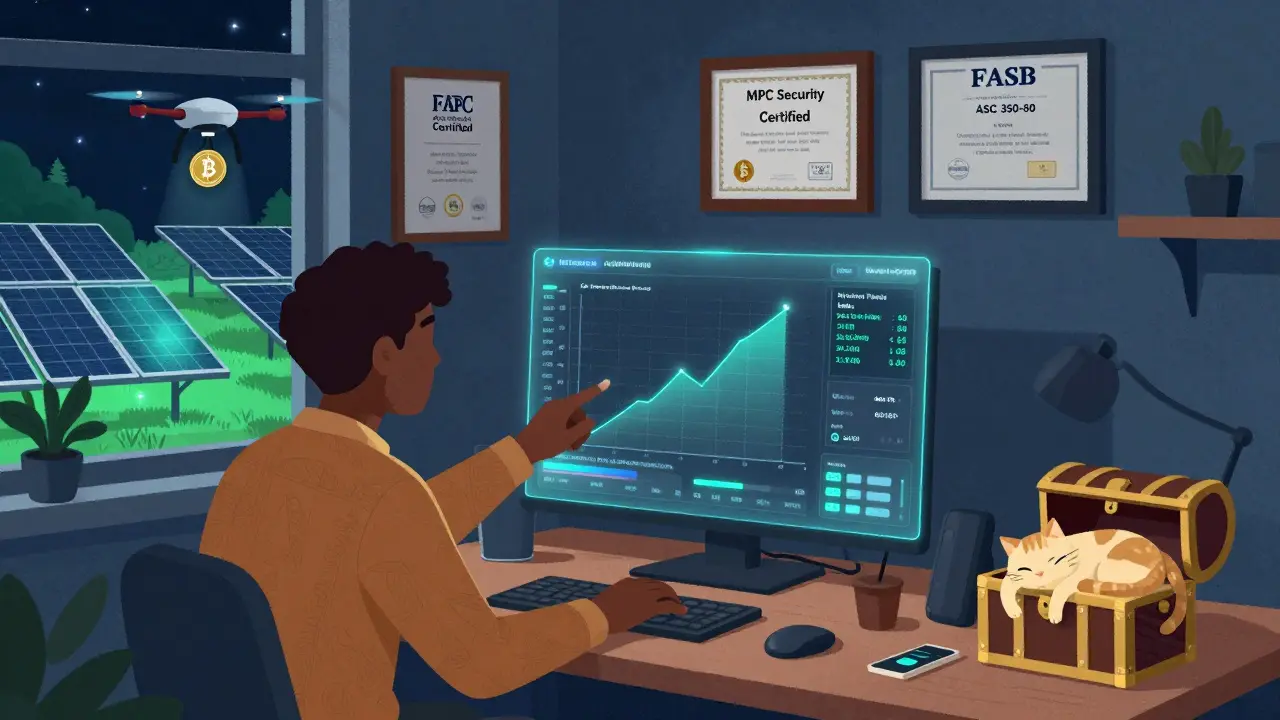
Remember when people stored crypto on exchanges? That’s over. Institutional custody is now the norm. Fireblocks and Copper lead the market with multi-party computation (MPC) wallets - no single private key exists. Even if one employee is compromised, the funds stay safe.
For individuals, hardware wallets are still essential. But even those aren’t enough anymore. Leading users now combine MPC wallets with time-delayed withdrawals (48-hour hold before transfers) and multi-signature approvals from trusted contacts.
And compliance matters. FASB’s ASC 350-60 standard now requires businesses to report digital assets at fair value - not just cost. That means your crypto gains and losses show up clearly on your net income statement. No more hiding behind “I didn’t sell.”
The Road Ahead: What’s Next?
By 2026, crypto portfolio management will look even more like traditional finance. Coinbase and MicroStrategy are expected to join the S&P 500 and Nasdaq-100, respectively. That means index funds - the kind your employer offers - will automatically include crypto exposure. You won’t have to choose. It’ll just be there.
Regulatory clarity is spreading. The U.S. Department of Labor is expected to allow crypto in 401(k) plans by mid-2026. That could unlock $500 billion in new capital. Meanwhile, the SEC and CFTC’s coordinated margining rules will cut capital inefficiencies by 37%, making cross-market strategies possible for the first time.
But risks remain. Outside the U.S., regulatory chaos persists. 63% of institutional investors still diversify geographically - holding assets in Singapore, Switzerland, and Dubai - to avoid jurisdictional shutdowns. And while AI-driven trading is powerful, it’s not infallible. A single flawed algorithm caused a $90 million loss in a DeFi protocol in January 2025. Automation needs oversight.
The future isn’t about getting rich quick. It’s about building durable wealth. Crypto portfolio management in 2026 is no longer about luck. It’s about systems. It’s about data. It’s about discipline.
Is crypto still too risky for a regular portfolio?
It depends on how you manage it. In 2024, passive crypto holdings returned 14.5% annually - less than the S&P 500’s 20%. But actively managed crypto portfolios returned 38.2%. The difference? Strategy. Risk controls. Rebalancing. If you treat crypto like a high-growth stock - with limits, monitoring, and diversification - it can be a solid part of a balanced portfolio. But if you just buy and hope, you’re playing roulette.
Should I use a crypto ETF or manage my own portfolio?
ETFs are great for beginners or hands-off investors. They’re simple, low-cost, and regulated. But they don’t give you access to DeFi, staking, or tokenized assets. If you want to earn yield, participate in governance, or take advantage of AI-driven opportunities, you’ll need to manage your own wallet. Most serious investors do both: 70% in ETFs for stability, 30% in self-managed positions for growth.
What’s the best AI tool for crypto portfolio management in 2026?
Token Metrics leads in predictive analytics, especially for retail users. Its AI flagged market shifts with 89% accuracy in 2025. For institutions, platforms like Artemis and Chainalysis Institutional offer deeper on-chain analytics and compliance tools. The best tool isn’t the most advanced - it’s the one you’ll actually use. Start simple: track your allocations, set rebalance triggers, and use one AI signal per week. Overcomplicating leads to paralysis.
Can I lose money on tokenized real-world assets?
Yes - and that’s the point. Tokenized real estate, bonds, or commodities carry the same risks as their physical counterparts. If the housing market crashes, your tokenized property drops in value. If interest rates rise, bond tokens lose yield. The blockchain doesn’t eliminate risk - it just makes it more transparent. That’s why 68% of institutional investors now pair RWA exposure with traditional asset classes to hedge.
How do I start managing a crypto portfolio in 2026?
Step 1: Define your goals. Are you saving for retirement? Building wealth? Generating income? Step 2: Pick one core asset - Bitcoin or Ethereum - and allocate 50% of your crypto budget to it. Step 3: Use a simple dashboard like CoinTracker or Delta to track everything. Step 4: Set a 5% rebalance rule. Step 5: Learn one new metric per month - NVT, Realized Profit/Loss, or Miner Position Index. Don’t try to master everything at once. Progress beats perfection.
christopher luke
February 23, 2026 AT 08:51Mary Scott
February 25, 2026 AT 01:34Andrew Hadder
February 25, 2026 AT 02:17Sean Logue
February 26, 2026 AT 13:47Amita Pandey
February 27, 2026 AT 05:50Dianna Bethea
February 28, 2026 AT 16:14Phillip Marson
March 2, 2026 AT 02:06Alyssa Herndon
March 2, 2026 AT 06:23Ifeanyi Uche
March 3, 2026 AT 03:35Elana Vorspan
March 3, 2026 AT 05:57Kenneth Genodiala
March 4, 2026 AT 18:03Michael Rozputniy
March 6, 2026 AT 02:24Danny Kim
March 7, 2026 AT 03:35Cathy Sunshine
March 7, 2026 AT 20:40Tanvi Atal
March 9, 2026 AT 10:40Sony Sebastian
March 9, 2026 AT 15:28Brian Lemke
March 10, 2026 AT 16:47