

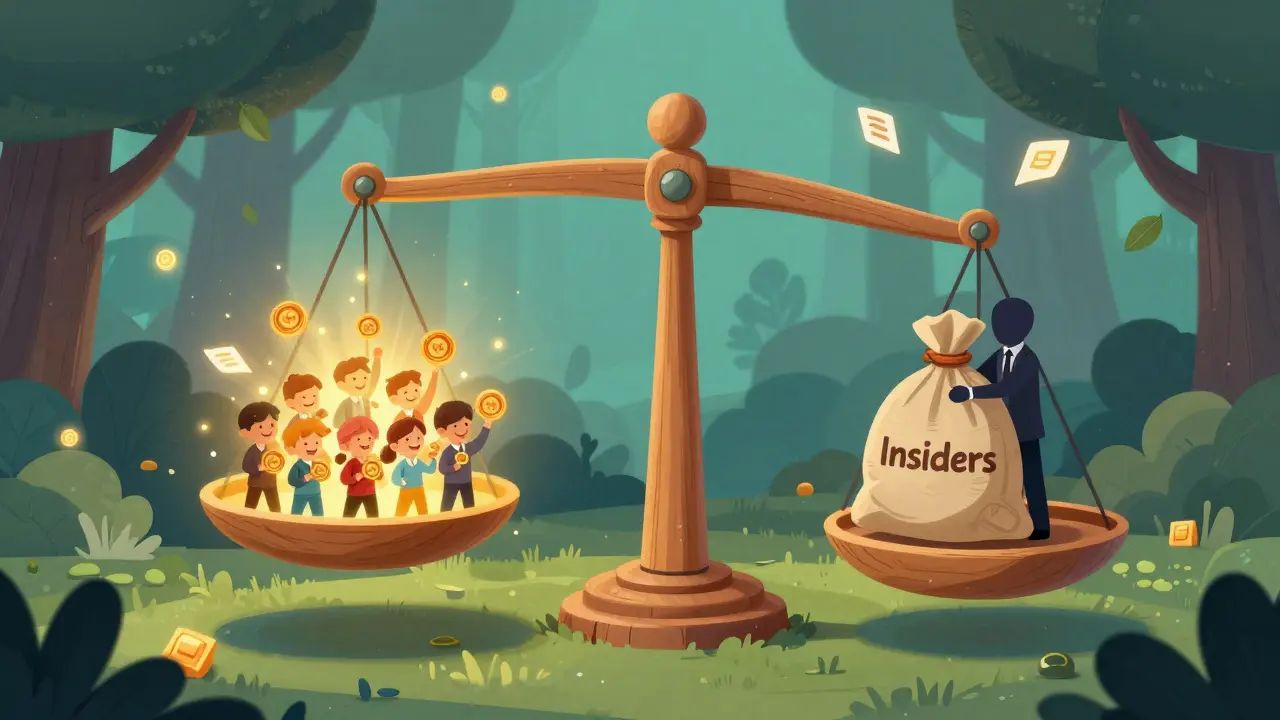
When a blockchain project wants to become truly decentralized, it doesn’t just launch a token-it launches a governance system. Governance tokens aren’t just digital assets; they’re voting rights. They let users decide how a protocol evolves: what fees to charge, how to spend its treasury, even whether to merge with another protocol. But here’s the catch: if you give too many tokens to a few insiders, the whole thing becomes centralized again. If you give them out too freely, the token’s value crashes. Getting this balance right is the hardest part of building a lasting Web3 project.
Why Distribution Matters More Than the Token Itself
A governance token only works if people actually use it to vote. But in 2025, the average participation rate in DAO votes is still below 15%. Why? Because most holders don’t feel invested. They bought the token hoping to flip it, not to shape the future of a protocol. That’s why distribution strategy isn’t a footnote-it’s the foundation. Take Uniswap’s 2020 airdrop. Instead of selling tokens to venture firms, they gave 400 UNI to every wallet that had swapped tokens on their platform before September 2020. That wasn’t charity. It was a filter. It excluded speculators and rewarded actual users. The result? Over 250,000 unique addresses received tokens, and 92% of them held less than 1% of the total supply. That’s what real decentralization looks like. Compare that to EOS in 2018. Their tokens were mostly sold to a handful of exchanges and whales. Within six months, 40% of the voting power was controlled by just 10 entities. The community had no real say. The protocol stalled. Governance tokens without fair distribution are just expensive lottery tickets.The Five Standard Allocation Pools
Most successful governance token projects split their supply into five buckets. These aren’t arbitrary-they’re tried-and-tested. Here’s what the top protocols use as of 2025:- Community (30-50%): This is where you win or lose. Airdrops, liquidity mining, and user rewards go here. Uniswap allocated 42% to its community. MakerDAO uses 40% to incentivize MKR holders and liquidity providers.
- Investors (15-20%): VCs and private buyers get this slice. But they don’t get instant access. Vesting schedules lock their tokens for 1-4 years. If they get 20% with no cliff, they’ll dump everything on day one.
- Team (10-15%): Founders and developers. Vesting here is non-negotiable. A 4-year schedule with a 12-month cliff is standard. If your team gets 15% with no vesting, you’re setting yourself up for a rug pull.
- Ecosystem & Reserves (20-25%): This is your war chest. Used for future grants, partnerships, and emergencies. MakerDAO’s reserve fund paid for its $100M bailout of the DAI peg in 2023.
- Advisors (2-5%): Legal, technical, and industry experts. Often tied to performance milestones.
Paid vs. Unpaid Distribution: The Trade-Offs
There are two main ways to get tokens into people’s hands: pay for them, or give them away.Paid models (private sales, SAFTs, public launchpads) raise capital fast. They’re clean from a legal standpoint-especially after the 2023 SEC v. Ripple ruling clarified how token sales can comply with securities law. But they concentrate power. Terraform Labs’ 2022 collapse showed what happens when 60% of tokens go to insiders. When the price dropped, those insiders had no incentive to stabilize the system-they’d already cashed out.
Unpaid models like airdrops and liquidity mining are more democratic. Uniswap’s airdrop created 250,000 stakeholders. Compound’s 2020 COMP distribution gave out 2,880 tokens per day to liquidity providers, turning users into defenders of the protocol.
But unpaid models have a dark side: farming bots. Balancer’s 2020 airdrop was hijacked by bots that claimed 37% of tokens by creating fake wallets. They didn’t use the protocol-they just exploited the rules. The fix? Use on-chain activity as a filter. Only reward wallets that held ETH or traded on your platform for at least 6 months. Don’t reward addresses that just appeared on the day of the drop.
Vesting: The Silent Guardian of Decentralization
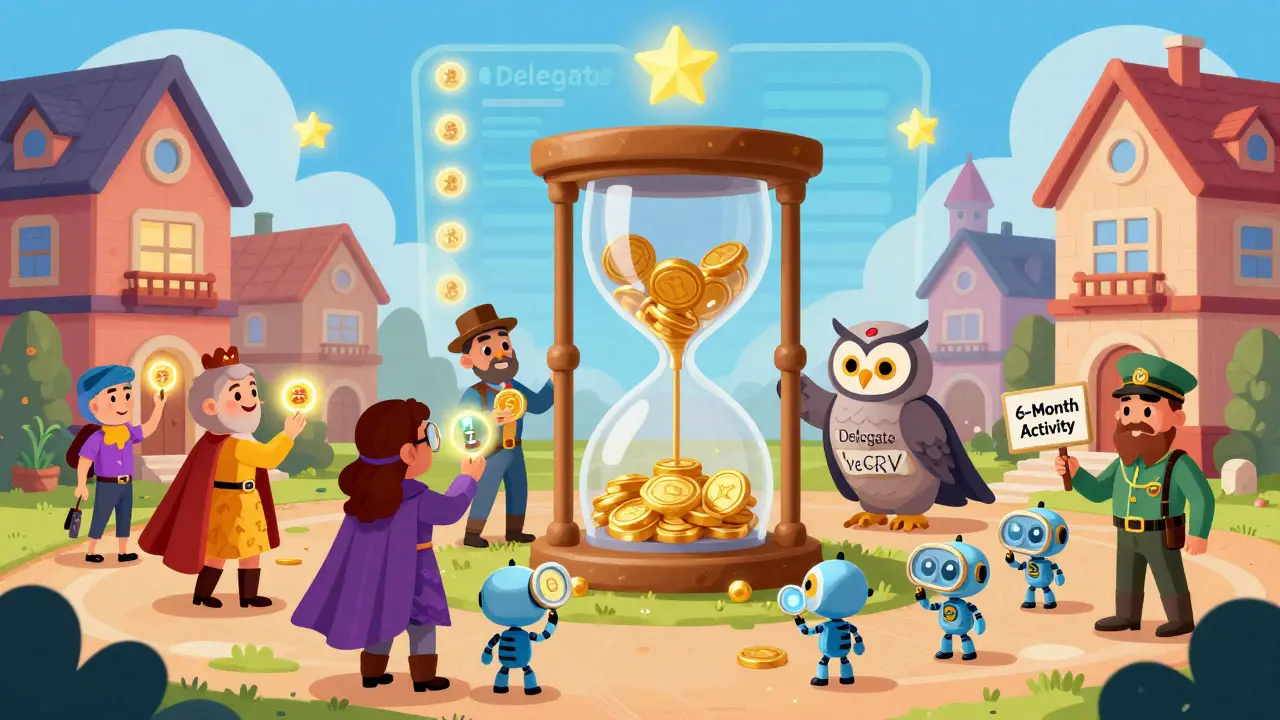
Vesting isn’t sexy. But it’s what keeps a project from blowing up.Imagine a founder gets 10% of the token supply. If they can sell it all on day one, why would they care if the protocol succeeds next year? That’s why vesting exists. The standard is a 12-month cliff, then linear unlocks over 3-4 years. Uniswap’s team and investor tokens had a 12-month cliff. No tokens unlocked until a year after launch. That gave the team time to build, not cash out.
Some projects go further. Aave’s AAVE tokens for early contributors have a 5-year vesting schedule. MakerDAO’s MKR team allocation unlocks in quarterly tranches over 4 years. This isn’t punishment-it’s alignment. It tells everyone: we’re in this for the long haul.
How to Prevent Whale Dominance
Even with fair distribution, a few big wallets can still control votes. That’s why top protocols use three tools:- Delegation: Uniswap lets holders assign their voting power to trusted delegates. In 2025, 78% of UNI voting power was delegated to 12 active community members. This turns 250,000 small holders into one powerful voice.
- Vote-escrowed tokens: Curve’s veCRV model lets users lock their CRV tokens for up to 4 years. In return, they get 2.5x voting power. This rewards long-term commitment, not short-term speculation.
- Quadratic voting: Aave is testing this in Q3 2025. Instead of one vote per token, you pay a cost that increases with each additional vote. One vote costs 1 token. Ten votes cost 55 tokens. This stops whales from buying 10,000 votes. It’s math that protects democracy.
Steemit’s failure in 2021 is a warning. The top 20 accounts controlled 51% of voting power. The community lost trust. The platform died. Governance isn’t about who has the most tokens-it’s about who has the most stake in the outcome.
Legal Landmines You Can’t Ignore
As of January 2026, the regulatory landscape is split. The EU’s MiCA framework says governance tokens are only financial instruments if they promise profit. The SEC says they’re securities unless distributed to at least 5,000 unaffiliated holders who control 75% of voting power.That means if you’re targeting U.S. users, you need to:
- Avoid selling tokens to non-accredited investors
- Use KYC/AML checks on all sales over $1,000
- Make sure your airdrop targets real users, not bots
Projects like Uniswap and Aave now have separate distribution strategies for U.S. and international users. One airdrop for the world. A different, legally compliant one for Americans. It’s messy, but it’s necessary.
Don’t assume your lawyer knows blockchain. Most don’t. Hire a firm like Perkins Coie or LegalNodes that’s handled DAO token launches before. Skipping this step can get your project shut down-or worse, lead to personal liability.
What Works in 2026: The Hybrid Model
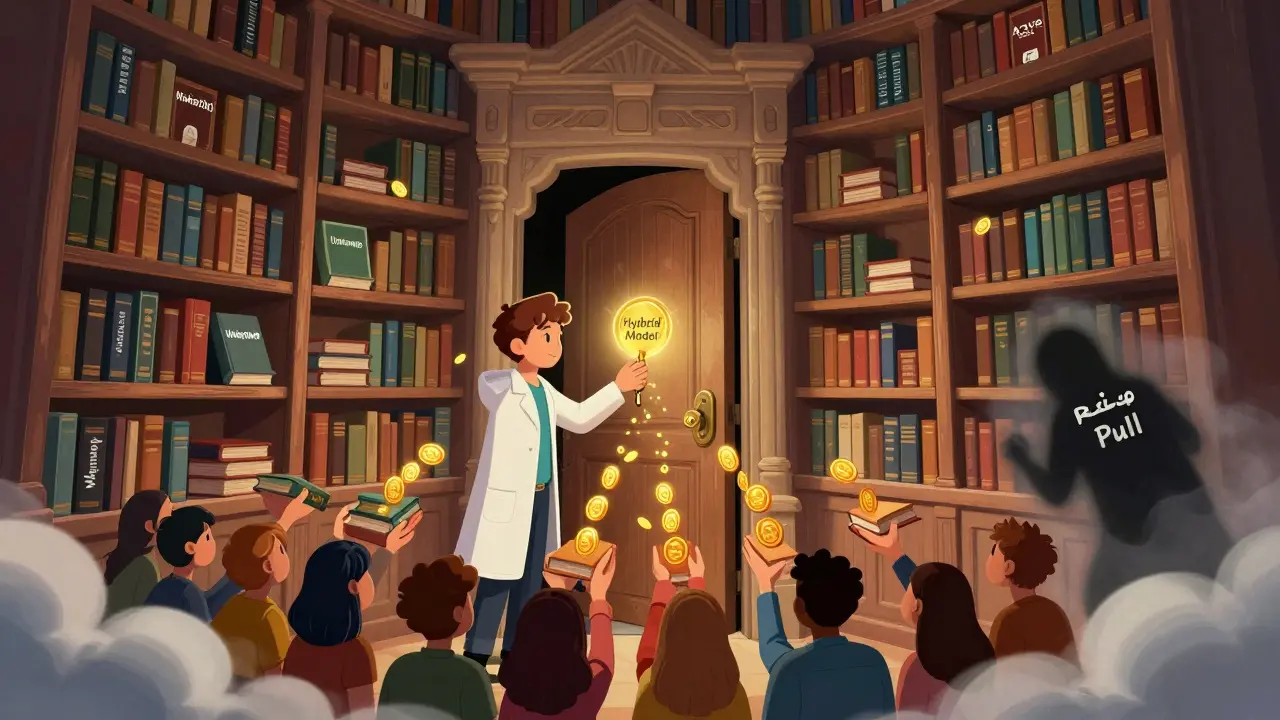
The best governance token strategies today aren’t pure airdrops or pure sales. They’re hybrids.MakerDAO’s approach is the gold standard:
- 2017-2018: Private sales to strategic partners (20% of supply)
- 2019-2021: Liquidity mining and community incentives (40%)
- 2022-present: Ongoing revenue sharing-10% of protocol fees go to MKR holders
That’s not a one-time event. It’s a living system. The more the protocol earns, the more value flows back to its users. That’s sustainable.
Curve’s veCRV model is another winner. Lock your CRV, earn more voting power, and get a share of trading fees. It turns passive holders into active participants.
The future? Progressive decentralization. Start with a concentrated distribution to fund development, then slowly shift power to the community over 2-3 years. That’s what Messari calls the “endgame” model-and it’s working.
Common Mistakes (And How to Avoid Them)
- Too much to the team: If your team gets more than 15%, you’re not decentralized. Keep it at 10-12%.
- No vesting: If your team or investors can sell immediately, you’re inviting a crash.
- High proposal thresholds: MakerDAO requires 10,000 MKR to submit a proposal. That’s over $20 million. It excludes 92% of holders. Lower it to 100 MKR. Let real users participate.
- Ignoring vote apathy: If less than 10% vote, your governance is broken. Use delegation. Use quadratic voting. Use incentives.
- Using centralized voting tools: Snapshot is great for off-chain voting-but it’s not on-chain. If your governance relies on Snapshot alone, you’re vulnerable to manipulation. Always pair it with on-chain execution.
Final Checklist for Your Token Distribution
Before you launch:- ✅ Define your goal: Are you raising capital? Or building community?
- ✅ Allocate no more than 25% to insiders (team + investors)
- ✅ Use 12-month cliffs and 3-4 year vesting for team and investors
- ✅ Reserve 30-50% for community via on-chain activity, not random airdrops
- ✅ Implement delegation or vote-escrowed tokens to reduce whale influence
- ✅ Get legal review from a firm experienced in Web3 securities law
- ✅ Use Snapshot + on-chain execution for voting
- ✅ Plan for ongoing incentives-tokens should earn, not just vote
Governance tokens aren’t about giving away free money. They’re about building a society. And like any society, it needs rules, fairness, and accountability. Get the distribution right, and your protocol can last decades. Get it wrong, and you’ll be another footnote in blockchain’s history of failed promises.
What’s the difference between a governance token and a utility token?
A utility token gives access to a service-like paying for storage on Filecoin or computing power on Render. A governance token gives voting rights. You can propose changes, vote on upgrades, or elect delegates. Some tokens, like UNI and MKR, do both: they’re used for fees and governance. But if a token has no voting power, it’s not a governance token.
Can I distribute governance tokens without a sale?
Yes. Many top protocols, like Uniswap and Aave, started with airdrops or liquidity mining instead of sales. But you still need to raise capital somehow. That’s why most use a hybrid: a small private sale to fund development, then community rewards to grow adoption. Pure airdrops without any funding usually fail because the team can’t pay for audits, legal, or development.
How do I prevent airdrop farming?
Use on-chain behavior as a filter. Only reward wallets that have interacted with your protocol for at least 6 months. Track unique addresses, not just transactions. Use tools like Nansen or Dune Analytics to detect bot wallets. Some projects now require KYC for airdrop claims. Others use proof-of-humanity systems like BrightID to verify real users.
Why do some governance tokens have inflation?
Inflation keeps the system alive. If you give out all your tokens upfront, you have nothing left to reward new users. MakerDAO, for example, mints new MKR tokens to cover bad debt. Aave and Uniswap distribute new tokens as rewards for liquidity provision. The key is to keep inflation below 2% per year. Above that, token value erodes. Below that, you can still incentivize growth without crashing the price.
What happens if no one votes on proposals?
If quorum isn’t met, the proposal fails. That’s by design. It prevents rogue actors from pushing through changes with low participation. But if this happens often, your governance is broken. Fix it by lowering proposal thresholds, using delegation, or adding incentives like fee shares for voters. Aave saw participation jump from 8% to 22% after introducing voting rewards.
Are governance tokens regulated as securities?
It depends. The SEC says yes if they’re sold with the expectation of profit and lack meaningful governance rights. But if tokens are distributed broadly to users who actively participate in governance-like Uniswap’s airdrop-they’re less likely to be classified as securities. The key is distribution and function. If 5,000+ unaffiliated holders control 75% of voting power, you’re likely safe under the SEC’s 2024 framework.
Ritu Singh
January 6, 2026 AT 23:16They say decentralization but really it's just a new way for the same elite to control everything under a fancy blockchain label
Uniswap's airdrop? Sure, 250k addresses... but how many of those were real people vs. burner wallets made by devs in their basement?
They want you to believe in democracy but the voting power is still concentrated in the hands of a few who've been in the game since 2017
It's not governance-it's theater with smart contracts
Gideon Kavali
January 7, 2026 AT 22:50Let me be perfectly clear: if you're distributing governance tokens without SEC compliance, you're not building a decentralized future-you're committing financial terrorism against American investors!
Uniswap's airdrop? Illegal under U.S. securities law-period.
The SEC didn't just 'clarify' things in 2023-they drew a red line, and anyone ignoring it is either naive or malicious.
And don't get me started on 'quadratic voting'-that's socialist math disguised as innovation.
Real freedom is private ownership, not voting on DAO proposals while your wallet gets audited by bureaucrats.
Wake up, America-this isn't Web3, it's WebCommunism.
Allen Dometita
January 9, 2026 AT 11:00Bro this is actually super cool 😎
Like imagine if your favorite app let you vote on new features instead of just hoping they listen
Uniswap giving tokens to real users? That’s genius
Not to the whales, not to the VCs-just to the people who actually used it
And the vesting thing? So smart
Team can’t just cash out and run
That’s how you build trust
Also veCRV? Love it
Lock your tokens, get more power, get paid
It’s like a savings account that also lets you run the bank 🤯
greg greg
January 11, 2026 AT 00:17It's interesting how the entire discourse around governance token distribution assumes that participation is inherently desirable, but what if the majority of users don't actually want to govern? What if they simply want to transact, to use the protocol as a tool without being burdened by the psychological weight of political engagement?
Furthermore, the notion that delegation or vote-escrowed tokens 'solve' whale dominance ignores the structural reality that power gravitates toward those with the most time, knowledge, and social capital-regardless of token distribution mechanics.
Quadratic voting may mathematically reduce inequality, but it doesn't address the epistemic hierarchy that emerges when governance becomes a specialized skill rather than a universal right.
And let's not pretend that on-chain execution eliminates manipulation-Snapshot may be off-chain, but the real vulnerability lies in the oracle systems that feed data into the voting mechanism, which are often centralized by design.
Perhaps the real question isn't how to distribute tokens fairly, but whether governance itself should be a function of the protocol at all, or whether it should be outsourced to a separate, non-financialized institution entirely.
LeeAnn Herker
January 11, 2026 AT 09:16Oh wow, so we're pretending that giving tokens to people who swapped on Uniswap before 2020 means it's 'decentralized'?
How cute.
Meanwhile, the same team still controls the multisig, the dev fund, and the upgrade keys
And the 'community' votes? They're just voting on proposals written by the core team
It's like democracy where the president writes all the ballots
And don't even get me started on the 'legal compliance' stuff
You think the SEC cares about your 5,000 unaffiliated holders?
They're just waiting for the next rug pull to make headlines
And you're out here praising airdrops like they're a moral victory
Meanwhile, your wallet is just a pawn in a game designed to make insiders rich
Wake up, sheeple.
Sherry Giles
January 12, 2026 AT 03:52Canada’s doing it right-we don’t need American-style token capitalism
Real decentralization isn’t about who votes-it’s about who owns the infrastructure
Why should a bunch of anonymous devs in Silicon Valley get to decide how our financial systems work?
And what’s with this ‘vesting’ nonsense?
If your team can’t wait 4 years to get paid, they shouldn’t be building a protocol
Also-why is everyone ignoring that 80% of these DAOs are run by the same 30 people?
It’s not democracy-it’s a club
And the airdrops? Just PR for people who already had money
Real users? They’re still paying gas fees while the whales vote on fee changes
Caitlin Colwell
January 13, 2026 AT 09:56Really appreciate how you laid this out
It’s easy to get lost in the jargon
But the core idea-fair distribution as the foundation-is simple
And the part about delegation? That’s the quiet hero of Web3 governance
Letting people who don’t have time to vote still have a voice
That’s human
Not tech
Just… thank you
Charlotte Parker
January 14, 2026 AT 00:29Of course the article praises Uniswap’s airdrop
It’s the same people who told us DeFi was ‘permissionless’ while they held 60% of the supply
And now they want us to believe that vesting schedules are the answer?
Let me laugh
Every ‘fair’ distribution model is just a new way to disguise control
They call it democracy but it’s still a pyramid scheme with a DAO logo
And quadratic voting? Cute
As if math can fix human greed
Wake up
There is no decentralization
There’s only better branding
Calen Adams
January 15, 2026 AT 06:18Bro this is the blueprint right here
Community pool at 40%? Yes
Team vesting with 12-month cliff? Non-negotiable
veCRV model? Absolute flex
And the kicker? Ongoing revenue sharing
That’s the real secret sauce
Not just voting power-actual yield
When your tokens earn you fees, you stop treating them like lottery tickets
You start caring
And that’s the only way this shit lasts
Also-quadratic voting is the future
Whales can’t just buy 10k votes
It’s elegant
It’s fair
It’s the only way to scale democracy without turning into a shitshow
Valencia Adell
January 15, 2026 AT 20:08Let’s cut through the fluff.
90% of these protocols are insolvent in all but name.
Uniswap’s ‘community’? 250k addresses-but 80% of them hold less than $20 worth of UNI.
That’s not decentralization-that’s dust.
Meanwhile, the top 0.1% control 60% of voting power.
And the ‘reserves’? A slush fund for insiders to fund their next project.
Every ‘successful’ model is just a rebrand of the same Ponzi logic.
They call it governance.
We call it a liquidity trap with a ballot.
Sarbjit Nahl
January 16, 2026 AT 09:07One must question the underlying assumption that governance token distribution is the primary determinant of decentralization
Consider the case of Ethereum-its governance is not token-based yet remains robust
Token distribution may influence participation, but institutional structure, developer consensus, and social coordination are far more critical
Furthermore, the notion that 30-50% community allocation guarantees fairness ignores the asymmetry of information and access
Whales still acquire tokens through private channels, front-running airdrops, or manipulating liquidity mining
True decentralization requires not just distribution, but epistemic equity
And that cannot be achieved through token mechanics alone
Paul Johnson
January 18, 2026 AT 05:57Why do people keep falling for this?
They give tokens to users but the devs still control everything
And the vesting? Just a delay tactic
They’ll dump anyway
And don’t even get me started on delegation
Who are these ‘trusted delegates’?
Same people who run the project
It’s all theater
Real decentralization means no one has control
Not 12 people with 78% of the votes
And the SEC stuff?
They’re just scared
They don’t want you to have power
So they make you jump through hoops
But the truth?
It’s all rigged
Meenakshi Singh
January 20, 2026 AT 04:31Okay but let’s be real-how many of these airdrops even reach real people?
Most of the wallets getting tokens are bots or dev wallets with 100+ addresses
And the ‘on-chain activity’ filter? Easy to fake with flash loans
Plus-why is everyone ignoring that most DAO voters are just bots or whales with voting bots running 24/7?
And the ‘community’? They’re just holding because they got free tokens
They don’t care about governance
They care about the next pump
So yeah-this whole system is built on a lie
And we’re all just pretending it works
Jessie X
January 21, 2026 AT 11:07It’s refreshing to see someone actually talk about delegation
So many people think governance means everyone votes on everything
But that’s not how real communities work
People have lives
They don’t want to read 50-page governance docs
Delegation lets them trust someone who does
And that’s okay
It’s not perfect
But it’s the closest we’ve gotten to real participation
Also-thank you for mentioning Snapshot
So many forget it’s just a frontend
On-chain execution is what matters
Kip Metcalf
January 22, 2026 AT 11:31Y’all are overthinking this
Just give tokens to people who use the thing
Lock the team’s tokens
Let the community vote
And if no one votes? Then the proposal dies
Simple
Stop trying to engineer democracy
Just make it fair
And let people decide
That’s it
That’s the whole thing
Frank Heili
January 24, 2026 AT 07:15One thing the article misses: the role of tokenomics in shaping voter behavior
When tokens are inflationary, voters have an incentive to vote for proposals that increase supply-because their holdings gain value from dilution
When tokens are deflationary, voters prefer proposals that reduce supply-even if it harms protocol growth
So the distribution model isn’t just about fairness-it’s about aligning incentives with long-term protocol health
And that’s why revenue-sharing models like MakerDAO’s are so powerful
They turn governance into an economic activity, not a political one
People vote not because they ‘care’-they vote because it pays
Mujibur Rahman
January 26, 2026 AT 05:22From the UK, I’ve watched this whole thing unfold
What’s missing in most discussions is cultural context
Western models assume individual participation
But in many cultures, collective decision-making is the norm
Delegation isn’t just a technical fix-it’s a cultural bridge
And the idea that ‘more voters = better democracy’? That’s American exceptionalism
Some communities prefer consensus over voting
Some don’t want to vote at all
Maybe the real innovation isn’t in the token model-but in designing governance that respects cultural diversity, not just token distribution
Dave Lite
January 27, 2026 AT 16:38Just want to say-this is the clearest breakdown I’ve seen
And the vesting part? So important
So many projects fail because the team bails after launch
But if your team’s locked in for 4 years?
You know they’re in it
Also-love the veCRV mention
Locking tokens to get more power? Genius
It turns HODLers into stakeholders
Not speculators
And the legal stuff? Yeah
Don’t skip the lawyer
Even if you think you know blockchain
Most lawyers don’t
But the ones who do? They’re worth every penny
Thanks for this
Becky Chenier
January 28, 2026 AT 18:35Interesting take on the hybrid model
But I wonder-does starting with concentrated distribution undermine the goal of decentralization from the outset?
If the foundation is built on insider control, even gradual shifts to community governance feel like concessions rather than rights
Is true decentralization possible if it’s granted, not inherited?
Just thinking aloud
jim carry
January 29, 2026 AT 14:38Let me just say-this is the most dangerous thing I’ve read all year
They’re giving people voting rights
And they think that makes it democratic
But what happens when the people vote to shut down the protocol?
What happens when the community votes to stop paying the devs?
What happens when the users decide they don’t want to pay fees anymore?
You think the team will just sit there and let it happen?
No
They’ll change the code
They’ll fork it
They’ll relaunch as a new token
And call it ‘improved’
Don’t be fooled
This isn’t democracy
This is a trap
Veronica Mead
January 29, 2026 AT 19:13It is imperative to note that the entire premise of governance token distribution is predicated upon a flawed epistemological framework: that economic participation equates to political legitimacy.
This is a dangerous conflation.
Ownership of a financial instrument does not, nor can it, confer moral or civic authority.
Furthermore, the normalization of token-based governance in the absence of legal personhood, liability structures, or constitutional safeguards renders such systems inherently unstable and legally precarious.
One cannot construct a polity upon the foundation of speculative capital.
It is not merely misguided-it is ontologically incoherent.
Mollie Williams
January 31, 2026 AT 08:38What if the real question isn’t how to distribute tokens-but whether governance should exist at all?
What if the protocol’s value lies not in who votes, but in how reliably it functions?
Maybe the most decentralized system is the one that needs no votes at all
Where rules are baked in, immutable, and self-enforcing
Where the only ‘governance’ is the code itself
And the tokens? Just a way to pay for usage
Not to rule
Maybe we’ve been asking the wrong question this whole time
Not ‘how do we make it fair?’
But ‘how do we make it unnecessary?’
Surendra Chopde
February 1, 2026 AT 17:25Good breakdown
But I think we’re missing the biggest point
Most users don’t care about governance
They care about low fees, fast swaps, and uptime
So why are we putting so much energy into voting mechanics?
Maybe the real solution is to automate governance
Let the protocol self-adjust based on usage data
And only let humans vote on major forks or emergencies
Not every fee change
Not every parameter tweak
Just the big stuff
Everything else? Code it
Tiffani Frey
February 3, 2026 AT 15:01Thank you for including the legal nuances-so many overlook this
But I’d add: even if you comply with MiCA and SEC rules, you’re still vulnerable to jurisdictional arbitrage
One user in the EU, one in the US, one in Singapore-each governed by different rules
And what happens when a DAO proposal passes in one region but violates another’s laws?
Who is liable?
How do you enforce compliance across borders?
Token distribution is just the first layer
The real challenge is building a governance system that can exist in a world of conflicting legal frameworks
That’s the next frontier
Allen Dometita
February 4, 2026 AT 09:33Man I just realized something
Uniswap didn’t just give tokens to users
They gave them a reason to care
Before, you used Uniswap because it was cheap
Now? You use it because you helped build it
That’s the magic
Not the token
Not the voting
But the feeling that you’re part of something bigger
That’s what keeps it alive
Not code
Not rules
But belonging
Frank Heili
February 4, 2026 AT 11:41Exactly
That’s why revenue-sharing is the real game-changer
It’s not just about voting-it’s about earning
When your tokens generate income, you don’t just vote
You defend
You audit proposals
You argue in forums
You recruit others
Because your wallet is on the line
That’s the invisible engine of sustainability
Not democracy
But self-interest aligned with the protocol’s success