

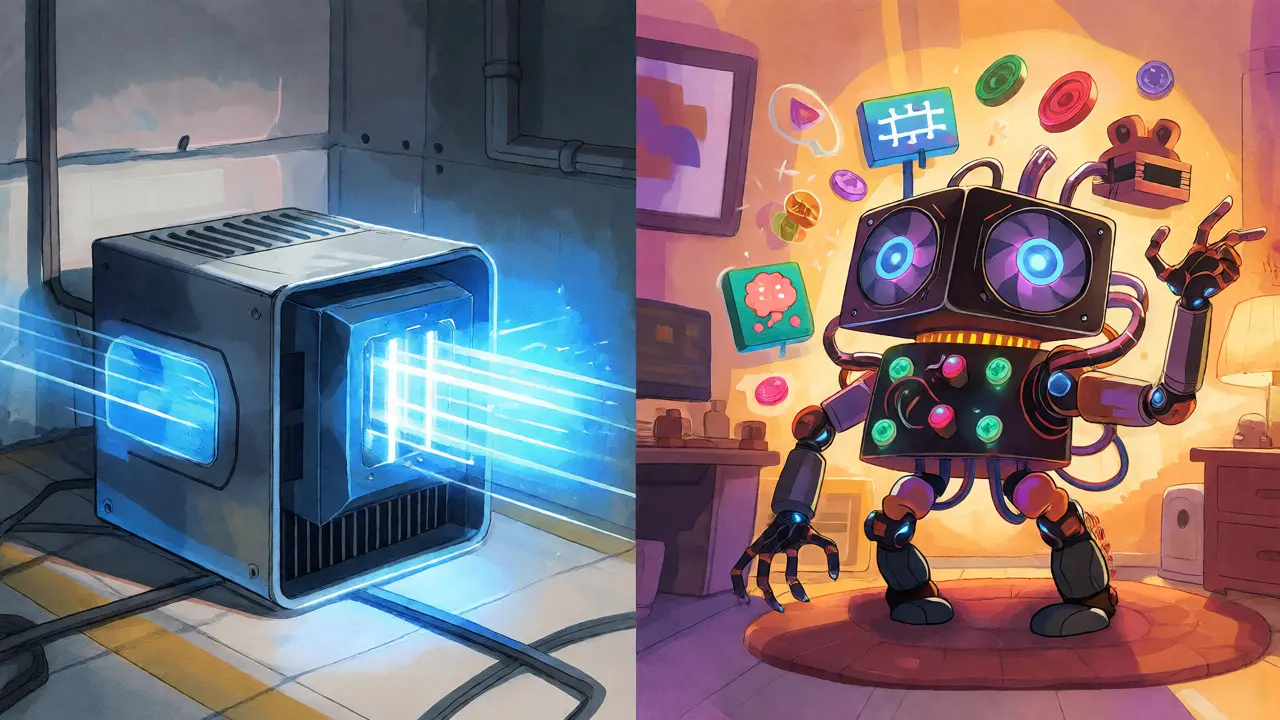
You’ve got the electricity bill. You’ve got the ambition. But do you buy a machine that does one thing perfectly, or a computer that can do ten things decently? This is the core dilemma facing every miner today. ASIC mining and GPU mining are not just different tools; they represent two completely different philosophies of profit generation in the blockchain space.
If you’re looking to mine Bitcoin, you likely need an ASIC. If you want to chase the next big altcoin boom without losing your shirt on obsolete hardware, GPUs are your safety net. The choice isn’t about which technology is "better" in a vacuum-it’s about risk tolerance, capital availability, and what you plan to do with your hardware when the market shifts.
Key Takeaways
- Efficiency vs. Flexibility: ASICs offer superior hash-per-watt efficiency for specific algorithms (like SHA-256) but zero flexibility. GPUs sacrifice raw efficiency for the ability to switch coins instantly.
- Upfront Cost: A single high-end ASIC can cost $3,000-$10,000+. A GPU rig might start at $1,500 but scales incrementally.
- Resale Value: GPUs retain significant value due to demand from gamers and AI developers. ASICs often become e-waste once newer models launch or if their target coin dies.
- Infrastructure Needs: ASICs require industrial-grade cooling and power management. GPUs can run in a spare room with standard household wiring, though noise remains an issue.
- Market Context (2026): With Bitcoin difficulty at historic highs, ASICs remain essential for BTC miners. However, GPU mining thrives on memory-intensive algorithms like Ethash variants and KawPow, where ASIC dominance is lower.
Understanding the Core Technologies
To make the right decision, you need to understand what you’re actually buying. It’s not just a box that makes money; it’s a specialized computer architecture.
Application-Specific Integrated Circuit (ASIC) is exactly what it sounds like: a chip designed for one job only. Imagine a factory stamping out license plates. An ASIC miner cannot play video games, render 3D animations, or mine Ethereum Classic if it was built for Bitcoin. It runs one algorithm-say, SHA-256-with brutal efficiency. Because the circuitry is hardwired for this single task, it consumes less energy per calculation than any general-purpose processor.
On the other side, we have the Graphics Processing Unit (GPU). Originally designed to render pixels for video games, GPUs excel at parallel processing. They can handle thousands of calculations simultaneously. While they are less efficient than ASICs for simple math problems, their programmability allows them to tackle complex, memory-heavy algorithms that resist ASIC optimization.
| Feature | ASIC Miner | GPU Rig |
|---|---|---|
| Primary Use Case | Mining specific coins (BTC, LTC, DOGE) | Mining multiple altcoins, gaming, AI tasks |
| Hash Rate Efficiency | Extremely High (TH/s or GH/s) | Moderate (MH/s) |
| Power Consumption | High absolute draw, low per-hash cost | Lower absolute draw, higher per-hash cost |
| Initial Investment | $3,000 - $10,000+ per unit | $300 - $800 per card (scalable) |
| Lifespan & Obsolescence | Short (12-24 months competitive life) | Longer (can be repurposed) |
| Noise Level | Very Loud (Industrial jet engine sound) | Moderate (Fan noise manageable) |
The Profitability Equation: Hashrate and Power
Profitability in mining comes down to three variables: the price of the coin, the network difficulty, and your electricity cost. Your hardware determines how much work you can do for every dollar spent on power.
Let’s look at real-world numbers from late 2025 and early 2026. The Bitmain Antminer S21 Hydro, a top-tier Bitcoin ASIC, generates approximately 335 TH/s while consuming 5,360 watts. That’s a massive amount of heat and power, but it crushes competition in the SHA-256 algorithm space. Compare this to a modern GPU like the NVIDIA RTX 4090, which might pull 450 watts but produces significantly fewer hashes for Bitcoin-specific tasks (in fact, it’s useless for Bitcoin).
However, flip the script to an algorithm like Ethash (used by Ethereum Classic) or KawPow (Ravencoin). Here, GPUs shine because these algorithms are memory-hard. They require large amounts of fast VRAM to store datasets that change frequently. ASICs struggle here because adding enough memory to keep up with changing data becomes too expensive and inefficient. For these coins, a rig of six GPUs will often outperform a single ASIC in terms of return on investment during bull markets.
Here is the rule of thumb: If the algorithm is simple and static (like SHA-256), ASICs win. If the algorithm is complex and memory-dependent, GPUs win.
Flexibility: The Hidden Advantage of GPUs
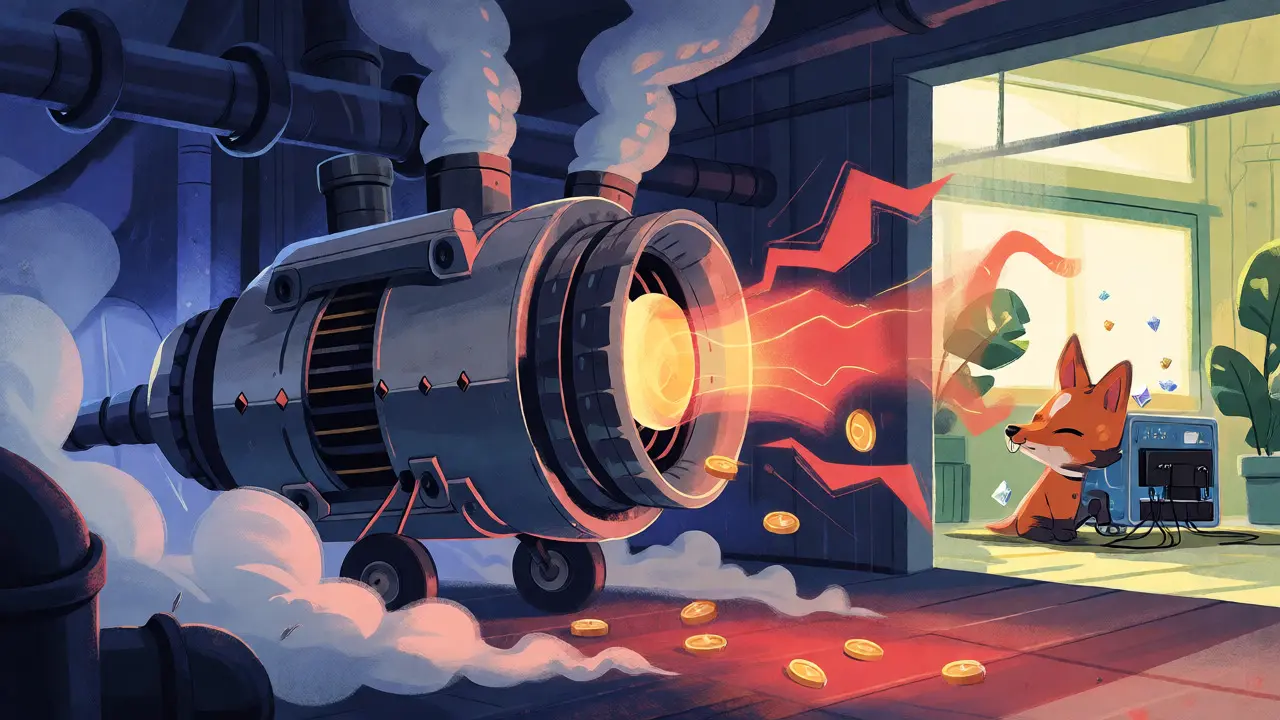
This is where most new miners underestimate the risk of ASICs. When you buy an ASIC, you are betting on one cryptocurrency. If you buy a Scrypt ASIC for Litecoin, and suddenly everyone switches to a new algorithm, your $5,000 machine becomes a paperweight. You can’t update its firmware to mine Bitcoin. You can’t use it for anything else. Its resale value plummets immediately.
GPUs offer insurance against this volatility. In 2021, many miners used GPUs to mine Ethereum. When Ethereum switched to Proof-of-Stake, those same GPUs didn’t become trash. Miners simply changed their software configuration and started mining Ravencoin, Ergo, or Kaspa. Some even sold their cards to gamers who were desperate for inventory.
In 2026, this versatility is crucial. The crypto landscape changes rapidly. New projects launch with ASIC-resistant algorithms specifically designed to prevent centralization by big mining farms. If you want to participate in these emerging networks, you need the adaptability of a GPU. You can monitor profitability charts daily and switch rigs to whichever coin offers the best margin, all without spending another dime on hardware.
Infrastructure and Operational Challenges
Buying the hardware is only half the battle. Running it is the other half.
ASIC Operations: These machines are loud. We’re talking 75-85 decibels, similar to a vacuum cleaner running constantly next to your ear. They also generate immense heat. You cannot put an Antminer in your bedroom. Most serious ASIC miners operate in dedicated warehouses or basements with heavy-duty ventilation. You need industrial-grade power distribution units (PDUs) and often three-phase electrical connections if you are running more than a few units. Cooling solutions range from air-cooled fans to expensive hydro-cooling systems (like the S21 Hydro mentioned earlier), which add complexity and maintenance costs.
GPU Operations: A GPU rig is essentially a desktop computer with extra graphics cards. It fits under a desk. It’s quieter, though still noticeable. You can build it with standard consumer parts: a motherboard, CPU, RAM, and risers. The setup process involves installing drivers, configuring mining software (like NiceHash, T-Rex, or LolMiner), and tweaking overclock settings to balance power and performance. While more hands-on initially, the infrastructure requirements are far lower. You don’t need a warehouse; a well-ventilated garage works fine.
Which One Should You Choose?
The answer depends entirely on your profile as a miner.
Choose ASIC Mining If:
- You have access to very cheap electricity (under $0.06/kWh is ideal).
- You want to mine established, high-cap coins like Bitcoin, Litecoin, or Dogecoin.
- You have a dedicated space with proper cooling and power infrastructure.
- You prefer a "set it and forget it" approach after initial setup.
- You are comfortable with the risk of hardware obsolescence within 1-2 years.
Choose GPU Mining If:
- You are starting small and want to scale gradually.
- You want to diversify across multiple altcoins to hedge against market crashes.
- You live in an area with moderate electricity costs but lack industrial power options.
- You value the ability to resell or repurpose your hardware for gaming or AI workloads later.
- You enjoy the technical aspect of optimizing drivers and switching algorithms.
The Future Outlook for 2026 and Beyond
The mining industry is splitting into two distinct lanes. On one side, institutional investors dominate ASIC mining. They have the capital for massive facilities and negotiate bulk electricity rates. For them, individual home miners using older ASICs are becoming unprofitable. The trend is toward larger, more efficient ASIC clusters.
On the other side, GPU mining remains the domain of enthusiasts and smaller operations. As long as there are cryptocurrencies that prioritize decentralization over raw efficiency, GPUs will have a role. Developers continue to create algorithms that punish ASICs by requiring high memory bandwidth. Furthermore, the rise of AI has created a dual-market for GPUs. Even if mining profits dip, the demand for powerful graphics cards for machine learning keeps their residual value high. This economic floor makes GPUs a safer long-term asset compared to single-use ASICs.
For the average person in Wellington-or anywhere else-who wants to get involved in mining without risking their life savings, starting with a GPU rig is the logical first step. It teaches you the mechanics of mining, lets you test the waters, and preserves your capital flexibility. Once you’ve mastered the game and found a niche, you can decide if scaling up with ASICs makes sense for your specific goals.
Can I mine Bitcoin with a GPU?
Technically, yes, but practically no. The difficulty of the Bitcoin network is so high that a GPU would consume more in electricity costs than it earns in Bitcoin rewards. ASICs are required for profitable Bitcoin mining.
Which is better for beginners, ASIC or GPU?
GPU mining is generally better for beginners. The upfront cost is lower, the setup is similar to building a PC, and you can easily switch coins if one becomes unprofitable. ASICs require significant infrastructure planning and carry higher financial risk.
Do ASICs last longer than GPUs?
Physically, both can last several years. However, economically, ASICs have a shorter lifespan. They become obsolete quickly as manufacturers release more efficient models. GPUs retain value longer because they can be used for other purposes like gaming or AI processing.
Is GPU mining still profitable in 2026?
Yes, but it depends heavily on the coin. Major ASIC-dominated coins like Bitcoin are out of reach for GPUs. However, memory-intensive altcoins such as Ravencoin, Ergo, and newer Layer-1 blockchains remain viable for GPU miners, especially if electricity costs are reasonable.
How much noise do ASIC miners make?
ASIC miners are extremely noisy, typically producing 75-85 decibels of continuous fan noise. This is comparable to a lawnmower or a busy street. They are generally unsuitable for living spaces unless housed in a soundproofed enclosure or remote facility.