


Imagine sending $100 to a friend using a digital wallet. Now imagine that same $100 gets sent to five different people before the first transaction even confirms. That’s double-spending - and it’s the reason blockchain had to invent consensus mechanisms in the first place. Without them, digital money would be as unreliable as a photocopy of a check. But with consensus, every transaction gets locked in place, not by a bank, but by a network of strangers who have no reason to trust each other. How does that even work?
What Is Double-Spending and Why Does It Matter?
Double-spending happens when someone tries to use the same digital token more than once. In the physical world, this isn’t possible - you can’t hand someone a $20 bill and still have it in your pocket. But digital files? They can be copied. Before blockchain, companies like PayPal or banks acted as middlemen to track who had what. They kept a central ledger and said, “This money is spent - don’t let it be spent again.” Blockchain removes that middleman. It’s a public, distributed ledger. So if there’s no central authority, how do you stop someone from sending the same Bitcoin to two people at once? That’s where consensus mechanisms come in. They’re the rules that make sure every node in the network agrees on what’s real and what’s fake.How Consensus Mechanisms Stop Double-Spending
At its core, a consensus mechanism is a system that forces participants to prove they’re playing by the rules. It doesn’t rely on trust - it relies on cost. The cost of cheating has to be higher than the reward. Here’s how it works in practice:- When a transaction is made, it’s broadcast to the whole network.
- Nodes check if the sender has enough balance and hasn’t already spent that money.
- If the transaction looks valid, it gets grouped with others into a block.
- Validators (miners or stakers) compete or are chosen to add that block to the chain.
- Once added, the block is cryptographically linked to the one before it.
- Other nodes verify the block and accept it only if it follows the rules.
Proof of Work: The Original Lock
Bitcoin uses Proof of Work (PoW). Miners race to solve a cryptographic puzzle. The first one to solve it gets to add the next block and earns new Bitcoin as a reward. The puzzle is hard to solve but easy to verify - that’s the trick. Why does this stop double-spending? Because changing a past transaction means redoing every block after it. And to do that, you’d need more computing power than everyone else combined - over 51% of the network’s total hash rate. That’s called a 51% attack. In practice, it’s nearly impossible. Bitcoin’s network has over 700 exahashes per second. To outpace that, you’d need thousands of the most powerful mining rigs, consuming hundreds of megawatts of electricity. The cost? Billions of dollars. The reward? Maybe a few million in stolen coins - and everyone would know it was you. The coins you stole would crash in value instantly. PoW isn’t perfect. It uses massive amounts of energy. But for what it does - securing a decentralized network without a single point of failure - it’s still the most battle-tested method we have.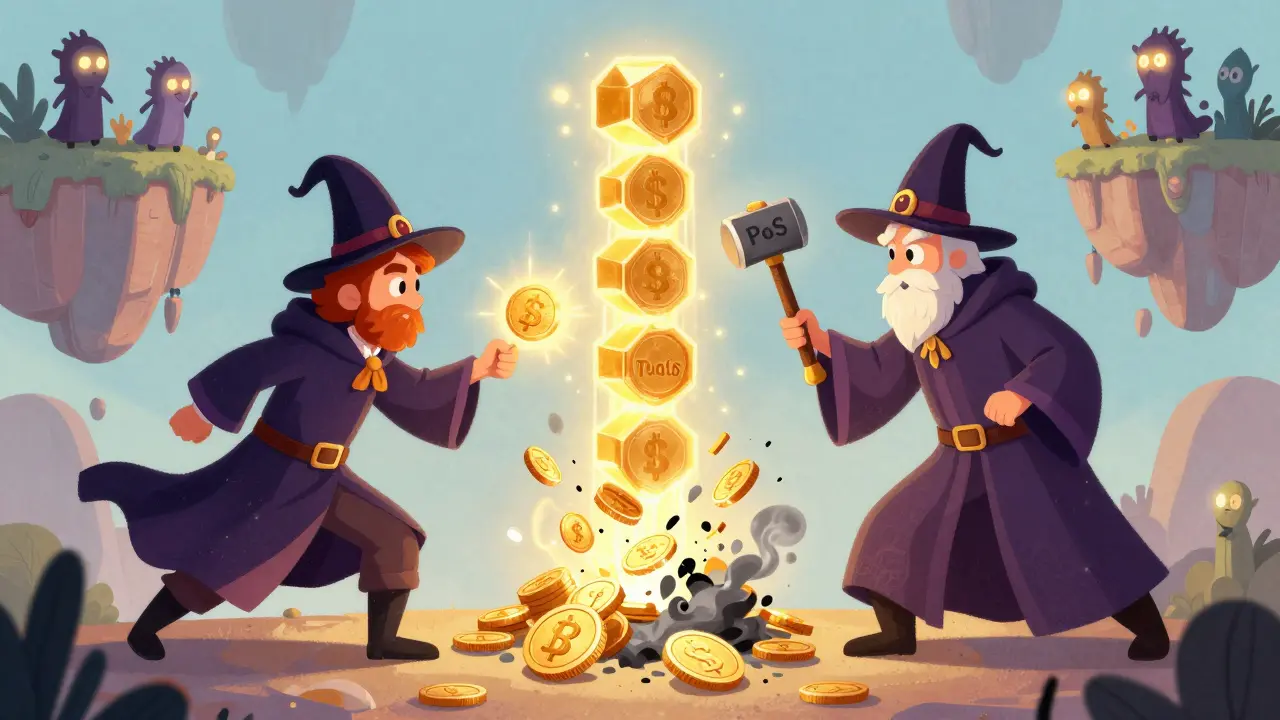
Proof of Stake: The Economic Lock
Proof of Stake (PoS) replaces mining with staking. Instead of using electricity to solve puzzles, validators lock up their own cryptocurrency as collateral. The more you stake, the higher your chance of being chosen to validate the next block. Here’s the catch: if you try to cheat - say, by approving a double-spend - you lose your stake. It’s automatic. The protocol detects dishonest behavior and slashes your tokens. You don’t just lose the reward. You lose the money you put up. Ethereum switched to PoS in 2022. Before that, it used PoW and consumed as much energy as a small country. After the switch, energy use dropped by 99.9%. That’s not just good for the planet - it’s good for security. PoS makes attacks expensive not because of hardware, but because of capital. To launch a successful double-spend on Ethereum’s PoS network, you’d need to own over 33% of all ETH in circulation. At current prices, that’s over $60 billion. And even if you had it, you’d destroy the value of your own holdings. Why would you risk $60 billion to steal $1 million?Delegated Proof of Stake and Hybrid Models
Delegated Proof of Stake (DPoS) takes PoS a step further. Token holders vote for a small group of validators - usually 20 to 100 - who take turns producing blocks. If one of them acts dishonestly, voters can kick them out and replace them. It’s like a digital election with real consequences. Some blockchains go hybrid. Decred combines PoW and PoS: miners create blocks, but stakeholders vote on whether to accept them. Horizen uses PoW for block production and PoS for network security. These hybrid systems add layers of defense. One layer might be easy to attack - but two? Much harder.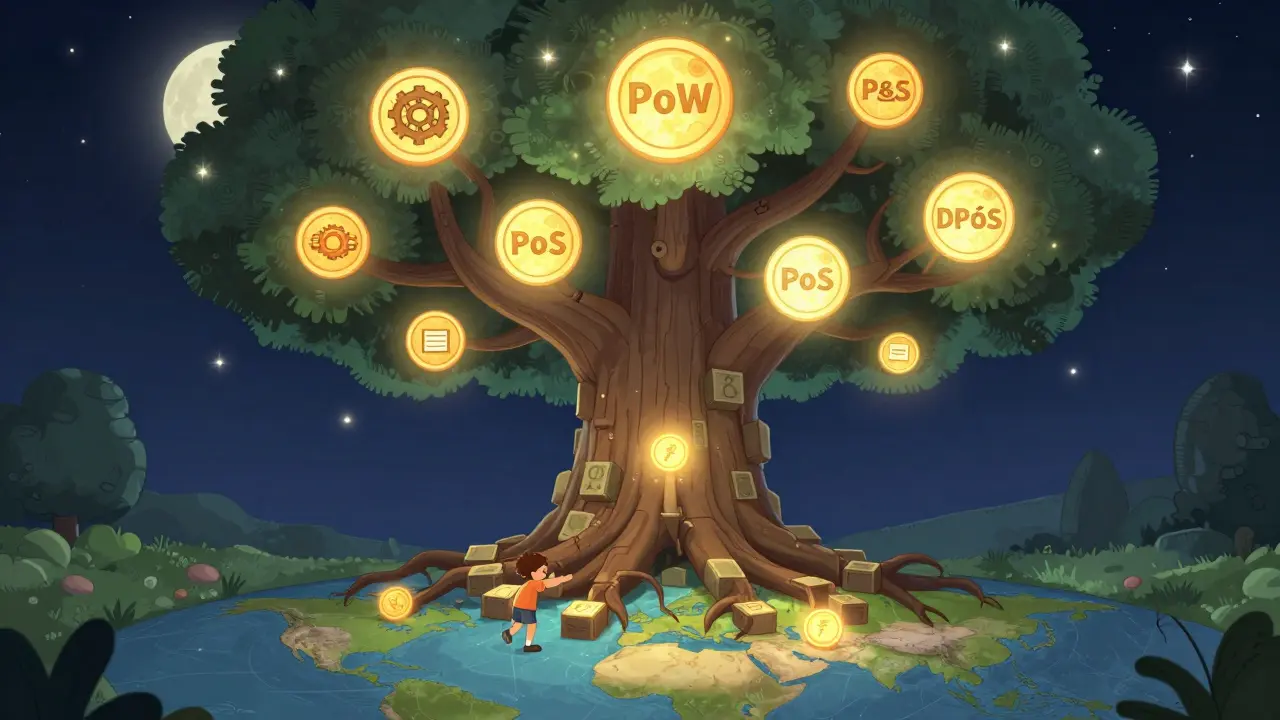
Confirmations: The Time-Based Safety Net
Even with strong consensus, there’s a small window where a double-spend could work - right after a transaction is broadcast but before it’s confirmed. That’s why networks use confirmations. Each time a new block is added on top of the one containing your transaction, it’s called a confirmation. One confirmation? Maybe not enough. Six? That’s the Bitcoin standard for large payments. Why six? Because the deeper a block is in the chain, the harder it is to rewrite. After six blocks, the chance of a successful double-spend drops below 0.0001%. It’s not zero - but it’s close enough that no one has ever pulled it off on Bitcoin’s main network. Other networks have different rules. Some require just one confirmation. Others require 12 or more. It depends on how fast they produce blocks and how much value is at stake.Why Consensus Mechanisms Are Unbeatable
No single technology stops double-spending. It’s the combination that works:- Transaction verification - checks for duplicates before they’re even accepted.
- Immutable blockchain - once written, history can’t be erased without breaking the chain.
- Distributed ledger - thousands of nodes hold copies. If one lies, the others see it.
- Economic penalties - cheat, and you lose money.
- Computational cost - cheat, and you need more power than the whole network.
What’s Next?
Consensus mechanisms are still evolving. Researchers are working on quantum-resistant cryptography because one day, quantum computers might break the math behind today’s blockchains. Layer 2 systems like Lightning Network handle fast, low-cost transactions off-chain, but they still rely on the main chain’s consensus to settle disputes. Central bank digital currencies (CBDCs) are also testing new models - some using permissioned blockchains with centralized validators. But for true decentralization, PoW and PoS remain the gold standards. The future won’t be one consensus mechanism. It’ll be a mix - chosen based on what matters most: speed, security, or sustainability. But no matter the design, the goal stays the same: make double-spending impossible, not because we trust each other - but because it’s too expensive to try.Can double-spending happen on Bitcoin?
Technically, yes - but only if someone controls more than 51% of Bitcoin’s total mining power and spends years building a secret alternate chain. In practice, this has never happened on the main Bitcoin network. The cost of such an attack exceeds $10 billion, while the potential gain is far lower. Bitcoin’s design makes double-spending economically irrational.
Is Proof of Stake safer than Proof of Work?
Both are secure, but in different ways. Proof of Work protects against attacks with computational power - it’s expensive to mine. Proof of Stake protects with economic penalties - it’s expensive to lose your stake. PoS is more energy-efficient and faster, but PoW has been running for over 15 years without a successful 51% attack. Neither is perfect, but both are extremely hard to break.
Why do some blockchains need more confirmations than others?
It depends on block time and network size. Bitcoin creates a block every 10 minutes, so six confirmations take about an hour - giving attackers little time to reverse the transaction. Networks like Solana or Polygon produce blocks in seconds, so they may only need 1-3 confirmations. The goal isn’t the number - it’s the total time and computational effort needed to overwrite the transaction.
Can a 51% attack happen on Ethereum now that it’s Proof of Stake?
A 51% attack in PoS doesn’t mean controlling 51% of computing power - it means owning 51% of all staked ETH. That’s over $60 billion. Even if someone had that much, they’d destroy the value of their own holdings by triggering slashing penalties and losing market confidence. Ethereum’s system is designed so that attacking it costs more than the entire network is worth.
Do all cryptocurrencies prevent double-spending the same way?
No. Most use some form of consensus - PoW, PoS, or DPoS - but the details vary. Some prioritize speed over security, others use hybrid models. A few experimental chains have weaker protections. But the major networks - Bitcoin, Ethereum, Litecoin, Solana - all use consensus mechanisms that make double-spending practically impossible. The strength lies in the economic and cryptographic incentives, not the algorithm alone.
Brenda White
March 16, 2026 AT 18:15Carol Lueneburg
March 17, 2026 AT 15:34No banks. No middlemen. Just math and incentives. It’s like trust built from scratch - and honestly? It’s kind of magical.
Tobias Wriedt
March 19, 2026 AT 13:56Ernestine La Baronne Orange
March 20, 2026 AT 19:19Manali Sovani
March 21, 2026 AT 05:53Konakuze Christopher
March 21, 2026 AT 09:08S F
March 22, 2026 AT 21:35Angelica Stovall
March 24, 2026 AT 08:11Taylor Holloman.
March 26, 2026 AT 06:20And the fact that people still get scared of it? That’s the real story. We’re scared of systems we don’t understand... but we trust banks that literally print money out of thin air. Weird, right?
Bryan Roth
March 27, 2026 AT 18:17Consensus isn’t about control - it’s about alignment. Everyone has skin in the game. That’s the beauty. You don’t need to trust the system. You just need to understand why it works.
And yeah, PoS is way more sustainable. PoW is like using a steam engine to power a spaceship - it works, but why? Let’s evolve.
sai nikhil
March 27, 2026 AT 23:36Sahithi Reddy
March 29, 2026 AT 19:57George Hutchings
March 30, 2026 AT 23:51That’s why PoS matters. Not because it’s 'better' - but because it’s accessible.
Henrique Lyma
April 1, 2026 AT 15:11Steph Andrews
April 3, 2026 AT 04:40kinda like a lock that gets stronger the more you turn it