

Crypto Crime Recovery Estimator
Calculate Your Potential Recovery
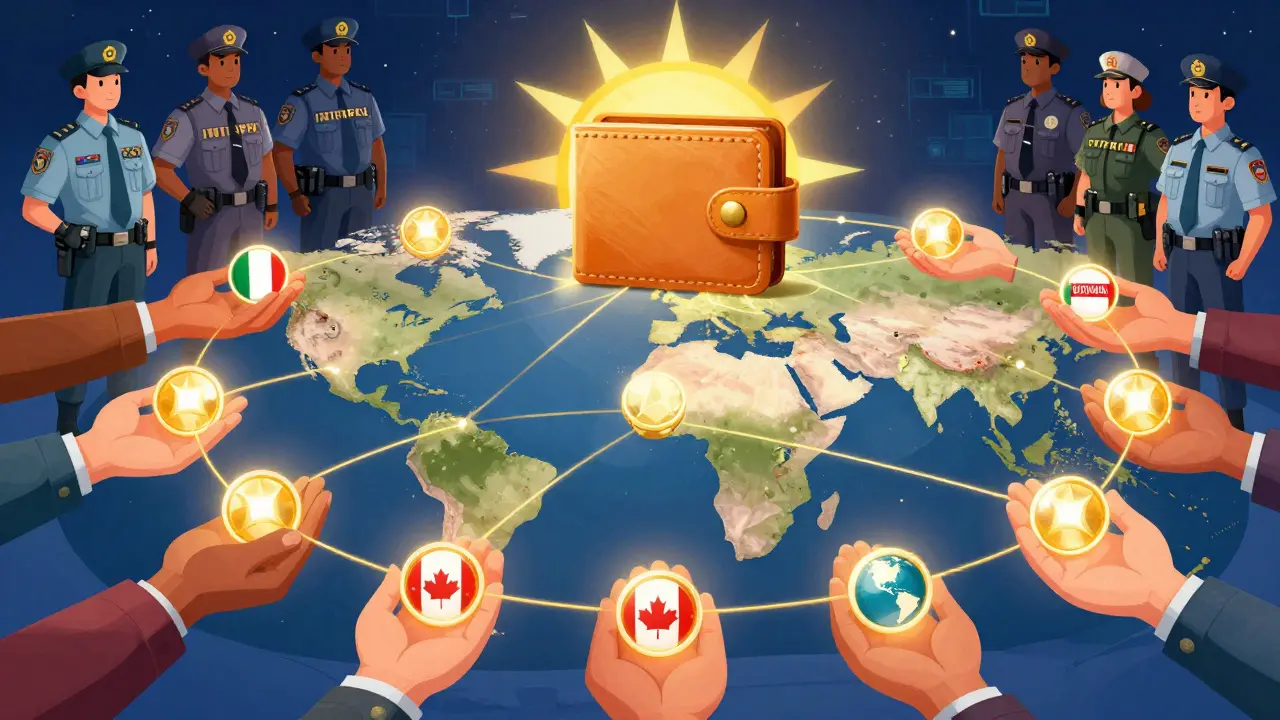
Based on 2025 international enforcement data, this tool estimates how much of your stolen cryptocurrency might be recoverable. International cooperation significantly increases recovery rates.
Enter your details to see estimated recovery.
For years, people said if you lost money to a crypto scam, it was gone for good. No trace. No recovery. But that’s changing. In 2025, international cooperation on crypto crime enforcement isn’t just a buzzword-it’s saving victims real money and putting criminals behind bars across continents.
Why Borders Don’t Matter Anymore in Crypto Crime
Crypto doesn’t care about national borders. A scammer in Nigeria can target retirees in Canada using a wallet registered in Singapore, then wash the funds through a decentralized exchange in the Cayman Islands. Traditional police forces? They’re stuck at their own borders. That’s why single-country investigations kept failing. Criminals knew it. They exploited it. The turning point came when law enforcement realized they had to work together. INTERPOL, the global police network with 195 member countries, became the central hub. Not just for sharing intel-but for launching joint operations that hit multiple countries at once. Take Operation Serengeti 2025. In August, authorities in Angola shut down 25 illegal crypto mining farms. At the same time, arrests happened in Germany, Zambia, and South Korea. The scam? A fake investment platform that tricked 65,000 people out of $300 million. Without coordinated action, the money would’ve vanished into DeFi protocols. Instead, investigators traced it-step by step-across blockchains.How They’re Actually Tracking the Money
It’s not magic. It’s technology-and collaboration. Every major crypto transaction leaves a trail on the blockchain. Even if criminals use mixers or privacy coins, they eventually have to cash out. That’s where they slip up. They send funds to exchanges that require KYC. Or they use bridges between chains, which leave digital fingerprints. Tools like Chainalysis, Elliptic, and TRM Labs give law enforcement the ability to follow those trails. These companies don’t just map wallets-they predict behavior. For example, if a wallet receives stolen funds and then sends small amounts to 200 different addresses over 72 hours, it’s likely laundering. The system flags it automatically. But here’s the real breakthrough: INTERPOL’s I-GRIP system. Launched in 2022, it lets financial intelligence units in different countries send real-time freeze requests to banks and exchanges. In Operation HAECHI VI, which ran from April to August 2025, this system helped recover $439 million. That’s not a typo. $439 million. In one operation. One case: A Korean steel company got scammed with forged shipping documents. $3.9 million was wired to a fake account in Dubai. Local police couldn’t touch it. But through I-GRIP, they coordinated with UAE authorities. The funds were frozen within hours. Recovered. Returned.Where the System Still Breaks Down
It’s not perfect. Criminals are adapting faster than regulations can keep up. Cross-chain laundering is now the go-to method. Instead of moving money through one blockchain, criminals use bridges to jump between Ethereum, Solana, Polygon, and even lesser-known chains. Each hop adds layers of obscurity. Elliptic’s 2025 report found over $21.8 billion in illicit crypto has been laundered this way. Then there’s the problem of speed. In 2021, 40% of stolen crypto went straight to exchanges. By Q2 2025, that number dropped to 15%. Why? Criminals are using non-KYC swap services, peer-to-peer marketplaces, and even gambling sites to convert crypto to cash without leaving a paper trail. Jurisdictional conflicts still cause delays. A country might have the evidence but lack the legal power to freeze assets abroad. Or an exchange in one country refuses to cooperate because local laws don’t require it. INTERPOL helps, but it can’t force action. It can only facilitate. And training? It’s uneven. In 2022, only 62% of INTERPOL member countries had dedicated crypto investigation units. By 2025, that jumped to 87%. But that still leaves 13%-countries where officers have never seen a blockchain address. They need 120 hours of training just to understand how to trace a transaction. Not everyone has the resources.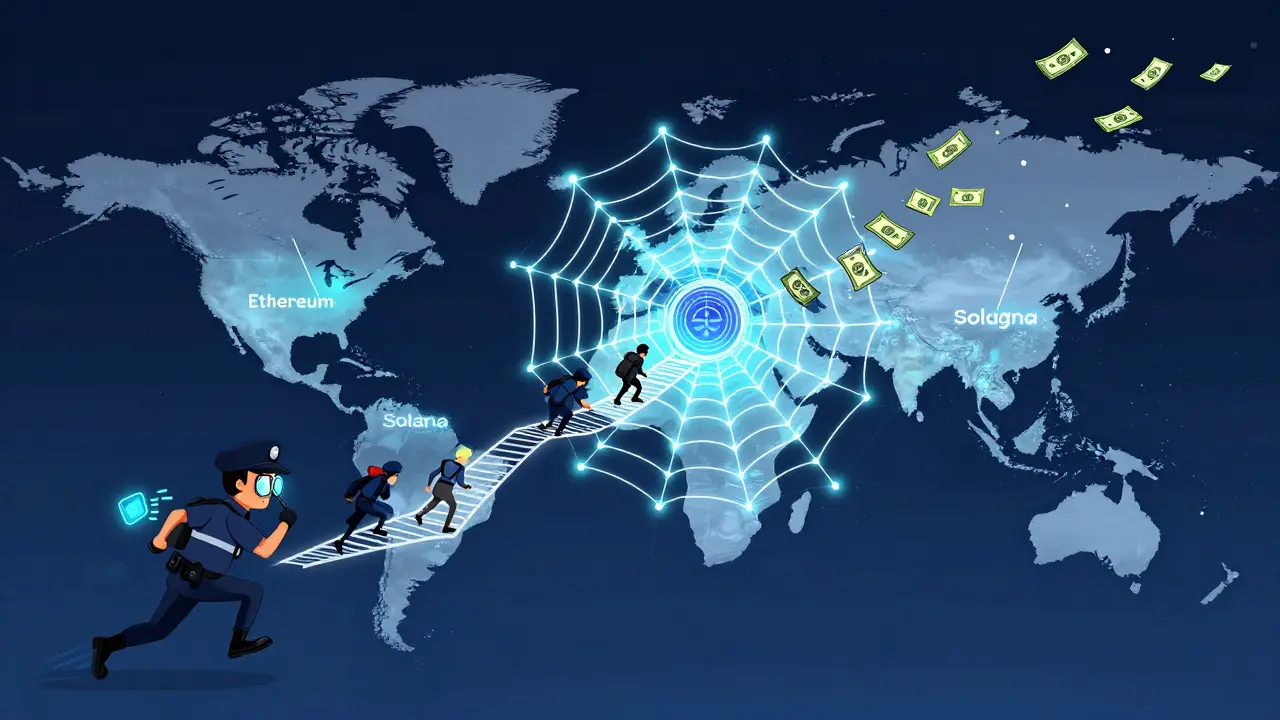
Regional Differences in Enforcement
Not all countries fight crypto crime the same way. The U.S. leans hard on prosecution. The Department of Justice has filed charges against individuals for market manipulation in meme coins and altcoins. In October 2024, 17 people were charged in Massachusetts for using bots to inflate trading volumes. Civil cases from the SEC follow closely behind. Europe, through Europol, focuses more on the human cost. Their August 2025 conference highlighted how crypto scams are being used to recruit minors into online fraud rings. They’re targeting the pipeline, not just the money. Africa’s role has grown dramatically. Operation Serengeti 2025 included heavy participation from AFRIPOL. Countries like Angola and Zambia, once seen as safe havens for crypto criminals, are now leading the charge in shutting down mining operations and scam hubs. The difference? The U.S. goes after individuals. Europe goes after networks. Africa goes after infrastructure. And together? They’re covering more ground than any one region ever could.Who’s Really Doing the Heavy Lifting?
You might think governments are running the show. But they’re not. Private companies like Chainalysis, Elliptic, and TRM Labs are the real backbone. They provide the tools, the data, and the expertise. INTERPOL’s Director, Theos Badege, openly says: “Working with private sector experts has given us insights we could never have developed alone.” These firms don’t just analyze blockchains-they build the software that law enforcement uses. TRM Labs’ platform can identify wallets linked to sanctioned entities like terrorist groups. Elliptic was the first to offer cross-chain screening that works across 150+ blockchains. Chainalysis tracks the movement of $15 billion in illicit crypto holdings in 2025-with Bitcoin making up 75% of that total. Even the World Economic Forum plays a role. Their Cybercrime Atlas isn’t a database. It’s a living map. It pulls together reports from governments, private firms, and NGOs to show where threats are emerging. It’s like a weather radar for crypto crime. Without these partners, law enforcement would be flying blind.
What’s Next? The Battle Is Just Getting Started
Crypto crime isn’t disappearing. It’s evolving. State-sponsored actors and ransomware groups are now using crypto more than ever. The TRM Labs 2025 report warns that terrorist financing via crypto is rising, especially through decentralized platforms with no oversight. The next big challenge? AI-powered scams. Criminals are using generative AI to create fake videos of CEOs asking for wire transfers. Or voice clones of loved ones begging for crypto help. These aren’t just phishing emails anymore. They’re hyper-personalized, emotionally manipulative attacks. The response? More integration. More training. More real-time data sharing. INTERPOL is already testing AI tools that can predict scam patterns before they even launch. And recovery rates? They’re climbing. In 2024, standalone operations recovered about $120 million per major operation. In 2025, with global coordination, that number jumped to $439 million in one go. That’s proof it works. The message is clear: if you want to fight crypto crime, you can’t do it alone. The criminals operate globally. The solution has to too.What This Means for You
If you’re a victim of a crypto scam, don’t give up. Report it. Immediately. Even if you sent funds overseas, international teams can still trace them-especially if you act fast. If you run a business that handles crypto, make sure your team knows how to spot red flags. Suspicious transfers. Unusual wallet patterns. Sudden spikes in small transactions. These are early warnings. And if you’re just watching from the sidelines? Understand this: the days of “crypto is lawless” are over. The world is building a net. And it’s getting tighter every month.Can crypto scams really be traced and recovered today?
Yes, but only if international cooperation is involved. Tools like INTERPOL’s I-GRIP system allow real-time freezing of funds across borders. In 2025, operations like HAECHI VI recovered $439 million by tracing transactions through multiple blockchains and coordinating with exchanges and banks in 40 countries. Recovery is still difficult for small, decentralized scams, but large-scale frauds are increasingly being dismantled.
What role do private companies play in crypto crime enforcement?
Private firms like Chainalysis, Elliptic, and TRM Labs provide the blockchain analytics tools that law enforcement uses to trace illicit transactions. They map wallet networks, identify laundering patterns, and flag sanctioned entities. INTERPOL relies on these companies for data and technical support-without them, most investigations would stall due to lack of expertise and tools.
Why is cross-chain laundering such a big problem?
Cross-chain laundering lets criminals move stolen crypto between different blockchains-like from Ethereum to Solana to Polygon-using decentralized bridges and non-KYC exchanges. Each jump makes tracing harder. Elliptic estimates over $21.8 billion in illicit crypto has been laundered this way in 2025. Current tools struggle to automatically track these hops, requiring manual analysis that takes hours or days-time criminals use to disappear.
Which countries are most active in crypto crime enforcement?
The U.S. leads in prosecutions, especially against market manipulation. The European Union focuses on human trafficking and minor recruitment via crypto scams. African nations like Angola and Zambia are now key players in shutting down mining hubs and scam operations. South Korea and the UAE have strong bilateral cooperation for asset recovery. INTERPOL’s global network ensures all 195 member countries can contribute, even if their capacity varies.
How effective are international operations compared to single-country efforts?
Far more effective. In 2024, standalone operations recovered an average of $120 million per major case. In 2025, INTERPOL-coordinated operations like HAECHI VI recovered $439 million-78% more. Multi-jurisdictional ops can shut down entire scam networks at once, freeze assets across borders, and arrest suspects in multiple countries simultaneously. Single-country efforts often only catch low-level actors while the masterminds remain untouched.
What skills do law enforcement officers need now to fight crypto crime?
Officers now need training in blockchain analytics tools, understanding of decentralized finance (DeFi) protocols, knowledge of cross-chain bridges, and familiarity with international asset recovery laws. INTERPOL requires 120 hours of specialized training for officers involved in crypto investigations. Without this, they can’t interpret wallet data or understand how criminals are moving funds.
Is Bitcoin still the main cryptocurrency used in crime?
Yes. According to Chainalysis, Bitcoin still makes up 75% of all illicit crypto holdings in 2025. Its early adoption, high liquidity, and widespread exchange support make it the preferred choice for criminals. However, newer chains like Ethereum and Solana are seeing increased use in laundering due to their smart contract capabilities and DeFi integrations.
What’s the biggest threat to future crypto crime enforcement?
The rise of AI-powered scams and state-sponsored crypto use. Criminals are now using AI to create convincing voice and video deepfakes to trick victims into sending crypto. Meanwhile, terrorist groups and sanctioned regimes are increasingly using crypto for financing, exploiting gaps in global oversight. Enforcement must evolve faster than these threats-or risk falling behind.