


Before 2025, if you traded Bitcoin or Ethereum in the U.S., you were playing by rules that didn’t officially exist. The SEC sued exchanges. The CFTC fined platforms. No one knew who was in charge. That changed on July 18, 2025, when the Investment and Securities Act 2025 - specifically the CLARITY Act - became law. It didn’t ban crypto. It didn’t crush innovation. It gave traders, exchanges, and investors a clear map for the first time.
What the CLARITY Act Actually Does
The CLARITY Act doesn’t treat all crypto the same. It splits digital assets into three buckets, each with its own regulator and rules:- Digital commodities - like Bitcoin and Ethereum - are under the CFTC. This means they’re treated like oil, gold, or wheat. No more arguing whether they’re securities.
- Investment contract assets - tokens sold with the promise of profit from others’ work - stay under the SEC. This covers most new tokens launched through ICOs or token sales.
- Permitted payment stablecoins - USD-backed coins like USDC or USDT - are regulated under the separate GENIUS Act. They’re treated like digital cash, not investments.
This is huge. Before 2025, the SEC used the Howey Test to guess whether a token was a security. That created chaos. If you bought Solana in 2023, was it a commodity or a security? No one knew. Now, if it’s Bitcoin, the CFTC says it’s a commodity. End of story.
What This Means for Crypto Traders
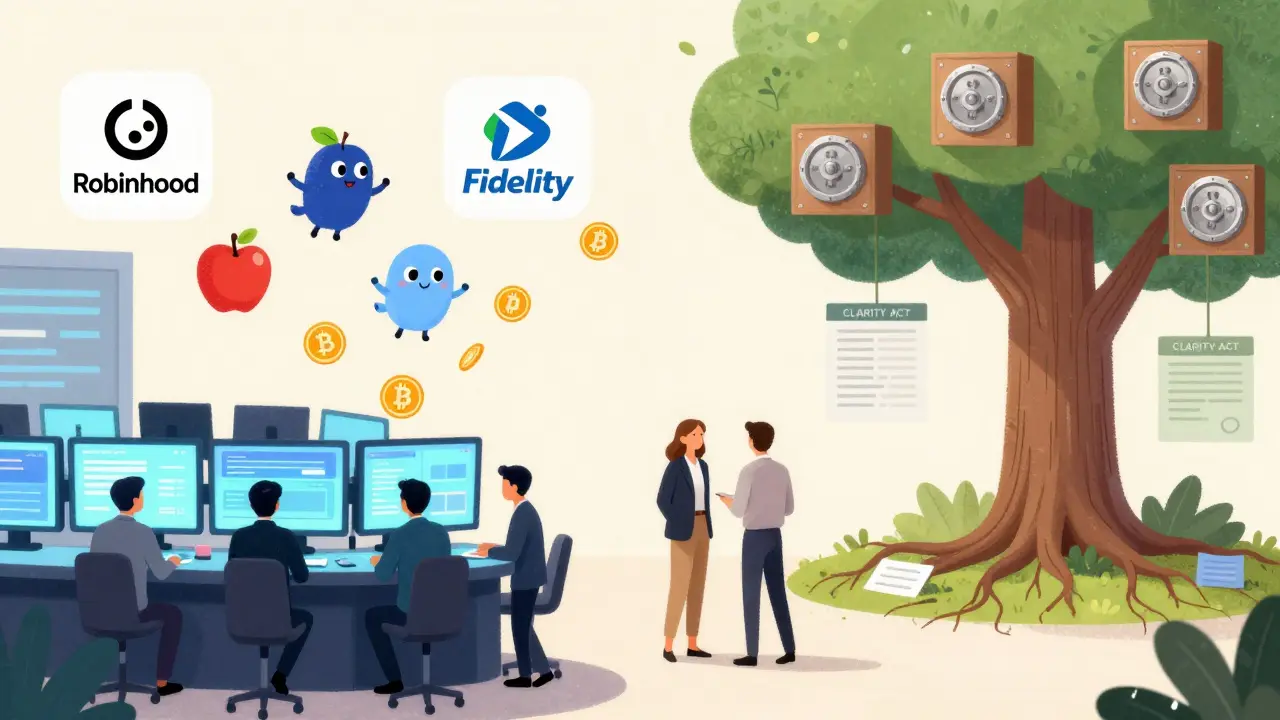
If you’re an individual trader, the biggest change is access. Before 2025, major brokerages like Fidelity and Charles Schwab couldn’t legally offer crypto trading without risking SEC enforcement. Now, the CLARITY Act says: if a platform is registered with the SEC, it can trade digital commodities. That’s why you now see Robinhood, E*TRADE, and Fidelity offering Bitcoin and Ethereum directly in your brokerage account.It also means fewer platform shutdowns. Before 2025, exchanges like Binance.US got hit with lawsuits because the SEC claimed their tokens were unregistered securities. Now, if a token is classified as a digital commodity, it can be listed legally on a registered ATS or national exchange. That’s why Coinbase, Kraken, and Gemini have added dozens of new coins in 2025 - not because they’re riskier, but because they’re now legal.
How Institutional Investors Are Reacting
Big money didn’t enter crypto because it was risky. It stayed out because it was legally messy. The CLARITY Act fixed that. Registered Investment Advisers (RIAs) can now advise clients on Bitcoin without worrying about violating SEC Rule 204A-1. If Bitcoin is a commodity, it doesn’t count as a “reportable security” for employee trading surveillance. That’s saved firms millions in compliance costs.State trust companies - like Northern Trust and State Street - can now legally custody Bitcoin under new SEC no-action letters. Before, they couldn’t touch it. Now, they’re building crypto custody products. The result? Institutional inflows into spot Bitcoin ETFs hit $12 billion in Q3 2025, up 300% from 2024. Pension funds, endowments, and family offices are allocating 1-3% of portfolios to digital commodities.
What’s Still Restricted
The law didn’t remove all barriers. If a token is classified as an investment contract - meaning it was sold as a way to make money from a project’s success - it’s still tightly controlled by the SEC. You can’t trade those on a regular brokerage platform unless they’re registered. That’s why tokens like Solana (SOL) and Cardano (ADA) are fine - they’re commodities. But tokens from new DeFi protocols or AI-driven token sales? If they look like securities, they’re still blocked.DeFi platforms that don’t register with regulators are still in legal gray zones. The CLARITY Act doesn’t protect anonymous protocols. If you’re using Uniswap or Aave to trade an unregistered security token, you’re still taking legal risk. The law targets platforms, not users - but platforms can’t operate legally if they list illegal tokens.
How Compliance Changed for Firms
Crypto firms had to rebuild their compliance departments from scratch. A firm that used to treat all crypto as securities now needs two separate teams: one for CFTC-regulated commodities, one for SEC-regulated tokens. They need new software to track which assets fall where. They need updated employee handbooks. They need training modules explaining that buying Bitcoin is now like buying gold - no pre-clearance needed.Broker-dealers had to upgrade their entire infrastructure. Blockchain records aren’t the same as stock ledgers. The SEC now requires exchanges to keep immutable, timestamped records of every trade - on-chain. That means integrating with blockchain explorers, not just traditional databases. Firms that didn’t invest in this tech by October 2025 got fined. Those that did? Their trading volumes jumped 40% in six months.

Why This Is Different From Europe or Asia
The EU’s MiCA law tries to regulate every single crypto asset under one umbrella. It’s complex, slow, and expensive. The U.S. approach is surgical: only regulate what needs regulating. Stablecoins? Regulated. Bitcoin? Commodity. New speculative tokens? Securities. That’s why U.S. crypto trading volume grew 58% in 2025 while the EU’s grew just 8%.Compared to Singapore or the Cayman Islands - which have light-touch rules - the U.S. now offers something better: legal certainty with guardrails. You can trade Bitcoin on a regulated exchange. You know your money is safe. You know the platform won’t get shut down tomorrow. That’s what attracts real money.
What Comes Next
The SEC is already working on new custody rules for digital commodities. They’re expected to allow federally chartered banks to hold crypto by mid-2026. That’s the next big step - when JPMorgan or Bank of America starts offering Bitcoin custody directly to clients.Some states are still trying to impose their own crypto rules. But the CLARITY Act makes digital commodities “covered securities,” meaning state laws can’t block their trading. That’s why Texas, Florida, and California are dropping their conflicting crypto regulations. The federal law wins.
The real test? Will this framework survive political change? If a new administration comes in 2028, will they roll it back? So far, both parties have supported it. The industry has $2.5 trillion at stake. That’s too big to ignore.
What You Should Do Now
If you trade crypto in the U.S.:- Know which assets are commodities (Bitcoin, Ethereum, Solana, etc.) and which are securities (new tokens, especially from private sales).
- Use only SEC-registered platforms for trading. They’re the only ones legally allowed to list digital commodities.
- If you’re an investor or advisor, update your compliance records. Bitcoin no longer counts as a reportable security under Rule 204A-1.
- Watch for custody options from traditional banks. That’s coming in 2026.
This isn’t the end of crypto regulation. It’s the beginning of a real market. The chaos is over. The rules are clear. Now it’s up to you to trade smart.
Is Bitcoin now legal to trade under the Investment and Securities Act 2025?
Yes. Bitcoin is classified as a digital commodity under the CLARITY Act and is regulated by the CFTC, not the SEC. It can be legally traded on any SEC-registered broker-dealer or exchange. This classification removes years of legal uncertainty and allows institutions to offer Bitcoin in brokerage accounts without regulatory risk.
Can I still trade altcoins like Cardano or Solana?
Yes, as long as they’re classified as digital commodities. Both Cardano (ADA) and Solana (SOL) are treated as commodities under the new law, not securities. That means they can be listed on regulated platforms like Coinbase, Fidelity, and Robinhood. If a new altcoin is launched as a security - promising returns based on a team’s efforts - it may be restricted until registered with the SEC.
Does the law ban decentralized exchanges (DeFi)?
No, the law doesn’t ban DeFi platforms. But it doesn’t protect them either. If a DeFi protocol lists unregistered security tokens, it’s operating illegally. The CLARITY Act holds platforms accountable, not users. So while you can still use Uniswap or Aave, you’re taking legal risk if you trade tokens that should be registered with the SEC.
Can my financial advisor now include crypto in my portfolio?
Absolutely. Registered Investment Advisers can now legally advise clients on Bitcoin and other digital commodities without triggering securities reporting rules under SEC Rule 204A-1. Many firms have updated their compliance manuals and are now offering crypto as part of diversified portfolios, especially for clients with long-term investment horizons.
What happens if a crypto token gets reclassified?
If the SEC reclassifies a token from a commodity to a security - for example, if a project starts offering profit-sharing features - the platform must delist it unless it registers the token as a security. Traders aren’t penalized, but access may be restricted. That’s why it’s important to monitor announcements from exchanges and the SEC about asset classifications.
Are stablecoins like USDC affected by this law?
Yes, but under a different law - the GENIUS Act. Stablecoins backed by U.S. dollars are regulated as payment instruments, not investments. They must be fully reserved, audited monthly, and issued only by licensed financial institutions. This makes them safer than before and gives them a clear path to integrate with banks and payment systems.
Bianca Martins
December 28, 2025 AT 19:18alvin mislang
December 30, 2025 AT 12:59Monty Burn
December 30, 2025 AT 13:30Alexandra Wright
January 1, 2026 AT 10:46Jack and Christine Smith
January 3, 2026 AT 07:30Michelle Slayden
January 4, 2026 AT 05:07Alex Strachan
January 5, 2026 AT 07:24Rick Hengehold
January 5, 2026 AT 20:22Brandon Woodard
January 5, 2026 AT 22:50Antonio Snoddy
January 7, 2026 AT 19:09Ryan Husain
January 8, 2026 AT 07:27Rajappa Manohar
January 9, 2026 AT 11:00prashant choudhari
January 11, 2026 AT 01:39Willis Shane
January 11, 2026 AT 13:12Jake West
January 11, 2026 AT 19:46Shawn Roberts
January 13, 2026 AT 05:05Emily L
January 14, 2026 AT 21:59Gavin Hill
January 14, 2026 AT 22:48SUMIT RAI
January 16, 2026 AT 17:47Andrea Stewart
January 17, 2026 AT 23:05Josh Seeto
January 19, 2026 AT 10:58Khaitlynn Ashworth
January 19, 2026 AT 19:20NIKHIL CHHOKAR
January 20, 2026 AT 02:05Mike Pontillo
January 21, 2026 AT 03:29Joydeep Malati Das
January 21, 2026 AT 08:07rachael deal
January 22, 2026 AT 09:48Jordan Fowles
January 23, 2026 AT 15:55Bianca Martins
January 25, 2026 AT 04:53