


Staking Rewards Calculator & Comparison
Calculate Your Staking Rewards
Estimated Rewards
Annual Reward: $0.00
Total Value After 1 Year: $0.00
*Results are estimates based on current APY rates and do not account for price volatility.
Staking Method Comparison
Staking crypto isn’t magic. It’s not a get-rich-quick scheme. But if you’re holding coins like Ethereum, Polkadot, or Solana, it’s one of the easiest ways to make your crypto work for you-without selling or trading. You lock up your tokens to help secure a blockchain, and in return, you earn more tokens. Simple. Straightforward. And it’s been around long enough that the process is now accessible even if you’ve never run a server or touched a command line.
What Is Crypto Staking, Really?
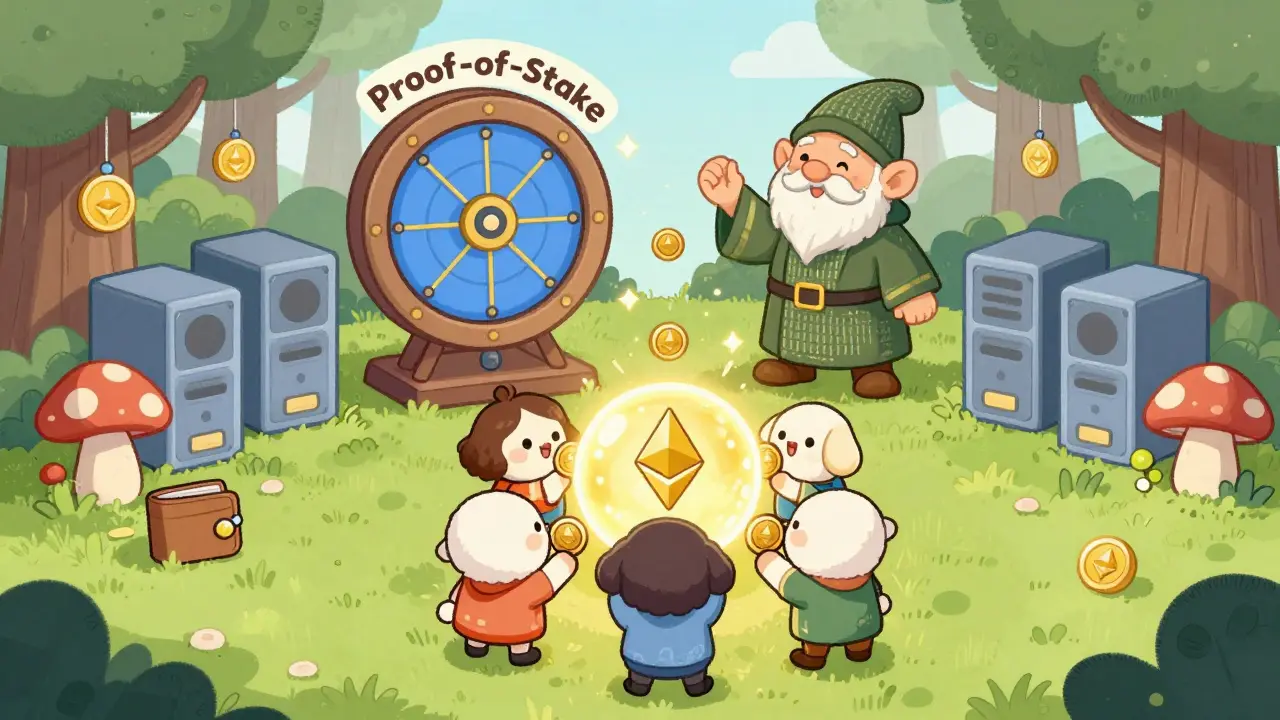
Crypto staking is how some blockchains verify transactions and add new blocks without using massive amounts of electricity. Instead of miners solving complex math problems (like Bitcoin), staking uses validators-people who lock up their own tokens as collateral. If they do their job right, they get rewarded. If they mess up or act dishonestly, they lose part of their stake. That’s called slashing.
This system is called proof-of-stake (PoS). Ethereum switched to it in 2022, and since then, over 40% of all Ethereum supply has been staked. Other networks like Cardano, Polkadot, and Cosmos rely on it too. If you own any of these coins, you’re already sitting on a potential income stream.
Staking doesn’t require you to be a tech expert. You don’t need to buy expensive hardware. You don’t need to run a 24/7 server. But you do need to understand the trade-offs.
How Staking Rewards Work
Every time a blockchain adds a new block, it distributes rewards to validators. These rewards come from two places: newly minted tokens and transaction fees. Your share depends on how much you stake and how many others are staking on the same network.
APY (annual percentage yield) varies. Ethereum currently offers around 3-5% APY. Polkadot hovers near 10-12%. Solana can be 6-8%. Some newer or smaller chains offer higher returns-sometimes over 20%-but those come with bigger risks. Higher yield usually means less security, less liquidity, or higher chance of slashing.
Don’t chase the highest APY. A 25% return sounds great until you lose half your stake because the validator you picked got slashed. Or until the platform freezes your funds and you can’t access them for months.
Five Ways to Stake Crypto (And Which One’s Right for You)
There are five main ways to stake. Each has different levels of control, risk, and complexity.
1. Centralized Exchange Staking (Easiest)
Platforms like Coinbase, Kraken, and Bitpanda let you stake with one click. You buy ETH, click ‘Stake’, and you’re done. Rewards show up weekly or monthly. No setup. No technical knowledge. Bitpanda even lets you unstake anytime-no lock-up period.
But here’s the catch: you don’t control your private keys. The exchange does. That means if Coinbase gets hacked, gets shut down, or freezes your account (yes, this has happened), your staked crypto could disappear or be locked indefinitely.
Best for: Beginners, people who want passive income with zero effort, small amounts under $1,000.
2. Staking Pools (Middle Ground)
Staking pools let you combine your tokens with others to meet minimum requirements. For example, Ethereum needs 32 ETH to run your own validator. That’s over $100,000. Most people can’t afford that. So you join a pool-like Lido or Rocket Pool-and stake 0.1 ETH or even 0.01 ETH. The pool runs the validator for you, and you get a proportional share of the rewards.
You still hold your tokens in your own wallet. The pool doesn’t take custody. That’s safer than centralized exchanges. Rewards are distributed automatically. Some pools charge a small fee (5-10%) for their service.
Best for: People who want more control than exchanges but don’t want to run their own node. Good for Ethereum, Polkadot, or Cosmos holders.
3. Decentralized Staking Platforms (More Control)
Platforms like MetaMask, Keplr, or Phantom let you stake directly through your wallet. You connect your wallet to a blockchain’s staking dashboard, approve the transaction, and lock your tokens. You keep your private keys. No middleman.
This is safer than exchanges-but more complex. You need to understand gas fees, smart contracts, and how to recover your wallet if you lose your seed phrase. One wrong click and you could lose access to your funds.
Best for: Intermediate users who want to learn blockchain mechanics and value self-custody.
4. Running Your Own Validator (Highest Control, Highest Effort)
If you have 32 ETH (or the equivalent in other coins), you can run your own validator node. You need a dedicated computer, constant internet, and technical skills to update software, monitor uptime, and avoid slashing.
Pros: You earn the full reward-no pool fees. You help decentralize the network. You’re truly part of the blockchain’s security.
Cons: One mistake can cost you thousands. A power outage? Slashing. A software bug? Slashing. You’re responsible for everything. Most people don’t do this unless they’re technically trained or deeply committed.
Best for: Tech-savvy users, crypto enthusiasts, or those with serious capital and patience.
5. Delegated Staking on Mobile Apps (New and Growing)
Apps like Trust Wallet or Coinbase Wallet now let you delegate staking directly from your phone. You pick a validator from a list, tap ‘Stake’, and you’re done. It’s like exchange staking-but your tokens stay in your wallet. You’re not giving up custody.
These apps show validator performance scores, uptime history, and fee rates. You can switch validators if one underperforms. It’s a big step toward making staking safe and easy.
Best for: Mobile-first users who want self-custody without the complexity.
Where to Stake: Top Platforms Compared
Here’s a quick breakdown of the most popular options:
| Platform | Minimum Stake | APY Range | Lock-Up Period | Self-Custody? | Best For |
|---|---|---|---|---|---|
| Coinbase | 0.0001 ETH | 3.5-5% | 18-24 hours | No | Beginners |
| Kraken | 0.0001 ETH | 3-4.5% | 1-2 days | No | Traders already on Kraken |
| Bitpanda | 0.001 DOT | 8-25% | None | No | Flexible staking, no lock-in |
| Lido | 0.0001 ETH | 3-5% | 1-2 days | Yes | Ethereum staking with self-custody |
| MetaMask | Varies by chain | 5-15% | Varies | Yes | Users who want full control |
Notice something? The safest options (self-custody) often have slightly lower APY. The highest yields come from centralized platforms or new chains. That’s not a coincidence. Higher risk = higher reward.
Big Risks Nobody Talks About
Staking isn’t risk-free. Here’s what can go wrong:
- Slashing: If a validator goes offline too long or signs two conflicting blocks, they get penalized. You could lose 1-5% of your stake. This is rare on big networks like Ethereum, but common on smaller ones.
- Lock-up periods: Some platforms lock your coins for days or weeks. If the market crashes, you can’t sell. You’re stuck.
- Platform failure: If an exchange goes under (like FTX), your staked coins vanish. No insurance. No recourse.
- Regulatory changes: Governments are starting to tax staking rewards as income. In the U.S., Canada, Australia, and the EU, you may owe taxes every time you earn rewards-even if you don’t sell.
- Token value drops: You earn 5% in ETH, but ETH drops 20%. You’re still down 15%. Staking doesn’t protect you from market volatility.
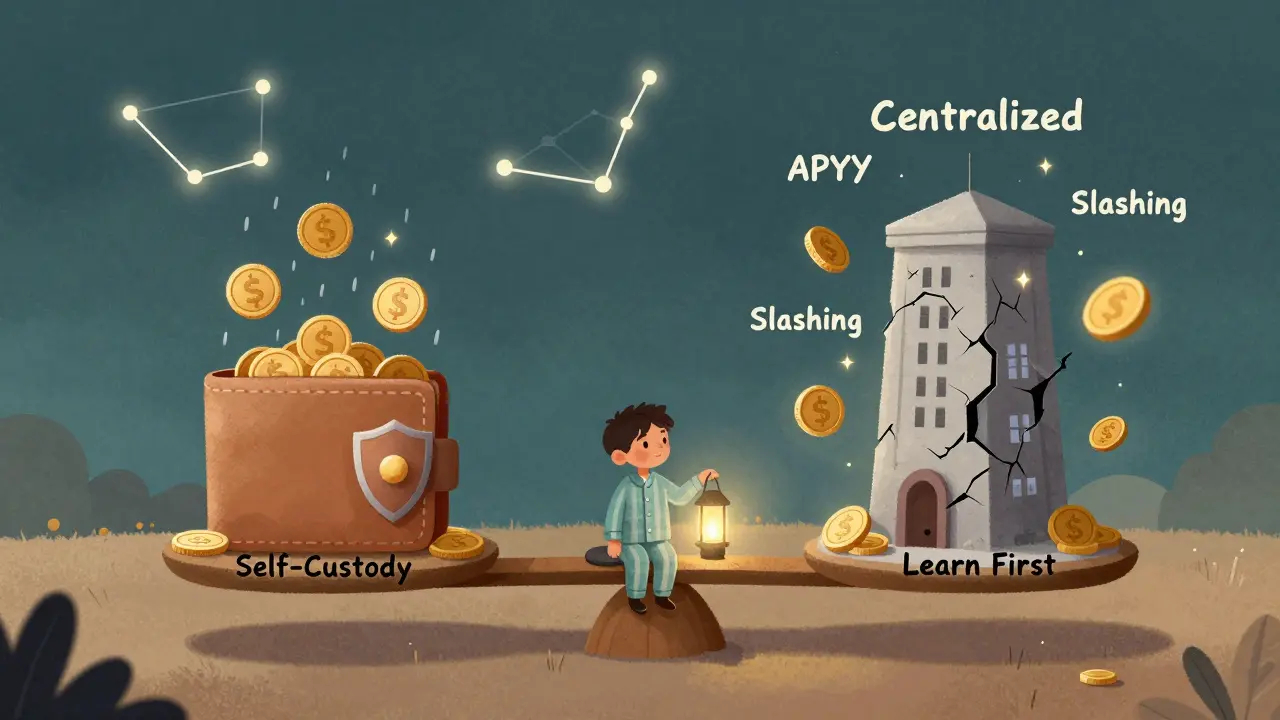
Staking is not a guaranteed return. It’s a trade-off: you give up liquidity and control for potential rewards. Know what you’re giving up.
How to Start Staking (Step-by-Step)
Here’s how to stake your first crypto-safely.
- Choose a coin that supports staking. Ethereum, Solana, Polkadot, Cardano, Cosmos. Avoid Bitcoin, Dogecoin, or Litecoin-they don’t stake.
- Buy your crypto. Use a trusted exchange like Coinbase, Kraken, or Binance. Transfer it to your own wallet if you’re using a decentralized method.
- Choose your staking method. Beginners: use Coinbase or Kraken. Intermediate: use Lido or MetaMask. Advanced: run your own validator.
- Stake your tokens. Click ‘Stake’ or ‘Delegate’. Confirm the transaction. Pay the gas fee (if applicable).
- Track your rewards. Most platforms show your estimated APY and payout schedule. Check weekly. Don’t assume it’s automatic.
- Reinvest or withdraw. Some platforms let you compound rewards. Others pay out in cash. Decide what you want to do.
Start small. Stake $50. See how it works. Learn the interface. Then scale up.
What to Do After You Stake
Staking isn’t a set-it-and-forget-it system. Here’s what to do next:
- Check your validator’s performance. If you’re using a pool or delegated staking, look up your validator’s uptime. If it’s below 98%, switch.
- Watch for network upgrades. Ethereum, Solana, and others update frequently. These can affect staking rewards or lock-up times. Follow official channels.
- Understand your taxes. In New Zealand, Australia, and the U.S., staking rewards are taxable income. Keep a record of every reward you receive. Use a crypto tax tool like Koinly or CoinTracker.
- Diversify. Don’t stake all your crypto on one platform or one chain. Spread it across 2-3 networks to reduce risk.
Final Thoughts: Is Staking Worth It?
Yes-if you do it right.
Staking turns idle crypto into passive income. It’s greener than mining. It supports decentralized networks. And with platforms making it easier than ever, there’s no reason not to try it.
But don’t be fooled by 20% APY ads. Don’t stake everything. Don’t trust exchanges with your life savings. Don’t skip learning the basics.
Start small. Stay informed. Keep your keys safe. And remember: staking doesn’t make you rich. But it can make your crypto holdings do more than just sit there.
Can you lose money staking crypto?
Yes. You can lose money if the value of your staked coin drops, if the platform you’re using gets hacked or shuts down, or if you get slashed for validator errors. Slashing is rare on major networks like Ethereum but possible on smaller ones. Always understand the risks before staking.
Do you need 32 ETH to stake Ethereum?
Only if you want to run your own validator. Most people use staking pools like Lido or Rocket Pool, where you can stake as little as 0.0001 ETH. These pools combine small stakes to meet the 32 ETH requirement, so you don’t need to own a full ETH amount.
Are staking rewards taxable?
In most countries, including New Zealand, Australia, the U.S., and the EU, staking rewards are treated as taxable income. You owe tax when you receive them, not when you sell. Keep records of every reward you earn and use a crypto tax tool to calculate your liability.
What’s the safest way to stake crypto?
The safest way is using a decentralized staking platform like Lido or MetaMask, where you keep control of your private keys. Avoid centralized exchanges if you’re staking large amounts. Always check the validator’s uptime and reputation before delegating.
How often do you get paid staking rewards?
It varies. Ethereum rewards are distributed roughly every 6-8 minutes, but they’re usually paid out to users weekly or monthly. Platforms like Bitpanda pay weekly. Exchanges like Coinbase pay monthly. Check your platform’s payout schedule before staking.
Can you unstake anytime?
Not always. On Ethereum, unstaking takes 18-24 hours after a request. Some exchanges allow instant unstaking, but you might lose rewards. Platforms like Bitpanda let you unstake anytime with no lock-up. Always check the unstaking rules before you stake.
If you’re holding crypto that supports staking, you’re already sitting on a way to earn passive income. You don’t need to be a genius. You just need to be careful. Start small. Learn as you go. And remember: the goal isn’t to get rich overnight-it’s to make your crypto work harder, safely, and sustainably.
nicholas forbes
December 6, 2025 AT 11:57Staking feels like putting money in a savings account that sometimes gets robbed by the bank-except the bank is a blockchain and the robbers are algorithmic penalties. I get the appeal, but I’m still wary of giving up liquidity for ‘rewards’ that might vanish if the network glitches or some overlord decides to de-list my coin.
Regina Jestrow
December 8, 2025 AT 08:56I tried staking ETH on Coinbase last year and got 4.2% APY-great until I realized I couldn’t move my coins during the FTX collapse. I didn’t lose anything, but I felt powerless. Now I use Lido. My keys are mine, and I still sleep at night. Not perfect, but better than handing over the keys to a corporation that might get subpoenaed tomorrow.
Lore Vanvliet
December 9, 2025 AT 19:35Y’all are acting like staking is some kind of moral victory. 🙄 It’s just crypto’s version of a Ponzi scheme with extra steps. If you’re not mining, you’re just feeding the machine so someone else can get rich while you get ‘rewards’ that get taxed like wages. And don’t even get me started on how the U.S. government is already drafting laws to turn your passive income into a audit nightmare. 💸🇺🇸
Stanley Wong
December 11, 2025 AT 14:23I’ve been staking Polkadot for over a year now through a delegation pool and honestly it’s been smooth. The APY hovers around 11% and I’ve never been slashed. The real trick is picking a validator with over 99% uptime and low fees. I use Polkadot.js and check the dashboard weekly. It’s not hard, just requires attention. People act like it’s rocket science but it’s more like setting up a recurring bank deposit with extra tech jargon. Also don’t stake more than you’re willing to lose-crypto’s still a gamble even when it’s ‘safe’.
Nicole Parker
December 12, 2025 AT 15:55I think the most important thing people forget is that staking isn’t about making money-it’s about believing in the network. When you stake, you’re not just earning tokens, you’re helping keep the blockchain honest. That’s powerful. I started with $50 on MetaMask just to see how it worked. Now I’ve got 12% of my portfolio staked across three chains. It’s not a get-rich-quick thing, but it’s the closest thing crypto has to a responsible investment. And honestly? It makes me feel like I’m part of something bigger than just price charts.
Cristal Consulting
December 12, 2025 AT 22:43Start small. Use Lido or Kraken. Check your validator’s uptime. Track your rewards. Reinvest if you’re comfortable. Done. You don’t need to be a coder or a finance guru. Just be consistent. And if you’re nervous, stake $20 and see how it feels. You’ll learn more in a week than reading ten blog posts. 💪
Jerry Perisho
December 14, 2025 AT 15:48Slashing is real but rare on Ethereum. The real risk is centralized platforms. I’ve seen people lose everything on Celsius and FTX. If you care about your crypto, self-custody is non-negotiable. Use MetaMask or Keplr. Even if it’s harder, it’s safer. Also remember: APY isn’t profit. It’s a projection. If ETH drops 30% while you earn 5%, you’re still down. Don’t confuse yield with return.
Manish Yadav
December 14, 2025 AT 21:09This is why America is falling behind. You people treat crypto like a game show. You stake your money like it’s a lottery ticket and then cry when the government taxes it. In India we know real work. We don’t sit back and earn tokens because we ‘helped the network.’ We build. We code. We mine. This staking nonsense is lazy. You want real wealth? Build something. Don’t just lock your coins and hope for magic.
Noriko Robinson
December 15, 2025 AT 02:27Just staked my first 0.1 ETH on Lido today after reading this guide-thank you!! I was so scared I’d mess up but the interface was actually super simple. My wallet showed the delegation right away and the rewards tracker is live. I’m not rich but I feel like I’m doing something smart. Also I’m keeping a spreadsheet of all my rewards-taxes are scary but I’m ready 😅
ronald dayrit
December 15, 2025 AT 21:15There’s a philosophical tension here that nobody addresses: staking transforms ownership into participation. When you hold Bitcoin, you’re a passive observer. When you stake ETH, you become a node in a distributed consensus mechanism. You’re no longer just a consumer-you’re a contributor to a new kind of economic infrastructure. This isn’t about yield. It’s about the redefinition of value itself. The blockchain isn’t just a ledger-it’s a social contract. And your stake is your signature.
Yzak victor
December 16, 2025 AT 11:45Man I wish I’d known all this before I staked my SOL on an exchange last year. Got 7% for a few months then they froze my account for ‘compliance reasons.’ Took 3 weeks to get it back. Now I use Phantom and stake directly. Yeah I pay gas fees and have to update my node sometimes, but at least I know my coins are mine. Don’t trust anyone with your keys-not even ‘trusted’ apps. If you don’t hold the seed phrase, you don’t own it.
Madison Agado
December 18, 2025 AT 01:09The most dangerous myth is that staking is ‘free money.’ It’s not. It’s risk-adjusted participation. You’re trading liquidity, control, and exposure to market volatility for a small yield. And if you don’t understand slashing, validator reputation, or tax implications-you’re not investing, you’re gambling with your crypto. Read the docs. Check the forums. Don’t just click ‘Stake’ because the APY looks nice.
Roseline Stephen
December 19, 2025 AT 23:39I appreciate the breakdown. I’ve been holding ADA for two years and never staked because I didn’t know how. This made it feel less intimidating. I’m going to try it on the official Cardano wallet next week. Small amount first. Just to see.
Mariam Almatrook
December 20, 2025 AT 19:18While the article presents staking as a benign, accessible financial tool, it systematically obscures the structural power dynamics inherent in proof-of-stake systems. The notion that ‘anyone’ can participate ignores the capital concentration required to meaningfully influence validation. The so-called ‘decentralized’ pools like Lido are effectively oligarchic intermediaries, consolidating control under a few entities. Furthermore, the normalization of staking rewards as ‘passive income’ functions as ideological camouflage for the extraction of value from the broader crypto economy. One must ask: who truly benefits from this architecture? Not the retail staker. Not the validator with 32 ETH. But the platform that controls the interface, the regulatory apparatus that taxes the yield, and the venture capital firms that funded the infrastructure. Staking is not empowerment-it is the quiet enclosure of digital commons under the guise of participation.
ronald dayrit
December 21, 2025 AT 04:11Mariam raises a profound point. The entire staking ecosystem is a beautiful illusion of democracy. We are told we are ‘validators’-but we delegate to pools controlled by a handful of corporations with legal teams and server farms. The 32 ETH requirement was designed to be a barrier, and now we’ve replaced it with a new barrier: trust in intermediaries. The blockchain was supposed to remove middlemen. Now we’ve created new ones dressed in smart contract robes. The revolution didn’t come with a bang. It came with a UI button labeled ‘Stake Now.’