

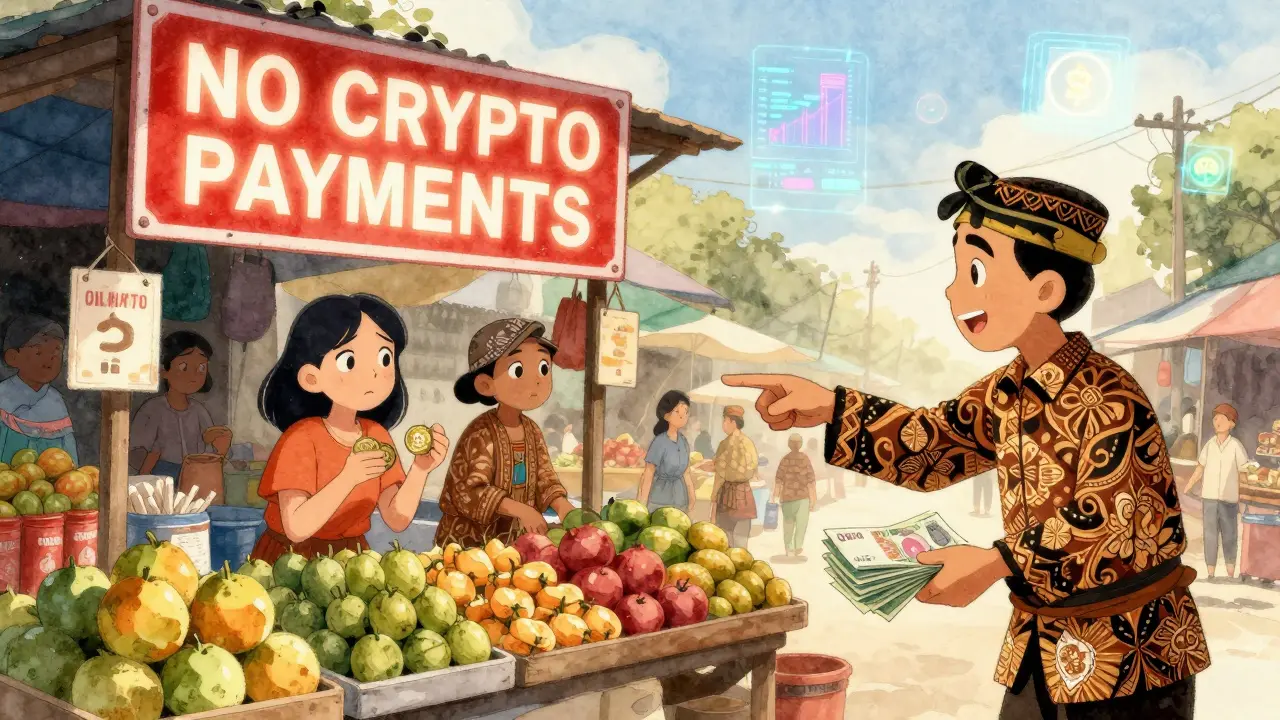
Indonesia lets you buy, sell, and trade cryptocurrency - but you can’t use it to pay for coffee, groceries, or an online order. That’s the strange reality millions of Indonesians face every day. Crypto is legal as an investment. It’s regulated. It’s growing fast. But if you try to pay someone with Bitcoin or USDT, you’re breaking the law.
Why Indonesia Banned Crypto Payments
The ban isn’t new. It started in 2016 with Bank Indonesia Regulation No. 18/40/PBI/2016, and was reinforced in 2017. The central bank’s position is simple: only the rupiah is legal tender. That’s written into Indonesia’s Currency Law. No exceptions. No gray areas. Even if you’re using Bitcoin to pay for a flight to Bali, it’s still illegal. In November 2025, Bank Indonesia made it even clearer. Agusman, Executive Director of the Department of Communication, stated publicly: "Virtual currency including bitcoin is not recognized as a valid payment instrument. It is prohibited to be used as a means of payment in Indonesia." The reason? Financial stability. Risk of fraud. Potential harm to consumers. And the fear that crypto could undermine the rupiah’s role in the economy. But here’s the twist: Indonesia doesn’t ban crypto outright. It just splits it in two. You can trade it - as long as you do it through licensed platforms. You just can’t use it to buy anything.Who Controls Crypto Now? The OJK Takeover
Before January 10, 2025, crypto was treated like a commodity - regulated by Bappebti, the agency that oversees futures and commodities trading. That changed overnight. Oversight moved to the Financial Services Authority (OJK), the same body that regulates banks, insurance, and stock markets. OJK Regulation No. 27 of 2024 reclassified crypto as a "digital financial asset," not a commodity. That’s a big deal. It means crypto is now treated more like stocks or bonds than soybeans or gold. The move aligned Indonesia with global financial standards, similar to the EU’s MiCA framework. The new rules are strict:- Exchanges need at least IDR 50 billion (about $3.2 million) in capital
- Custodians must have IDR 25 billion ($1.6 million)
- Token issuers need IDR 10 billion ($640,000)
The Payment Ban vs. The Trading Boom
Despite the payment ban, crypto trading in Indonesia is exploding. In 2024, trading volume hit IDR 127.5 trillion ($8.1 billion). That’s a 28% jump from the year before. Over 14 million Indonesians - more than 5% of the population - are actively trading crypto. The top three platforms dominate: Indodax (58%), Tokocrypto (27%), and Pintu (15%). International players like Binance barely register - less than 0.3% market share - because they can’t meet Indonesia’s licensing rules. Even big companies are getting involved. Eighty-seven percent of Indonesia’s top 100 publicly listed companies now hold crypto assets on their balance sheets. That’s up from just 52% in late 2024. So why does the payment ban still exist? Because the central bank and financial regulator are pulling in opposite directions. OJK is building a modern, professional crypto market. Bank Indonesia is guarding the rupiah like a fortress. The result? Businesses are stuck in the middle.
How People Are Bypassing the Ban (And Why It’s Risky)
The law says no crypto payments. But people are finding ways. On Reddit’s r/IndonesiaCrypto, users report losing deals because customers can’t pay in USDT. One merchant lost $12,000 in revenue after an international buyer couldn’t pay via crypto - even though the buyer’s company preferred it. A survey by Indodax found 74% of users think the payment ban is outdated. Sixty-three percent admit they’ve used peer-to-peer channels to pay for goods anyway - even though they know it’s illegal. On Kaskus, Indonesia’s biggest online forum, threads like #cryptoID458921 (with over 47,000 views) explain how sellers work around the ban: convert crypto to gift cards, prepaid phone credits, or digital vouchers. Buy Bitcoin. Sell it for GoPay credit. Use that to pay a shop. It’s not direct - but it works. Professor Budi Suharjo from Universitas Gadjah Mada found that 68% of merchants accept crypto informally. That’s a huge loophole. And it’s dangerous. No consumer protection. No dispute resolution. No recourse if someone scams you.Tax Changes: A Silver Lining
While the payment ban stays, taxes got better. On August 1, 2025, the Ministry of Finance replaced the 1% VAT on crypto transactions with a flat 0.21% final income tax. That’s a massive cut - from 1% down to less than a quarter of a percent. The change reclassified crypto as a "digital financial asset," not a taxable good. It’s now treated like stocks. The Directorate General of Taxes created a special unit with 147 auditors to monitor transactions. They’re connected to OJK’s monitoring system (SIM IAKD), so every trade is tracked. This isn’t about encouraging spending. It’s about making trading cleaner, fairer, and easier to tax. The government wants to capture revenue without scaring away investors.How Indonesia Compares to Neighbors
Indonesia’s approach is unique in Southeast Asia. - Thailand: Lets merchants accept crypto under strict conditions. Some stores already take Bitcoin. - Singapore: Licensed payment providers can process crypto payments. It’s regulated, but allowed. - Malaysia: Bans crypto payments, but is testing pilot programs to relax rules. - Vietnam: Also bans payments, but lacks a strong regulator. Indonesia is far more organized. Indonesia’s system is stricter than most - but also more professional. The licensing rules, capital requirements, and compliance systems are among the most advanced in the region. The downside? Businesses pay more and move slower. A 2025 analysis by Alvarez & Marsal found Indonesian companies face 37% higher costs and 3.2 extra days to settle international payments because they can’t use crypto. They’re forced to use slow, expensive bank wires instead.
What’s Next? The Digital Rupiah and the Future
There’s talk of change. Indonesia’s House of Representatives is reviewing Draft Law No. 12/2025 on Digital Rupiah Integration. The idea? Use a central bank digital currency (CBDC) to connect with crypto - not as payment, but as a bridge for cross-border settlements. Bank Indonesia’s Governor Perry Warjiyo says any relaxation of the payment ban would need "comprehensive assessment of monetary policy transmission mechanisms." Translation: don’t expect changes soon. But here’s the real question: if crypto is regulated, taxed, and traded by millions - why is it still illegal to pay with it? The answer isn’t about technology. It’s about control. The rupiah is a symbol of national sovereignty. The central bank fears losing influence over money flow. Even if crypto is safer than cash, it’s still outside their system.What This Means for You
If you’re an investor: Indonesia is one of the best places in Asia to trade crypto. Strong regulation. Low fees. High volume. Just keep your assets on licensed platforms. If you’re a merchant: Don’t accept crypto as payment. You risk fines, legal trouble, or even criminal charges. Use the workaround - convert to gift cards or digital credits - but know it’s not safe. If you’re a consumer: You can buy crypto. You can sell it. But you can’t use it to pay for anything official. Don’t be fooled by apps or shops claiming otherwise. They’re breaking the law - and you could be too. The system is confusing. It’s inconsistent. But it’s clear: trading is welcome. Spending is not.Frequently Asked Questions
Is it legal to buy Bitcoin in Indonesia?
Yes. Buying, selling, and trading cryptocurrency is fully legal in Indonesia under the supervision of the Financial Services Authority (OJK). You must use licensed exchanges like Indodax, Tokocrypto, or Pintu. These platforms are regulated, must meet strict capital and security standards, and report all transactions to OJK.
Can I use crypto to pay for goods or services in Indonesia?
No. Bank Indonesia’s regulations explicitly prohibit using cryptocurrency - including Bitcoin, Ethereum, or USDT - as a means of payment. This applies to all businesses, online stores, and individuals. Even if a shop accepts crypto, it’s operating illegally. The only legal tender is the Indonesian rupiah.
What happened to the 1% VAT on crypto transactions?
As of August 1, 2025, the 1% Value Added Tax (VAT) was replaced with a 0.21% final income tax under Minister of Finance Regulation No. 50 of 2025. Crypto is now classified as a digital financial asset, not a taxable good. This significantly reduces the tax burden on traders and aligns Indonesia’s policy with how securities are taxed.
Are crypto exchanges regulated in Indonesia?
Yes. Since January 10, 2025, the Financial Services Authority (OJK) regulates all crypto exchanges. They must have minimum capital (IDR 50 billion for exchanges), implement anti-money laundering (AML) systems, meet ISO 27001 security standards, and connect to OJK’s real-time monitoring system (SIM IAKD). Only licensed platforms can operate legally.
Why does Indonesia allow crypto trading but ban payments?
The central bank (Bank Indonesia) sees crypto as a threat to the rupiah’s role as legal tender and fears it could destabilize monetary policy. Meanwhile, the financial regulator (OJK) sees crypto as a legitimate investment asset that can drive innovation. The result is a split: trade it all you want, but don’t spend it. This protects the national currency while allowing financial growth in the investment space.
What are the penalties for using crypto as payment?
Businesses that process crypto payments face fines up to IDR 5 billion ($320,000) per violation under OJK rules. Individuals aren’t typically fined, but they risk being involved in illegal financial activity. Platforms caught facilitating payments can lose their license. Enforcement is increasing as OJK’s monitoring system becomes more sophisticated.
Is there a chance the crypto payment ban will be lifted?
Not anytime soon. While Draft Law No. 12/2025 explores connecting crypto with a digital rupiah (CBDC), Bank Indonesia has made it clear that any relaxation of the payment ban requires a full review of monetary policy impacts. Governor Perry Warjiyo has stated no changes are planned. The current policy - trade yes, pay no - remains firm.
Rachel McDonald
December 24, 2025 AT 19:30Jayakanth Kesan
December 26, 2025 AT 09:52Grace Simmons
December 28, 2025 AT 07:38Mmathapelo Ndlovu
December 29, 2025 AT 00:15Aaron Heaps
December 29, 2025 AT 13:05Alison Fenske
December 29, 2025 AT 20:16Kevin Karpiak
December 30, 2025 AT 13:20Naman Modi
January 1, 2026 AT 09:30Melissa Black
January 3, 2026 AT 07:53roxanne nott
January 5, 2026 AT 06:37Craig Fraser
January 6, 2026 AT 12:53Radha Reddy
January 7, 2026 AT 12:46Cathy Bounchareune
January 8, 2026 AT 21:05Vyas Koduvayur
January 9, 2026 AT 13:54Dan Dellechiaie
January 9, 2026 AT 14:12Shubham Singh
January 10, 2026 AT 00:41Charles Freitas
January 11, 2026 AT 18:25Tyler Porter
January 11, 2026 AT 22:33Jake Mepham
January 12, 2026 AT 08:14Ashley Lewis
January 12, 2026 AT 13:32Dusty Rogers
January 12, 2026 AT 16:21Earlene Dollie
January 14, 2026 AT 04:38Collin Crawford
January 14, 2026 AT 21:12Megan O'Brien
January 15, 2026 AT 06:27