

Indonesia Crypto License Capital Calculator
Calculate Your License Capital
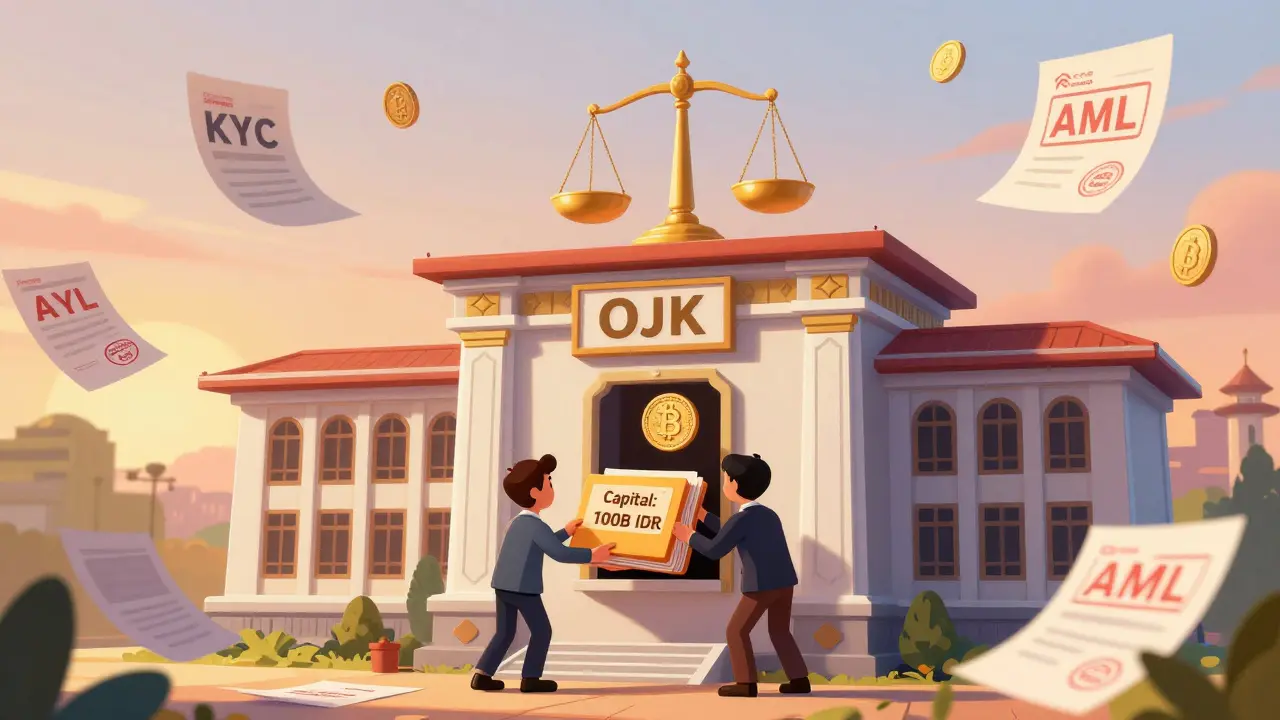
Based on OJK requirements: 100 billion Rupiah (≈$6M) paid-up capital + 50 billion Rupiah (≈$3M) minimum equity
Required Capital
Note: Actual requirements must be met in Rupiah. Current rates may fluctuate. OJK requires verified bank deposits.
Before January 2025, running a crypto exchange in Indonesia meant dealing with BAPPEBTI. Now, it’s all about the OJK and the Digital Financial Assets (DFA) framework. If you’re trying to launch or operate a crypto platform in Indonesia, you’re not just upgrading your tech-you’re entering a completely new regulatory world. The rules changed overnight. And the stakes? Higher than ever.
Who Regulates Crypto in Indonesia Now?
The Otoritas Jasa Keuangan (OJK) took over from BAPPEBTI on January 10, 2025. That’s not just a name change. It’s a full structural overhaul. OJK doesn’t just supervise banks and insurance-it now controls every part of digital asset trading. The shift means crypto is no longer treated like a commodity. It’s now classified as a financial asset, subject to the same scrutiny as stocks or bonds. This puts Indonesia on par with Singapore and Malaysia in terms of regulatory maturity.How Much Money Do You Need to Start?
You can’t just set up a website and call it an exchange. The capital requirements are brutal. You need at least 100 billion rupiah (about $6 million USD) in paid-up capital. That’s money you have to actually have in the bank, not just promise. On top of that, you need 50 billion rupiah ($3 million USD) in minimum equity. These aren’t suggestions. They’re non-negotiable. This filters out small operators and startups without serious funding. Only well-capitalized firms-like Indodax, Tokocrypto, and Pintu-can realistically compete. For new entrants, this means either bringing in deep-pocketed investors or partnering with existing players.The Licensing Process: Five Steps You Can’t Skip
Getting licensed isn’t a formality. It’s a marathon. Here’s what it actually takes:- Register your company as a PT PMA (foreign investment company) through Indonesia’s Ministry of Investments portal. This isn’t just paperwork-it’s legal identity.
- Collect every document needed: articles of incorporation, shareholder lists, beneficial owner profiles, governance policies, and proof of capital. Everything must be notarized.
- Submit your application to OJK with full documentation. All files must be translated into Indonesian by a certified translator. No English documents accepted.
- Pass the inspection. OJK sends auditors to check your tech setup, security protocols, KYC systems, and AML controls. They’ll test your systems. They’ll dig into your ownership history.
- Wait for approval. The review can take 4 to 8 months. There’s no fast track. If any part of your application is incomplete, you start over.

Your Tech Has to Be Bulletproof
OJK doesn’t care how fancy your app looks. They care about how secure it is. You need:- End-to-end encryption for all user data
- Multi-signature wallet systems for cold storage
- Real-time KYC verification with ID and facial recognition
- AML monitoring tools that flag suspicious transactions
- A documented information security policy approved by OJK
What Coins Can You Trade?
The new DFA Exchange, a separate body under OJK, now controls which cryptocurrencies can be traded. In April 2025, they released the first official list: 1,444 digital assets. That’s a 70% jump from BAPPEBTI’s last list of 851. Bitcoin, Ethereum, Solana, and Cardano are all included. But so are dozens of lesser-known tokens-each vetted for liquidity, community activity, and technical integrity. Here’s the catch: even if a coin is on the list, OJK can pull it at any time. If a token shows signs of market manipulation, fraud, or low trading volume, it gets delisted immediately. Exchanges can suggest new coins, but the final call rests with OJK. You can’t list anything without approval. Period.Compliance Isn’t Optional-It’s Constant
Once you’re licensed, the work doesn’t stop. You’re under 24/7 surveillance. Every trade, every deposit, every withdrawal is monitored. You must report suspicious activity to PPATK, Indonesia’s financial intelligence unit, within 24 hours. Failure to report? That’s a criminal offense. You also need:- A dedicated compliance officer based in Indonesia
- Quarterly audits of your AML/KYC systems
- Annual reporting to OJK on transaction volumes, user growth, and risk exposure
- Real-time dashboards accessible to regulators

What About Taxes?
On August 1, 2025, Indonesia changed how crypto is taxed. Gone is the 10% VAT on trades. In its place: a flat 0.21% final income tax on every transaction. That’s it. No complex reporting. No income brackets. No deductions. The tax is automatically withheld by the exchange and paid to the government. This move was designed to remove friction. Before, traders had to file separate tax returns. Now, the system is seamless. It also signals that the government sees crypto as a legitimate financial instrument-not a gray-market gamble.Who’s Already Licensed?
As of March 2025, only one company holds the new DFA Exchange license. But over 20 platforms still operate under their old BAPPEBTI permits-grace period until July 2025. After that, they all must reapply under OJK rules. The big names you know-Indodax, Tokocrypto, Pintu, Reku-are all working to meet the new standards. Smaller platforms? Many are merging. Others are shutting down.What’s Next?
OJK is running a regulatory sandbox for fintech startups. If you’re building something new-like tokenized bonds or DeFi lending-this is your chance to test it legally. But you still need to be licensed. The sandbox doesn’t give you a free pass. Looking ahead, Indonesia will likely align more closely with global standards-FATF guidelines, MiCA-like rules, and cross-border cooperation with ASEAN neighbors. But for now, the message is clear: if you want to operate here, you play by Indonesia’s rules. No shortcuts. No exceptions.Can foreign companies apply for an Indonesian crypto license?
Yes, but they must register as a PT PMA (foreign investment company) with the Ministry of Investments. All operations, including servers and staff, must be based in Indonesia. Foreign ownership is allowed, but local compliance officers and physical presence are mandatory.
What happens if I don’t reapply by July 2025?
Your existing BAPPEBTI license becomes invalid. You must stop all trading activities immediately. Continuing to operate without an OJK license is illegal and can lead to criminal charges, asset seizures, and fines up to 10 billion rupiah ($600,000 USD).
Can I list a new cryptocurrency without OJK approval?
No. Only assets on the official DFA Exchange list can be traded. You can submit a request for inclusion, but OJK reviews each proposal for risk, liquidity, and compliance. Approval is not guaranteed, and the process takes 60-90 days.
Is there a minimum user requirement to get licensed?
No, there’s no minimum user threshold. But OJK requires proof of operational readiness-meaning you must demonstrate you can handle real trading volume, not just a test environment. Platforms with no users or low activity may be flagged during inspections.
How often does OJK inspect licensed exchanges?
At least once a year, but inspections can happen anytime. OJK uses real-time monitoring tools to track trading patterns. If suspicious activity is detected-like rapid wash trading or unverified deposits-an unscheduled audit is triggered immediately.
Do I need to store user funds in Indonesia?
Yes. All cold wallets and hot wallets holding user assets must be physically located within Indonesia. You cannot use foreign custody providers unless they’re licensed under the DFA framework and approved by OJK.
Nicholas Ethan
December 9, 2025 AT 13:24The capital requirements are a joke. $6M just to start? This isn't regulation-it's a cartel setup for the big boys. Small players are dead on arrival. OJK is just protecting incumbents under the guise of 'financial stability'.
And don't get me started on the server localization. You think this is about security? It's about data control. Indonesia wants to own your users' behavior. Welcome to digital feudalism.
Steven Ellis
December 11, 2025 AT 09:27Actually, this is one of the most thoughtful regulatory frameworks in Southeast Asia. The capital requirements ensure operational integrity-no more fly-by-night exchanges vanishing with user funds.
The mandatory local servers? That’s not control-it’s accountability. If you’re handling financial assets, you owe users the same protection banks provide. Indonesia’s doing it right: clear rules, real enforcement, zero tolerance for fraud.
Compare this to places where crypto is a Wild West. Here, you get legitimacy. That’s worth the cost.
Sue Gallaher
December 11, 2025 AT 23:13They’re forcing foreign companies to set up shop here but still won’t let them use AWS or Google Cloud? What a joke. This isn’t sovereignty-it’s tech isolationism.
And 1444 coins? That’s not regulation. That’s a lottery. Half of those tokens are garbage. They’re just trying to look busy.
Claire Zapanta
December 12, 2025 AT 18:56Remember when BAPPEBTI was in charge? At least then you knew it was a joke. Now OJK is the real monster. They don’t just regulate-they surveil. Real-time dashboards? 24/7 monitoring? This isn’t finance. It’s a police state for traders.
And the tax? 0.21% sounds tiny until you realize every single trade is tracked, logged, and reported. You’re not trading crypto anymore. You’re feeding data to the state.
Bridget Suhr
December 12, 2025 AT 19:44Some of this makes sense. Local servers? Good. KYC? Necessary. But why force every exchange to be a bank? Crypto was supposed to be decentralized. Now it’s just another regulated industry with red tape.
I’m torn. I want safety, but I also miss the wild west days. Maybe this is progress… or maybe it’s just another way to kill innovation.
Rakesh Bhamu
December 13, 2025 AT 10:56As someone who’s been in the space since 2017, I’ve seen this coming. Indonesia needed this. Too many scams. Too many fake exchanges. Too many users losing life savings.
The $6M cap is steep, but if you’re serious about building something real, you can raise it. Partnerships. VCs. The market will adapt.
This isn’t the end of crypto here-it’s the beginning of a real market.
Joey Cacace
December 14, 2025 AT 03:20Wow. This is actually really well thought out. I didn’t expect Indonesia to be this advanced. The 0.21% tax is genius-simple, efficient, no room for evasion.
And the fact they’re allowing new coins through a vetted list? That’s smart. Not too strict, not too loose. Just right.
Big props to OJK. This is how you do crypto regulation.
Patricia Whitaker
December 14, 2025 AT 18:07100 billion rupiah? That’s ridiculous. Who’s going to pay that? Only the rich. So now crypto is just for billionaires. Congrats, Indonesia-you just made it exclusive.
And you call this innovation? It’s just a tax on ambition.
Taylor Farano
December 16, 2025 AT 03:20Oh look, another country that thinks it can out-regulate Silicon Valley. You want to be Singapore? Then stop acting like a 19th-century customs office.
Local servers? Certified translators? A 4–8 month approval window? You’re not building a financial hub. You’re building a bureaucratic graveyard.
Ian Norton
December 16, 2025 AT 10:50They say ‘bulletproof tech’ but never mention what happens if the system fails. Who’s liable? The exchange? The government? The user?
And if OJK can delist any coin at any time? That’s not regulation. That’s arbitrary power dressed up as policy. This isn’t a market. It’s a dictatorship with a dashboard.
amar zeid
December 16, 2025 AT 21:56Most people don’t realize how much this aligns with ASEAN’s digital finance roadmap. Indonesia’s setting the tone. Malaysia’s watching. Thailand’s listening. This is the blueprint for the region.
Yes, it’s strict. But look at the alternatives-Philippines chaos, Vietnam black markets, Cambodia scams. This is the price of legitimacy.
Stanley Machuki
December 17, 2025 AT 23:18Finally someone gets it. The tax system alone is worth it. No more filing 1099s, no more confusion. Just 0.21% taken automatically. Clean. Simple. Fair.
And the fact they’re forcing real KYC? That’s the only way this survives long-term. No more anonymous wallets. No more laundering. This is the future.
Hari Sarasan
December 18, 2025 AT 06:29Let me be clear: this is not regulation. This is nationalization under the guise of financial oversight. The OJK is not a regulator-it is a gatekeeper. The capital requirements are not for stability-they are for exclusion.
The servers? The translations? The 4–8 month wait? This is not about protecting users. This is about controlling the narrative. This is digital protectionism. And it will backfire.
JoAnne Geigner
December 19, 2025 AT 11:20I’ve read a lot of regulatory updates, but this one actually gives me hope. It’s not perfect, but it’s balanced. They’re not trying to ban crypto. They’re not letting it run wild. They’re building a system that can scale, that can protect people, and that can earn global trust.
Yes, it’s hard. But hard doesn’t mean wrong. If you want to be taken seriously in finance, you don’t cut corners. You build foundations. And Indonesia? They’re building a foundation.
Abhishek Bansal
December 19, 2025 AT 16:06Wait so you need $6M just to start? Bro. I made $500 in 2021 trading meme coins. Now I’m supposed to be a bank? This is why crypto is dying. It’s not about freedom anymore. It’s about who has the most money.
And why do I need to translate everything to Bahasa? I’m not even in Indonesia. Why am I being forced to play by their rules if I’m not even there?
Kathy Wood
December 20, 2025 AT 22:37They shut down two exchanges for not verifying 30% of users? That’s not enforcement-that’s cruelty. What about the people who just signed up? What if they’re students? Retirees? People without IDs? This isn’t safety. It’s exclusion disguised as compliance.
And now you’re telling me I can’t trade a coin because OJK says so? Who elected them? No one. And now they control my money.
Heath OBrien
December 21, 2025 AT 12:39They’re calling this progress? This is the end of crypto. No more anonymity. No more freedom. Just another government-controlled financial tool. You think you’re trading Bitcoin? No. You’re feeding data to a surveillance state.
And the tax? 0.21% sounds cute until you realize every trade is recorded forever. Welcome to the panopticon.
Jeremy Eugene
December 23, 2025 AT 01:14This is the most comprehensive crypto regulatory framework I’ve seen in emerging markets. The alignment with FATF, the local custody rules, the real-time monitoring-all of it shows serious intent.
Yes, it’s burdensome. But if you’re building a legitimate business, you should want this. It’s the difference between being a trusted platform and being a target for fraudsters.
Kathryn Flanagan
December 24, 2025 AT 00:27Let me just say this: if you’re thinking of launching an exchange in Indonesia, you better have a team of lawyers, compliance officers, and tech auditors ready to move in. This isn’t a startup. This is a corporate operation now.
And don’t think you can cut corners. OJK isn’t playing. They’ve got real-time dashboards. They’ve got auditors on the ground. They’ve got teeth.
But honestly? That’s a good thing. We’ve seen too many people get burned. This isn’t the death of crypto. It’s the birth of a responsible one.
Albert Chau
December 24, 2025 AT 20:29You call this maturity? This is control. The moment you need a government-approved list of coins to trade, you’ve lost. Crypto was supposed to be permissionless. Now you need a permit to buy Bitcoin.
And the fact that OJK can delist any coin overnight? That’s not regulation. That’s censorship. You’re not building a market-you’re building a museum.
Jessica Petry
December 25, 2025 AT 01:40It’s funny how people act like $6M is too much. If you’re building something that handles other people’s money, you should have skin in the game. If you can’t raise that kind of capital, you shouldn’t be in charge of financial infrastructure.
And the server rule? Of course it’s mandatory. You don’t let foreign companies store your citizens’ financial data on AWS servers in Virginia. That’s not paranoia. That’s basic sovereignty.
Eunice Chook
December 25, 2025 AT 20:31They’re calling this a financial asset? Then why is it taxed differently than stocks? Why not just integrate it into the existing system?
This isn’t innovation. It’s a bureaucratic sideshow. They’re creating a parallel financial system just to feel powerful.
And the 1444 coins? That’s not diversity. That’s chaos dressed up as choice.
Rakesh Bhamu
December 27, 2025 AT 18:10Just saw a startup in Jakarta got approved in 5 months. They had a full compliance team, local servers, and real AML tools. No shortcuts. But they’re live now.
It’s hard. But it’s possible. And when you’re licensed, you get real customers. Real trust. Real growth.
This isn’t a wall. It’s a filter. And the ones who make it through? They’ll be the leaders.
Stanley Machuki
December 29, 2025 AT 05:03And the tax? Still the best part. No more tax season panic. No more spreadsheets. Just 0.21% gone, automatically. The government wins. Users win. Even the exchanges win-less overhead.
This is how you scale adoption. Not by banning. Not by overcomplicating. By making it stupid simple.