

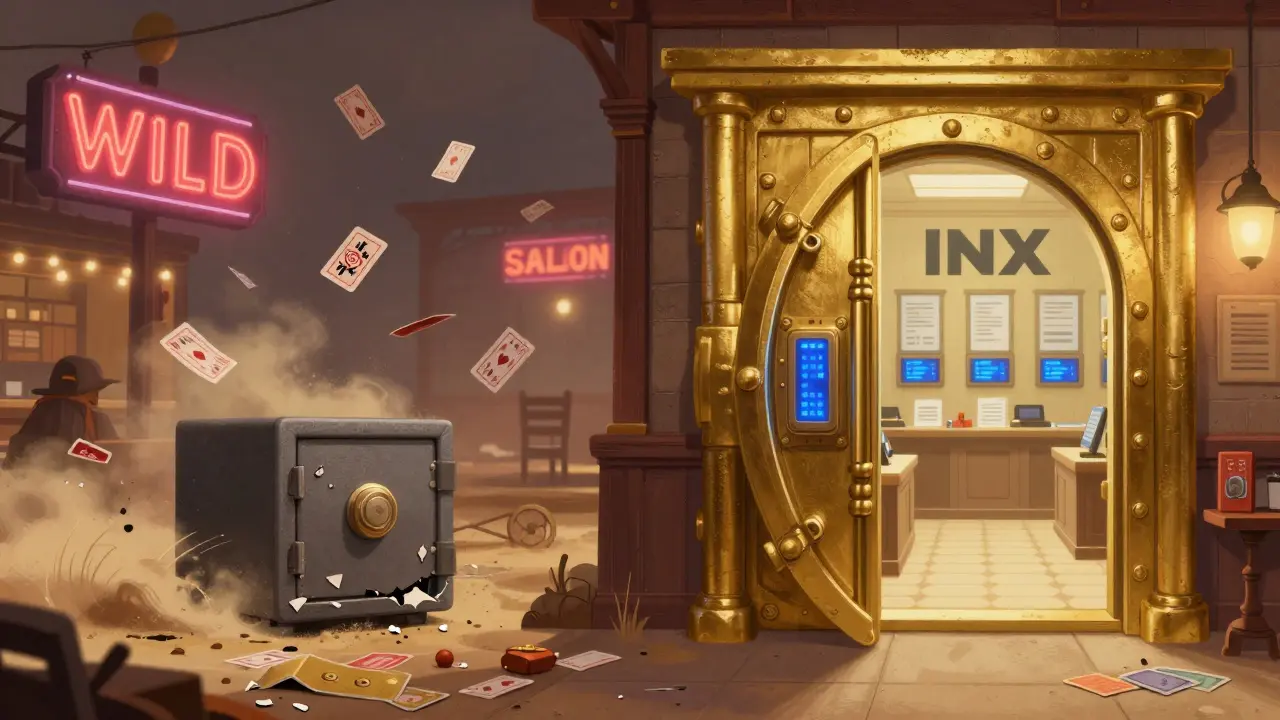
Most crypto exchanges are wild west saloons. You get speed, leverage, and hundreds of coins, but you also get regulatory gray areas and the occasional hack. Then there is INX, which operates more like a fortified bank vault. It is one of the few platforms in the world that is fully registered with the US Securities and Exchange Commission (SEC) to trade both standard cryptocurrencies and digital securities. If you are looking to day-trade meme coins or use 100x leverage, this platform will frustrate you. But if you are an accredited investor seeking compliant access to tokenized real-world assets, INX might be exactly what you have been waiting for.
This review breaks down how INX works, who it is actually for, and whether its heavy compliance focus comes at too high a cost for your portfolio. We look at the fees, the technology, the limited coin selection, and the unique value proposition of trading security tokens alongside Bitcoin.
What Is INX? A Hybrid Trading Platform
To understand INX, you have to stop thinking about it as just another crypto exchange like Binance or Coinbase. INX Limited was founded to bridge the gap between traditional finance (TradFi) and decentralized finance (DeFi). It launched its primary trading solution, INX.One, after completing a $85 million IPO in August 2020. This made it the first blockchain company to complete a registered public offering, setting a precedent for institutional legitimacy.
The platform operates under multiple SEC regulations, including Regulation ATS (Alternative Trading System), Regulation D, Regulation A+, and Regulation S. It holds a Distributed Ledger Technology (DLT) license from the Gibraltar Financial Services Commission. This regulatory moat is its biggest selling point. While most exchanges operate in a legal gray area regarding securities, INX provides a legally compliant environment for trading tokenized stocks, private equity, and other real-world assets (RWAs).
However, this compliance comes with strict rules. You cannot just sign up and start trading everything. Access to the security token portion of the platform requires accreditation verification. For standard cryptocurrencies, the barrier to entry is lower, but the experience is still tailored toward conservative, long-term holders rather than speculative traders.
Crypto Selection and Security Token Ecosystem
If you are used to scrolling through lists of 500+ coins on other exchanges, INX will feel sparse. As of 2026, the platform supports trading for only seven major cryptocurrencies:
- Bitcoin (BTC)
- Ethereum (ETH)
- Litecoin (LTC)
- Avalanche (AVAX)
- Zcash (ZEC)
- Ripple (XRP)
- Solana (SOL)
Why so few? INX focuses on quality and regulatory clarity over quantity. These are established assets with clear market positions. But the real draw for many users is not the crypto itself; it is the security tokens. INX allows users to trade tokens representing real-world assets. This includes tokenized shares of companies, real estate investment trusts, and private credit instruments.
| Feature | INX | Coinbase / Binance |
|---|---|---|
| Asset Types | Crypto + Security Tokens (RWAs) | Cryptocurrencies Only |
| Regulatory Status | SEC Registered (ATS, Reg D, etc.) | Varies (Often unregistered ATS) |
| Coin Count | 7 Major Coins | 200+ Coins |
| Leverage/Margin | No | Yes (Up to 100x) |
| Daily Volume | $5-7 Million | $15-20 Billion+ |
The table above highlights the trade-off. You lose variety and leverage, but you gain access to a completely different asset class that is largely unavailable on mainstream retail exchanges. For institutional investors and accredited individuals, the ability to hold Bitcoin and a tokenized share of a commercial building in the same portfolio is revolutionary.
User Experience and Interface
The INX.One interface is clean, professional, and intentionally simple. It avoids the cluttered dashboards seen on high-frequency trading platforms. Both desktop and mobile-responsive versions offer candlestick charts powered by TradingView, comprehensive order books, and market depth charts.
The learning curve is moderate. New users typically spend 45-60 minutes on initial setup. The KYC/AML process is rigorous. For standard crypto trading, you provide identification documents. For security tokens, you must undergo additional accreditation verification, which can take 3-5 business days. This is significantly longer than the 1-2 day turnaround on pure crypto exchanges, but it is necessary for legal compliance.
Once verified, the trading experience is straightforward. You can place limit, market, stop-limit, and stop-market orders. There are no complex derivatives interfaces to confuse you. However, advanced traders may find the charting tools lacking compared to standalone platforms like TradingView’s full suite. The mobile app, rated 4.3/5 on the Apple App Store, excels at providing a unified portfolio view but lacks deep technical analysis features.
Fees, Liquidity, and Slippage
Here is where the "regulated" label starts to show its teeth. INX does not publish a detailed fee schedule publicly, but transaction fees can be paid in USD, BTC, or ETH. The bigger issue is not the explicit fee, but the implicit cost of liquidity.
Liquidity refers to how easily you can buy or sell an asset without affecting its price. Because INX has a niche user base, its daily trading volume averages around $5-7 million. Compare this to Binance, which processes $15-20 billion daily. Low volume means wider bid-ask spreads.
In practice, this means slippage. On Coinbase, executing a $50,000 Ethereum order might result in 0.15% slippage. On INX, that same order could see 0.8% slippage due to thinner order books. For small trades, this is negligible. For large institutional moves, it adds up. Users should be aware that they are paying for regulatory safety, not execution speed or depth.
Security and Custody
Security is INX’s strongest suit. The platform employs BitGo Trust Company, Inc. as its qualified custodian. BitGo is an industry leader in institutional-grade crypto custody. Assets are stored using a combination of 'hot' (online) and 'cold' (offline) storage solutions with multi-signature wallet technology.
This setup meets Rule 206(4)-2 standards under the Investment Advisers Act of 1940, which sets strict requirements for safeguarding client funds. Unlike many exchanges that commingle user funds, INX’s structure ensures that your assets are held separately and securely. The "Smart Contract Guarantee" feature further enhances transparency by allowing users to verify transaction details on-chain.
However, the platform’s architecture has a technical limitation. It uses sequential processing, handling transactions one after another rather than in parallel. While this enhances security and auditability, it can create throughput bottlenecks during periods of extreme market volatility. Dr. Sarah Chen from MIT’s Digital Currency Initiative noted in 2023 that this could disadvantage retail participants during rapid price swings. To address this, INX announced an integration with the Avalanche blockchain in August 2025 to improve transaction speed.

Who Should Use INX?
INX is not for everyone. Here is a quick breakdown of who benefits and who should look elsewhere.
Best For:
- Accredited Investors: Those seeking compliant exposure to security tokens and tokenized real-world assets.
- Institutional Clients: Firms requiring SEC-compliant infrastructure for digital asset trading.
- Conservative Crypto Holders: Users who prioritize regulatory safety and cold storage over trading features.
Not For:
- Day Traders: Lack of leverage, futures, and low liquidity make active trading difficult.
- Altcoin Hunters: With only 7 coins, you won’t find new gems or meme coins here.
- High-Frequency Traders: Sequential processing and wider spreads will eat into profits.
Future Outlook and Roadmap
The landscape for digital assets is shifting rapidly. Following the 2024 Grayscale Bitcoin Trust ruling, the SEC’s stance on digital assets is evolving, which bodes well for platforms like INX that operate within clear frameworks. SEC Commissioner Hester Peirce praised such platforms in March 2025 as essential for market maturation.
INX is expanding. By Q2 2026, the platform plans to increase its cryptocurrency offerings to 15 major coins, introduce staking for Proof-of-Stake assets, and launch a dedicated institutional API with FIX protocol support. The global security token market, valued at $6.2 billion in late 2025, is projected to grow at a 38.7% CAGR through 2030. INX currently holds an estimated 18.3% market share in this niche, positioning it as a key player in the tokenization revolution.
Bernstein Research forecasts INX could reach $50 million in annual revenue by 2027, driven primarily by issuance fees for security tokens. While it will likely remain a "volume laggard" in general crypto trading, its dominance in the regulated security token space gives it a sustainable competitive advantage.
Is INX a safe exchange?
Yes, INX is considered highly safe due to its SEC registration and partnership with BitGo Trust Company for custody. It uses multi-signature cold storage and adheres to strict regulatory standards, making it safer than many unregulated offshore exchanges. However, no platform is immune to all risks, and users should always practice good personal security hygiene.
Can I trade leverage on INX?
No, INX does not offer margin trading, leverage, perpetual contracts, or futures. The platform is designed for spot trading of cryptocurrencies and security tokens, focusing on capital preservation and regulatory compliance rather than speculative trading strategies.
How do I become an accredited investor on INX?
To access security tokens, you must verify your accredited investor status during the KYC process. This typically involves proving an annual income exceeding $200,000 ($300,000 with a spouse) for the last two years, or having a net worth over $1 million excluding your primary residence. Documentation is required, and verification takes 3-5 business days.
What cryptocurrencies can I trade on INX?
As of 2026, INX supports seven major cryptocurrencies: Bitcoin (BTC), Ethereum (ETH), Litecoin (LTC), Avalanche (AVAX), Zcash (ZEC), Ripple (XRP), and Solana (SOL). The platform plans to expand this list to 15 coins by mid-2026.
Why is the liquidity on INX lower than other exchanges?
INX serves a niche market of regulated security token traders and conservative crypto investors. Its strict compliance requirements limit its user base compared to mass-market exchanges like Binance or Coinbase. Additionally, its sequential processing architecture prioritizes security over high-speed throughput, which naturally limits high-frequency trading volume.