


When you hear "Kujira Fin crypto exchange," you might picture a polished platform like Binance or Coinbase - but that’s not what it is. Kujira Fin isn’t a centralized exchange at all. It’s a DeFi ecosystem built on the Cosmos blockchain, and its native token, KUJI, is traded almost entirely on decentralized platforms. If you’re looking to trade KUJI, you won’t find it on Robinhood or Kraken. You’ll need to connect a wallet, navigate a decentralized exchange, and understand the risks of a low-liquidity asset. This isn’t a review of a typical crypto exchange. It’s a reality check on what Kujira actually is - and whether it’s worth your time.
What Is Kujira, Really?
Kujira isn’t a place to buy Bitcoin with a credit card. It’s a suite of decentralized finance tools built to serve the Cosmos network. Think of it as a factory that builds DeFi products - lending, borrowing, yield farming, and trading - all designed to generate real, on-chain returns. The KUJI token powers this system. It’s not just a currency; it’s a governance and utility token that lets users vote on upgrades, earn rewards from protocol fees, and access exclusive features. Unlike most tokens that rely on hype, Kujira’s growth came from actual usage. In early 2024, wallet addresses jumped from 117,000 to 180,000 in just six weeks. That’s not pump-and-dump behavior - that’s people using the platform. But adoption has slowed since then. The ecosystem’s total value peaked around $70 million, mostly from real activity, not price spikes. That’s important. It means Kujira’s value isn’t just tied to speculation. It’s tied to whether people keep using its tools.Where Can You Trade KUJI?
Here’s the hard truth: you can’t buy KUJI on most major exchanges. It’s not listed on Binance, Coinbase, or Kraken. The only places you’ll find it are decentralized exchanges (DEXs) within the Cosmos ecosystem - mostly Kujira’s own DEX, called Kujira Swap. This limits accessibility. If you don’t already have a crypto wallet like Keplr, and you don’t understand how to swap tokens on a DEX, you’re locked out. Trading volume is low. CoinLore classifies KUJI as a low-trade-volume asset, which means two things: price swings are wild, and slippage is high. If you try to buy $1,000 worth of KUJI, you might end up paying 10% more than expected because there aren’t enough sellers. That’s not a bug - it’s a feature of illiquid markets. And because it’s not on big exchanges, there’s no customer support if something goes wrong. You’re on your own.Current Price and Market Performance
As of March 2026, KUJI trades around $0.20. That’s down from its all-time high of $5.22. That’s a 96% drop. That sounds terrifying - and it is - but context matters. The token’s value isn’t just about price. It’s about how much activity is happening on the network. Recent numbers tell a rough story:- -12.59% in the last 24 hours
- -11.14% in the last week
- -46.49% in the last month
- -83.48% over the last three years
Price Predictions: Hope vs. Reality
Some analysts are betting big on KUJI. Crypto.ro predicts it could hit $6.20 in 2025 and $7.85 by year-end. CoinLore’s algorithm forecasts $3.64 in 2025 and $42.96 in ten years. Changelly’s more conservative take? $0.196 average in 2025, $1.18 by 2030. These predictions aren’t magic. They’re based on assumptions: adoption of Cosmos, regulatory shifts, and increased liquidity. But here’s the catch - none of these forecasts account for the fact that KUJI has been losing ground for years. If the Cosmos ecosystem slows down, Kujira loses its runway. If no major exchange lists KUJI, liquidity won’t improve. And if users stop farming yield on Kujira’s DEX, the real yield engine stops running.Why Kujira Could Still Matter
Despite the price drop, Kujira isn’t dead. It’s still one of the few DeFi ecosystems focused on real yield. Most DeFi projects promise 100% APY from token emissions - but those yields vanish when the token crashes. Kujira’s yield comes from actual trading fees, lending interest, and protocol revenue. That’s sustainable. If the Cosmos network grows, Kujira’s infrastructure becomes more valuable. Also, the ecosystem has built real tools: a stablecoin (USK), a lending protocol (KUJI Lend), and a DEX that handles millions in daily volume. These aren’t vaporware. They’re working. And if the broader crypto market rebounds, Kujira’s infrastructure could attract new users looking for safe, real yield - not just speculation.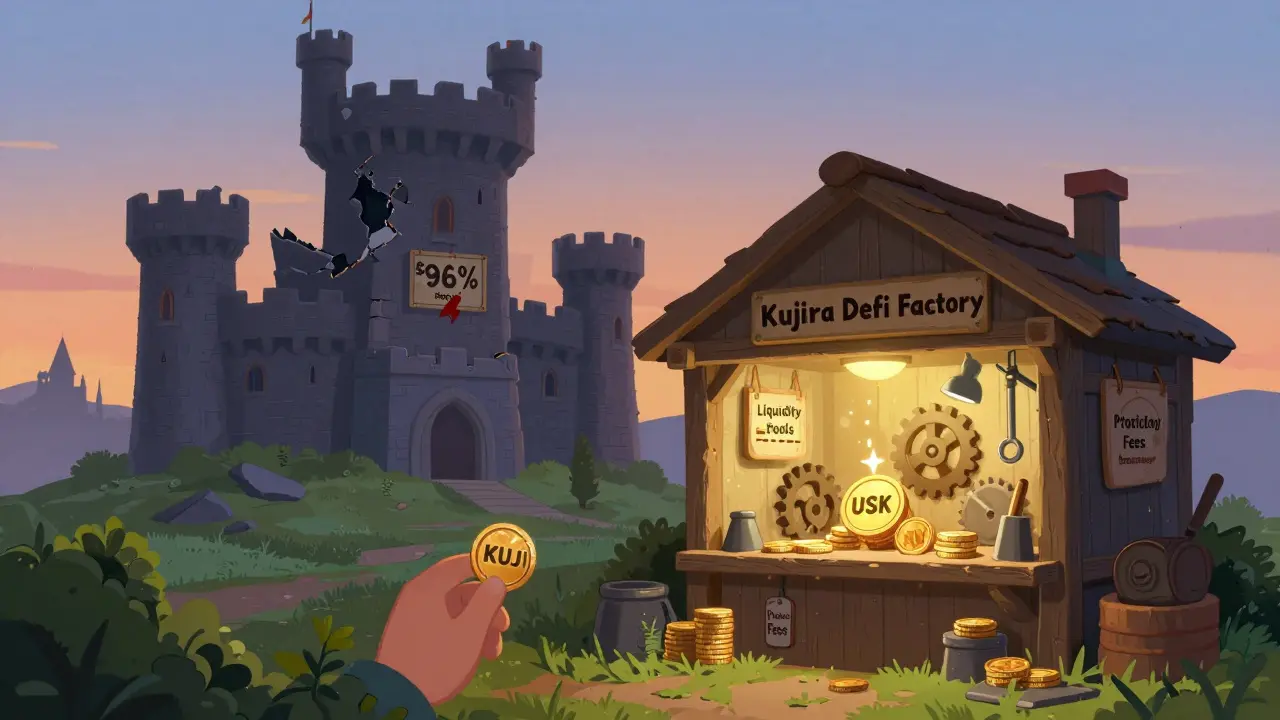
The Risks You Can’t Ignore
Low liquidity means you might not be able to sell when you want to. High volatility means your portfolio could lose 20% in a day. No exchange listing means no fiat on-ramps - you can’t buy KUJI with PayPal or a bank transfer. And then there’s Cosmos. Kujira’s fate is tied to the Cosmos network. If Cosmos adoption stalls - if other chains like Solana or Ethereum dominate DeFi - Kujira could become irrelevant. It’s not a standalone project. It’s a supporting actor in a bigger play. Regulatory risk is real too. Kujira operates across borders, and regulators don’t yet know how to treat DeFi protocols. One crackdown on yield farming could freeze the whole system.Who Should Trade KUJI?
If you’re a beginner, stay away. KUJI isn’t a “set and forget” investment. It’s a high-risk, technical play. If you’re already deep into Cosmos DeFi - you use Keplr, you’ve swapped tokens on Osmosis, you understand staking and liquidity pools - then KUJI might fit in your portfolio. But only as a small bet. Allocate 1-2% of your crypto holdings at most. If you’re looking for a crypto with strong fundamentals, real usage, and long-term infrastructure - Kujira is worth watching. But don’t buy it because a prediction says it’ll hit $10. Buy it because you believe in the ecosystem. And be ready to hold through the pain.Final Take
Kujira Fin isn’t a crypto exchange. It’s a DeFi engine. And KUJI isn’t a stock - it’s a utility token in a fragile, ambitious system. The price is down. The volume is low. The risks are high. But the underlying tech still works. If you’re comfortable with the complexity and the volatility, Kujira offers something rare: a DeFi project built on real yield, not hype. Just don’t expect a quick flip. This is a long game - if you’re willing to play it.Is Kujira Fin a centralized crypto exchange like Binance?
No, Kujira Fin is not a centralized exchange. It’s a decentralized finance (DeFi) ecosystem built on the Cosmos blockchain. KUJI, its native token, is traded primarily on decentralized exchanges like Kujira Swap, not on platforms like Binance or Coinbase. You need a crypto wallet and some technical knowledge to interact with it.
Where can I buy KUJI token?
You can buy KUJI on decentralized exchanges within the Cosmos ecosystem, such as Kujira Swap, Osmosis, or other Cosmos-based DEXs. It’s not listed on any major centralized exchanges as of 2026. To trade it, you’ll need a wallet like Keplr, some Cosmos chain assets (like ATOM or USDC), and an understanding of how to swap tokens on a DEX.
Why is KUJI’s price so low compared to its all-time high?
KUJI peaked at $5.22 but has since fallen over 96% due to broader crypto market conditions, low trading volume, and reduced speculative interest. Unlike tokens backed by massive exchange listings or corporate adoption, KUJI’s value is tied to real usage within the Cosmos DeFi ecosystem. When user growth slowed, the price followed. It’s a classic case of hype fading faster than fundamentals can sustain.
Is Kujira a good long-term investment?
It depends. Kujira has real DeFi infrastructure - lending, stablecoins, and yield-generating tools - which sets it apart from speculative projects. If the Cosmos network grows, Kujira’s value could rise. But if Cosmos stagnates, or if liquidity doesn’t improve, KUJI may stay stuck in low-trading territory. It’s not a guaranteed win. Only consider it if you believe in Cosmos DeFi and can tolerate high volatility.
What’s the difference between Kujira and other DeFi projects?
Most DeFi projects rely on token emissions to pay users high APYs - but those yields collapse when the token price drops. Kujira generates real yield from trading fees, lending interest, and protocol revenue. This means its rewards are more sustainable. It’s less about pumping tokens and more about building functional, long-lasting financial tools on Cosmos.
Should I stake KUJI tokens?
Staking KUJI can earn you rewards from protocol fees, but it’s not without risk. The token’s price is volatile, and if the value drops significantly while you’re staked, your overall return could be negative. Only stake what you can afford to lose, and make sure you understand how to unstake and withdraw your tokens if needed. Always check the current APY and lock-up period before staking.
Douglas Anderson
March 11, 2026 AT 12:02Kujira isn't a exchange. It's a DeFi engine. Most people don't get that. They see the price drop and panic. But if you look at the actual usage-wallets, trading volume, protocol fees-it's still humming. The infrastructure is solid. The token just hasn't caught up yet.
vasantharaj Rajagopal
March 11, 2026 AT 12:37Low liquidity means slippage kills you on buys. I tried to dump 500 KUJI last week and ended up at 80% of the quoted price. No one on Reddit talks about this. They just say "buy the dip." But when there's no depth, the dip is a cliff.
Anshita Koul
March 12, 2026 AT 05:58It's not about the price, is it? It's about whether the system keeps running. Kujira isn't trying to be the next Binance-it's trying to be the plumbing of Cosmos DeFi. And plumbing doesn't get headlines. It just works. Quietly. Reliably. Until someone finally notices it's the only thing holding the whole house together.
Tina Keller
March 13, 2026 AT 04:15I came from Ethereum DeFi. I thought I'd seen it all. Then I tried Kujira. The UI is clunky. The docs are sparse. But the yield? Real. Actual trading fees flowing into stakers-not just new token emissions. It’s like finding a quiet, well-maintained garden in a desert of fireworks and smoke.
Most projects burn out in six months. Kujira’s been here three years. That’s not luck. That’s discipline.
Michael Suttle
March 14, 2026 AT 05:25They don’t want you to know this-but Kujira’s being quietly suppressed. Big exchanges won’t list it because they’re owned by the same players who profit from centralized stablecoins. This is a war. KUJI is the resistance. The price drop? A coordinated attack. The real story? It’s still growing on-chain. They can’t kill what they can’t control.
Julie Tomek
March 15, 2026 AT 15:28For those of you who are new to DeFi, I want to gently remind you that liquidity is not just a metric-it’s a lifeline. When you trade on a DEX with low volume, you are essentially becoming the market maker. You are taking on risk that centralized platforms absorb for you. This is not a casual investment. This is a technical commitment. Please ensure you have tested withdrawals, understand slippage tolerance, and have a cold wallet ready before proceeding.
Brandon Kaufman
March 16, 2026 AT 15:07I used to think Kujira was dead. Then I checked the KUJI Lend pool. It’s still getting $2M in daily deposits. People aren’t leaving. They’re just waiting. And if the next Cosmos upgrade goes well? This could be the quiet breakout nobody saw coming.
Craig Gregory
March 17, 2026 AT 04:10Let’s be honest: KUJI is a graveyard for retail traders. You bought it at $1.50? Congrats, you’re underwater. You bought it at $3? You’re in the red zone. The only people making money here are the early whales who dumped at $4.50 and the devs who got their seed allocation. This isn’t DeFi innovation-it’s a redistribution scheme disguised as a protocol.
PIYUSH KOTANGALE
March 17, 2026 AT 16:39vishnu mr
March 17, 2026 AT 23:57i thoght kujira was a exchage too lol but no its more like a deif hub... i staked my kuji last month and got 12% apy from fees not new tokens... thats real... even if price down
Grace van Gent-Korver
March 18, 2026 AT 16:00I’m from the Midwest. I don’t know what a DEX is. But I do know this: if you can’t buy it with PayPal, it’s not for me. I’m not trying to become a blockchain engineer just to trade a token. Kujira’s cool. But it’s not for everyone.
Zephora Zonum
March 19, 2026 AT 07:34Lindsay Girvan
March 19, 2026 AT 20:04ann neumann
March 20, 2026 AT 03:54They’re all lying. Every single one. The price is being manipulated by a consortium of Cosmos validators who control 60% of the staked KUJI. They’re dumping in waves, slowly, so retail doesn’t panic. The real value? It’s all locked in governance votes. Nobody talks about that because they don’t want you to know you’re being used as a liquidity pump.
I’ve seen this before. Remember Terra? Luna? Same script. Same actors. Just a new name.
William Montgomery
March 20, 2026 AT 11:14You’re all missing the point. Kujira doesn’t need to be on Binance. It needs to be on-chain. And it is. The fact that you can’t buy it with a credit card means it’s actually decentralized. That’s a feature. Not a bug. If you want convenience, go to Coinbase. If you want freedom, use Kujira.
Mara Alves Mariano
March 21, 2026 AT 15:56Of course KUJI is down. America’s been pumping Solana and Ethereum while the rest of the world builds real infrastructure. Kujira’s not for you. It’s for the people who don’t care about your TikTok crypto influencers. It’s for the builders. The quiet ones. The ones who show up even when no one’s watching.
And yeah, I’m Indian. And yeah, I’m proud of that. We didn’t wait for permission to build. We just did it.
Adam Ashworth
March 21, 2026 AT 21:00Look, if you’re holding KUJI because you think it’ll hit $10, you’re delusional. But if you’re holding it because you believe in the tools-USK, Kujira Swap, the lending pool-then you’re not just holding a token. You’re backing a movement. And that’s worth something.
Tom Jewell
March 23, 2026 AT 11:03People forget that DeFi isn’t about price charts. It’s about trustless systems. Kujira’s not flashy. No celebrity endorsements. No hype videos. Just code. And that code is still running. People are still swapping. Still lending. Still earning. That’s more than 90% of crypto projects can say after three years.
It’s not sexy. But it’s real.
karan narware
March 23, 2026 AT 21:21Wow. You wrote a novel. And still didn’t answer the question: Is Kujira Fin an exchange? No. It’s a blockchain ecosystem. You didn’t say that. You buried it in paragraphs. That’s why people get confused. Just say it: It’s not an exchange. Stop pretending it is.
Douglas Anderson
March 24, 2026 AT 02:01That’s exactly right. The title says "review," but the whole thing reads like an infomercial for Cosmos. If you’re going to write about Kujira, stop calling it an exchange. That’s misleading. It’s like calling a bicycle a car because it has wheels.