

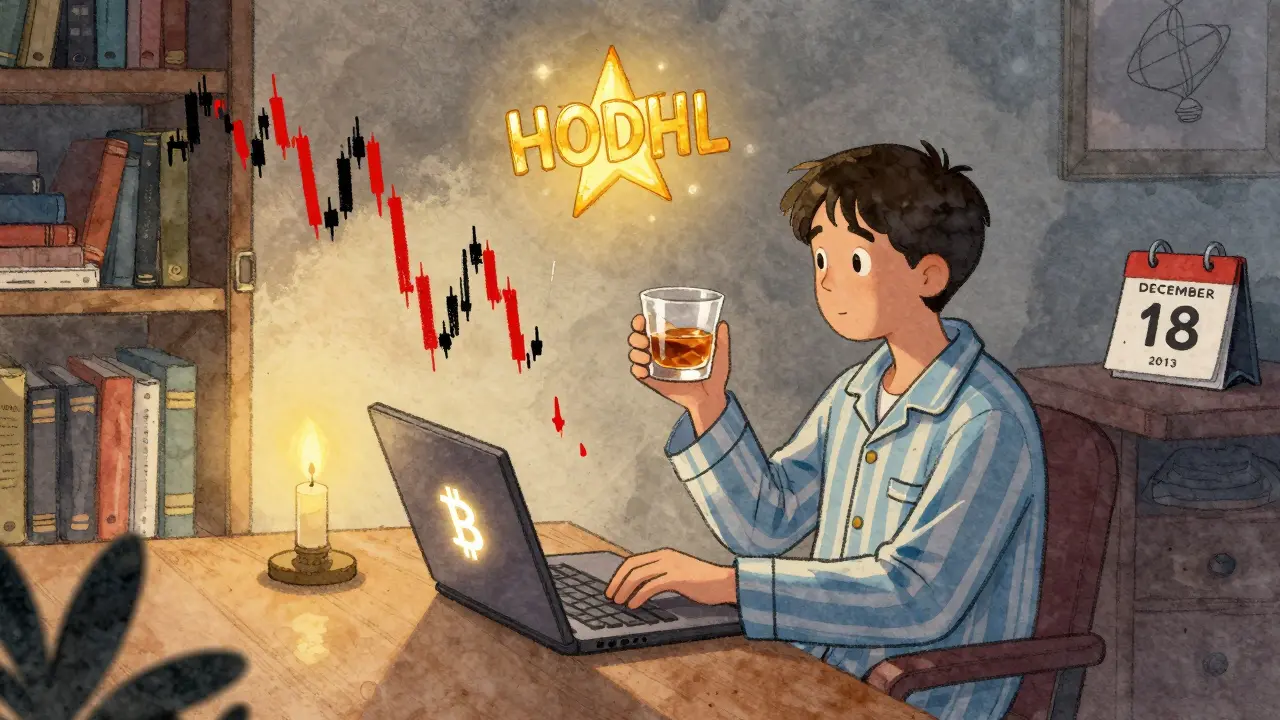
On December 18, 2013, a frustrated trader on Bitcointalk typed "I AM HODLING" after drinking whiskey and watching Bitcoin crash 39% in one day. He meant to say "holding"-but the typo stuck. What started as a drunken mistake became the defining philosophy of a generation of crypto investors. Today, HODLing isn’t a meme. It’s a proven path to wealth.
What HODLing Actually Means
HODLing isn’t just buying crypto and forgetting about it. It’s a disciplined decision to hold through every crash, every panic, every headline screaming "Crypto is dead." The strategy works because it removes emotion from investing. Most people lose money in crypto not because the asset fails-but because they sell low and buy high. HODLers avoid that trap entirely. The math is simple: Bitcoin was trading around $100 in early 2013. By the end of that year, it hit $1,100. Then it crashed to $200 in 2015. HODLers didn’t panic. They bought more. By 2017, it hit $20,000. Then crashed to $3,000 in 2018. HODLers held. By 2021, it hit $69,000. Then dropped to $16,000 in 2022. Still held. In 2025, Bitcoin trades near $70,000. Someone who bought $1,000 worth in 2013 and held through every storm now has over $700,000. That’s not luck. That’s strategy.Real People, Real Results
Reddit’s r/cryptohodl community has over 987,000 members. Scroll through it, and you’ll find real stories-not speculation. One user, u/BitcoinPioneer87, bought 50 BTC in 2014 at $250 each. Total investment: $12,500. He stored it on a Trezor wallet. He didn’t check his balance for months at a time. When Bitcoin hit $3,200 in 2018, friends begged him to sell. He didn’t. When it hit $69,000 in 2021, his holdings were worth $3.45 million. He still holds. He doesn’t talk about it much. He just lives. Another case: a New Zealand teacher bought 2 BTC in 2015 for $600. She didn’t know what blockchain was. She just believed in the idea. She kept her keys on a hardware wallet. In 2022, during the FTX collapse, her portfolio dropped 78%. She didn’t touch it. In 2025, it’s worth $140,000. She used part of it to pay off her mortgage. The rest? Still HODLing. These aren’t outliers. CoinTracker’s 2024 survey of 5,300 long-term holders found that 68% of those who held for at least three years turned a profit. The top 10%-those who held five years or more-saw returns over 1,200%. Median return? 380%.Why Most People Fail at HODLing
HODLing sounds easy. But 88% of people who start don’t finish. Why? The biggest killer? Emotional selling during drawdowns. When Bitcoin dropped from $69,000 to $16,000 in 2022, 63% of failed HODLers panicked and sold. They thought the crash was the end. It wasn’t. It was the beginning of the next bull run. Another reason: bad security. Over 98% of crypto losses happen on exchanges. One Reddit user, u/CryptoRegret99, lost $68,000 in ETH because he kept his keys on an exchange and fell for a Discord scam. He thought he was "just keeping it convenient." Convenience cost him everything. And then there’s diversification gone wrong. Many HODLers put 80% of their portfolio into one altcoin-"the next Bitcoin." In 2023, 92% of tokens launched during the 2017 ICO boom had zero trading volume. Nasdaq found that 89% of small-cap altcoins fail within five years. HODLing works best when you focus on Bitcoin and Ethereum. The rest? Keep it under 15%.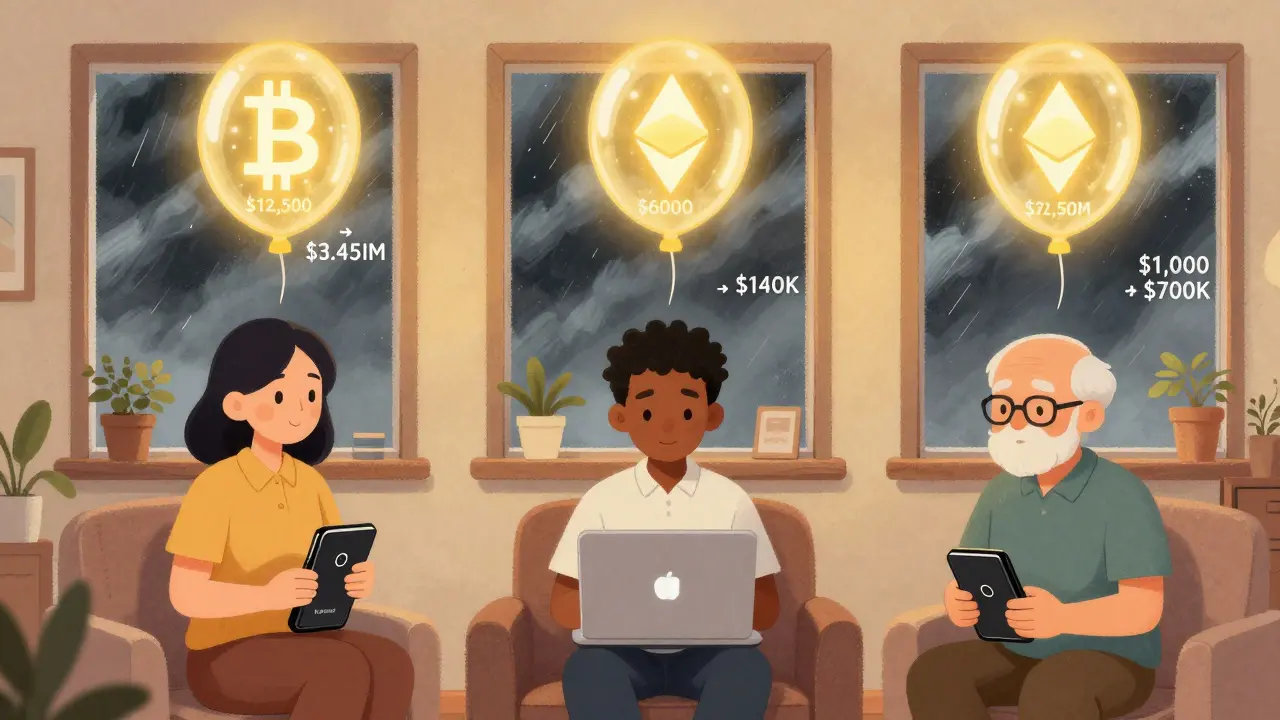
The Technical Side: How to HODL Right
You can’t HODL without the right setup. First, cold storage. Use a hardware wallet-Ledger Nano X or Trezor Model T. These devices store your private keys offline. No internet connection. No hackers. No excuses. Second, backup your seed phrase. Write it on metal. Store it in a fireproof safe. Don’t take a photo. Don’t email it. Don’t store it in the cloud. If you lose it, your crypto is gone forever. Third, don’t trade. Set up automatic buys if you want to dollar-cost average. But don’t check your balance every day. One HODLer told CoinTracker: "I haven’t looked at my wallet in 18 months. Woke up a millionaire." That’s the mindset. Fourth, use staking. Ethereum lets you earn 3.5-5.5% annual yield by staking your ETH. That’s free money while you hold. Over five years, that compounds into tens of thousands in extra returns. Fifth, rebalance slowly. If your portfolio shifts because one asset surged, adjust no more than 5% per year. Don’t chase pumps. Don’t dump dumps. Stay steady.Why Bitcoin and Ethereum Are the Only Real HODL Assets
Not all crypto is equal. Bitcoin has 99.98% uptime since 2009. No other network comes close. It’s the only digital asset with a proven track record across multiple market cycles. Its halving cycle-every four years-has triggered bull markets in 2012, 2016, 2020, and 2024. Each time, the price surged after the event. That’s not coincidence. It’s structure. Ethereum isn’t just a currency. It’s a global computer running over 4,000 decentralized apps. From DeFi to NFTs to tokenized real estate, Ethereum is the backbone of Web3. Its staking yield and developer activity make it the most resilient altcoin. WisdomTree’s 2024 report found that assets with a market cap under $10 billion had 89% higher failure rates. Bitcoin’s market cap in 2025 is $1.2 trillion. Ethereum’s is $450 billion. Most altcoins? Under $1 billion. They’re gambling chips. Bitcoin and Ethereum are infrastructure.What Institutional Investors Are Doing
Big money didn’t wake up and start HODLing yesterday. MicroStrategy’s CEO, Michael Saylor, bought over 214,800 BTC. He’s held through 80% drawdowns. He says volatility is "the cost of admission for asymmetric upside." He’s not alone. Grayscale, Fidelity, and BlackRock now hold over 1.28 million BTC-6.1% of all Bitcoin in circulation. The 2024 spot Bitcoin ETF approvals triggered $45 billion in institutional inflows within a year. This isn’t speculation anymore. This is portfolio allocation. Pension funds, endowments, and sovereign wealth funds are now allocating 0.5-2% of their assets to Bitcoin. They’re not day trading. They’re HODLing. Even central banks are getting involved. El Salvador bought 1,716 BTC at an average price of $124,700. As of April 2025, that investment is up 28%. They’re not trying to time the market. They’re betting on the long term.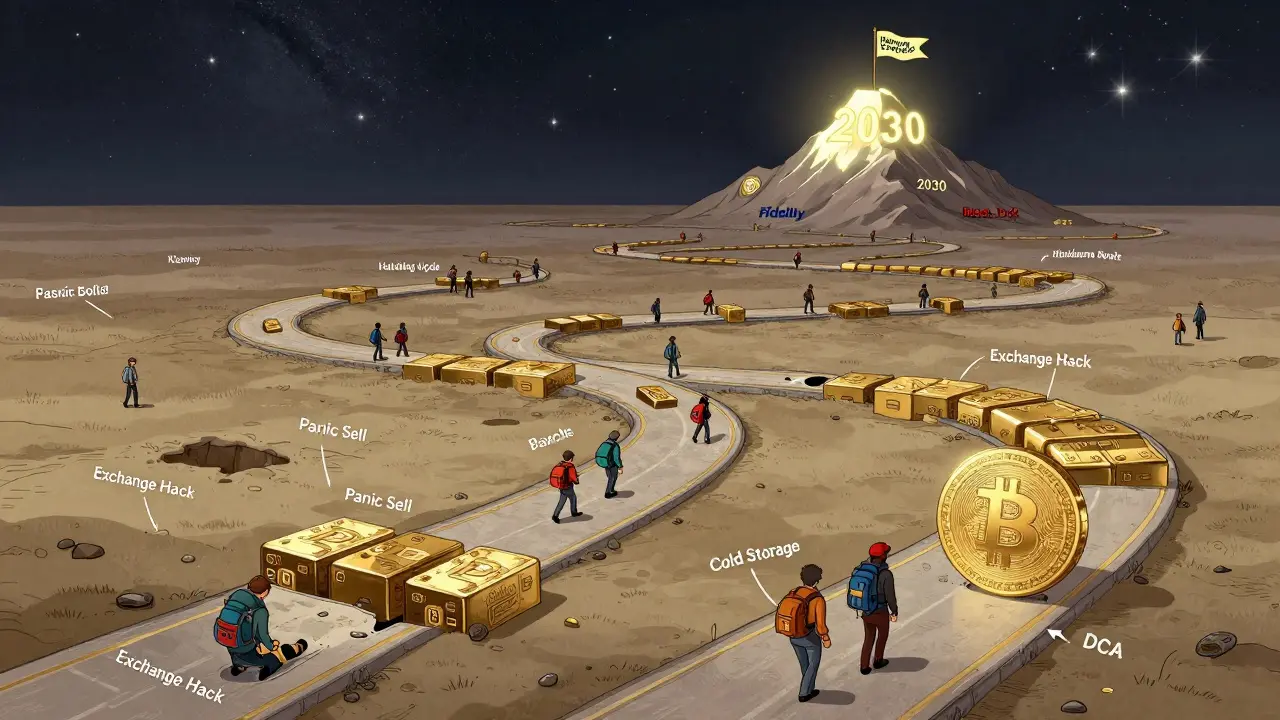
The Future of HODLing
HODLing isn’t static. It’s evolving. Bitcoin Ordinals, launched in 2023, turned individual satoshis into collectibles. Some rare "genesis" inscriptions now sell for $50,000+. HODLers aren’t just holding Bitcoin-they’re holding digital artifacts. AI tools like TokenMetrics now give every token a "HODL Score" out of 100. Assets scoring above 75 have an 89% survival rate through bear markets. Below 50? 11%. That’s not guesswork. That’s data-driven filtering. Fidelity projects that by 2030, pension funds will hold $420 billion in crypto. That’s not a prediction. It’s a trajectory. The market is maturing. The noise is fading. The real investors are staying.What to Do If You’re Starting Now
You don’t need to buy Bitcoin in 2013 to win. You just need to start now-and stick with it. 1. Buy Bitcoin and Ethereum. No altcoins. Not yet. 2. Use a hardware wallet. Ledger or Trezor. Period. 3. Buy small amounts regularly. $50 a week. $200 a month. Dollar-cost average. 4. Set a reminder: "Check balance once every 6 months." 5. Ignore the news. Ignore Twitter. Ignore influencers. 6. If Bitcoin drops 40%, buy more. That’s not a crash. That’s a sale. 7. Hold for at least four years. That’s one full halving cycle. That’s how you outperform the market. The people who made fortunes in crypto didn’t trade. They waited. They didn’t chase trends. They built systems. They didn’t fear volatility. They understood it. HODLing isn’t about getting rich quick. It’s about getting rich slow-and staying rich.What Happens If You Sell?
Selling during a dip is the most common mistake. It’s also the most expensive. In 2018, Bitcoin fell to $3,122. Many sold. They thought it was over. They were wrong. In 2021, it hit $69,000. That’s a 2,100% gain from the bottom. In 2022, Bitcoin dropped to $16,800. People sold again. They thought the bull market was dead. They were wrong. In 2025, it’s back above $70,000. If you sold at the bottom of either crash, you locked in a loss. You missed the biggest gains. HODLing isn’t about being right every time. It’s about not being wrong when it matters most.Is HODLing still a good strategy in 2026?
Yes. HODLing has outperformed active trading in every major market cycle since 2013. Bitcoin’s 4-year halving cycles have consistently triggered bull markets, and institutional adoption is accelerating. The strategy works because it removes emotion and leverages compounding. Assets like Bitcoin and Ethereum have proven network effects, regulatory clarity, and growing utility-making them ideal for long-term holding.
Can I HODL altcoins successfully?
You can, but it’s far riskier. Over 90% of altcoins launched during the 2017 ICO boom are dead by 2025. Successful HODL portfolios keep 65-70% in Bitcoin, 25-30% in Ethereum, and under 15% in carefully selected altcoins with strong development teams, real utility, and high HODL Scores (above 75). Most altcoins lack the infrastructure, community, or adoption to survive multi-year bear markets.
How do I store crypto for long-term HODLing?
Use a hardware wallet like Ledger Nano X or Trezor Model T. These devices store your private keys offline, making them immune to online hacks. Never store large amounts on exchanges or software wallets. Write your 24-word recovery seed phrase on metal and keep it in a fireproof safe. Never take a photo or store it digitally. Test your backup by restoring it on a new device before relying on it.
What’s the minimum time I should HODL?
At least four years. That’s the length of one Bitcoin halving cycle, which has historically triggered major bull markets. Historical data shows that holding for less than three years increases the chance of loss. The most successful HODLers hold for five to ten years or more. Time in the market beats timing the market.
Should I stake my Ethereum while HODLing?
Yes. Since the Ethereum Shanghai upgrade in 2023, you can withdraw staked ETH. Staking earns you 3.5-5.5% annual yield without selling your holdings. This turns passive HODLing into active wealth-building. Over five years, that’s an extra 20-30% in returns. It’s one of the few ways to earn income while staying true to the HODL philosophy.
What if Bitcoin crashes 80% again?
If you’re truly HODLing, you don’t panic. Bitcoin has dropped 80% or more three times since 2013-and rebounded each time with 5x-10x gains. The key is to have a plan: if you bought in phases, buy more at lower prices. If you’re using dollar-cost averaging, keep contributing. Emotional selling is the only real risk. The market doesn’t care about your fear. It only cares about long-term adoption-and that trend is still rising.
rachael deal
January 3, 2026 AT 02:16HODLing changed my life. I bought my first 0.1 BTC in 2019 for $900. Didn’t check it for two years. Woke up one morning and saw it was worth $8k. I cried. Not because I was rich, but because I finally trusted myself.
Now I teach my nieces about crypto like it’s a savings account. No hype. Just patience.
And yeah, I still don’t check my wallet every day. I’ve got better things to do.
Elisabeth Rigo Andrews
January 4, 2026 AT 08:00Let’s be real - HODLing is just a euphemism for being too lazy to trade. The entire narrative is built on survivorship bias. You’re ignoring the 92% of altcoins that went to zero. You’re ignoring the fact that 78% of retail crypto investors lose money. And you’re ignoring that Bitcoin’s halving cycle is a lagging indicator, not a predictive one.
Real investors hedge. Real investors rebalance. Real investors don’t treat blockchain like a religion.
Adam Hull
January 5, 2026 AT 19:17Oh wow. Another cultist sermon on HODLing. Let me guess - you also think the halving is divine intervention and that Ledger Nano X is a sacred relic?
Bitcoin’s price action is manipulated by whale pools and ETF inflows. The ‘strategy’ you’re glorifying is just blind faith wrapped in charts.
And let’s not forget: 80% of the ‘millionaire HODLers’ you cite are just influencers selling courses. The real ones? They’re quietly selling into the rally and buying land.
You’re not a HODLer. You’re a meme.
Andrew Prince
January 6, 2026 AT 21:40While I appreciate the earnestness of this exposition, I must respectfully contend that the foundational premise of HODLing as a universally applicable wealth strategy is empirically unsound.
Historical performance does not guarantee future results, particularly in an asset class characterized by extreme volatility, regulatory uncertainty, and non-fundamental valuation metrics.
Moreover, the implicit assumption that Bitcoin and Ethereum are the only viable assets ignores the emergent layer of decentralized infrastructure - including ZK-rollups, modular blockchains, and tokenized real-world assets - which may supplant their dominance.
Furthermore, the reliance on anecdotal case studies from Reddit constitutes a severe sampling bias, as the population of self-identified HODLers is not representative of the broader investing public.
One must also consider opportunity cost: capital locked in illiquid digital assets precludes investment in equities, real estate, or human capital - all of which offer more stable, tax-advantaged, and legally enforceable returns.
Therefore, while HODLing may yield outsized returns in favorable macroeconomic conditions, it remains a high-risk, low-diversification strategy that is neither prudent nor scalable for the majority of investors.
One does not build generational wealth by staring at candlesticks and praying to Satoshi.
Jordan Fowles
January 7, 2026 AT 04:19There’s something beautiful about HODLing that isn’t about money.
It’s about learning to sit with discomfort. To not react. To trust a system you can’t control.
I used to check my portfolio every hour. Now I check it once a year. I don’t feel richer. I feel calmer.
It’s not a trading strategy. It’s a meditation.
And maybe that’s why it works - because the market doesn’t care about your anxiety. It only responds to time.
People think they’re buying crypto. They’re really buying patience.
Steve Williams
January 7, 2026 AT 23:38As a Nigerian, I’ve seen what real volatility looks like - hyperinflation, currency controls, bank closures.
Bitcoin didn’t make me rich. But it gave me dignity.
I send money to my family without fees. I save without a bank. I don’t need permission.
HODLing isn’t about profit. It’s about freedom.
And that’s worth more than any chart.
Jack and Christine Smith
January 8, 2026 AT 13:06OMG I’m so here for this!! I bought my first 0.5 BTC in 2020 and I didn’t even know what a wallet was lol
I just kept it on Coinbase and forgot about it
Then one day I checked and I had enough to pay my student loans
Now I’m like ‘HODL FAM’ and I tell all my friends
Also I got a Trezor and wrote my seed on a metal plate and hid it in my grandma’s cookie jar 😘
She thinks it’s a secret recipe 😂
Jackson Storm
January 8, 2026 AT 20:45Biggest mistake people make? Thinking HODLing means doing nothing.
You need to do the work - cold storage, seed backup, dollar-cost averaging, staking ETH.
I’ve helped 12 friends set up wallets. 11 are still holding. One sold at $28k because his dog ate his metal seed phrase.
Don’t be that guy.
And if you’re new? Start with $10 a week. No stress. No FOMO. Just consistency.
That’s how real wealth builds.
Raja Oleholeh
January 10, 2026 AT 12:48USA always talk about HODL. India has real problems. Electricity, water, food.
Bitcoin? Nice. But I eat first.
Still, I bought 0.02 BTC. Just in case.
🙏
Prateek Chitransh
January 11, 2026 AT 09:45Wow. Another ‘Bitcoin is the future’ sermon. How original.
Let me guess - you also think the moon is made of cheese and Elon is a prophet?
Meanwhile, in the real world, governments are rolling out CBDCs, and Bitcoin’s energy use is still a political liability.
You’re not a visionary. You’re a nostalgist clinging to a 2017 meme.
But hey, if you want to throw money into a digital black hole, go ahead.
Just don’t call it investing. Call it digital gambling with a TED Talk soundtrack.
Michelle Slayden
January 12, 2026 AT 15:58The psychological discipline required to HODL is, in many ways, more valuable than the financial returns.
It teaches delayed gratification in an age of instant everything.
It fosters resilience against noise.
It demands intellectual humility - recognizing that you cannot predict the future, but you can control your behavior.
These are not crypto skills. These are life skills.
And that, perhaps, is the true legacy of HODLing.
Vernon Hughes
January 13, 2026 AT 06:57HODL worked for me
But I didn’t do it for the money
I did it because I believed
And now I’m just quietly living
That’s all
Alison Hall
January 13, 2026 AT 10:37My dad called me crazy for buying crypto.
Now he asks how to set up a Ledger.
Best feeling ever.
Don’t overthink it. Just start small.
And don’t check your balance every day.
Trust the process.
Amy Garrett
January 14, 2026 AT 18:12so i bought 1 btc in 2021 at 60k
then it crashed to 16k
i cried for a week
then i bought 2 more
now its 70k
i still dont check it
my mom thinks i’m a wizard
she’s not wrong
Haritha Kusal
January 16, 2026 AT 01:52my friend lost 10k in 2022
she cried
then she bought more
now she’s paid off her house
hodling isn’t magic
it’s just not giving up
and that’s harder than it sounds
Elisabeth Rigo Andrews
January 16, 2026 AT 14:03So now we’re romanticizing financial ignorance? HODLing is just a cover for not doing your due diligence.
You don’t get rich by ignoring volatility - you get rich by understanding it, hedging it, and exploiting it.
And let’s not forget - most of these ‘millionaire HODLers’ were already middle-class and had the luxury to lose money for a decade.
What about the single mom working two jobs who can’t afford to tie up $10k in crypto?
Stop pretending this is a universal path to wealth.
It’s not. It’s a lottery ticket with a philosophy.