


When you think of Bitcoin ownership, you might picture individual investors buying a few coins on their phone. But the real story isn’t about retail traders - it’s about large organizations stacking Bitcoin like digital gold. As of mid-2025, over 130 public companies hold more than 693,000 BTC, which is about 3.3% of all Bitcoin ever mined. These aren’t small bets. These are corporate treasury moves that are reshaping how money works in the digital age.
MicroStrategy: The Bitcoin Empire
If there’s one name that defines institutional Bitcoin buying, it’s MicroStrategy - now rebranded as a company that turned its entire business model around to bet everything on Bitcoin. As of August 2025, MicroStrategy holds 640,031 BTC, making it by far the largest institutional holder in the world.
They didn’t just dip their toes in. Since August 2020, they’ve spent over $42.4 billion to buy Bitcoin, averaging about $70,982 per coin. Their latest purchase? $51.4 million for 430 more BTC. Today, nearly 92.5% of their entire balance sheet is made up of Bitcoin. That’s not a side investment - it’s their core asset.
Their CEO, Michael Saylor, is the driving force. He personally owns over 17,700 BTC and talks about Bitcoin nonstop on social media. He doesn’t just believe in it - he’s built a company around the idea that Bitcoin is the best store of value on the planet. And he’s convinced other companies should do the same.
Robinhood: The Retail Giant With a Bitcoin Backbone
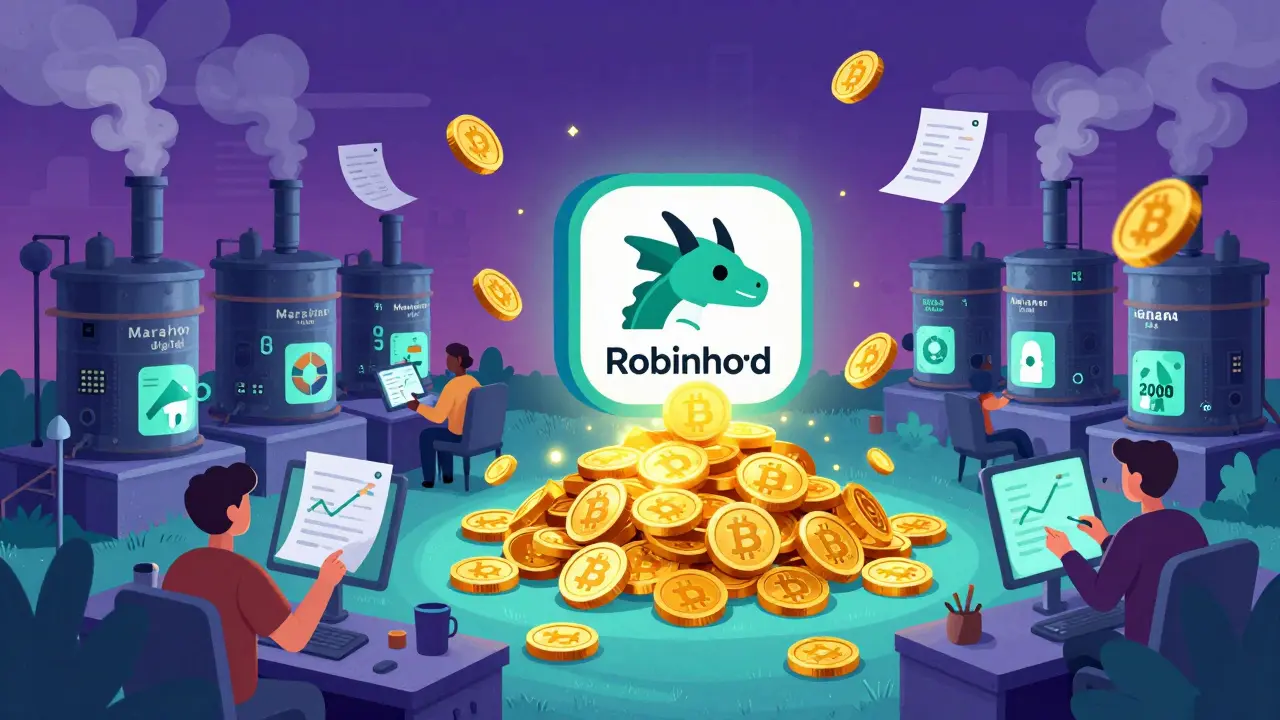
You use Robinhood to trade stocks or buy Dogecoin for fun. But behind the scenes, Robinhood Markets quietly built up the second-largest Bitcoin position of any public company: 136,755 BTC.
Why? Because they’re not just a trading app - they’re a crypto infrastructure player. Holding Bitcoin isn’t speculative for them. It’s operational. They need it to back customer deposits, settle trades, and manage liquidity across their platform. Their holdings have grown steadily as crypto trading volumes exploded. Unlike MicroStrategy, they didn’t buy Bitcoin to hedge inflation. They bought it because their business runs on it.
Marathon Digital: The Miner Who Also Hoards
Most Bitcoin holders buy it. Marathon Digital Holdings mines it. Operating nine mining facilities across North America, Marathon produces about 24.4 BTC every single day.
But here’s the twist: they don’t sell most of it. According to Arkham Intelligence, they hold 16,105 BTC as a treasury asset. Other sources claim they own over 40,000 BTC. The discrepancy? Mining companies constantly buy, sell, and re-invest. Some days they sell to cover operating costs. Other days, they hold back to ride price surges.
Marathon is a hybrid - part mining operation, part institutional investor. They’re not just producing Bitcoin. They’re betting their future on its value.
Tesla: The Cautious Player
In February 2021, Tesla made headlines by buying $1.5 billion worth of Bitcoin - using 7.5% of its cash reserves. At the time, it felt like a revolution. Elon Musk even said Tesla might start accepting Bitcoin for car payments.
But then came the crash. In Q2 2022, Tesla sold 75% of its Bitcoin holdings, taking a $140 million loss. They didn’t panic - they adjusted. Today, they still hold 11,509 BTC, worth about $1.37 billion. No more buying. No more selling. Just holding.
Tesla’s approach is the opposite of MicroStrategy’s. They didn’t go all-in. They tested the waters, saw the volatility, and decided to keep a moderate position. For big corporations with complex supply chains and shareholder pressure, Tesla’s path is more common than you think.
Block Inc.: Jack Dorsey’s Bitcoin Bet
Block Inc. - the company behind Cash App and Square - holds 8,584 BTC as of 2025. Its founder, Jack Dorsey, has been one of Bitcoin’s loudest advocates for over a decade. He once said Bitcoin is the “only true global currency.”
Block doesn’t treat Bitcoin as a treasury reserve like MicroStrategy. Instead, they use it to power their payment systems. They let users buy, sell, and send Bitcoin. Holding BTC helps them manage settlement risks and liquidity. It’s less about investment, more about integration.
Other Major Holders: The Quiet Giants
There’s more to the story than the top four.
- GameStop bought 4,710 BTC after its 2021 meme-stock surge. They’re using Bitcoin to fund their shift from retail gaming to digital commerce.
- Twenty One Capital holds 37,230 BTC - a private fund built entirely around Bitcoin accumulation. They’re not public, but their holdings rival major corporations.
- Metaplanet a Japanese tech firm, announced plans in 2025 to accumulate 210,000 BTC by 2027. They already hold 15,555 BTC and are buying aggressively.
- Galaxy Digital an institutional investment firm, holds Bitcoin for its clients, making it a key bridge between traditional finance and crypto.
Even exchanges like Binance and Bitfinex hold massive amounts - not because they’re investing, but because they need Bitcoin on hand to serve millions of users. Their wallets are like bank vaults filled with digital cash.

Why This Matters: The New Corporate Treasury
Before 2020, corporate treasuries held cash, bonds, and gold. Now, Bitcoin is on the list. Why?
- Inflation hedge: When central banks print money, Bitcoin’s fixed supply becomes more attractive.
- Balance sheet strength: Holding Bitcoin can improve a company’s asset-to-liability ratio - if the price rises.
- Debt leverage: Some companies borrow at low interest rates to buy Bitcoin, betting the asset will outpace their borrowing cost.
But it’s not without risk. Tesla’s 2022 sell-off showed how quickly markets can turn. If Bitcoin crashes, these companies can take big hits. Still, the trend is clear: more firms are treating Bitcoin like cash - not speculation.
The Bigger Picture: Concentration and Control
Here’s the uncomfortable truth: most of these holdings are concentrated. MicroStrategy alone owns nearly 10% of all institutional Bitcoin. Add Robinhood, Marathon, and Block, and you’re looking at over half of all corporate Bitcoin in just four players.
This creates a strange dynamic. If one of these companies decides to sell - even a small portion - it could shake the market. But if they keep buying, they’re quietly building a new financial foundation.
Bitcoin’s price isn’t just driven by retail traders or ETFs anymore. It’s shaped by corporate decisions, treasury policies, and CEO convictions.
What’s Next?
More companies will join. Regulatory clarity around accounting for Bitcoin (like FASB guidelines) is making it easier. Custody solutions are getting safer. Bitcoin ETFs have lowered the barrier for institutional entry.
But the real question isn’t who will buy next. It’s whether traditional finance will fully accept Bitcoin as money - or just a risky asset. The companies listed here are already treating it like money. The rest of the world is catching up.
Who holds the most Bitcoin among public companies?
As of mid-2025, MicroStrategy (now Strategy) holds the most Bitcoin of any public company, with over 640,000 BTC. This is more than the combined holdings of the next 10 largest institutional holders.
Why do companies buy Bitcoin instead of keeping cash?
Companies buy Bitcoin to hedge against inflation, diversify assets, and potentially earn returns. With interest rates low and fiat currencies losing value over time, Bitcoin’s fixed supply makes it an attractive alternative to holding cash or bonds.
Is Bitcoin safe for corporate treasuries?
It’s risky but manageable. Companies use cold storage, multi-signature wallets, and insurance to protect holdings. While price volatility is a concern, many see long-term appreciation as worth the short-term swings. Tesla’s 2022 sale shows they’re willing to cut losses - but most now treat Bitcoin as a long-term hold.
Do mining companies like Marathon own Bitcoin because they mine it?
Yes - but not just because of mining. While Marathon produces around 24 BTC daily, they hold a large portion of it as a strategic asset. They don’t sell everything they mine. Some they reinvest into mining equipment; others they hold to benefit from price growth.
Can regular investors copy what these companies are doing?
You can’t buy 100,000 BTC like MicroStrategy, but you can adopt the same mindset. Many investors now use dollar-cost averaging to buy small amounts of Bitcoin regularly - just like corporations do. The strategy isn’t about timing the market. It’s about building a position over time, regardless of price swings.
Freddie Palmer
February 8, 2026 AT 19:49David Bain
February 9, 2026 AT 03:38Alisha Arora
February 10, 2026 AT 05:05Taybah Jacobs
February 11, 2026 AT 03:43Deeksha Sharma
February 11, 2026 AT 23:01Michael Sullivan
February 12, 2026 AT 20:38Paul Jardetzky
February 13, 2026 AT 16:27Paul Gariepy
February 15, 2026 AT 09:03Mrs. Miller
February 15, 2026 AT 16:52Reda Adaou
February 16, 2026 AT 03:12Jim Laurie
February 16, 2026 AT 04:17Udit Pandey
February 16, 2026 AT 13:07mahikshith reddy
February 17, 2026 AT 08:47Brendan Conway
February 17, 2026 AT 09:18Katie Haywood
February 19, 2026 AT 01:21Matt Smith
February 19, 2026 AT 05:17Sharon Lois
February 20, 2026 AT 11:15Josh Flohre
February 21, 2026 AT 07:13