

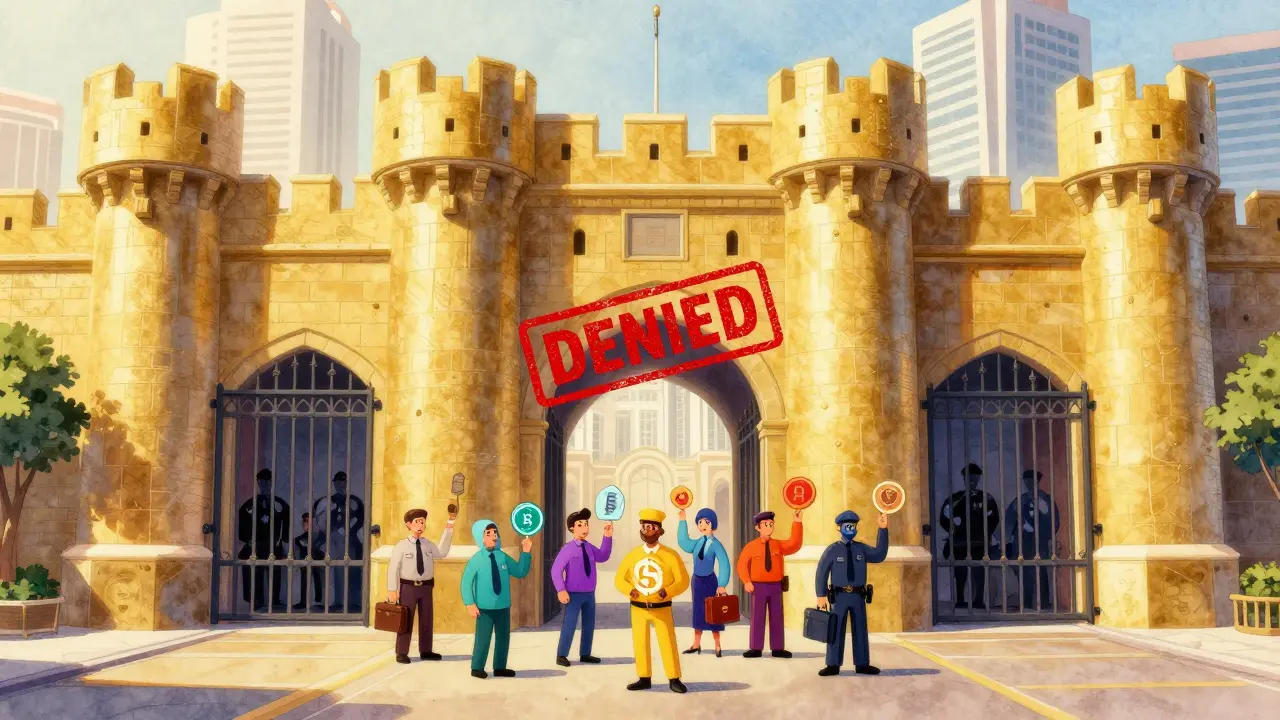
For years, Singapore was the golden ticket for cryptocurrency startups. If you wanted to launch a digital asset exchange or a stablecoin project in Asia, this city-state offered clear rules, deep capital markets, and a reputation for financial integrity. But that era has effectively ended. As of mid-2026 unfolds, the Monetary Authority of Singapore (MAS) is the central bank and financial regulatory authority of Singapore has pulled back the welcome mat. The regulator has implemented a framework so strict that it functions as a de facto ban on new licenses for most crypto businesses.
If you are a founder, investor, or compliance officer looking at Singapore today, the landscape looks nothing like it did two years ago. The window for easy entry is closed. The question is no longer 'How do I get a license?' but rather 'Is my business model even viable under these new constraints?'
The Shift from Friendly Fortress to Strict Gatekeeper
To understand where we are now, we have to look at why MAS changed its tune. For a long time, Singapore prided itself on being a pro-innovation hub. They wanted to be the gateway to Asia for blockchain technology. However, regulators noticed a troubling pattern known as 'regulatory arbitrage.'
Here is how it worked: Crypto companies would register in Singapore to borrow the country’s reputable brand. They would set up a local office with minimal staff, but their actual operations-serving customers, holding funds, and running servers-were often located overseas in jurisdictions with weaker oversight. They were using Singapore’s name as a shield while avoiding its strict rules.
MAS decided this risk was too high. In June 2025, they announced a hard pivot. They declared that they would issue Digital Token Service Provider (DTSP) licenses only in 'extremely limited circumstances.' Why? Because the inherent risks of Anti-Money Laundering (AML) and Counter-Terrorism Financing (CFT) could not be adequately managed when firms served offshore clients. The regulator essentially said: if you can't prove you aren't laundering money through our jurisdiction, you don't get to play here.
The Legal Hammer: Financial Services and Markets Act 2022
This isn't just policy guidance; it's law. The backbone of this crackdown is the Financial Services and Markets Act 2022 (FSMA) is Singapore's comprehensive legislation governing financial services and markets. Specifically, Section 137 of the FSMA gives MAS extraterritorial reach.
What does that mean for you? It means location doesn't matter as much as you might think. If you are a Singapore corporation or an individual operating from Singapore, you need a DTSP license-even if your users are exclusively in Europe, the US, or elsewhere. Even if your servers are in Ireland. Even if your funds are held in Switzerland. If the decision-making happens in Singapore, MAS has jurisdiction.
| Jurisdiction | Licensing Approach | Extraterritorial Reach | Current Market Sentiment |
|---|---|---|---|
| Singapore | De facto ban on new licenses; existing ones face heavy scrutiny | High (Section 137 FSMA applies to all SG-based operators regardless of user location) | Restrictive, focused on financial integrity over growth |
| Switzerland | Active licensing via FINMA; cantonal variations exist | Moderate (focuses on domestic impact) | Stable, established crypto-friendly ecosystem |
| United Arab Emirates | Aggressive licensing via VARA and ADGM | Low to Moderate (focused on attracting inbound business) | Growing, competitive, and business-friendly |
The timeline was brutal. MAS issued the final licensing requirements in June 2025, giving firms a hard deadline of June 30, 2025, to comply. That gave many companies less than four weeks to overhaul their entire operational structure. There was no grace period. No extensions. If you weren't compliant by July 1, 2025, you had to stop operating immediately.
What Does Compliance Actually Look Like?
For the few firms that still hold licenses or are fighting to keep them, the burden is immense. This isn't about filling out a form. It requires a complete transformation of your business infrastructure. Here is what MAS demands:
- Singapore-Based Compliance Officer: You cannot hire someone remotely in London or Tokyo. You must appoint a qualified compliance officer physically based in Singapore. These roles command salaries between SGD 150,000 and SGD 250,000 annually. This alone kills the margin for many small startups.
- Capital Thresholds: Minimum capital requirements ensure firms can absorb shocks, though specific amounts vary by business type. This ties up liquidity that could otherwise be used for development.
- Annual Independent Audits: Your books must be open to external auditors who specialize in crypto assets. This adds significant annual overhead.
- Cybersecurity Standards: You must meet rigorous cybersecurity protocols to protect customer data and assets. A breach isn't just a technical failure; it's a regulatory violation.
- Rigorous AML/CFT Protocols: You need automated systems to screen every transaction against global sanctions lists and detect suspicious patterns in real-time.
Consumer protection rules added in September 2024 also bite hard. You must conduct mandatory suitability assessments for every customer. You cannot allow high-risk practices, such as letting users buy crypto with credit cards, because that exposes retail investors to debt risks they may not understand. Clear risk disclosures are mandatory, meaning you can't hide the volatility of digital assets behind glossy marketing copy.

The Travel Rule: Data Exchange is Non-Negotiable
One of the most technically demanding requirements is the implementation of the Travel Rule, enforced through Notice PSN02. If you facilitate a transaction exceeding SGD 1,500 (approximately USD 1,100), you must collect and share specific information about the sender and receiver.
This includes names, identification numbers, and account details. You have to send this data to the receiving institution before the transaction settles. This sounds simple, but integrating this into legacy banking systems or peer-to-peer platforms is a nightmare. Many firms had to spend between SGD 50,000 and SGD 200,000 on specialized software solutions just to handle this data exchange correctly.
If you fail to transmit this data, the transaction should ideally be blocked. If you process it anyway, you are violating MAS regulations. The system requires interoperability between different platforms, which is still a developing standard globally, adding another layer of complexity for Singapore-based firms.
The Human Cost: Job Market Shock
Regulations don't just affect balance sheets; they affect people. The abrupt tightening of rules sent shockwaves through Singapore's crypto job market. According to LinkedIn workforce analytics tracked in early 2025, crypto-related job postings in Singapore dropped by 37% in Q1 2025 compared to the previous quarter.
Talented engineers, product managers, and marketers began leaving the country for more welcoming jurisdictions like Dubai or Zug, Switzerland. International firms that had planned to expand into Singapore scaled back or canceled their plans entirely. The signal was clear: Singapore is no longer prioritizing market growth. It is prioritizing risk mitigation.
Industry analysts estimate that operational costs for remaining firms increased by 25-40% due to these compliance burdens. For a startup burning cash to find product-market fit, a 40% increase in overhead is often fatal. Only firms with 'elite compliance infrastructure' and strong operational justification stood a chance.

Who Survived? The Elite Few
Before the crackdown, approximately 200 firms had applied for or held provisional licenses. By June 2025, industry analysis suggested that only 15-20 of these entities would maintain full compliance. Who are they? Typically, these are large, well-capitalized exchanges or institutional-grade custodians that already had robust legal teams and global presences.
Smaller players, niche trading platforms, and innovative DeFi wrappers found themselves squeezed out. They either exited Singapore completely, moving their headquarters to friendlier jurisdictions, or they shut down operations. The ecosystem shrank dramatically, but the quality of the remaining participants rose significantly.
Stablecoins and Future Outlook
MAS hasn't stopped there. In November 2023, they published a separate regulatory framework for stablecoins, aiming for a 'high degree of value stability.' This means issuers must back tokens with high-quality liquid assets and undergo regular audits. In May 2025, MAS hinted at further guidance on Decentralized Finance (DeFi) protocols, suggesting that the regulatory net will continue to widen.
The long-term viability of this approach remains debated. Critics, including academics like Dr. Jane Lim from the Asian Fintech Institute, warn that overly restrictive regulation could permanently diminish Singapore's role in the global crypto ecosystem. They argue that innovation requires room to experiment, and excessive caution drives talent away.
MAS officials counter that a smaller, higher-quality industry better serves Singapore's long-term interests. They believe that protecting the country's reputation as a trusted financial hub is more valuable than hosting hundreds of risky crypto startups. The success of this strategy will likely be measured over the next 24 months by looking at two metrics: the reduction in crypto-related financial crime incidents involving Singapore entities, and the maintenance of investor confidence in the broader financial system.
What Should You Do Now?
If you are considering launching a crypto business in Singapore, pause. The days of easy entry are gone. You need to ask yourself if your business model can withstand the cost of elite compliance. Can you afford a local compliance officer? Can you integrate complex Travel Rule software? Can you justify your presence to MAS beyond just making money?
If the answer is no, look elsewhere. Jurisdictions like the UAE and Switzerland still offer active licensing programs and are competing aggressively for crypto business. Singapore is now a fortress, not a frontier. It is safe, stable, and expensive. Whether that fits your needs depends entirely on your risk appetite and resources.
Can I still get a crypto license in Singapore in 2026?
Technically yes, but practically very difficult. MAS stated they will issue licenses only in 'extremely limited circumstances.' Unless you are a large, well-capitalized institution with exceptional compliance infrastructure, obtaining a new Digital Token Service Provider (DTSP) license is unlikely. Most new applicants are being rejected due to unresolved AML/CFT concerns regarding offshore activities.
Does MAS regulate crypto companies serving only overseas clients?
Yes. Under Section 137 of the Financial Services and Markets Act 2022 (FSMA), MAS has extraterritorial reach. If you are a Singapore corporation or individual operating from Singapore, you must obtain a DTSP license regardless of where your users, servers, or funds are located. Serving exclusively overseas clients does not exempt you from regulation.
What are the penalties for non-compliance with MAS crypto rules?
Penalties are severe. They include fines of up to SGD 200,000 (approximately USD 147,000), potential imprisonment for responsible individuals, and mandatory cessation of operations. There is no grace period; once the deadline passes, non-compliant firms must stop all regulated activities immediately.
How much does it cost to implement Travel Rule compliance?
Implementation costs vary based on transaction volume and existing infrastructure, but estimates range from SGD 50,000 to SGD 200,000. This covers the integration of specialized software capable of collecting, verifying, and exchanging sender/receiver data for transactions exceeding SGD 1,500, as required by Notice PSN02.
Why did MAS change its stance on crypto regulation?
MAS shifted its focus from promoting innovation to mitigating reputational risk. Regulators identified 'regulatory arbitrage,' where firms used Singapore's reputable brand while operating with minimal oversight abroad. To protect Singapore's standing as a trusted financial hub, MAS tightened controls to prevent money laundering and terrorist financing risks associated with cross-border token services.
Are there any exceptions for small crypto startups?
No. The regulatory framework applies equally to all entities conducting digital token services from Singapore. Small startups often struggle the most due to high fixed costs, such as hiring a Singapore-based compliance officer (SGD 150,000-250,000/year) and meeting capital thresholds. This has led many small firms to exit the jurisdiction.