


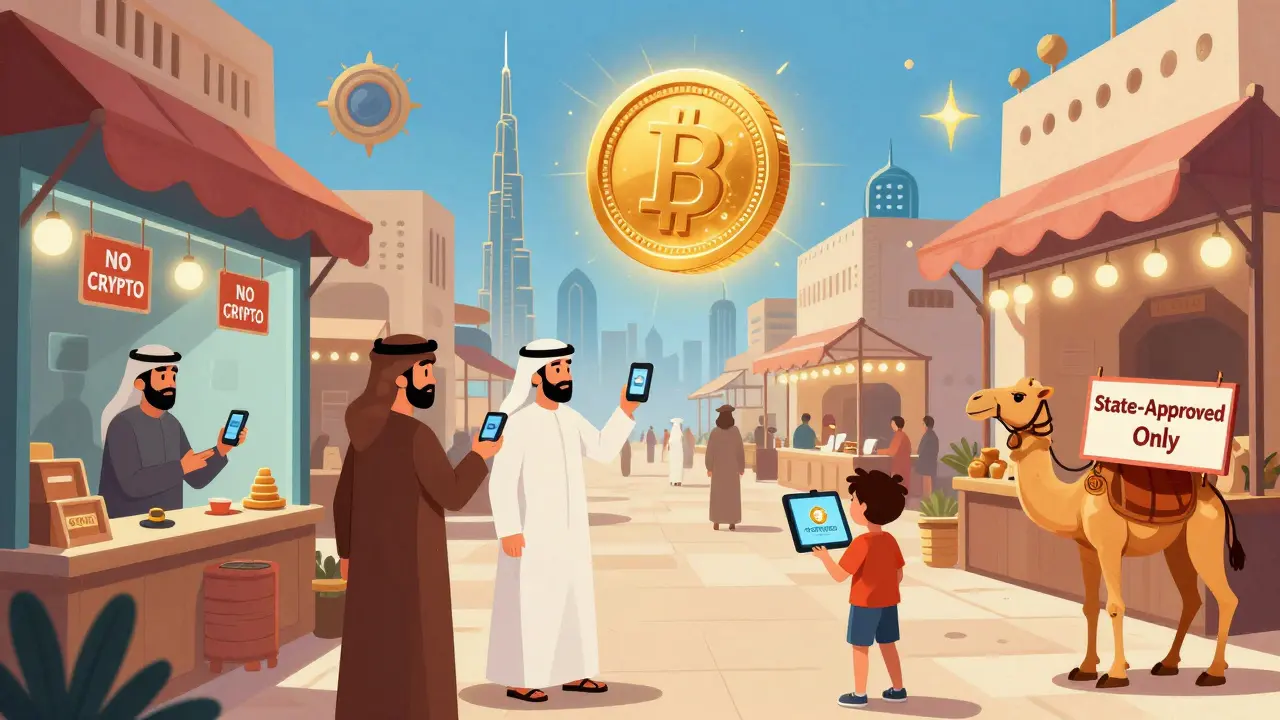
When you think of the Middle East, you might picture oil, luxury malls, or ancient trade routes. But today, a quieter revolution is happening behind closed doors: governments are shutting down banks from touching cryptocurrency. Not because they hate tech, but because they’re trying to control it. Across the Gulf Cooperation Council (GCC), a patchwork of strict rules has emerged - some countries ban crypto banking outright, others let it in through back doors, and a few are building their own digital currencies to replace it entirely.
What’s Actually Banned? It’s Not What You Think
Let’s clear up a common misunderstanding. These bans aren’t about people buying Bitcoin on Binance or holding Ethereum in a wallet. Individuals can still trade crypto privately - in fact, millions do. The bans target financial institutions. Banks, credit unions, payment processors - they’re locked out. If you’re a bank in Saudi Arabia or Qatar, you can’t hold crypto for customers, convert it to local currency, or even process payments involving digital assets. Violate that rule? You’re looking at fines, license suspension, or worse.This isn’t about stopping innovation. It’s about control. Governments don’t want private digital money competing with their own financial systems. They’re fine with blockchain - as long as they’re the ones running it.
Saudi Arabia: The Controlled Experiment
Saudi Arabia walks a tightrope. The Saudi Arabian Monetary Authority (SAMA) has told banks: no crypto transactions - unless you get special permission. That permission? Almost never granted. But here’s the twist: Saudi Arabia is one of six countries running the mBridge project - a central bank digital currency (CBDC) pilot that uses blockchain to settle cross-border payments between central banks. Think of it as a government-controlled version of crypto, built for banks, not everyday users.SAMA also runs a fintech sandbox. Startups can test blockchain-based lending, tokenized bonds, or automated payments - but only if they stay away from Bitcoin or Ethereum. The message is clear: we’re not against digital assets. We’re against unregulated ones. The goal? To replace Western-dominated payment networks with a regional, sovereign system.
United Arab Emirates: The Open Door with a Lock
The UAE is the region’s most crypto-savvy economy - and still, its banks can’t touch most cryptocurrencies. The Central Bank of the UAE allows only approved tokens, like the Dirham Payment Token, to be used for payments. Anything else? Forbidden for banks. But here’s where it gets interesting: the UAE was one of the first to test cross-border CBDCs back in 2019 with Project Aber, a joint effort with the Saudi Central Bank.Unlike its neighbors, the UAE has created clear licensing rules. Companies can apply to become licensed crypto service providers - but banks? Still barred. The result? A thriving crypto ecosystem outside the banking system, with exchanges, wallets, and trading platforms operating under strict oversight, while traditional banks sit on the sidelines.
Qatar: The Strictest, But Changing
Qatar used to be the region’s hardest line. In 2020, the Qatar Financial Centre Regulatory Authority (QFCRA) banned all virtual asset services - including Bitcoin, stablecoins, and even tokenized assets. No exceptions. No gray areas.Then, in September 2024, everything shifted. The QFCRA introduced new Digital Asset Regulations 2024. Now, tokenized shares, bonds, and real estate can be legally issued and traded - as long as they’re not labeled as “cryptocurrencies.” Bitcoin and stablecoins? Still Excluded Tokens. Banks can’t touch them. But companies in the Qatar Financial Centre can now issue digital securities, use smart contracts, and settle trades on blockchain - all under government supervision.
This isn’t a reversal. It’s a refinement. Qatar is building a legal framework for institutional digital assets - just not for retail crypto. The next phase, expected in Q2 2025, will likely formalize this split even further.
Kuwait: Shutting Down the Mines
Kuwait doesn’t bother with complex regulations. It just shuts things down. In 2023, authorities cracked down on crypto mining operations - the ones that power Bitcoin’s network using massive amounts of electricity. The result? A 55% drop in local electricity demand tied to mining. That’s not a coincidence. It’s a policy.There’s no licensing system. No sandbox. No CBDC pilot. Kuwait’s stance is simple: crypto is a threat to energy security and financial stability. If you’re mining, you’re breaking the law. If you’re a bank, you’re not allowed to even hear the word “Bitcoin.”
Bahrain: The Middle Ground
Bahrain is the outlier. It’s the only GCC country with a formal licensing regime for crypto-asset activities. The Central Bank of Bahrain’s Crypto-Asset (CRA) module lets banks and financial institutions offer crypto services - but only if they’re licensed. That means regulated custody, trading, and even crypto-to-fiat conversion - under strict AML and KYC rules.Bahrain has tested interoperability with JP Morgan’s blockchain network and runs its own CBDC pilot. It’s the only GCC nation where a bank could legally offer Bitcoin trading to institutional clients. That’s why it’s become a hub for crypto startups looking to operate legally in the region - even if they can’t access the Saudi or Qatari markets.
Oman and the Regional Trend
Oman hasn’t released detailed rules yet, but it’s clearly following the pack. It’s part of the mBridge CBDC pilot and has signaled it will adopt a licensing-based model similar to Bahrain and the UAE. No sudden bans. No open doors. Just slow, careful alignment with regional standards.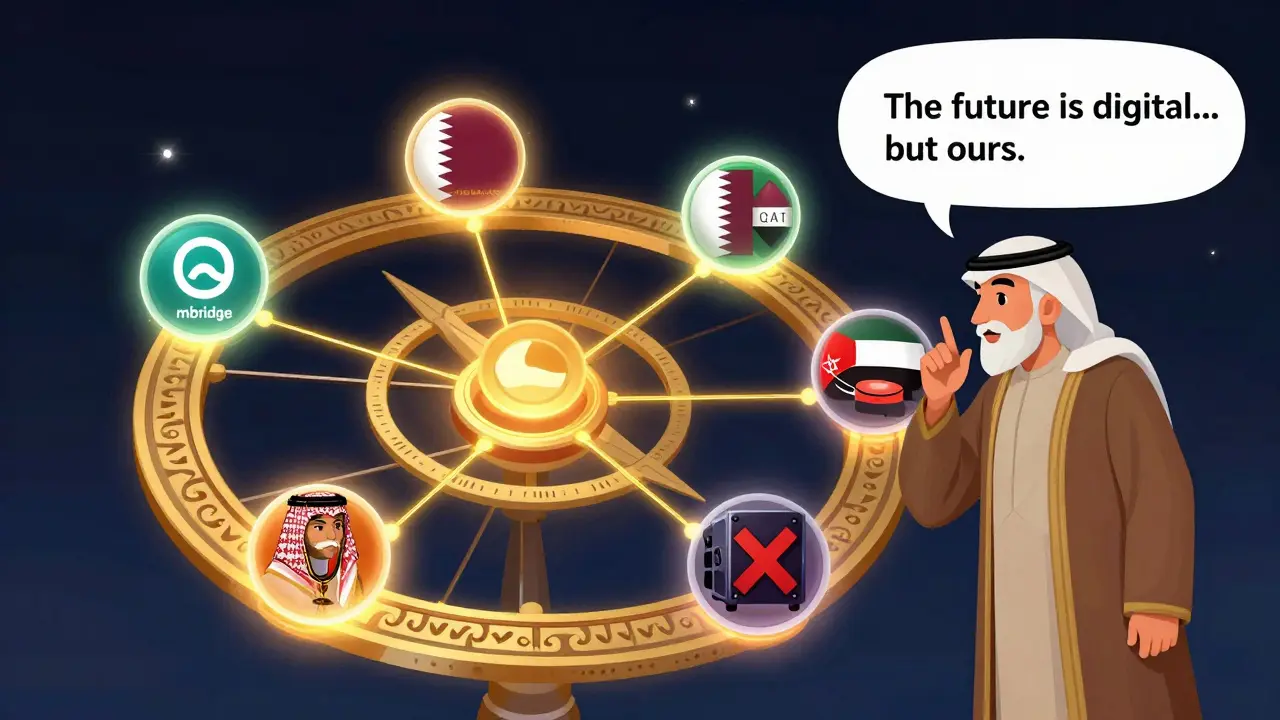
Why This Matters: The CBDC Strategy
The real story here isn’t the bans. It’s what’s happening behind them. Every major GCC country is building its own central bank digital currency. Saudi Arabia, UAE, Bahrain, Oman - all are testing blockchain-based systems to settle payments between banks, reduce reliance on the U.S. dollar, and speed up cross-border trade.These aren’t experiments. They’re replacements. The goal? To create a regional financial network that doesn’t need SWIFT, doesn’t rely on Wall Street, and doesn’t answer to foreign regulators. And guess what? Blockchain is the tool they’re using - but only for their own digital money.
That’s why the bans make sense. If your bank can’t touch Bitcoin, but can use a government-issued digital dirham, you’re not losing innovation. You’re just moving it under state control.
What This Means for You
If you’re an individual in the UAE or Saudi Arabia: you can still buy crypto. You just can’t use your bank account to do it. You’ll need peer-to-peer platforms, crypto ATMs, or offshore exchanges - and you’ll face higher fees and less liquidity.If you’re a business: you’re stuck. No bank support means no payroll in crypto, no supplier payments in Bitcoin, no treasury management using digital assets. Unless you’re in Bahrain, or you’re operating in a free zone with a license - you’re out of luck.
If you’re an investor: look at the CBDCs. The real value isn’t in Bitcoin. It’s in the infrastructure being built - the digital rails that will power the next decade of Middle Eastern finance.
The Future: Gradual Opening, Not Collapse
Don’t expect these bans to vanish overnight. But don’t assume they’re permanent either. The pattern is clear: governments are building the tech first, then deciding who gets to use it. Qatar’s 2025 framework, Bahrain’s licensing model, and the mBridge CBDC network are all stepping stones.The next five years will likely see licensed crypto custody services, regulated tokenized securities, and even crypto-backed loans - but only through government-approved channels. Private, decentralized finance? Still out. But institutional, state-sanctioned digital assets? That’s the future.
What’s happening in the Middle East isn’t anti-crypto. It’s pro-control. And if you’re trying to understand the region’s financial future, stop looking at Bitcoin. Start watching the central banks.
Can I still buy cryptocurrency in Saudi Arabia or the UAE?
Yes, individuals can still buy and hold cryptocurrency in Saudi Arabia, the UAE, and other GCC countries. The bans only apply to banks and financial institutions - not private citizens. You can use peer-to-peer platforms, crypto ATMs, or offshore exchanges. But you won’t be able to link your bank account directly to these services, and you’ll face higher fees and less liquidity than in countries with open banking.
Why do Middle Eastern countries ban crypto banking but allow CBDCs?
Because CBDCs are controlled by the government. Central bank digital currencies are designed to replace cash and improve payment efficiency - not to compete with the state. Private cryptocurrencies, like Bitcoin, are decentralized and unregulated, which threatens monetary control, financial stability, and national sovereignty. Governments want the benefits of blockchain - faster settlements, lower costs, better traceability - but only under their own rules.
Is crypto mining illegal in the Middle East?
In Kuwait, yes - mining is actively shut down due to high electricity use, and enforcement has reduced mining-related power consumption by 55%. In Qatar and Saudi Arabia, mining isn’t explicitly banned by law, but it’s effectively blocked because banks won’t process payments for mining equipment or energy bills tied to it. In the UAE and Bahrain, mining isn’t illegal, but it’s not encouraged and lacks infrastructure support.
Can a business in Dubai accept Bitcoin as payment?
Technically, yes - but only if you don’t use a bank. Businesses can accept Bitcoin directly from customers using wallets or payment processors. However, converting that Bitcoin into UAE dirhams or depositing it into a business bank account is prohibited. Most businesses avoid it because of the risk, complexity, and lack of banking support. Licensed crypto service providers can help, but they’re not banks.
Which GCC country is the most crypto-friendly for businesses?
Bahrain is the most crypto-friendly for businesses because it has a formal licensing system through its Central Bank. Companies can apply to operate as crypto-asset service providers - offering custody, trading, and exchange services under regulatory oversight. The UAE allows licensed token platforms but still blocks banks from participating. Qatar and Saudi Arabia offer limited pathways for tokenized assets, but not for Bitcoin or Ethereum. Bahrain remains the only place where a business can legally integrate crypto into its financial operations with bank support.
Will these crypto banking bans last forever?
Probably not. The bans are temporary measures while governments build their own digital currency systems. Once CBDCs are fully operational and proven secure, we’ll likely see licensed, regulated crypto services slowly introduced - but only under state control. Don’t expect Bitcoin to become legal tender. Do expect tokenized bonds, digital securities, and government-backed stablecoins to become mainstream in the next 5-10 years.
Gareth Fitzjohn
January 30, 2026 AT 11:36Interesting breakdown. I always assumed the Middle East was anti-crypto, but this makes it clear they’re just building their own version. Kinda like how some countries allow Uber but ban taxis - it’s not about the tech, it’s about who controls it.
CBDCs are the real story here. Not Bitcoin. Not Ethereum. The digital dirham, the mBridge network - that’s where the money’s going.
Moray Wallace
February 1, 2026 AT 08:33Hard to argue with the logic. If you’re a sovereign state trying to protect your currency and financial sovereignty, letting private crypto run wild is like letting strangers print your money. Smart move to keep banks out - even if it inconveniences regular users.
Dylan Morrison
February 3, 2026 AT 03:19Wow 😍 This is like watching a civilization upgrade its OS without letting anyone install random apps. The GCC isn’t rejecting crypto - it’s saying, ‘We’ll build the app store ourselves.’
CBDCs are the future. And honestly? I’m kinda glad they’re doing it right. No memes, no rug pulls. Just clean, state-backed digital money. 🌍✨
William Hanson
February 4, 2026 AT 10:56Typical authoritarian crypto fear-mongering. They don’t ‘want control’ - they want to crush freedom. If you can’t use your money how you want, you’re not free. This isn’t innovation - it’s digital feudalism.
Kevin Thomas
February 5, 2026 AT 16:38Look, if you’re a normal person in Dubai or Riyadh and you want to buy BTC - go ahead. Use a P2P app, a crypto ATM, whatever. The bans are on banks, not people. But if you’re a business trying to pay suppliers or run payroll? Yeah, you’re screwed unless you’re in Bahrain.
And honestly? Bahrain’s the only one doing it right. Licensing, oversight, integration - that’s how you build a real crypto economy. The rest are just building walls around their own digital playgrounds.
Jack Petty
February 7, 2026 AT 03:15CBDCs = surveillance currency. They’re not replacing SWIFT - they’re replacing your privacy. Every transaction tracked. Every purchase monitored. This isn’t finance. It’s social credit with blockchain.
They call it ‘control.’ I call it tyranny with a whitepaper.
Brianne Hurley
February 8, 2026 AT 20:48Ugh. So basically, the Gulf states are like, ‘We love tech… but only if we own it.’ Classic. Meanwhile, the rest of the world is trying to decentralize, and they’re just building bigger, fancier cages.
Also, ‘institutional digital assets’? Sounds like Wall Street got a visa. Real exciting.
christal Rodriguez
February 8, 2026 AT 23:28They’re not banning crypto. They’re banning decentralization. Big difference.
Joshua Clark
February 10, 2026 AT 12:31This is actually one of the most nuanced takes I’ve seen on crypto regulation in the region. It’s not black and white - it’s not ‘crypto bad’ or ‘crypto good.’ It’s about who gets to play, and under what rules. Bahrain’s licensing model is genuinely forward-thinking - they’re creating a legal pathway, not just a wall.
And the mBridge project? That’s huge. Imagine a regional financial network that doesn’t rely on the dollar, doesn’t need SWIFT, and settles cross-border payments in seconds. That’s not just innovation - that’s geopolitical power.
Meanwhile, Kuwait just shuts down miners because they use too much electricity. That’s not a policy - that’s a band-aid. And Qatar’s ‘excluded tokens’ loophole? Brilliant. They’re allowing tokenized real estate and bonds, but not Bitcoin - because they don’t want retail speculation, they want institutional efficiency.
It’s all about control, yes - but control doesn’t always mean oppression. Sometimes, it just means order. And in a region where financial stability matters more than hype, maybe that’s not such a bad thing.
Ramona Langthaler
February 11, 2026 AT 05:11USA should ban this kind of authoritarian nonsense. America built the internet, not some oil-rich autocrats with digital ledgers. Let them keep their CBDCs - we’re going full crypto freedom here.
Sunil Srivastva
February 12, 2026 AT 06:58As someone from India, I find this fascinating. We’re also debating CBDCs - but with a huge population, we can’t afford to ban crypto outright. The GCC approach is bold. They’re saying: ‘We’ll lead, not follow.’
And honestly? Bahrain’s model could be a blueprint for other emerging markets. Licensing, not banning. Oversight, not oppression.
Rachel Stone
February 12, 2026 AT 07:45So… they ban banks from crypto but let you buy Bitcoin with cash? Cute.
Calvin Tucker
February 12, 2026 AT 15:17The real irony is that blockchain was designed to remove intermediaries - and now central banks are using it to create the ultimate intermediary: themselves.
Gustavo Gonzalez
February 13, 2026 AT 18:35Everyone’s acting like this is some deep geopolitical chess move. Nah. It’s just rich countries being scared of losing control. You think they’re building CBDCs for efficiency? They’re building them because they know crypto is inevitable - and they’d rather own the future than be left behind.
Also, ‘tokenized real estate’? That’s just Wall Street with a new coat of paint. Same greed, different blockchain.
Gary Gately
February 13, 2026 AT 22:02so like… you can buy crypto but not use your bank? lol that’s so dumb
why not just let banks do it? then ppl wouldn’t have to use sketchy p2p apps and get scammed
Brandon Vaidyanathan
February 15, 2026 AT 02:31OH MY GOD. THE CBDCS ARE A TRAP. THEY’RE WATCHING YOU. EVERY TRANSACTION. EVERY BIT.
THEY’RE BUILDING THE SURVEILLANCE STATE AND CALLING IT ‘FINANCIAL INNOVATION.’
THIS IS THE NEW NORMAL. AND WE’RE ALL JUST SLEEPWALKING INTO IT.
WHY IS NO ONE TALKING ABOUT THIS???
Katie Teresi
February 15, 2026 AT 14:29So they’re banning Bitcoin but letting banks use blockchain? Classic. They want the tech without the freedom. Pathetic.
Lori Quarles
February 17, 2026 AT 08:57This is actually kind of beautiful. They’re not rejecting innovation - they’re shaping it. Imagine if the U.S. had done this instead of letting crypto turn into a casino. Bahrain’s approach is the future - regulated, safe, smart.
Stop seeing this as oppression. See it as evolution.
Steven Dilla
February 17, 2026 AT 18:21Big respect to Bahrain for being the only one with a real plan. 🙌
Everyone else is just scared. Bahrain’s like, ‘Let’s build it right.’ The rest are like, ‘Let’s block it until we figure out how to own it.’
And honestly? That’s the difference between leadership and fear.
Akhil Mathew
February 18, 2026 AT 22:29Super insightful. I’ve been watching this from India - we’re debating whether to ban or embrace crypto. The GCC’s path is a middle ground: don’t ban, but don’t let chaos rule either. Licensing + CBDCs = smart. Bahrain’s model could be a global template.
Aaron Poole
February 20, 2026 AT 06:58Love how this isn’t just about crypto - it’s about sovereignty. The Gulf states aren’t anti-tech. They’re anti-dependence. They don’t want their financial system tied to Wall Street or SWIFT. CBDCs are their way of saying, ‘We run our own money now.’
And yeah, it’s controlled - but control doesn’t have to mean oppression. It can mean stability. Especially in a region where economic volatility is a real threat.
Bahrain’s the only one letting banks play - and that’s why startups are flocking there. Smart move.
Robert Mills
February 21, 2026 AT 21:38CBDCs = the future. Get on board or get left behind. 💪🚀
Joseph Pietrasik
February 22, 2026 AT 04:29so they ban banks from crypto but let you buy it with cash? sounds like a scam
William Hanson
February 22, 2026 AT 08:53Someone said Bahrain’s model is smart. It’s not. It’s a Trojan horse. Letting banks touch crypto under ‘regulation’ means they’ll freeze accounts, report users, and turn finance into a government loyalty program.
True decentralization? Still banned. Just now it’s called ‘licensed.’