

You bought a digital collectible for five figures. It looks great in your wallet. But when you try to move it to a different platform or prove you own the commercial rights to use that image on a t-shirt, things get messy. Why? Because most NFT standards are technical specifications that define how unique tokens are created and transferred but often fail to address storage, legal rights, or cross-chain compatibility leave massive gaps.
Since William Entriken and his team proposed ERC-721 the foundational Ethereum standard for non-fungible tokens introduced in January 2018, the market has exploded. We went from Rare Pepes to billion-dollar trades. Yet, the underlying plumbing hasn't kept pace with user expectations. You’re dealing with high gas fees, disappearing images, and vague copyright laws. This isn't just a developer problem; it affects every collector and creator.
The Core Technical Bottlenecks
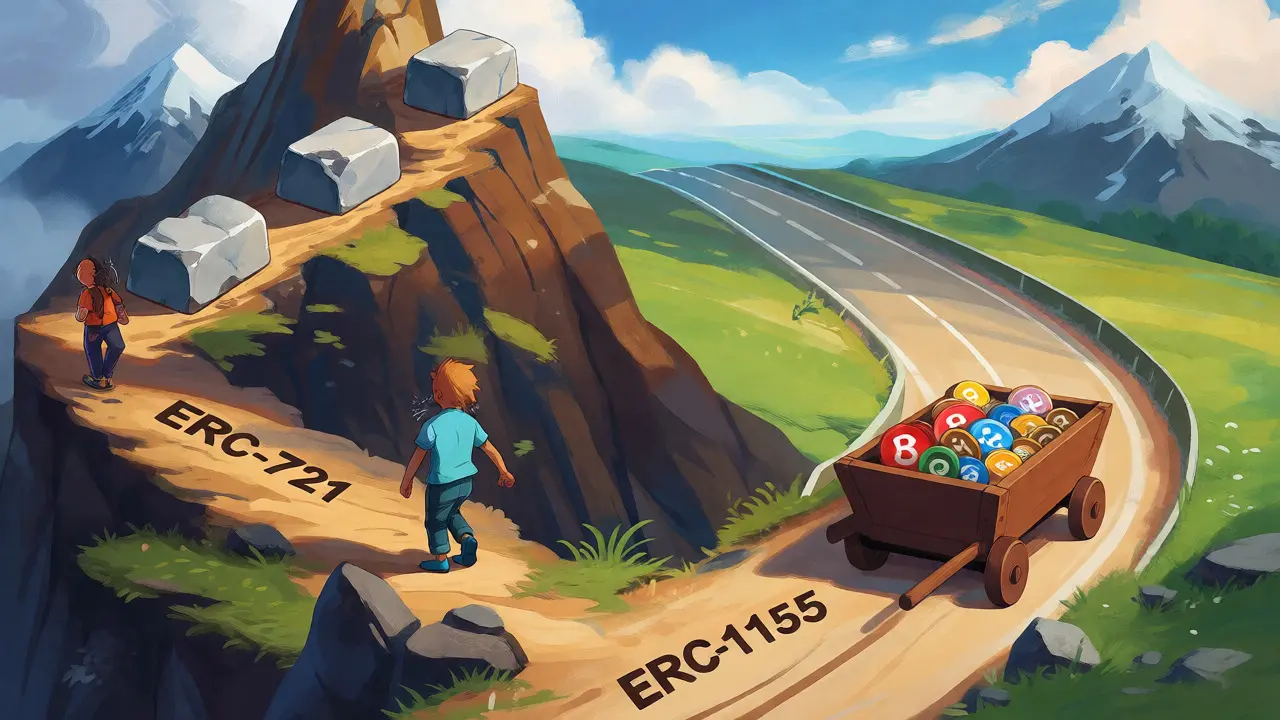
Let’s look at why ERC-721 struggles under pressure. It treats every single token as a unique entity requiring its own ID within a contract. If you want to mint 10,000 profile pictures, you aren’t doing one transaction. You’re triggering thousands of individual operations. On Ethereum’s mainnet, where block space is scarce and expensive, this is brutal.
Consider the cost. Minting a large collection via standard ERC-721 loops can burn through gas faster than you can say "gas war." Small creators get priced out. Retail buyers hesitate because a $20 NFT might cost $50 in fees during network congestion. ERC-1155 a multi-token standard allowing batch transfers of both fungible and non-fungible assets in a single smart contract was designed to fix this. It lets you send 100 different in-game items in one go. That’s efficient. But here’s the catch: while ERC-1155 saves money, it adds complexity. Wallets and marketplaces don’t always display these mixed batches clearly. Users see a jumbled mess instead of a clean portfolio.
The Metadata Black Hole
Here is a scary thought: Your NFT exists on the blockchain, but the art linked to it might not. Token metadata information describing the NFT such as name, description, and media URL which is typically stored off-chain is rarely stored directly on-chain due to size constraints. Instead, standards like ERC-721 rely on a tokenURI a pointer string that links to external JSON data containing the NFT's attributes and media location.
This URI usually points to a centralized server (like AWS) or a decentralized network like IPFS InterPlanetary File System a peer-to-peer hypermedia protocol used for decentralized storage. If that central server shuts down, or if no one pins your IPFS content, your NFT becomes a blank square. The token remains valid on the ledger, but the value-the visual asset-vanishes. There is no built-in guarantee of permanence in current standards. They assume the link works forever. In reality, link rot is real.
| Feature | ERC-721 | ERC-1155 |
|---|---|---|
| Token Type | Unique Non-Fungible Only | Mixed (Fungible & Non-Fungible) |
| Batch Transfers | No (Requires multiple calls) | Yes (Native support) |
| Gas Efficiency | Low for large collections | High for bulk operations |
| Contract Deployment | New contract per collection | Single contract for many types |
| Ecosystem Support | Universal / Mature | Growing / Complex integration |
Interoperability and Chain Fragmentation
You buy an NFT on Ethereum. Can you easily trade it on Solana? Not really. Standard fragmentation the existence of incompatible technical specifications across different blockchain networks preventing seamless asset movement is a huge hurdle. ERC-721 is specific to Ethereum-compatible chains. Solana has its own SPL Token program. Flow uses Cadence contracts. These systems speak different languages.
To move an asset between them, you need bridges. Bridges introduce risk. They require locking tokens on one chain and minting wrapped versions on another. This breaks the "native" ownership model. If the bridge gets hacked-and they have been before-your asset is gone. Furthermore, applications built for ERC-721 cannot natively read data from a Tezos FA2 token without custom middleware. This silos liquidity. A buyer on OpenSea can’t easily bid on a piece listed exclusively on a niche marketplace using a different standard.
The Legal Gray Area
What did you actually buy? For most people, the answer is "I bought the JPEG." Wrong. Buying an NFT rarely transfers copyright. According to research by Galaxy Digital, most licenses grant only limited personal display rights. You can’t print your Bored Ape on a coffee mug and sell it unless the license explicitly says so.
The problem is that NFT standards do not encode legal semantics. There is no field in ERC-721 for "Commercial Rights: Yes/No." Rights are handled in separate Terms of Service documents hosted on websites. These documents change. They are hard to find. Courts in places like Finland have started treating NFTs as property objects, but they distinguish strictly between owning the token and owning the intellectual property. Until standards include machine-readable license fields, users will keep getting sued or confused.
Solutions Emerging in 2026
It’s not all doom and gloom. Several initiatives are patching these holes.
- Metadata Standardization: The Metaverse Standards Forum released a template in late 2025. It proposes structured fields for asset type, creator, and usage context. This doesn’t store the file on-chain, but it ensures everyone reads the metadata the same way. It reduces ambiguity.
- Layer-2 Scaling: While not a standard itself, moving NFT activity to Layer-2 networks like Arbitrum or Base drastically cuts costs. It makes ERC-721 viable again for small creators by removing the mainnet gas barrier.
- License Encapsulation: Projects are starting to embed license URLs directly into the metadata JSON. Marketplaces are beginning to parse these fields to show users exactly what they can do with their purchase before they click "Buy."
Security is also improving. Early implementations had bugs. Reentrancy attacks were common. Now, libraries like OpenZeppelin provide audited, standardized code blocks. Developers don’t have to write transfer logic from scratch anymore. This reduces the attack surface significantly.
Practical Takeaways for Creators and Collectors
If you are building or buying, keep these rules in mind:
- Check Storage: Does the project use IPFS with pinning services? Or is it relying on a startup’s website? If the latter, expect potential link rot.
- Read the License: Don’t assume commercial rights. Look for explicit statements about merchandising and derivative works.
- Choose the Right Standard: Use ERC-721 for high-value, one-of-one art where simplicity matters. Use ERC-1155 for gaming or large collections where batch efficiency saves money.
- Verify Interoperability: If you plan to use the asset in multiple metaverses, check if those platforms support the specific chain and standard you are using.
The technology is maturing. We are moving from experimental toys to robust financial instruments. But we still need better tools to manage the gap between code and law, and between on-chain truth and off-chain storage.
Why does my NFT image disappear?
Most NFTs store a link (URI) to the image rather than the image itself. If the server hosting that link goes offline or stops serving the file, the image disappears from your view, even though the token record remains on the blockchain.
Is ERC-1155 better than ERC-721?
Not necessarily. ERC-1155 is more gas-efficient and supports batching, making it ideal for games and large collections. However, ERC-721 is simpler and has broader ecosystem support, making it better for high-value, individual collectibles where ease of use is paramount.
Does buying an NFT give me copyright?
Usually, no. Current NFT standards do not automatically transfer copyright. Ownership of the token is distinct from ownership of the intellectual property. Most projects grant limited licenses, such as personal display rights, which must be checked in the project's Terms of Service.
Can I move an ERC-721 NFT to Solana?
Not natively. ERC-721 is an Ethereum standard. To move it to Solana, you typically need a bridge service that locks the original token and mints a wrapped version on Solana. This process introduces security risks and may affect liquidity.
How do new standards solve metadata issues?
New initiatives, like the Metaverse Standards Forum templates, propose structured schemas for metadata. While they don't force on-chain storage, they ensure consistent interpretation of fields like creator, rights, and asset type across different platforms, reducing confusion.