

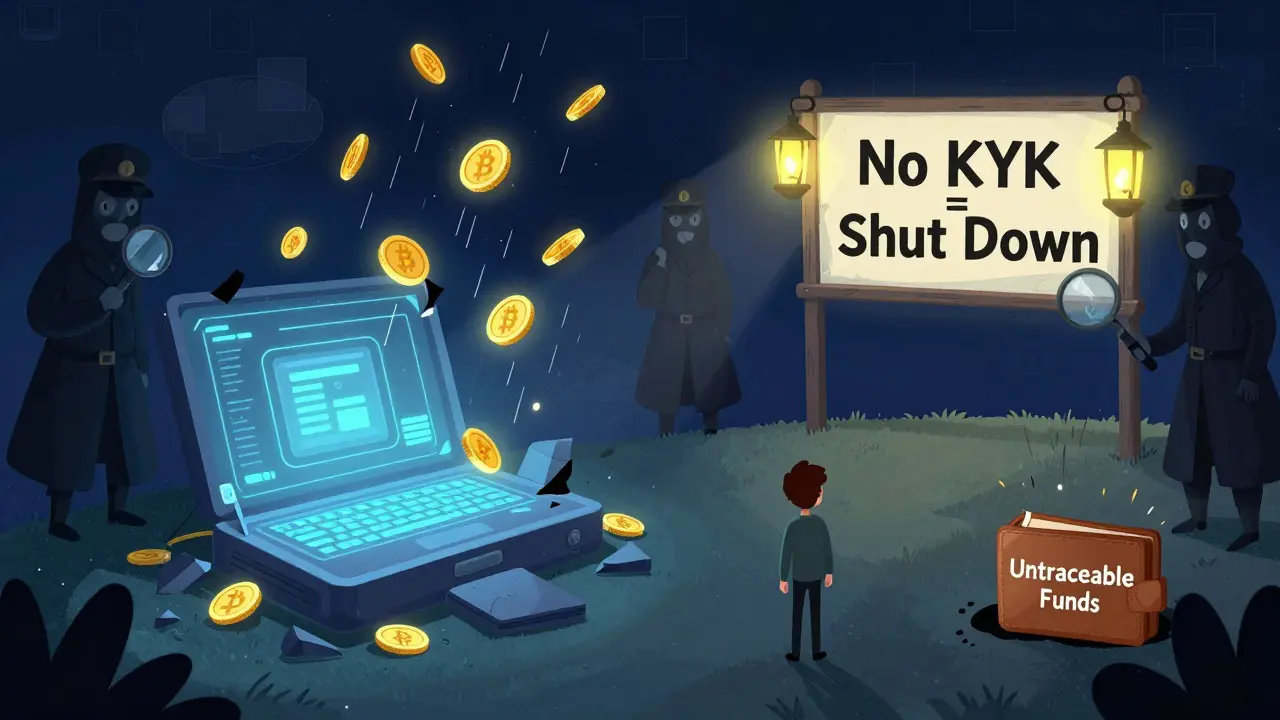
By 2025, no-KYC crypto exchanges were no longer just a niche option-they were a target. Governments around the world didn’t just warn them. They shut them down. Entire platforms vanished overnight. Apps were blocked. Websites went dark. And the reason wasn’t about controlling innovation. It was about stopping crime.
Why no-KYC exchanges became a red flag
No-KYC means no identity verification. Users could sign up, deposit funds, trade, and withdraw without showing a passport, ID, or proof of address. On the surface, that sounds private. But in practice, it became a magnet for fraudsters, money launderers, and sanctions evaders. In 2024, the U.S. Department of Justice filed criminal charges against KuCoin and its founders. The accusation? Allowing over $5 billion in suspicious funds to flow through the platform while ignoring basic anti-money laundering rules. The same year, the Commodity Futures Trading Commission (CFTC) added a civil complaint. By March 2025, KuCoin had been forced out of the Seychelles, its former home, and relocated to Turks and Caicos-just one of many attempts to escape regulation. India took an even harder line. In 2025, its Financial Intelligence Unit (FIU-IND) issued notices to 25 offshore exchanges-including Huione, Paxful, Changelly, and BitMex-for serving Indian users without registering. Under the Prevention of Money Laundering Act (PMLA), 2002, any crypto platform touching Indian users must comply. It didn’t matter if the exchange was based in Singapore, Malta, or the Cayman Islands. If Indian users traded on it, it was breaking the law. The result? Apps were pulled from Google Play and Apple App Store. Websites were blocked at the ISP level. No warnings. No grace period.The domino effect: How one shutdown triggers others
When regulators go after one exchange, the pressure spreads. Banks don’t want to work with platforms that can’t prove they know who their users are. Payment processors like Visa and Mastercard cut ties. Stablecoin issuers refuse to onboard them. Advertisers pull campaigns. Affiliates stop promoting them. Coinbase paid a $100 million settlement in 2023 after the New York Department of Financial Services found gaps in its AML and KYC controls. Even a top-tier exchange wasn’t safe. That sent a clear message: size doesn’t protect you. Compliance does. The ripple effect hit smaller no-KYC platforms even harder. Bitunix, which still reported $1.8 billion in daily trading volume in late 2025, faced mounting pressure. No bank would touch its fiat gateway. Its users couldn’t deposit dollars or euros. Its liquidity dried up. Trading volume dropped. And by early 2026, it quietly began rolling out KYC-too late to avoid the stigma.What changed in 2024-2025?
Before 2024, many no-KYC exchanges operated under the assumption that regulation was slow, patchy, or impossible to enforce globally. That belief collapsed fast. - In 2024, the Financial Action Task Force (FATF) updated its guidance to treat unregistered VASPs (Virtual Asset Service Providers) as high-risk entities. This gave countries legal backing to cut them off. - International intelligence sharing improved. FIUs in India, the U.S., the UK, and the EU began exchanging transaction data on suspicious addresses linked to unverified exchanges. - Blockchain analytics firms like Chainalysis and CipherTrace provided regulators with tools to trace funds from no-KYC platforms directly to known criminal wallets. The numbers speak for themselves. In 2023, only 72% of centralized exchanges had full KYC. By 2025, that number jumped to 92%. Even among smaller platforms, 79% of the global crypto market now operates under KYC rules. Why? Because users started demanding it. A 2025 CipherTrace report showed that strong KYC reduced crypto fraud risk by 38%. And 67% of institutional investors said they wouldn’t touch a platform without it. In the U.S., 58% of retail users said they preferred KYC exchanges-not because they liked giving up privacy, but because they trusted them more.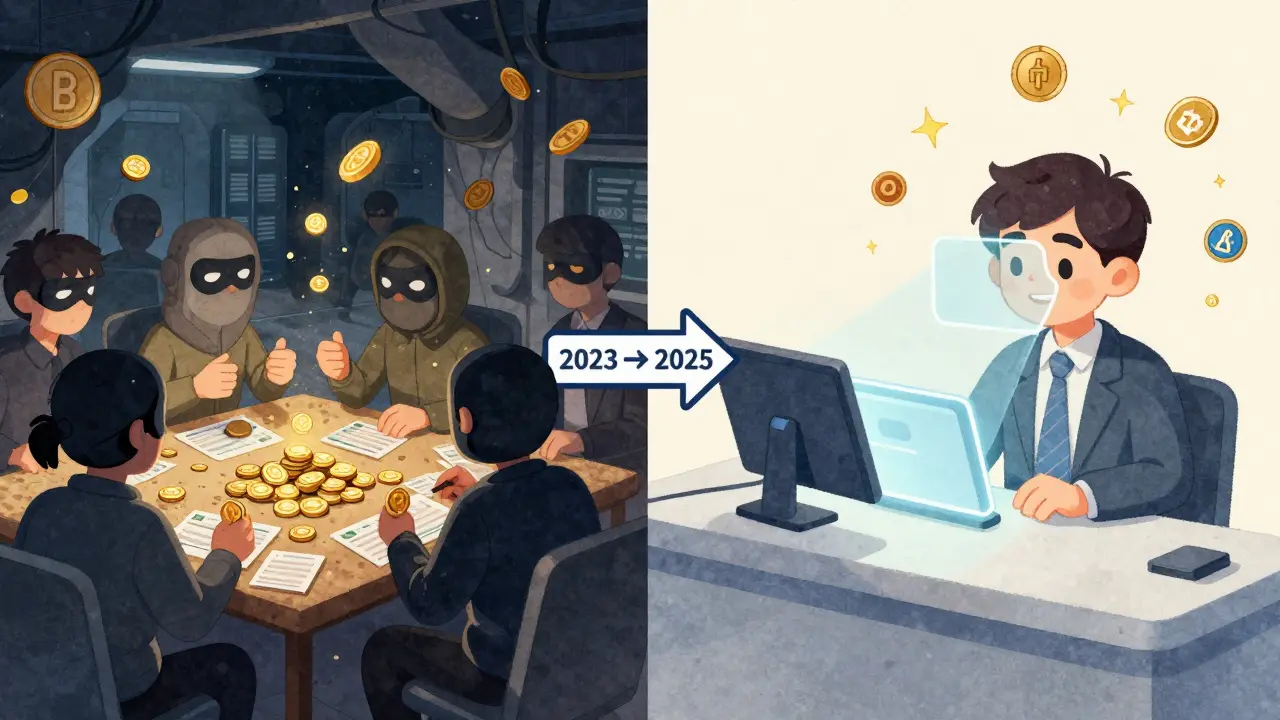
The rise of fast KYC: Compliance doesn’t have to be slow
One of the biggest myths about KYC is that it’s a hassle. In 2023, verifying your identity on a major exchange took an average of 7 minutes. By 2025, that dropped to 3.5 minutes. Some platforms now use AI to verify IDs in under 90 seconds. How? Facial recognition. Liveness detection. Document scanning powered by machine learning. Integration with government ID databases in over 60 countries. These aren’t futuristic tools-they’re standard now. Platforms like Kraken, Binance, and Coinbase streamlined KYC to the point where users barely notice it. You upload a photo of your ID. You take a selfie. You wait. Done. No paperwork. No calls. No delays. That’s the new reality: compliance isn’t a barrier. It’s a feature. And users are voting for it with their wallets.Where do no-KYC exchanges go now?
Some didn’t adapt. They moved. KuCoin went to Turks and Caicos. BTSE moved to Costa Rica. Others tried to rebrand as DeFi protocols or peer-to-peer marketplaces to avoid the label of “exchange.” But regulators caught on. The U.S. Treasury’s Office of Foreign Assets Control (OFAC) started blacklisting DeFi protocols that knowingly hosted transactions from unverified exchanges. The EU’s MiCA regulation, which fully took effect in late 2025, explicitly banned anonymous trading on any platform serving EU users-even if it was decentralized. There’s no safe haven left. Jurisdictions with no rules are also the ones with no banking access. No bank means no fiat on-ramps. No fiat on-ramps means no real volume. And no volume means no survival.
YANG YUE
March 24, 2026 AT 14:35It’s wild how we thought privacy meant no rules, but turns out it just meant no protection.
Real privacy is control - not anonymity. You want to own your data? Prove who you are, then lock it down.
That’s the shift. We’re not losing freedom. We’re trading chaos for safety.
And honestly? I’d rather have a 90-second KYC than lose my life savings to some ghost exchange.
It’s not about trust in the system. It’s about trust in yourself to do the right thing.
Kevin Da silva
March 24, 2026 AT 19:36KYC isn’t the enemy. The lack of banking access is.
Regulators didn’t kill no-KYC. Banks did.
Brad Zenner
March 26, 2026 AT 01:37Had a friend lose $12k on a no-KYC site last year. Vanished overnight. No emails. No replies. Just a 404.
Now he uses Kraken. Pays for insurance. Sleeps fine.
Privacy doesn’t mean ghosting your identity. It means choosing who sees it.
Anna Lee
March 27, 2026 AT 01:33OMG YES!! I was so skeptical about KYC but once I tried it on Coinbase it took like 2 mins?? Like I uploaded my license and took a selfie and BOOM done 😍
So much easier than I thought!! Now I feel safe AF 🙌
John Alde
March 28, 2026 AT 15:16The real story here isn’t about regulation - it’s about economic gravity.
No-KYC exchanges operated in a vacuum, pretending they could exist without fiat rails, banking partnerships, or institutional trust.
But crypto isn’t a sandbox. It’s a financial system. And systems need anchors.
Even Bitcoin miners need banks to pay their electricity bills.
So when Visa cuts you off, and Mastercard freezes your processor, and Circle refuses to issue USDC to you - you don’t get to blame regulators.
You get to realize that the market voted with its wallets.
And the market chose compliance over chaos.
That’s not oppression. That’s evolution.
Kevion Daley
March 29, 2026 AT 23:43Ugh. Another ‘crypto is evil’ lecture disguised as journalism.
What about privacy rights? What about sovereign individuals?
Why is everyone so eager to hand over their identity to Big Finance?
It’s not about crime - it’s about control.
And you’re just the latest sheep in line.
Dominic Taylor
March 30, 2026 AT 21:33The FATF guidance update in 2024 was the tipping point - it created a global regulatory alignment that didn’t exist before.
Previously, VASPs could arbitrage jurisdictional gaps - now, any jurisdiction without AML/KYC compliance is automatically flagged as non-cooperative.
That’s why KuCoin had to relocate three times - they weren’t fleeing regulation, they were fleeing liquidity.
And the fact that institutional adoption jumped from 38% to 67% post-2025 proves one thing: compliance is now a competitive advantage, not a burden.
Lorna Gornik
March 31, 2026 AT 07:21So I just did KYC on Binance after avoiding it for 3 years…
Turns out the AI selfie thing is kinda cool? Like it told me my ID was blurry and I had to retake it 😅
And then it was done in 78 seconds. No call center. No paperwork.
Wish I’d done it sooner. Now I feel like I’m actually part of the system instead of lurking in the shadows 🤷♀️
aravindsai pandla
April 1, 2026 AT 19:39As someone from India, I’ve seen this firsthand.
FIU blocked 25 platforms in one go. No warning. No appeal.
But here’s the truth - most of those platforms were not just no-KYC. They were *actively* targeting Indian users with misleading ads, fake influencers, and ‘double your crypto in 24 hours’ scams.
KYC didn’t kill freedom. It killed predators.
Tammy Stevens
April 1, 2026 AT 20:14Let’s be real - the real winners here aren’t regulators.
They’re the blockchain analytics firms. Chainalysis, CipherTrace, Elliptic - they’re the new oil barons.
They sold the tech to governments, then got paid to monitor the fallout.
So yes, KYC is here to stay.
But who really profits? Not users. Not even exchanges.
It’s the surveillance-industrial complex.
Shana Brown
April 2, 2026 AT 04:36Y’all are overcomplicating this 😊
People just want to feel safe when they trade.
And guess what? KYC makes them feel safe.
So instead of fighting it, let’s make it faster, prettier, and more private.
Like… imagine a future where your identity is encrypted, verifiable, and yours alone.
That’s not the end of privacy. That’s the next level.
Tony Phillips
April 3, 2026 AT 03:29I used to run a no-KYC P2P platform. We had 10k users. Then one day, our Stripe integration got cut. Then PayPal. Then our bank account. Then our AWS server.
We didn’t get a subpoena. We didn’t get a warning.
We just… stopped working.
It wasn’t a raid. It was a slow suffocation.
And honestly? I’m glad.
Because we weren’t stopping crime.
We were just letting it happen quietly.
Shayne Cokerdem
April 5, 2026 AT 01:22USA always gotta be the police of the world lol
Why you ban crypto privacy but let banks launder billions?
Big banks got KYC? Nah they got lawyers.
Real criminals? They got offshore trusts.
So yeah, go ahead and shut down the little guys.
Meanwhile, your tax dollars fund the real monsters.
Joshua T Berglan
April 5, 2026 AT 12:57Just tried a ZKP KYC on Bitstamp yesterday. No ID upload. Just proved I’m me using math.
It felt like magic.
Regulators got the wrong idea - they think KYC = surveillance.
But the future is KYC = verification without exposure.
We’re not giving up privacy.
We’re upgrading it.
Andrew Midwood
April 6, 2026 AT 01:41Let’s not pretend this is about crime.
This is about tax collection.
Every time someone trades on a no-KYC exchange, the IRS loses a cut.
Now that crypto is mainstream, they’re not gonna let a single satoshi slip through.
They didn’t shut down KuCoin because it was bad.
They shut it down because it was untaxed.
Ananya Sharma
April 6, 2026 AT 18:31India banned 25 exchanges. No drama. No press conference.
Just blocked the apps.
People adapted.
Now they use local P2P with UPI.
It’s slower. Less glamorous.
But it works.
Regulation doesn’t have to be loud to be effective.
Annette Gilbert
April 8, 2026 AT 00:11Oh wow. So the ‘crypto freedom’ crowd finally got what they deserved?
Let me grab popcorn. 🍿
They spent years screaming ‘CENSORSHIP!’ while running a Ponzi scheme with fake liquidity.
Now they’re crying because they can’t wash dirty money anymore.
Real crypto pioneers? They’re building on Bitcoin. Not some shady alt-exchange with no KYC and 1000% leverage.
DarShawn Owens
April 9, 2026 AT 08:13Just had a chat with my cousin who lost everything on Bitunix.
She’s 19. Thought she was being ‘edgy’ by using no-KYC.
Now she’s working retail to pay off her credit card debt.
There’s no heroism in ignoring basic safety.
It’s not about trust in government.
It’s about not being dumb.
Alicia Speas
April 10, 2026 AT 00:21It’s ironic - we built crypto to escape centralization.
Then we created centralized hubs of anonymity.
And now, the only thing that survived is the original idea: decentralized, permissionless, open.
But not anonymous.
Because true decentralization doesn’t need secrecy.
It needs transparency.
And the most decentralized thing of all? A system where everyone plays by the same rules.
Even if those rules are written by governments.
At least then, you know who you’re dealing with.
YANG YUE
April 10, 2026 AT 04:54Replying to @2174 - you think this is about control?
Try being the victim of a crypto scam.
Try watching your mom lose her retirement fund because someone told her ‘no KYC = more secure.’
Privacy without accountability isn’t freedom.
It’s a trap.
And you’re not a rebel.
You’re just the last one still stuck in the maze.