

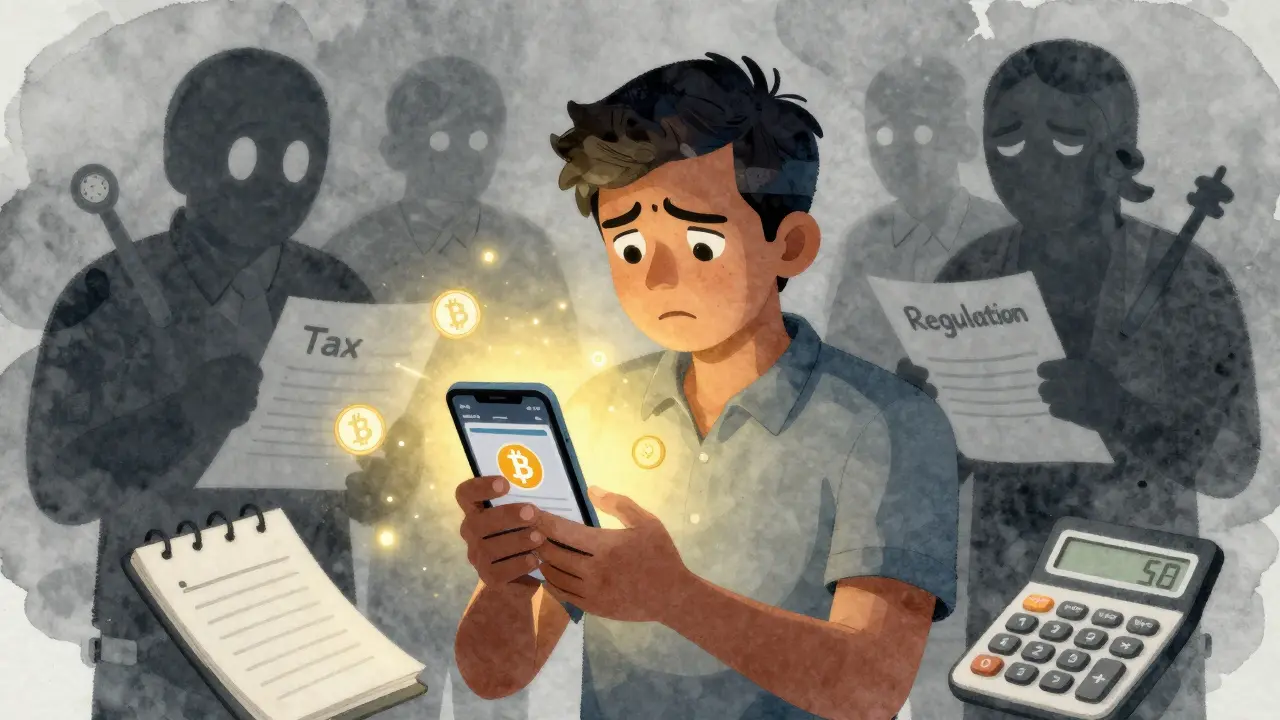
India Crypto Tax Calculator
Calculate how much tax you'll pay on your cryptocurrency transactions in India based on the current regulations (30% capital gains tax + 1% TDS on every transaction).
Tax Calculation Results
Note: TDS is deducted at source on every transaction regardless of profit or loss. Capital gains tax applies only to gains.
There’s a rumor spreading fast in Indian crypto circles: the government is about to ban non-custodial wallets. You’ve probably seen the headlines, the panic posts on Reddit, the WhatsApp forwards. But here’s the truth - India has never proposed banning non-custodial crypto wallets. Not once. Not in any official document, speech, or draft law. What’s happening is something far more confusing: a regulatory gray zone that’s making life hard for users who want to control their own money.
What Even Is a Non-Custodial Wallet?
A non-custodial wallet is your digital keychain for cryptocurrency. You hold the keys - literally. No exchange, no bank, no app can freeze your funds or take them away. Think Ledger Nano S Plus, Trust Wallet, Exodus, or MetaMask. These aren’t apps that store your crypto for you. They’re tools that let you interact with the blockchain directly. Your private keys? On your phone or hardware device. No one else has them. That’s the whole point of decentralization. In India, over 18.7 million people use these wallets. That’s 23% of all crypto users in the country. Why? Because after the WazirX hack in July 2024 stole $230 million, people stopped trusting exchanges. They moved their Bitcoin, Ethereum, and altcoins into wallets they control. And they’re not going back.The Myth of the Ban
The confusion starts with the 2021 draft of the Virtual Digital Assets (VDAs) Bill. It originally said “prohibit all private cryptocurrencies.” That scared everyone. But by 2023, the language changed. The government dropped the word “ban.” Instead, they went with heavy taxation: 30% on capital gains and 1% TDS on every crypto transaction. That’s not a ban. That’s a tax policy. Then came the Financial Intelligence Unit’s (FIU) March 2023 notice. It said all Virtual Asset Service Providers (VASPs) must register - even if they’re based overseas. But here’s the problem: the FIU didn’t distinguish between custodial services (like CoinDCX or WazirX) and non-custodial wallets. Legally, they treated them the same. That’s not how the rest of the world works. The FATF, the global financial watchdog, says non-custodial wallets aren’t VASPs unless they hold your keys. India ignored that. So now, wallet developers are stuck. If you’re building a non-custodial wallet like MetaMask and want to let Indian users buy crypto with UPI, you’re forced to add KYC flows - even though you don’t control the money. You’re being treated like a bank, but you’re not one. It’s like requiring a bicycle shop to get a driver’s license because someone rode a bike on the highway.What’s Actually Restricted?
You can still download and use non-custodial wallets in India. Ledger, Exodus, and Trust Wallet apps are all on Google Play. In fact, Google updated its policy in October 2025 and explicitly exempted non-custodial wallets from its new licensing rules. That’s a big deal. It means Google, one of the most powerful gatekeepers of app access, recognizes the difference. But here’s where it gets messy:- You can’t easily buy crypto with UPI in most non-custodial wallets. Only 3 out of 10 major wallets support it.
- Every time you send crypto, 1% gets taken as TDS - even if you’re losing money. One user on Reddit paid ₹28,000 in TDS on a ₹25,000 loss.
- Transaction confirmations take 27% longer in India because there are barely any local Bitcoin nodes. Only 1,247 in the whole country, compared to over 14,000 in Germany.
- There’s no clear legal definition of whether sending crypto from a non-custodial wallet to an exchange counts as a taxable event. Tax software like BitcoinTaxes.in is used by nearly 30% of users just to stay sane.

Why the Confusion? The Real Target
The government isn’t trying to ban self-custody. They’re trying to track money. The FIU’s October 2025 show-cause notices to 25 offshore platforms - including Trust Wallet - weren’t about banning wallets. They were about demanding compliance with anti-money laundering rules. The problem? Non-custodial wallets don’t collect user data. They can’t comply. So now, Indian regulators are stuck between two bad options: ignore the loophole, or force wallet providers to become something they’re not. Dr. Indranil Bhattacharya from IIM Ahmedabad put it bluntly in October 2025: “India’s failure to distinguish between custodial and non-custodial services represents a fundamental misunderstanding of blockchain architecture.” Meanwhile, former RBI Deputy Governor Dr. Viral Acharya argues that without oversight, these wallets become “unmonitored channels for money laundering.” He’s not wrong - $9.2 billion in untracked crypto moved across borders in 2024, according to the FIU. But punishing every user who wants to control their own keys isn’t the answer.How Are People Coping?
Indian crypto users are getting creative. Here’s what’s working:- Hardware wallets are booming. Ledger Nano Stax sales jumped 40% in 2025. At ₹13,999, it’s expensive - but people see it as insurance against exchange failures.
- P2P trading is the new on-ramp. Since UPI integration is rare, users buy crypto through LocalBitcoins, Paxful, or Telegram groups. It’s risky, but it works.
- Tax tools are essential. BitcoinTaxes.in and Koinly are now household names among serious holders. Without them, tax filing is a nightmare.
- Education is filling the gap. IIT Bombay’s October 2025 study found 63.7% of new users needed help setting up their first wallet. YouTube tutorials on seed phrase safety now have millions of views.

The Big Shift Coming in 2026
On October 7, 2025, the Ministry of Finance quietly released a draft amendment to the VDA rules. It said this: “Non-custodial wallet providers not facilitating fiat conversion shall not be classified as VASPs.” That’s it. That one sentence could change everything. This is the first time the government has officially acknowledged the difference between wallets that hold your money and wallets that just let you use it. Analysts from BCG predict 68.3% of Indian non-custodial wallet providers will be compliant by Q1 2026 once this rule is finalized. Dr. Rajesh Saraf, former SEBI advisor, says India will formally recognize non-custodial wallets as user-controlled tools by mid-2026. That’s not a ban reversal. It’s a correction.What Should You Do Right Now?
If you’re using a non-custodial wallet in India:- Don’t panic. Your wallet isn’t going away.
- Back up your seed phrase. 76.2% of support tickets in India come from people who lost theirs. Write it down. Store it offline. Never screenshot it.
- Use a hardware wallet for large holdings. If you have over ₹500,000 in crypto, cold storage is your best defense.
- Track every transaction. Use BitcoinTaxes.in or Koinly. Don’t rely on exchange statements - they don’t show your wallet activity.
- Stay updated. The Finance Ministry’s draft amendment will likely become law in early 2026. Watch for official notifications.
What’s Next?
India’s crypto regulation is stuck in a transitional phase. The old fear of “crypto is illegal” is fading. The new reality - “crypto is heavily taxed and poorly understood” - is taking over. Non-custodial wallets aren’t banned. They’re misunderstood. The government isn’t trying to take away your keys. It’s trying to trace the money that flows through them. The real threat isn’t a ban. It’s confusion. Poor documentation. Bad tax tools. And a system that treats a bicycle like a truck. By mid-2026, that will change. But until then, users have to navigate a maze of rules designed for a different world. The good news? People are adapting. The better news? The system is finally starting to catch up.Is it illegal to use a non-custodial wallet in India?
No, it is not illegal. Non-custodial wallets like Ledger, MetaMask, and Trust Wallet are fully functional in India. The government has never banned them. What’s restricted is the lack of clear rules around how they interact with Indian tax and anti-money laundering laws.
Can I still buy crypto with UPI using a non-custodial wallet?
Only a few wallets support UPI directly. As of October 2025, only 3 out of 10 major non-custodial wallets have integrated UPI on-ramps. Most users rely on peer-to-peer (P2P) trading through platforms like LocalBitcoins or Telegram groups to convert INR to crypto.
Why am I being charged 1% TDS even when I lose money on crypto?
India’s 1% TDS (Tax Deducted at Source) applies to every crypto transaction, regardless of profit or loss. This is a compliance requirement under the 2022 Finance Act. Even if you sell Bitcoin for less than you bought it, 1% is still deducted. Many users report this as unfair, but there’s no exemption built into the law yet.
Are hardware wallets safer than software wallets in India?
Yes. Hardware wallets like Ledger store private keys offline, making them immune to remote hacking. Software wallets on phones are vulnerable to malware and phishing. In India, where device theft and SIM-swapping are common, hardware wallets are strongly recommended for holdings over ₹100,000. Security reports show 98.7% protection against remote attacks with hardware wallets.
Will the government force me to register my non-custodial wallet?
No. Only entities that act as service providers - like exchanges or platforms that hold your keys - are required to register as VASPs. Non-custodial wallet users are not required to register. The October 2025 draft amendment confirms this: if you don’t facilitate fiat conversion or hold keys, you’re not a VASP.
What happens if I don’t pay crypto taxes in India?
The government can track crypto transactions through exchanges and payment gateways. If you’re caught evading taxes, you could face penalties of up to 100% of the tax due, plus interest. In extreme cases, the Income Tax Department may initiate proceedings under the Prevention of Money Laundering Act (PMLA). Using tax tools like BitcoinTaxes.in helps avoid mistakes.
Sharmishtha Sohoni
December 4, 2025 AT 17:25Just bought my first Ledger last week. Still nervous about seed phrases, but at least I know I’m not stuck with an exchange.
Ankit Varshney
December 5, 2025 AT 20:51India’s tax system treats crypto like a luxury good, not a technology. We’re punishing innovation because we don’t understand it.
Christy Whitaker
December 6, 2025 AT 12:16Of course they’re not banning wallets-they’re just making sure you suffer enough to give up.
Heather Hartman
December 7, 2025 AT 17:04Seriously though, if you’re holding more than a few thousand, get a hardware wallet. It’s not expensive insurance-it’s peace of mind. 💪
Steve Savage
December 7, 2025 AT 17:36It’s wild how the government treats a non-custodial wallet like a bank, but doesn’t make it pay FDIC fees. The hypocrisy is real.
Marsha Enright
December 7, 2025 AT 23:45I used to think I didn’t need a hardware wallet until my phone got stolen. Lost nothing because my keys were on a Ledger. Still shuddering thinking about it.
Durgesh Mehta
December 9, 2025 AT 09:35People keep saying the ban is a myth but the TDS on losses is real and it hurts. Why punish people for trying to be responsible
Alan Brandon Rivera León
December 9, 2025 AT 19:24India’s problem isn’t crypto-it’s trying to apply 19th century banking rules to 21st century tech. The system’s not broken, it’s just outdated.
Ziv Kruger
December 11, 2025 AT 15:16What’s freedom if you can’t control your own money? The state doesn’t own your keys. It never did. And it never will. Not really.
Ann Ellsworth
December 12, 2025 AT 16:04Let’s be honest-this isn’t about regulation. It’s about control. The FIU’s ‘notice’ is just a thinly veiled power play. They want visibility, not compliance.
Althea Gwen
December 13, 2025 AT 00:30Why are we even debating this? 🤦♀️ If you need a tutorial to use a wallet, maybe crypto isn’t for you. Just saying.
Joe B.
December 14, 2025 AT 08:03Let’s break this down statistically: 18.7 million users means ~1.2% of India’s population holds crypto. That’s not a movement-it’s a blip. But the regulatory overreach? That’s a tsunami. The 1% TDS alone generates more revenue than the entire Indian fintech startup ecosystem. So no, this isn’t about security-it’s about taxation as a revenue engine disguised as compliance. And the worst part? The data shows 78% of users don’t even know they can claim losses. They’re just paying. Blindly. Systematically. The government knows this. And they’re not fixing it.
samuel goodge
December 16, 2025 AT 05:03India’s node count is laughable-1,247 vs Germany’s 14,000. We’re not just behind, we’re disconnected. That’s why transactions lag. Infrastructure isn’t being built-it’s being ignored.
Sarah Roberge
December 16, 2025 AT 22:20They’re coming for your keys next. Mark my words. This ‘draft amendment’? A trap. Once you accept ‘exemption,’ they’ll demand registration anyway. It’s how they always work.
Jess Bothun-Berg
December 16, 2025 AT 23:58So you’re telling me a bicycle shop shouldn’t need a license… but a wallet that moves billions does? That’s not logic-it’s cognitive dissonance. And you’re buying it?
alex bolduin
December 18, 2025 AT 15:37People forget: non-custodial doesn’t mean untraceable. The blockchain sees everything. The government just doesn’t have the tools to read it yet. That’s the real story.
Catherine Williams
December 19, 2025 AT 02:26I helped my mom set up MetaMask last month. She’s 68. She didn’t understand blockchain, but she understood ‘no one can take my money.’ That’s all she needed. This isn’t tech-it’s dignity.
Nancy Sunshine
December 19, 2025 AT 19:08It’s fascinating how regulatory bodies across the globe are scrambling to categorize non-custodial wallets. The FATF’s 2023 guidance was crystal clear: if you don’t hold the keys, you’re not a VASP. India’s refusal to align with international standards isn’t an oversight-it’s a policy choice rooted in institutional inertia and a profound misunderstanding of decentralized architecture. This is not a legal ambiguity; it’s a governance failure.
Mohamed Haybe
December 20, 2025 AT 13:49Why do we even care what foreigners think? India has its own rules. If you want to use crypto, follow the tax. No whining. No excuses. This is not America. We don’t need your wallet drama
Vidyut Arcot
December 22, 2025 AT 00:00My uncle lost ₹2L in a P2P scam last year. Now he uses only hardware wallets. He doesn’t know what TDS means-but he knows not to trust strangers. That’s the real education happening here.
Melinda Kiss
December 22, 2025 AT 04:07Thank you for writing this. I’ve been trying to explain this to my cousins for months. The confusion isn’t about legality-it’s about clarity. And right now, there’s none. I’m printing this out for my family.
Andrew Brady
December 23, 2025 AT 07:56Mark my words: this ‘draft amendment’ is a distraction. The real plan? Force every wallet to integrate with Aadhaar. Once they have your ID tied to your wallet, you’re not just taxed-you’re monitored. Always.