


You might think that being a Non-Resident Indian (NRI) gives you special treatment when it comes to investing in Indian markets. For stocks, bonds, and mutual funds, that’s often true. You get exemptions on long-term capital gains if you reinvest wisely. But if you are holding Bitcoin, Ethereum, or any other cryptocurrency, the rules are starkly different. In fact, there is a harsh reality many NRIs miss: under current Indian law, there are virtually no specific tax exemptions or benefits for NRIs trading in crypto.
If you clicked this title hoping to find a loophole to avoid the flat 30% tax rate, you need to read carefully. The landscape shifted significantly with updates effective from April 1, 2025, and new residency rules kicking in by April 2026. Understanding these changes isn't just about compliance; it's about protecting your wealth from unexpected liabilities and double taxation scenarios.
The Hard Truth: No Special Crypto Exemptions for NRIs
Let’s clear the air immediately. Under the Income Tax Act of India, specifically regarding Virtual Digital Assets (VDAs), NRIs do not enjoy the same tax privileges they do with traditional financial instruments. When you buy shares in an Indian company and hold them for more than a year, you might pay lower taxes or even zero tax if you reinvest under certain sections. With crypto, that safety net doesn’t exist.
All cryptocurrency transactions by NRIs are subject to a flat 30% tax rate on capital gains. This applies regardless of whether you held the asset for two weeks or ten years. The distinction between short-term and long-term capital gains, which exists for stocks and real estate, has been completely eliminated for VDAs. Furthermore, you can only deduct the purchase cost of the asset. If you paid transaction fees, storage costs, or mining electricity bills, forget about claiming those as deductions. The calculation is brutally simple: (Sale Price - Purchase Price) x 30%.
This uniformity means that an NRI living in Dubai pays the exact same percentage on their crypto profits as a resident trader in Mumbai. There is no 'NRI discount' on crypto taxes.
Why Section 115F Doesn't Save You
Many seasoned NRIs know about Section 115F of the Income Tax Act. This section allows NRIs to claim exemption on long-term capital gains if they reinvest the proceeds into specified approved instruments like government bonds, debentures, or units of specific mutual funds. It’s a powerful tool for tax planning in traditional finance.
However, here is the catch: cryptocurrency investments are explicitly excluded from the list of approved instruments under Section 115F. You cannot sell Bitcoin, take the profit, and then buy an Indian bond to wipe out the tax liability on the crypto gain. The benefit is restricted to conventional assets. This exclusion represents a significant limitation for NRIs who wanted to use crypto as part of a broader, tax-efficient investment strategy within India.
| Feature | Traditional Assets (Stocks/Bonds) | Cryptocurrency (VDAs) |
|---|---|---|
| Tax Rate | Varies (often lower for long-term) | Flat 30% |
| Holding Period Benefit | Yes (Long-term vs Short-term) | No (Uniform rate) |
| Reinvestment Exemption | Available under Section 115F | Not Available |
| Deductions Allowed | Transaction costs, brokerage | Purchase cost only |
| Loss Offsetting | Can offset against other income/gains | Crypto losses can only offset crypto gains |
The TDS Trap: Section 194S Explained
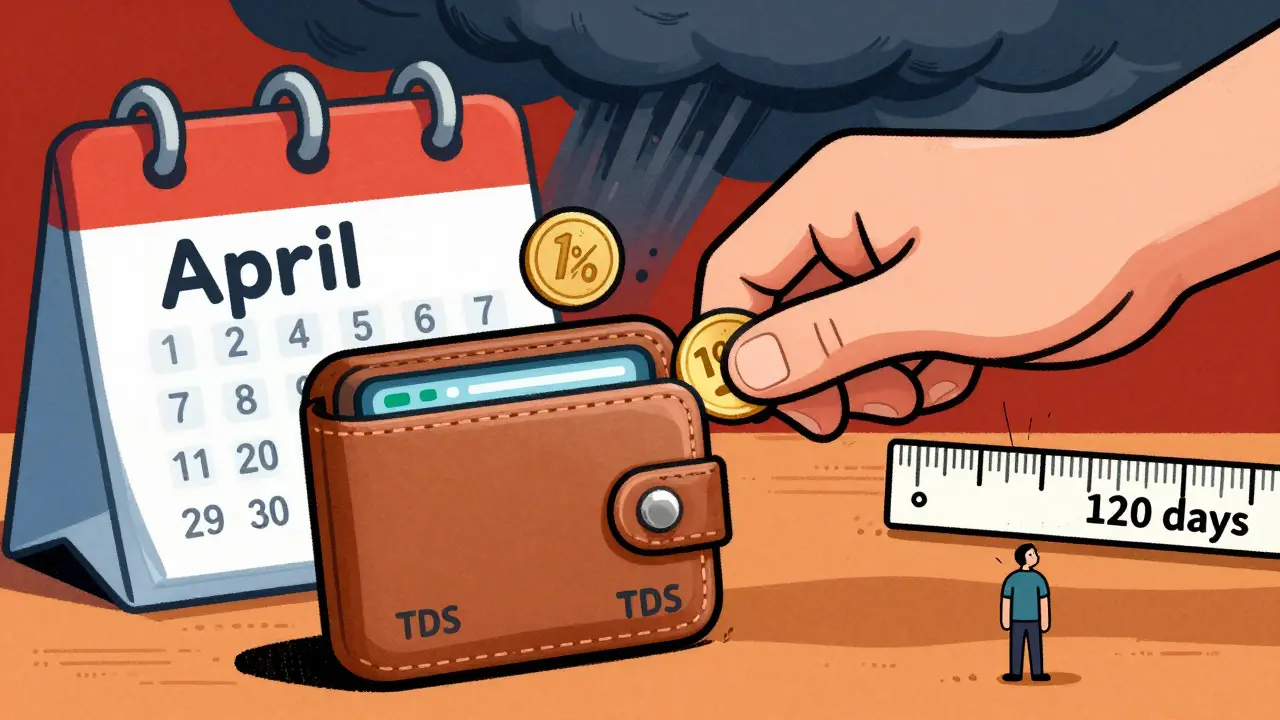
Beyond the final tax bill, there is the issue of cash flow. India introduced Tax Deducted at Source (TDS) under Section 194S for VDA transactions. This affects NRIs too, provided they transact through Indian exchanges or platforms registered in India. If your sale consideration exceeds ₹50,000 (and in some stricter interpretations, even ₹10,000), the exchange will deduct 1% of the transaction value before crediting your account.
For high-volume traders, this 1% adds up quickly. While this amount is creditable against your final tax liability, it ties up your capital temporarily. You have to file your return to get this money back. If you are using a foreign exchange platform that isn't compliant with Indian reporting standards, you avoid the immediate TDS, but you risk penalties later if the Indian authorities trace the transaction through bank transfers or IP addresses.
The 2026 Residency Shift: A Major Risk Factor
The most critical development for NRIs isn't just the tax rate-it's who gets taxed. The definition of 'resident' for tax purposes is changing. Effective April 1, 2026, the threshold for becoming a tax resident in India drops from 182 days to just 120 days.
Here is how this works: If you stay in India for 120 days or more in a financial year AND your income from Indian sources exceeds ₹15 lakhs, you become a tax resident. Why does this matter for crypto? Because residents are taxed on their global income. If you trigger this status, your crypto gains earned in Singapore, the US, or anywhere else in the world could potentially fall under Indian tax jurisdiction.
Previously, as a pure NRI, you were only taxed on income accrued or received in India. The ambiguity lies in what constitutes 'Indian source' for crypto. If you trade on Binance (global) but withdraw funds to an Indian NRE account, is that Indian source income? The regulations are still evolving, but the trend is toward wider net enforcement. If you plan to spend significant time in India post-2026, you must calculate your days meticulously. One extra week could change your tax status entirely.
Mining, Airdrops, and Gifts: Different Rules Apply
So far, we’ve talked about buying and selling. But what if you acquired crypto without paying for it? The tax treatment changes here. If you receive cryptocurrency through mining rewards, airdrops, or gifts, and you didn't pay a purchase price, the 30% flat tax doesn't apply immediately upon receipt.
Instead, the value of the crypto at the time of receipt is added to your total income and taxed at your applicable slab rates. For an NRI with high other income, this could mean a tax rate higher than 30%. Later, when you sell that mined coin, the cost basis is the fair market value at the time you received it. This creates a complex tracking requirement. You need records of the value of every airdrop on the day it hit your wallet, not just the day you sold it.

Compliance and Penalties: Don't Ignore Small Holdings
A common mistake among NRIs is assuming that because they live abroad, Indian tax laws don't apply to small crypto holdings. This is dangerous. Mandatory disclosure of cryptocurrency holdings and transactions is required in your Indian income tax return if you have any taxable connection to India. Failure to disclose can lead to severe penalties, including scrutiny of your entire financial profile.
Moreover, the inability to offset losses is a major pain point. If you lose ₹10 lakhs on Dogecoin and make ₹10 lakhs on Ethereum, you can offset them. But if you lose ₹10 lakhs on crypto and make ₹10 lakhs on Indian stocks, you cannot use the crypto loss to reduce the stock tax. Crypto losses are siloed. They can only be carried forward to set off against future crypto gains. This lack of flexibility makes the tax environment particularly unfriendly for speculative investors.
Strategic Takeaways for NRIs in 2026
Given the lack of exemptions, your strategy should focus on mitigation and compliance rather than avoidance. First, maintain impeccable records. Use portfolio trackers that generate reports compatible with Indian tax filing requirements. Second, review your travel plans. If you are close to the 120-day mark in India, consider leaving earlier to maintain NRI status and protect your global income from Indian taxation. Third, consult a tax advisor who specializes in cross-border digital assets. Generic CA advice might miss the nuances of VDA regulations.
While the government continues to refine these rules, the current stance is clear: crypto is treated as a high-tax, low-benefit asset class for everyone, with no special club for NRIs. Plan accordingly.
Do NRIs pay 30% tax on crypto gains in India?
Yes. Under the current framework, all Non-Resident Indians are subject to a flat 30% tax rate on capital gains from the sale of Virtual Digital Assets (VDAs). This rate applies regardless of the holding period, meaning there is no difference between short-term and long-term gains for crypto.
Can NRIs claim Section 115F exemption for crypto investments?
No. Section 115F provides exemptions for reinvestment in specific traditional instruments like bonds and mutual funds. Cryptocurrencies are explicitly excluded from this list, so NRIs cannot use this section to offset tax liabilities on crypto gains.
How does the new 120-day residency rule affect NRI crypto taxes?
Effective April 2026, staying in India for 120+ days with Indian income over ₹15 lakhs makes you a tax resident. Residents are taxed on global income. This means your crypto gains earned outside India could become taxable in India if you cross this threshold, whereas NRIs are typically taxed only on Indian-source income.
Is TDS applicable to NRIs trading crypto on Indian exchanges?
Yes. Under Section 194S, a 1% TDS is deducted on crypto transactions exceeding ₹50,000 (or ₹10,000 in some cases) on Indian platforms. This applies to both residents and NRIs. The deducted amount can be claimed as a credit against your final tax liability when filing returns.
Can I offset crypto losses against stock market gains as an NRI?
No. Losses incurred from cryptocurrency transactions can only be set off against gains from other cryptocurrency transactions. They cannot be used to reduce tax liability on income from stocks, bonds, or other traditional investment avenues.
Are mining rewards taxed differently for NRIs?
Yes. Crypto acquired through mining, airdrops, or gifts without purchase consideration is taxed at your applicable income slab rates upon receipt, rather than the flat 30% capital gains tax. The fair market value at the time of receipt becomes your cost basis for future sales.