

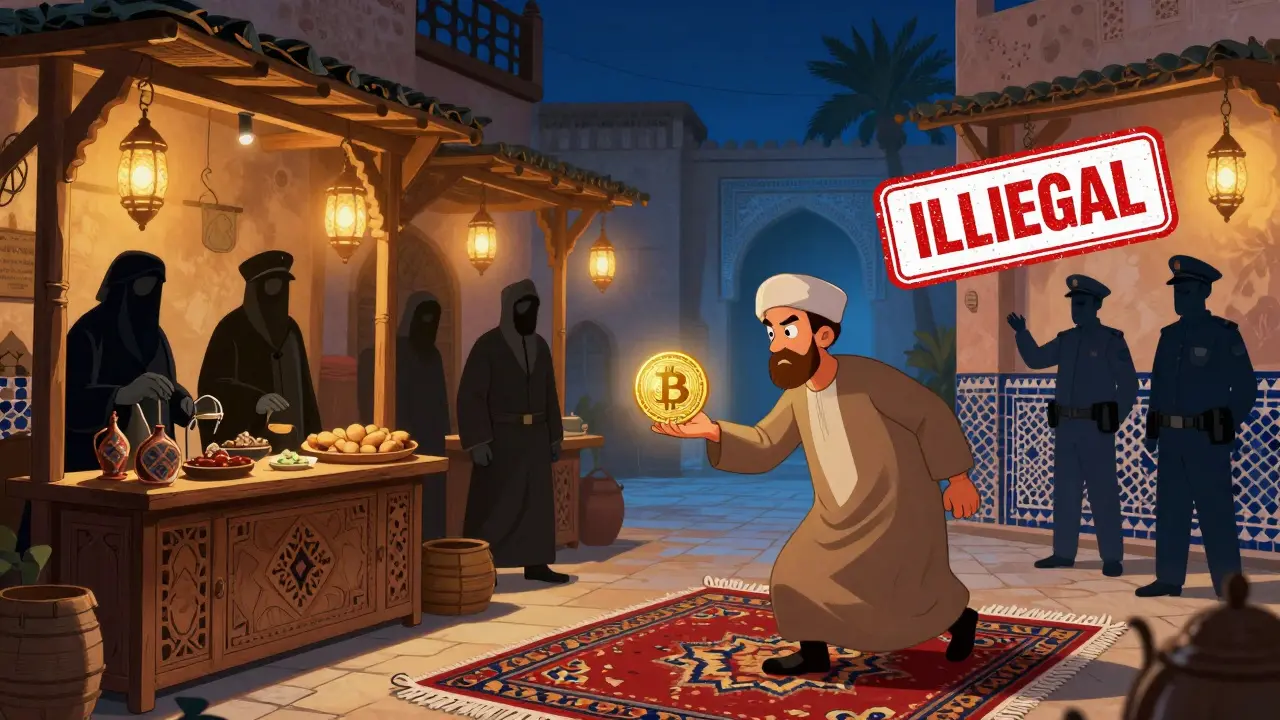
If you're trading cryptocurrency in Morocco, you're playing with fire-literally. Even though millions of Moroccans use Bitcoin, Ethereum, and other digital assets every day, the government still treats it like a crime. And the penalties aren't just a slap on the wrist. They can cost you thousands of dollars, land you in court, or shut down your business overnight.
Back in November 2017, Morocco’s Ministry of Economy and Finance dropped a bombshell: all cryptocurrency transactions were declared illegal. Not just regulated-banned. The reason? To stop people from bypassing the country’s strict foreign exchange rules. If you wanted to buy property in Spain or send money to family abroad, you had to go through official banks. Crypto made that too easy. So the government shut it down.
Here’s what happens if you get caught:
- Individuals trading crypto without approval face fines between MAD 20,000 and MAD 100,000 (about $2,000 to $10,000 USD).
- Companies, exchanges, or businesses using crypto for payments? Those fines jump to MAD 500,000 (around $50,000 USD).
- Repeat offenders? That’s when criminal charges kick in. Not just money-actual legal proceedings under Morocco’s financial crime laws.
These aren’t theoretical threats. In February 2025, Moroccan authorities launched a targeted crackdown on people using Bitcoin and Ethereum to buy real estate. They were trying to avoid currency controls by paying for villas in Marrakech or apartments in Casablanca with digital coins. The government tracked blockchain transactions, matched them to property deeds, and started issuing fines. One case involved a businessman who bought a $180,000 apartment using Tether. He was fined MAD 85,000 and ordered to repay the full amount through official channels.
It’s not just about buying property. Any business that accepts crypto as payment for goods or services is breaking the law. That includes online stores, freelancers getting paid in USDT, or even local shops accepting Litecoin. Even if you’re not running an exchange, just using crypto to pay your rent or buy a laptop? You’re still at risk.
But here’s the twist: the rules are changing.
In November 2024, Abdellatif Jouahri, the governor of Bank Al-Maghrib (Morocco’s central bank), announced that a new law to legalize and regulate cryptocurrency was in the final stages of approval. This isn’t a softening of stance-it’s a strategic shift. The government realized that banning crypto didn’t stop it. It just drove it underground, where they couldn’t tax it, track it, or protect users.
The new framework, expected to become law in 2025, will require every crypto exchange operating in Morocco to get a license from Bank Al-Maghrib. That means:
- Strict Anti-Money Laundering (AML) (Regulations designed to prevent criminals from disguising illegally obtained funds as legitimate income) checks on every user.
- Full Know Your Customer (KYC) (Process of verifying the identity of customers to prevent fraud and financial crime) verification-ID, proof of address, income sources.
- Reporting all transactions to the Moroccan Tax Administration (DGI) (The government body responsible for collecting taxes and enforcing tax laws in Morocco).
And with regulation comes taxation. Starting in 2026, profits from crypto trading will be taxed just like stocks or other investments:
- Individuals: 10% to 38% income tax, depending on total earnings.
- Corporate traders: 20% to 31% corporate tax rate.
- Crypto capital gains: 15% to 30%, matching the rate for securities.
Failure to report? That’s not a simple oversight. It’s tax evasion. And under Moroccan law, tax evasion can mean fines, asset seizures, or even jail time. The DGI is already building systems to track crypto wallets linked to bank accounts and property purchases.
So what does this mean right now? You’re caught between two worlds.
On one side: the old penalties are still active. If you’re trading on Binance or Coinbase without a license, you’re still breaking the law. The government hasn’t paused enforcement. In fact, they’ve increased monitoring. Banks now flag transfers to crypto exchanges. Payment processors block transactions linked to known crypto platforms.
On the other side: the new rules are coming. The draft law is approved by parliament and only needs final presidential signature. Once it’s law, the old fines will still exist-but only for those who refuse to comply with the new system. Licensed exchanges will operate legally. Unlicensed ones? They’ll be shut down, and their operators will face the full penalty range.
There’s another layer: Moroccan Capital Market Authority (AMMC) (The regulatory body overseeing securities, ICOs, and tokenized assets in Morocco). They’re already reviewing Initial Coin Offerings (ICOs) and tokenized real estate projects. If you’re raising money through crypto in Morocco, you need AMMC approval-or you’re committing fraud.
And here’s the kicker: Morocco isn’t just regulating crypto. It’s building its own digital currency. Bank Al-Maghrib has been testing a Central Bank Digital Currency (CBDC) (A digital form of a country’s official currency issued and regulated by its central bank) since 2024. Pilot testing starts in 2026. When it launches, it could replace much of the underground crypto activity-offering a government-backed digital alternative that’s traceable, secure, and taxable.
So who’s really at risk?
- Individual traders using peer-to-peer apps like LocalBitcoins? You’re in a gray zone. As long as you’re not running a business or using crypto for large purchases, enforcement is rare-but not impossible.
- Business owners accepting crypto as payment? You’re breaking the law today. When the new law passes, you’ll have to register, pay taxes, and comply-or face fines up to MAD 500,000.
- Exchange operators without a license? You’re already on the government’s radar. Several platforms were shut down in late 2024. Their owners received formal notices: shut down or face criminal charges.
Here’s the reality: Morocco’s crypto market is huge. Estimates put the value of crypto transactions in the country at $278 million in 2025 and rising to $292 million by 2026. That’s not small-time activity. It’s a major underground economy. The government knows this. That’s why they’re shifting from punishment to control.
The message is clear: you can trade crypto in Morocco-but only if you play by the new rules. No more hiding. No more anonymity. No more tax-free gains. If you want to keep trading, you’ll need to register, report, and pay. Otherwise, the fine is steep, the risk is real, and the clock is ticking.
By mid-2026, the old penalties will still exist-but they’ll only apply to those who refuse to adapt. The future belongs to those who comply.
Is it illegal to own cryptocurrency in Morocco?
Yes, owning crypto is technically illegal under Morocco’s 2017 ban. However, enforcement focuses on trading, exchanging, and using crypto for payments-not simply holding it. Most individuals who hold Bitcoin or Ethereum in personal wallets aren’t targeted unless they’re actively trading or using it to bypass financial regulations.
Can I use crypto to buy property in Morocco?
No. Using cryptocurrency to purchase real estate in Morocco is considered a violation of foreign exchange laws. Authorities actively track such transactions, especially since February 2025. If you attempt this, you’ll face fines, be forced to repay the transaction through official channels, and possibly be investigated for tax evasion.
What happens if I get caught trading crypto in Morocco?
If you’re caught trading crypto without authorization, you’ll likely receive a fine between MAD 20,000 and MAD 100,000 (for individuals) or up to MAD 500,000 (for businesses). Repeat offenses or large-scale activity can lead to criminal prosecution under Morocco’s financial crime laws. Bank Al-Maghrib and the DGI are actively building systems to identify and penalize non-compliant users.
Will crypto become legal in Morocco in 2025?
Yes, but not as a free-for-all. A new regulatory law is expected to be enacted in 2025, legalizing crypto trading-but only through licensed exchanges approved by Bank Al-Maghrib. You’ll need to complete KYC, report all transactions, and pay taxes. Unlicensed trading will remain illegal and subject to heavy penalties.
Do I have to pay taxes on crypto profits in Morocco?
Starting in 2026, yes. Capital gains from crypto trading will be taxed at 15-30%, and income from crypto activities will be subject to progressive income tax rates from 10% to 38%. The Moroccan Tax Administration is preparing systems to track wallet activity linked to bank accounts and property purchases. Failure to report is considered tax evasion.
Are peer-to-peer crypto trades allowed in Morocco?
Not officially. P2P trades are still considered unauthorized under the 2017 ban. While enforcement against individual P2P traders is rare, the government has the legal authority to fine anyone who engages in unlicensed trading. Once the new law passes, only licensed platforms will be permitted to facilitate trades-even P2P transactions will need to go through approved channels.
Can Moroccan banks block my account for crypto activity?
Yes. Moroccan banks are required to monitor transactions linked to crypto exchanges. If your bank detects repeated transfers to platforms like Binance, Coinbase, or Kraken, they may freeze your account, request documentation, or report you to financial authorities. Many users have reported sudden account restrictions after crypto-related transfers.
What’s the difference between the current penalties and the new rules?
Current penalties are based on prohibition: you’re fined just for trading. The new rules shift to compliance: you’re allowed to trade, but only if you’re licensed, taxed, and monitored. The fines stay the same-but now, they’re applied to those who refuse to join the regulated system. The goal isn’t to punish crypto-it’s to bring it into the formal economy.
By 2026, Morocco’s crypto landscape will look completely different. The crackdown isn’t over-it’s evolving. The question isn’t whether you can trade crypto anymore. It’s whether you’ll choose to do it legally-or risk losing more than just your coins.
Brenda White
March 16, 2026 AT 12:58Ernestine La Baronne Orange
March 17, 2026 AT 00:05Manali Sovani
March 18, 2026 AT 16:01Konakuze Christopher
March 19, 2026 AT 02:03sai nikhil
March 20, 2026 AT 11:38Sahithi Reddy
March 21, 2026 AT 02:49George Hutchings
March 22, 2026 AT 02:29Henrique Lyma
March 22, 2026 AT 06:58Steph Andrews
March 23, 2026 AT 23:28Prakash Patel
March 25, 2026 AT 14:19Zachary N
March 26, 2026 AT 06:37Elizabeth Kurtz
March 27, 2026 AT 05:09john peter
March 28, 2026 AT 14:28Marc Morgan
March 29, 2026 AT 16:21Anastasia Thyroff
March 30, 2026 AT 15:21Kira Dreamland
April 1, 2026 AT 13:15shreya gupta
April 3, 2026 AT 05:27Derek Lynch
April 4, 2026 AT 00:40Shreya Baid
April 5, 2026 AT 11:21Christopher Hoar
April 7, 2026 AT 04:37Robert Kunze
April 8, 2026 AT 15:16Sarah Zakareckis
April 10, 2026 AT 03:12Heather James
April 10, 2026 AT 21:11Sarah Hammon
April 11, 2026 AT 23:30Jerry Panson
April 12, 2026 AT 13:32Cheri Farnsworth
April 12, 2026 AT 21:47Gene Inoue
April 14, 2026 AT 15:38Ricky Fairlamb
April 14, 2026 AT 21:01Brenda White
April 16, 2026 AT 17:59Zachary N
April 17, 2026 AT 01:34Shreya Baid
April 18, 2026 AT 09:57