


Have you ever tried to trade on a decentralized exchange (DEX) only to watch your transaction sit in limbo for minutes while the price moves against you? It is frustrating. Now imagine a platform where that same trade settles in less than a second, with fees that are a fraction of what you pay on Ethereum. That is the promise of Shadow Exchange v2, a decentralized cryptocurrency exchange built specifically on the Sonic blockchain network. Launched in 2024 by an anonymous team incorporated in Panama, this platform has quickly become the dominant liquidity hub for Sonic users. But does it live up to the hype, or is it just another niche project chasing quick profits?
In this review, we break down how Shadow Exchange v2 works, who it is actually for, and whether its unique features justify moving your funds away from established giants like Uniswap or PancakeSwap.
What Is Shadow Exchange v2?
At its core, Shadow Exchange v2 is a concentrated liquidity layer. If you have used Uniswap V3, you know that concentrated liquidity allows providers to deposit capital into specific price ranges rather than spreading it across the entire curve. This increases capital efficiency but adds complexity. Shadow Exchange takes this concept and optimizes it for the Sonic network, which boasts sub-second block times and instant finality.
The platform was designed to solve a specific problem: high latency and exorbitant gas fees on older networks like Ethereum. By leveraging Sonic’s infrastructure, Shadow Exchange processes approximately 1,000 transactions per second. According to data from g-ever.org in 2024, this architecture results in fees that are roughly 95% lower than those found on Ethereum-based alternatives. For active traders, that cost difference is not just a saving; it is a game-changer.
Performance Metrics: The Numbers Don't Lie
Let's look at the hard data. As of Q2 2024, Shadow Exchange v2 reported a 24-hour trading volume of nearly $30 million ($29,996,634). While this might sound modest compared to the $18.7 billion daily volume of the broader DEX market, it places Shadow Exchange in the 88th percentile for volume among all decentralized exchanges. More importantly, it holds the top spot within the Sonic ecosystem.
| Metric | Value | Industry Context |
|---|---|---|
| 24-Hour Volume | $29.9M | Top 12% globally |
| Average Bid-Ask Spread | 0.781% | 23% tighter than industry avg (1.01%) |
| Supported Tokens | 38 | Limited compared to Uniswap (8,000+) |
| Trading Pairs | 87 | Focused on high-liquidity assets |
| Transaction Speed | <1 Second | Significantly faster than Ethereum (~15s) |
The most active pair is USDC.E/WS, accounting for over 34% of total volume. The tight bid-ask spread of 0.781% is particularly impressive. In trading terms, a tighter spread means you lose less money entering and exiting positions. DeFi Llama’s Q2 2024 report confirmed that this spread is significantly better than the average for similar platforms.
The x(3,3) Tokenomic Model: A Better Ve(3,3)?
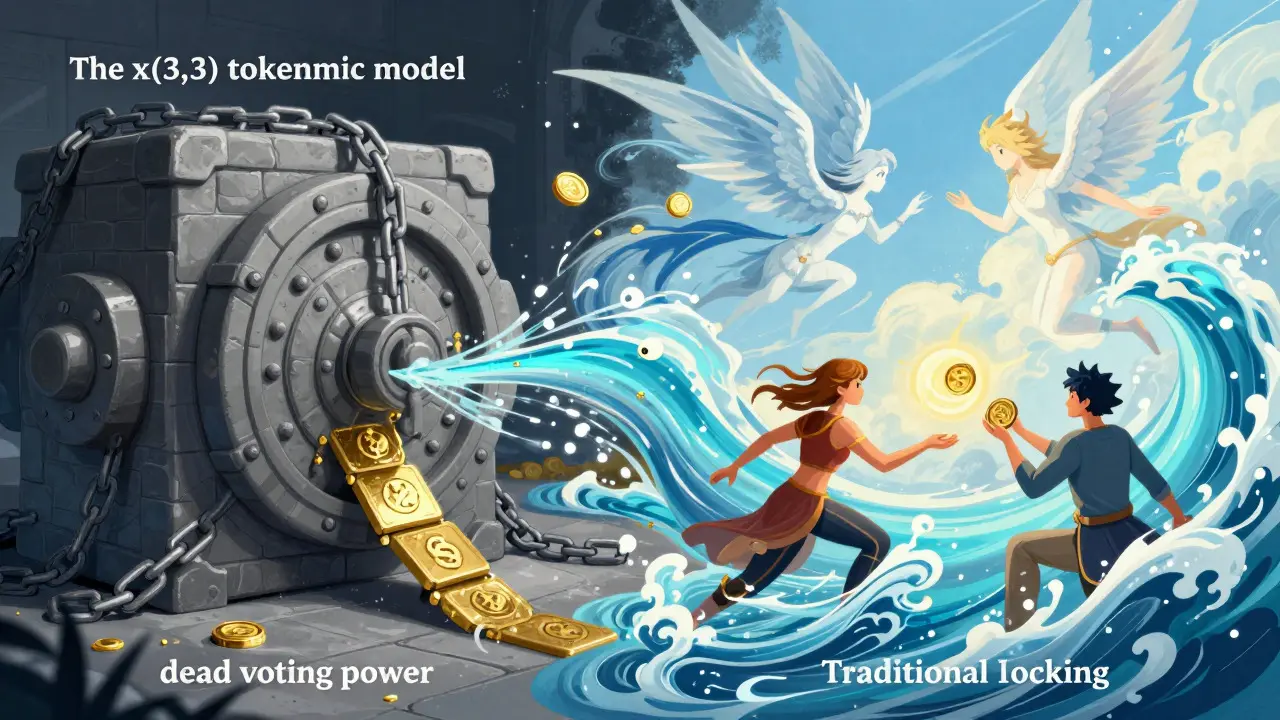
One of the most talked-about features of Shadow Exchange is its incentive model. Most major DEXs use the ve(3,3) mechanism, popularized by Curve Finance. In that model, users lock tokens to gain voting power and rewards. However, as noted by blocmates.com, many ve(3,3) platforms suffer from "dead voting power," where inactive users hold locked tokens that don't contribute to governance or liquidity dynamics.
Shadow Exchange introduced the x(3,3) model, described as a more fluid alternative. Instead of permanent locks, the system encourages dynamic participation. Users can deposit tokens, provide liquidity in wide or narrow ranges, and stake the resulting LP tokens to earn xSHADOW rewards. The strategy recommended by experienced yield farmers is to keep half the rewards as xSHADOW and reinvest the other half to buy more S and stS tokens. This creates a compounding effect without trapping capital indefinitely.
This design choice addresses a major pain point for liquidity providers: exit flexibility. If you want to leave, you aren't stuck waiting for a multi-year lock-up period to expire. This makes the platform attractive to sophisticated traders who need agility.

User Experience and Accessibility
Getting started with Shadow Exchange v2 is straightforward if you already use Web3 wallets. You will need an Ethereum-compatible wallet like MetaMask, configured to interact with the Sonic network. Setup typically takes 15-20 minutes for new users. There are no hardware requirements beyond a standard web browser.
However, the interface assumes a certain level of DeFi literacy. Unlike simple swap interfaces, Shadow Exchange requires you to understand concentrated liquidity ranges. If you set your price range too narrowly, you might miss out on trades or face impermanent loss if the price exits your range. The platform provides basic documentation, but much of the community guidance comes from third-party guides rather than official tutorials.
Support responsiveness is mixed. Some users report smooth experiences, while others have encountered account lockouts after multiple failed login attempts, requiring manual support intervention. Given the anonymous nature of the development team, trust is largely placed in the code and the smart contracts rather than customer service teams.
Pros and Cons: Who Should Use It?
Shadow Exchange v2 is not for everyone. Its value proposition depends entirely on your trading style and risk tolerance.
- Pros:
- Speed: Sub-second finality eliminates slippage anxiety during volatile markets.
- Cost: Fees are drastically lower than Ethereum-based DEXs.
- Efficiency: Tighter spreads mean better execution prices.
- Innovation: The x(3,3) model offers more flexible incentives than traditional ve(3,3).
- Cons:
- Limited Selection: Only 38 tokens are supported, far fewer than competitors.
- No Margin Trading: Spot trading only; no leverage options.
- Ecosystem Risk: Success is tied directly to the adoption of the Sonic blockchain.
- Learning Curve: Concentrated liquidity requires active management.
If you are a casual investor looking to buy Bitcoin or Ethereum once a month, Shadow Exchange is overkill. Stick to user-friendly platforms like Coinbase or Binance. But if you are a high-frequency trader, a yield farmer, or someone deeply embedded in the Sonic ecosystem, Shadow Exchange v2 offers tools that larger, slower exchanges simply cannot match.
Market Position and Future Outlook
As of mid-2025, Shadow Exchange has entered a "maintenance mode," prioritizing stability over new feature releases. This is a common phase for mature DeFi protocols after their initial growth surge. The focus has shifted to security audits and integrating deeper with Sonic’s broader ecosystem, including its airdrop programs.
The long-term viability of Shadow Exchange hinges on Sonic’s success. Sonic currently represents less than 1.2% of total DeFi TVL. If Sonic fails to gain traction, Shadow Exchange’s growth will stall. Conversely, if Sonic achieves its performance promises and attracts more developers, Shadow Exchange’s first-mover advantage could make it a dominant player in high-speed DeFi trading. Analysts at Messari suggest that specialized DEXs like this either get acquired or consolidate within three years if their underlying chains don’t scale significantly.
Final Verdict
Shadow Exchange v2 is a powerful tool for a specific audience. It delivers on its promise of speed and low costs, making it one of the most efficient trading environments in the current crypto landscape. However, its limited token selection and dependence on the Sonic network mean it should be viewed as a specialized instrument, not a replacement for your primary exchange. For traders willing to manage concentrated liquidity positions and navigate a slightly steeper learning curve, the benefits in fee savings and execution speed are substantial.
Is Shadow Exchange v2 safe to use?
Like any decentralized exchange, safety depends on the smart contract audits and the underlying blockchain. Shadow Exchange operates on the Sonic network, which is known for high throughput. However, because the development team is anonymous and incorporated in Panama, there is less regulatory oversight. Always start with small amounts to test the waters and ensure your wallet security is robust.
What is the difference between x(3,3) and ve(3,3)?
ve(3,3) typically requires long-term token locking, which can lead to "dead voting power" where inactive users hold influence. The x(3,3) model used by Shadow Exchange is designed to be more fluid, allowing for easier exit mechanisms and dynamic participation without permanently trapping capital.
Can I trade margin on Shadow Exchange?
No, Shadow Exchange v2 currently supports only spot trading. There are no margin or leveraged trading products available on the platform.
How many tokens does Shadow Exchange support?
As of Q2 2024, the platform supports 38 cryptocurrencies and 87 trading pairs. This is significantly fewer than major competitors like Uniswap, which supports over 8,000 tokens.
What wallet do I need to use Shadow Exchange?
You need a Web3 wallet compatible with the Sonic blockchain, such as MetaMask. Ensure your wallet is configured to recognize the Sonic network before connecting to the exchange.