


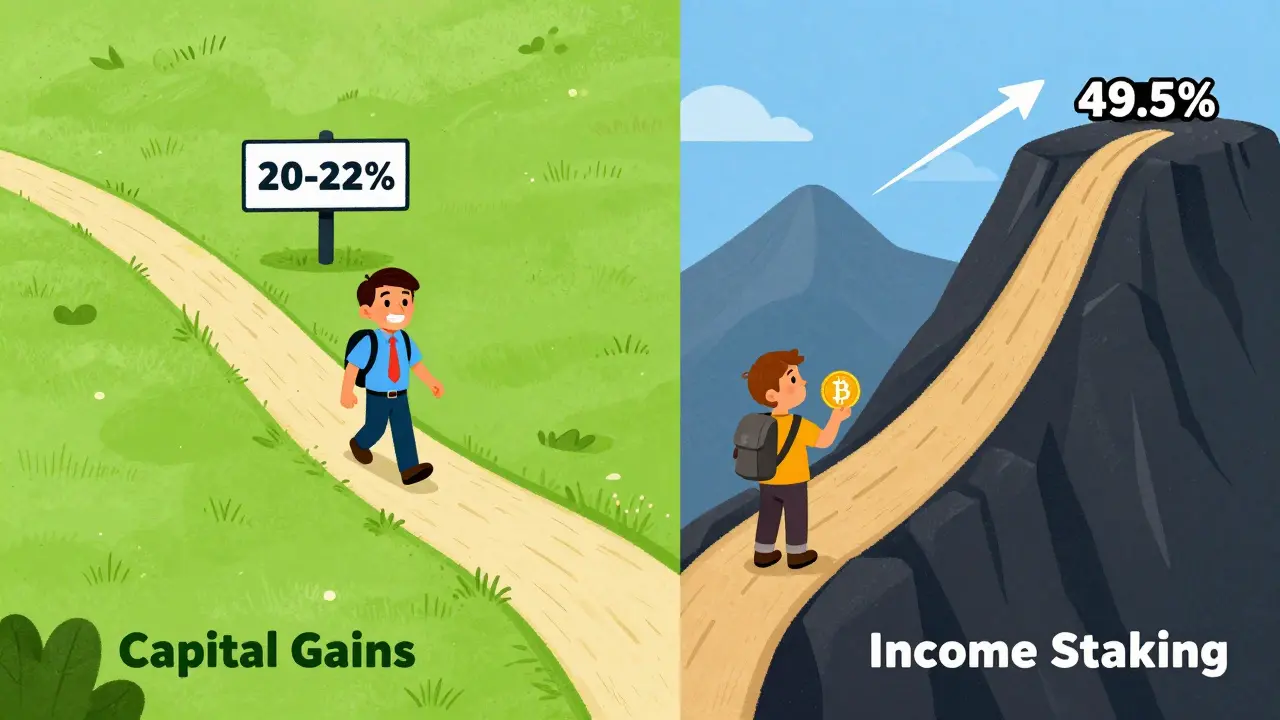
You’ve probably seen the headlines screaming about a massive 45% or even higher tax on your crypto profits in South Korea. It sounds terrifying if you’re holding Bitcoin or Ethereum and thinking about cashing out. But here is the truth that most clickbait articles miss: that high percentage is not the standard rule for selling your coins. The reality of South Korea's crypto tax system is far more nuanced, and for most retail investors, the actual rate you will pay is significantly lower-often just 20% to 22%.
To understand why there is so much confusion, we have to look at how the government classifies your money. Are you trading for profit, or are you earning income? This distinction changes everything. As we approach the final implementation window in January 2027, knowing exactly where you stand can save you millions of Won in unnecessary panic and potentially thousands in taxes through proper planning.
The Real Capital Gains Tax Rate: 20% Plus Local Taxes
If you buy Bitcoin today and sell it next year for a profit, you are subject to Capital Gains Tax (CGT). The base federal rate for this is set at 20%. However, taxes in South Korea always include local surcharges. When you add the local inhabitant tax, which is typically 10% of the central tax amount, your effective rate becomes 22%.
This 22% figure is what applies to the vast majority of active traders who are flipping assets. It is comparable to long-term capital gains rates in many other developed nations. It is not the 45%+ figure that circulates in fear-mongering threads. That higher number only appears when your crypto activity is classified as regular business income or wages, which brings us to the next critical category.
| Income Type | Tax Category | Effective Rate Range | Key Trigger |
|---|---|---|---|
| Trading Profits | Capital Gains Tax | 20% - 22% | Selling assets for profit above threshold |
| Mining/Staking/Airdrops | Other Income | 6.6% - 49.5% | Earning new coins via network participation |
| Crypto Salary/Services | Business/Professional Income | 6% - 49.5% | Receiving payment for work in crypto |
| Foreign Investors | Withholding/Net Gain | 11% or 22% | Non-resident disposals |
The 50 Million Won Shield: Who Pays Nothing?
Here is the best news for small-scale investors: you might not pay any capital gains tax at all. The South Korean government has established a generous annual exemption threshold of 50 million Korean Won (approximately $35,900 USD).
If your total net profit from all cryptocurrency trades combined does not exceed 50 million KRW in a single calendar year, your capital gains tax liability is zero. This policy was designed specifically to protect retail investors and casual holders while targeting professional traders and whales. For example, if you bought 1 BTC for 50 million KRW and sold it for 80 million KRW, your gain is 30 million KRW. Since this is below the threshold, you owe nothing in capital gains tax.
However, be careful with the word "net." You must calculate your total gains minus your total losses across all transactions. If you made 60 million in gains but also lost 15 million on bad trades, your net gain is 45 million. You still fall under the shield. But if you don't track your losses properly, the National Tax Service may assume your gross revenue is taxable, which is why record-keeping is non-negotiable.
Where the 45%+ Figure Comes From: Income vs. Gains
So where did the scary 45% statistic come from? It stems from the classification of "Other Income" and "Business Income." In South Korea, not all crypto earnings are treated as capital gains. If you receive crypto through mining, staking rewards, liquidity mining, or airdrops, these are often categorized as "other income."
"Other income" is taxed according to your personal income tax brackets. These brackets are progressive, meaning the more you earn, the higher the percentage you pay. For high-income earners, the marginal tax rate can reach up to 45% federally, plus local taxes, pushing the effective rate close to 49.5%. Similarly, if you are paid in cryptocurrency for freelance work or employment, that is treated as salary or business income, subject to the same high progressive rates.
This distinction is crucial. Selling your existing stash of Ethereum is a capital event (20-22%). Receiving new Ethereum tokens because you staked them is an income event (up to ~50%). Many users confuse these two, leading to widespread misinformation about a blanket "crypto tax."
The Timeline: Why You Still Have Time Until 2027
One of the biggest sources of anxiety is the implementation date. Originally scheduled for 2022, then delayed to 2025, the comprehensive crypto tax law has been pushed back again. Following intense political negotiations between the ruling People Power Party and the opposition Democratic Party in late 2024, the official start date for taxing capital gains on crypto is now January 1, 2027.
This delay gives you roughly eighteen months to prepare. During this interim period, the rules are technically still in flux, but the National Tax Service has already begun issuing clarifications. They expect residents to report comprehensive income on virtual assets received from foreign corporations starting in July 2025. This means that while the *capital gains* tax waits until 2027, the *income* tax on things like airdrops and staking may already be enforceable depending on specific rulings.
Industry experts view this delay positively. It prevents a sudden shock to the market and allows exchanges and DeFi protocols to build better reporting tools. However, it also means the government is watching closely. Do not assume this is a free-for-all period; use it to organize your financial records.
How to Track Your Transactions Without Going Crazy
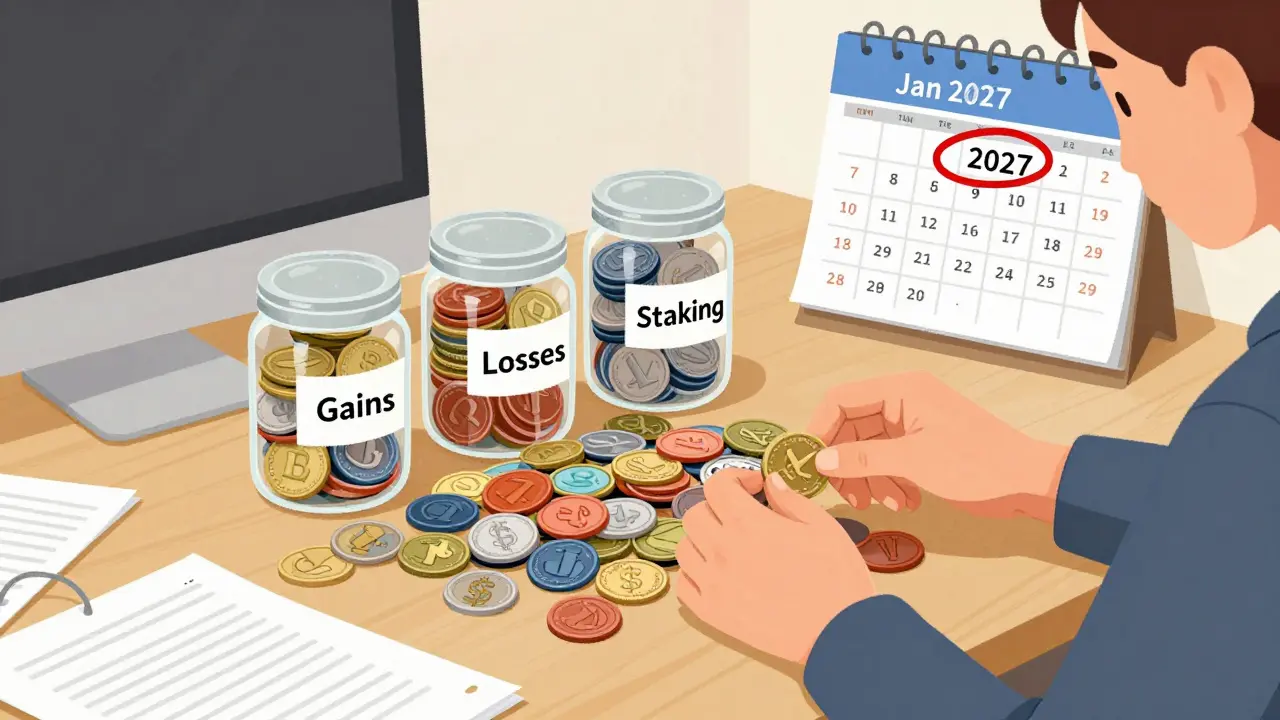
The blockchain is transparent, which is great for security but terrible for privacy if you want to hide transactions from the tax man. The National Tax Service expects you to maintain detailed records of every transaction. This includes timestamps, the value in Korean Won at the exact moment of the trade, and the purpose of the transaction.
For the average user, manually calculating the cost basis for hundreds of trades is impossible. Here is a practical workflow:
- Export Data Regularly: Every month, download your transaction history from every exchange you use (Bithumb, Upbit, Binance, etc.). Do not wait until December.
- Use Aggregator Tools: Utilize crypto tax software that supports Korean Won valuation. These tools connect to your exchanges via API and automatically calculate realized gains and losses.
- Separate Wallets: Keep your trading wallet separate from your long-term holding wallet. This simplifies the categorization of "active trading" versus "investment holding," though both are currently taxed similarly under CGT, it helps with mental accounting.
- Document DeFi Activity: If you use decentralized finance, screenshot your yields and record the token amounts received. Staking rewards are taxable events even if you never sell the tokens.
Tax professionals estimate that setting up this tracking system takes 10-20 hours initially. Doing it once now saves you dozens of hours of stress during tax season.
Common Pitfalls to Avoid in 2026
As you navigate this pre-implementation phase, watch out for these common mistakes:
- Ignoring Crypto-to-Crypto Trades: Trading Bitcoin for Solana is a taxable event in South Korea. You are deemed to have sold the BTC for KRW and then bought SOL. You must report the gain or loss on the BTC portion.
- Assuming NFTs Are Safe: Non-Fungible Tokens are subject to Capital Gains Tax if sold for a profit. If you minted an NFT for 100,000 KRW and sold it for 5 million, that profit counts toward your 50 million threshold.
- Overlooking Foreign Platforms: Using offshore exchanges does not exempt you from taxes. The National Tax Service has clarified that residents must report income from foreign crypto entities. With international data-sharing frameworks like the OECD’s CARF coming into play, hiding assets abroad is becoming increasingly risky.
- Confusing Gross vs. Net: Remember, the 50 million KRW exemption applies to *net* gains. Ensure you are subtracting your losses from your gains to see if you actually cross the threshold.
What This Means for Different Types of Investors
Your strategy should depend on your profile. If you are a casual investor with less than 50 million KRW in annual profits, your primary job is documentation. Keep your records clean so you can prove your gains are below the threshold. You likely won’t pay any capital gains tax.
If you are an active trader exceeding the threshold, budget for the 22% effective rate. Consider harvesting losses strategically before the end of the year to offset your gains and stay under the 50 million limit. This is a legal way to reduce your tax burden.
If you earn significant income through staking or mining, consult a tax professional immediately. Because this falls under "other income," it stacks with your salary and could push you into a higher tax bracket. There are no special exemptions for staking income, so accurate valuation at the time of receipt is critical.
When does South Korea officially start taxing crypto capital gains?
The official implementation date for the capital gains tax on cryptocurrency is January 1, 2027. This date was confirmed after political negotiations in late 2024, delaying previous plans for 2022 and 2025.
Is the 50 million KRW exemption per coin or total?
The 50 million KRW exemption is for your total net capital gains across all cryptocurrencies in a single calendar year. It is not per asset. You must aggregate all profits and losses from Bitcoin, Ethereum, altcoins, and NFTs to determine if you exceed the threshold.
Do I have to pay tax on staking rewards in 2026?
Yes, staking rewards are generally classified as "other income" and are subject to individual income tax rates, which can range from 6.6% to nearly 50% depending on your total income level. This applies even before the 2027 capital gains tax fully kicks in, as income tax rules are already in effect.
How are crypto-to-crypto trades taxed?
Crypto-to-crypto trades are treated as taxable events. When you swap one cryptocurrency for another, it is considered a sale of the first asset. You must calculate the gain or loss based on the Korean Won value at the time of the swap and report it accordingly.
Can I deduct my trading losses from my gains?
Yes, you can offset your capital gains with capital losses. The tax is calculated on your net gain. If you lost 10 million KRW on one trade and gained 15 million on another, your taxable gain is only 5 million KRW. Proper record-keeping of losses is essential for this deduction.
Barclay Chantel
May 29, 2026 AT 05:14It is frankly pathetic that people are still getting worked up over tax rates when the real issue is the inherent volatility and speculative nature of these digital tokens. The government isn't trying to crush you; they are simply trying to maintain fiscal responsibility in a world where your 'assets' can vanish overnight due to some obscure code error or market manipulation by offshore entities. You lot act as if paying taxes is a personal insult rather than a civic duty, but let's be honest, most of you are just gambling with money you don't have and expecting the state to subsidize your losses.
Joe Clements
May 31, 2026 AT 21:50This is super helpful info, thanks for sharing! It’s always nice to see someone break down the scary headlines into something manageable so we can actually plan ahead without panicking.
Rosie Morris
June 2, 2026 AT 17:49oh my god i was so worried bout the 45% thing but reading this makes me feel way better abt my staking rewards lol
lorna erni
June 3, 2026 AT 06:27Stop crying about taxes and start learning how the system works! If you think 22% is high, you clearly haven’t looked at what other countries charge or how much wealth inequality exists right now. Get your priorities straight and focus on building actual value instead of complaining about contributing to society.
stalin brian
June 3, 2026 AT 12:32hey guys does anyone know if this applies to us holding crypto on foreign exchanges too? im kinda confused bout the jurisdiction part
kamal ifrani
June 4, 2026 AT 17:01The entire premise of this article is flawed because it assumes the average person understands basic accounting principles, which is laughable given the current state of financial literacy. You are essentially telling people to trust their own ability to track transactions while ignoring the fact that the tax authorities have infinite resources to audit you. It’s a trap designed to catch the uninformed, and those who think they are safe under the 50 million won threshold are walking blindly into a bureaucratic nightmare.
saradee dee
June 4, 2026 AT 20:18Wow, this is such a huge relief to hear! I was thinking I would lose half my savings just by selling a little bit of Bitcoin. Thank you so much for explaining it in a way that doesn't make my head spin!
Craig Swanson
June 5, 2026 AT 11:49You need to take control of your financial narrative right now! Ignorance is not an excuse when the National Tax Service is actively watching. Get your records in order today, stop making excuses, and ensure you are compliant because the consequences of negligence will destroy your portfolio faster than any market crash ever could.
Bill Gunn
June 7, 2026 AT 07:29Great insights here! 🚀 Just remember that while the capital gains tax waits until 2027, the income tax on staking is already live. Make sure you're tracking those airdrops carefully because the IRS (and NTS) love a good surprise audit! 💰📊
Dana Rapoport
June 8, 2026 AT 23:03One must consider the philosophical implications of taxing digital assets that exist outside traditional banking systems. The delay until 2027 allows for a period of reflection on whether these instruments should be treated as property or currency, which fundamentally alters the ethical framework of taxation.
Hadleigh Edwards
June 10, 2026 AT 21:33I truly believe that this extended timeline provides a wonderful opportunity for all of us to educate ourselves thoroughly on the nuances of international tax law, and if we approach this situation with optimism and diligence, we can certainly navigate the complexities of the upcoming regulations without undue stress or financial hardship, ultimately leading to a more secure and prosperous future for every investor involved in this exciting technological revolution.
mark valmart
June 11, 2026 AT 12:25pretty solid guide man, just gonna keep my trading wallet separate like u said
Crystal Davis
June 11, 2026 AT 22:07This analysis fails to account for the cumulative effect of local surcharges which vary significantly by municipality, meaning the effective rate could easily exceed 22% for residents in major metropolitan areas. Furthermore, the classification of 'other income' is subject to interpretation by individual tax auditors, creating a grey area that favors the state rather than the taxpayer.
Christina Pearce
June 12, 2026 AT 21:41I’m curious if there are any specific software recommendations for tracking DeFi yields since manual entry seems prone to error?
Joshua Alcover
June 14, 2026 AT 20:01The implementation of these fiscal policies represents a necessary assertion of sovereign authority over decentralized financial instruments that have historically operated beyond the purview of national regulatory frameworks. It is imperative that citizens recognize the primacy of state taxation rights in maintaining economic stability and social cohesion within the nation-state paradigm.
Diana Morris
June 16, 2026 AT 13:55stop whining and pay ur taxes its not that hard get ur life together
Dianne Wright
June 17, 2026 AT 02:15i mean everyone knows the govts gonna take everything eventually so why bother trying to optimize anything just give them what they want and move on
trisya hazriyana
June 18, 2026 AT 04:46Oh look, another article pretending to simplify complex tax codes while ignoring the bureaucratic labyrinth that awaits the unwary. How quaint. The 'shield' is merely a carrot dangled before the masses to keep them compliant while the real predators feast on the margins.
Debbie Lewis
June 18, 2026 AT 10:35I guess I’ll just stick to holding for now and see how things play out, no rush to sell anyway.
Eric Grosso
June 19, 2026 AT 18:50wait so if i swap btc for eth do i have to report that even if i dont sell for cash yet?
Edith Mair
June 20, 2026 AT 07:25Can someone clarify if NFTs minted for free are considered zero-cost basis for tax purposes?
Sam Dashti
June 22, 2026 AT 06:17It’s fascinating how the lines blur between investment and speculation, isn’t it? One moment you’re a savvy holder, the next you’re a taxable trader. The dance between profit and penalty is quite the spectacle.
Miss Masquer
June 22, 2026 AT 23:48I find it incredibly interesting how different cultural approaches to finance influence these tax structures, and considering the global nature of cryptocurrency, it raises profound questions about how nations can cooperate to create a unified framework that respects both innovation and fiscal responsibility, which ultimately benefits everyone involved in this evolving digital ecosystem.