

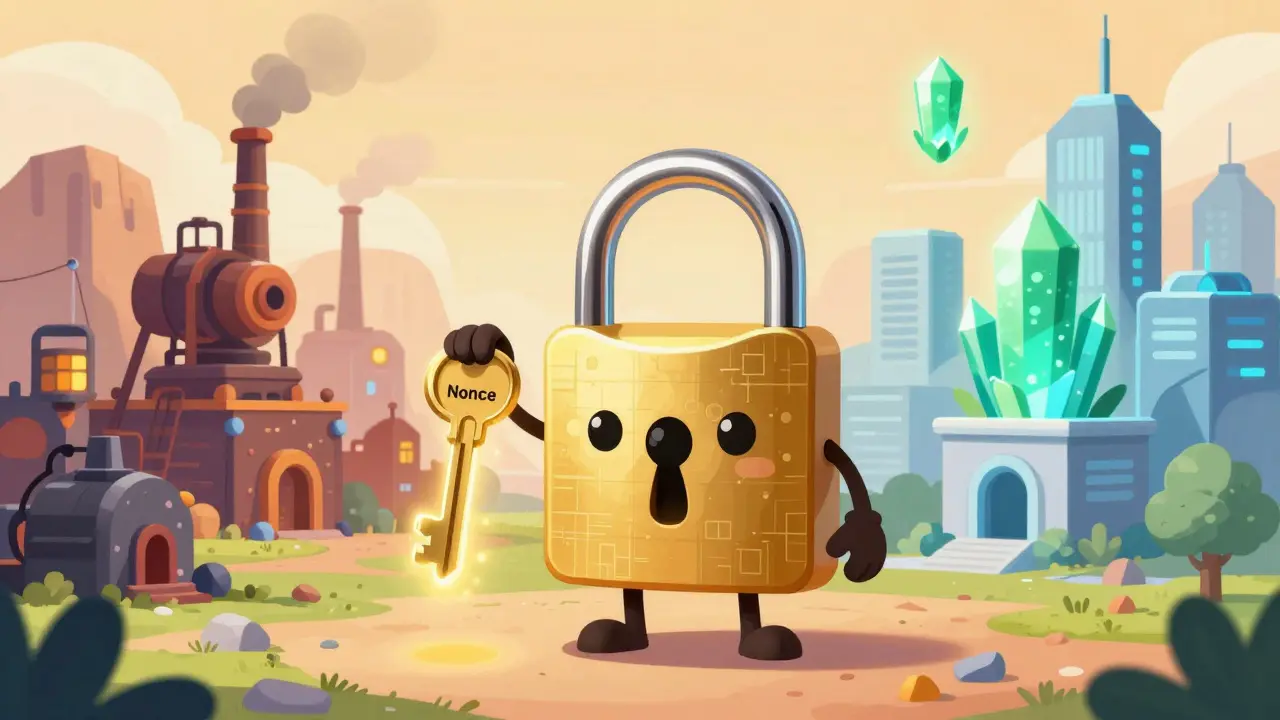
You might think the nonce is just a dusty relic from the early days of Bitcoin. After all, we live in an era where Ethereum has moved on to staking, and energy-efficient blockchains are everywhere. But if you believe the nonce is dead, you’re missing half the picture. The truth is more nuanced: while its role as a mining puzzle is shrinking, its function as a security anchor is evolving, not disappearing.
In 2026, the conversation around the nonce isn’t about whether it will vanish. It’s about how this simple "number used once" adapts to a fragmented blockchain landscape. From Layer-2 scaling solutions to hybrid consensus models, the nonce remains a critical component for data integrity, even when miners aren’t guessing numbers anymore. Let’s break down what’s actually happening under the hood.
What Is a Nonce, Really?
To understand where the nonce is going, we have to look at what it does right now. A nonce is a random or pseudo-random number that is used only once in a cryptographic communication. In the context of Proof-of-Work (PoW) a consensus mechanism where participants solve complex mathematical puzzles to validate transactions and create new blocks, the nonce is the variable that miners tweak to find a valid hash.
Think of it like a combination lock. You know the target (the difficulty threshold), but you don’t know the code. So you try 1, then 2, then 3, millions of times per second. When you hit the right number, the block is sealed. This process ensures that altering any transaction requires redoing all that computational work, which makes tampering prohibitively expensive. That’s the core value proposition: security through cost.
| Consensus Type | Nonce Usage | Primary Goal |
|---|---|---|
| Proof-of-Work | Critical (Mining Puzzle) | Prevent double-spending via computational cost |
| Proof-of-Stake | Minimal/None (Block Proposer Selection) | Economic security via collateral |
| Account-Based Systems | Transaction Ordering | Prevent replay attacks across networks |
The Decline of Mining Necessity
The biggest shift in the last few years has been the migration away from pure Proof-of-Work. Networks like Ethereum, Cardano, and Solana use Proof-of-Stake (PoS) a consensus algorithm where validators are chosen to create blocks based on the amount of cryptocurrency they hold and are willing to 'stake' as collateral. In PoS, there is no need to burn electricity solving hash puzzles. Validators are selected algorithmically, often using randomness beacons rather than brute-force nonce guessing.
Does this mean the nonce is obsolete? Not exactly. While the *mining* nonce is gone in these systems, the concept of uniqueness remains vital. For example, in account-based blockchains, every transaction still carries a nonce field. This number increments with each transaction sent from a specific address. Why? To prevent replay attacks. If you send $100 on Network A, you don’t want someone copying that exact same transaction signature and spending your money again on Network B. The transaction nonce acts as a unique fingerprint for ordering and validity checks.
Hybrid Models and the Resilience of PoW
Despite the hype around PoS, Proof-of-Work isn’t dead. Bitcoin, Litecoin, and Dogecoin continue to rely heavily on nonce-based mining. In fact, some newer projects are exploring hybrid models. These systems might use PoS for fast finality and low fees, but retain a layer of PoW for additional security or decentralization guarantees.
In these hybrid scenarios, the nonce returns to the spotlight. Miners still compete to secure the network, providing a decentralized audit trail. This creates a dual-layer security model: economic stakes protect against collusion, while computational work protects against physical coercion or key compromise. Here, the nonce serves as a bridge between two worlds, ensuring that neither purely economic nor purely computational threats can easily breach the system.

Layer-2 Solutions and Data Availability
As mainnets get congested, Layer-2 (L2) solutions like rollups have become essential. These systems bundle thousands of transactions off-chain and submit a single proof to the main chain. Interestingly, nonces play a subtle but crucial role here too. When L2s interact with the base layer, they must ensure state consistency. The nonce helps track the sequence of state updates, ensuring that no two states conflict.
Moreover, as zero-knowledge proofs (ZKPs) gain traction, the way we verify data changes. ZKPs allow one party to prove knowledge of a value without revealing the value itself. While ZKPs reduce reliance on traditional hashing for privacy, they still require unique identifiers to link proofs to specific transactions or states. The nonce evolves from a brute-force key into a structured identifier within complex cryptographic circuits.
Environmental Pressures and Regulatory Shifts
We can’t talk about the future of the nonce without addressing the elephant in the room: energy consumption. Governments worldwide are scrutinizing PoW chains due to their carbon footprint. Regulations in countries like China and parts of Europe have restricted mining activities. This pressure forces innovation. Developers are looking for ways to make nonce-based systems greener or transition entirely to PoS.
This regulatory tailwind accelerates the adoption of alternatives. However, it also drives research into "green mining." Some experimental protocols propose using renewable energy credits or waste heat recovery to offset PoW costs. In these niche cases, the nonce remains relevant, but its justification shifts from pure security to sustainable resource utilization. The narrative changes from "burning power" to "utilizing surplus energy securely."

Quantum Computing: The Next Frontier
Looking further ahead, quantum computing poses a theoretical threat to current cryptographic standards. While today’s SHA-256 hashes (used in Bitcoin’s nonce puzzles) are resistant to quantum attacks, future algorithms may not be. If quantum computers can efficiently reverse hash functions, the entire premise of nonce-based mining collapses.
This risk pushes the industry toward post-quantum cryptography. New consensus mechanisms may replace traditional hashing with lattice-based or hash-based signatures that are quantum-resistant. In this scenario, the nonce might transform into a different kind of cryptographic token-one designed specifically to withstand quantum decryption attempts. It’s a speculative area, but one that serious researchers are already mapping out.
Practical Implications for Developers and Users
If you’re building on blockchain technology, understanding the nonce’s evolution is practical, not just academic. For developers, managing transaction nonces correctly is critical to avoid stuck transactions. In high-throughput environments, losing track of a nonce can freeze user funds until the gap is filled. Smart contract audits must consider how nonces are handled in cross-chain bridges, where replay attacks are a common vector.
For users, the shift means less direct interaction with mining concepts but greater awareness of account security. Since nonces now primarily serve to order transactions and prevent replays, keeping your private keys safe is more important than ever. A stolen key allows an attacker to manipulate nonces and drain accounts before you can react.
Conclusion: Adaptation, Not Extinction
The nonce isn’t dying; it’s diversifying. Its role as a mining hammer is fading in many ecosystems, but its utility as a sequencing tool and security anchor is growing. As blockchains become more complex, layered, and interconnected, the need for unique, verifiable identifiers becomes paramount. Whether in hybrid consensus models, Layer-2 scaling, or post-quantum preparations, the nonce remains a foundational element of digital trust. The future isn’t about eliminating the nonce-it’s about refining it for a world beyond brute force.
Is the nonce still used in Ethereum after the Merge?
No, Ethereum no longer uses nonces for mining because it switched to Proof-of-Stake. However, transaction nonces are still used to order transactions from individual accounts and prevent replay attacks.
Why do some blockchains still use Proof-of-Work?
Some blockchains, like Bitcoin, prioritize maximum decentralization and proven security over energy efficiency. They believe the cost of PoW provides the strongest protection against censorship and attack.
How does a nonce prevent double-spending?
In PoW, the nonce makes altering past blocks computationally impossible. In account-based systems, the transaction nonce ensures each transaction is unique and processed in the correct order, preventing duplicate submissions.
Will quantum computing break nonce-based security?
Potentially. If quantum computers can efficiently reverse hash functions, current PoW mechanisms could be compromised. This is driving research into post-quantum cryptographic alternatives.
What is a hybrid consensus model?
A hybrid model combines elements of different consensus mechanisms, such as Proof-of-Work and Proof-of-Stake, to leverage the strengths of both-like PoW’s security and PoS’s efficiency.
Filbert Reeves
June 23, 2026 AT 04:58look i dont care what the article says but its all a big scam to keep us working while they mine dogecoin in their basements
the nonce is just a way for the elites to track our every move and sell it to advertisers who then manipulate our votes
you think you are safe with your little transaction nonces? please.
they are watching you right now reading this comment
the government wants you to believe that proof of stake is better because it uses less energy but really they just want to control the supply chain of electricity so they can turn off the lights when you try to buy bitcoin
it is all connected to the deep state and their plan to replace gold with digital tokens that have no real value
wake up sheeple before they steal your identity using quantum computers that do not even exist yet
Eric Scheinberg
June 23, 2026 AT 22:44It is imperative that we consider the structural integrity of these systems with precision
The transition from Proof-of-Work to Proof-of-Stake represents a fundamental shift in economic security models rather than a mere technical adjustment
We must ensure that our understanding of cryptographic primitives remains robust against evolving threats
The nonce serves as a critical identifier in maintaining state consistency across distributed ledgers
This function is indispensable for preventing replay attacks which remain a significant vulnerability in cross-chain interactions
We should approach this topic with rigorous analytical standards to avoid misconceptions about the role of computational work in modern consensus mechanisms
John Doe
June 25, 2026 AT 06:44I feel like everyone is missing the point here
The drama around whether mining is dead or alive is exhausting
What matters is that my transactions go through without getting stuck because I messed up the nonce counter
I remember losing hours of gas fees because I didn't increment the nonce correctly on Ethereum
It was a nightmare and I still have nightmares about it
Please just explain how to manage nonces properly instead of talking about quantum computing that might happen in fifty years
We need practical advice not theoretical fluff
Skm Shubham
June 27, 2026 AT 05:08You people are completely clueless about how blockchain actually works
The author tries to sound smart by talking about hybrid models but fails to mention that most of these projects are vaporware
If you cannot understand the basic concept of a nonce then you should not be touching crypto at all
It is embarrassing to see such ignorance spread around here
Stick to simple things like buying stocks if you cannot handle the complexity of cryptographic sequencing
Your opinion is worthless in this discussion
Rob Aronson
June 28, 2026 AT 10:28Great breakdown of the technical nuances 🧵
The distinction between mining nonces and transaction nonces is crucial for developers working on L2 rollups
We often see issues with state consistency when bridges fail to validate the nonce sequence properly
This leads to potential replay vulnerabilities that can be exploited by malicious actors
It is important to implement strict nonce management protocols in smart contracts to mitigate these risks
Also the mention of ZKPs is spot on as they require unique identifiers for proof verification 🔐
Danna Charris
June 29, 2026 AT 19:15Fascinating read
However I find the tone slightly too optimistic about the future of PoW
Let us not forget that energy consumption remains a significant barrier to widespread adoption
The elite circles prefer PoS for its efficiency and lower environmental impact
It is simply more sophisticated and aligns better with modern regulatory frameworks
One must appreciate the elegance of staking over brute force computation
Fede Faith
June 30, 2026 AT 10:42I totally agree with the points made about Layer-2 solutions
Managing nonces in high-throughput environments is tricky but essential
I have helped several teams debug stuck transactions caused by nonce gaps
It is always satisfying to solve these puzzles and get the funds moving again
Keep learning and stay curious about how these underlying mechanisms evolve
You will become a much better developer by understanding the basics deeply
Josh Dodson
June 30, 2026 AT 20:44hey guys great post man
i love how u explained the nonce stuff
its kinda cool that it still matters even after eth merge
im still learning about this so thanks for breaking it down
hope everyone has a good day and keeps coding safely
no more stuck txs for us lol
Kumaran sowkarpet
July 1, 2026 AT 10:36Hello friends from India :)
This article provides excellent insights into the evolution of blockchain technology
In our region we are seeing rapid adoption of both PoW and PoS networks
Understanding the nonce helps us build better applications for local businesses
We should encourage more educational content like this to help new developers
Technology knows no borders and knowledge is power :)
Mauricio Contreras Loredo
July 3, 2026 AT 02:07Oh wow another article pretending to be deep about blockchain
Sure let us talk about nonces while ignoring the fact that half these chains are rug pulls waiting to happen
But hey at least we can pretend we understand the math behind it
Real innovation is happening elsewhere not in some hybrid model dreamed up by VCs
Keep dreaming though it makes for good bedtime stories
sreeja boora
July 3, 2026 AT 15:03The focus on Western perspectives in this analysis is concerning
Indian developers contribute significantly to blockchain infrastructure yet are rarely acknowledged
We must prioritize indigenous technological sovereignty and reduce reliance on foreign consensus models
The nonce mechanism should be adapted to meet local regulatory requirements and cultural values
Global standards often ignore the specific needs of emerging markets like ours
Grace Newman
July 4, 2026 AT 08:34I cannot help but wonder who is funding this research on post-quantum cryptography
Is it possible that the same entities pushing for PoS are also influencing academic studies to discredit PoW?
The timing seems suspicious given the recent regulatory crackdowns on mining operations
We must remain vigilant against coordinated efforts to dismantle decentralized systems
Trust no one and verify everything yourself
Annemarie Fitzgerald
July 4, 2026 AT 09:48oh my god the existential dread of being replaced by a number
is the nonce really just a metaphor for our own fleeting existence?
we are all just random numbers used once in the grand scheme of the universe
and then poof we are gone like a block that never got confirmed
it is terrifyingly beautiful if you think about it
why do we cling to permanence when impermanence is the only truth?
Abby Sivertsen
July 4, 2026 AT 19:36Listen up folks
I have been in this space since 2013 and I can tell you that the nonce is not going anywhere
Stop listening to these tech bros trying to sell you on PoS because it is easier for them to centralize control
PoW is the only true form of decentralization because it requires physical resources
If you do not understand this you are already part of the problem
Wake up and start mining with renewable energy or get out of the way
Benjamin Eisen
July 6, 2026 AT 12:47Hey there
I was wondering if anyone else has experienced issues with nonce reordering on testnets
It seems like the validators sometimes process transactions out of order which causes headaches
I am trying to figure out if this is a bug or expected behavior
Any insights would be greatly appreciated as I am still learning the ropes
Thanks for sharing your thoughts on this complex topic
Kenneth Riley
July 7, 2026 AT 20:43you guys are so naive thinking this article tells the whole story
the real reason nonces are changing is because the big players want to consolidate power
proof of stake allows whales to control the network without doing any actual work
it is a rigged game from the start and nobody wants to admit it
keep digging deeper and you will find the corruption underneath
but most people are too lazy to look past the surface level explanations
ravi mahla
July 8, 2026 AT 17:54Haha nice try with the serious tone
But lets face it most of you do not know what a hash function is
Yet here you are debating the future of nonces like experts
Maybe spend less time typing comments and more time reading documentation
Just a friendly reminder from someone who actually builds things
Stay sarcastic and keep questioning everything 😂
Mark Brunschwiler
July 10, 2026 AT 06:22I feel so drained just reading all these opinions
Why does everyone have to be so aggressive about something as simple as a number?
It is just a nonce why can we not all get along and share our feelings about blockchain?
I wish people would stop attacking each other and start supporting one another
The negativity is overwhelming and I need to take a break from this community
Terry Hyland
July 12, 2026 AT 03:56this is all wrong
the government is using blockchain to track our movements and steal our money
the nonce is a tool for surveillance not security
they want you to believe it is safe but it is a trap
do not trust any system controlled by corporations or governments
go back to cash and live off the grid if you value your freedom
Tim Lefebvre
July 13, 2026 AT 02:23hey tim here from canada
just wanted to say that managing nonces can be tricky especially when dealing with multiple wallets
i had an issue recently where my transaction got stuck because i reused a nonce by accident
make sure you double check your wallet settings before sending anything important
it is easy to make mistakes so take your time and verify everything
hope this helps someone avoid the same headache
Monica Pathammavong
July 14, 2026 AT 21:15you clearly do not understand the implications of what you are saying
the author is misleading readers by suggesting that PoW is still relevant in any meaningful way
if you cannot grasp the superiority of PoS then you are not qualified to comment on this topic
stop spreading misinformation and educate yourself before posting nonsense
your lack of knowledge is showing and it is embarrassing for everyone involved