


Imagine losing your life savings to an investment platform that looks exactly like Binance or KuCoin. You deposit funds, watch fake profits climb, and then realize the "exchange" doesn’t exist. It’s a nightmare scenario that has become all too common for thousands of victims targeted by underground crypto trading in Cambodia, which is a sophisticated criminal ecosystem involving human trafficking, forced labor, and massive money laundering operations. This isn't just about shady deals; it's about organized crime networks that have turned Southeast Asia into a hub for financial fraud.
The situation in Cambodia is unique. Unlike other countries where crypto might be used for privacy or speculation, here it serves as the primary tool for transnational criminal organizations. These groups don't just trade Bitcoin; they run entire industries built on deception, violence, and exploitation. If you are looking to understand how these operations work, why they thrive despite bans, and what the recent crackdowns mean, this guide breaks down the reality behind the headlines.
Key Takeaways
- Cambodia’s underground crypto market is dominated by criminal syndicates like the Prince Group and Huione Guarantee, which launder billions through scam compounds.
- The National Bank of Cambodia (NBC) banned crypto in 2019 but shifted to a licensing system in late 2024, inadvertently creating new loopholes for criminals.
- Victims often lose everything after being lured by fake investment platforms that mimic legitimate exchanges.
- Recent U.S. Justice Department actions in late 2025 have seized billions in assets, signaling a major international crackdown.
- Despite enforcement, the network remains resilient, adapting to encrypted channels and cross-border transactions.
From Ban to Boom: The Regulatory Vacuum
To understand why Cambodia became a hotspot for illicit crypto activity, we have to look at its regulatory history. In 2019, the National Bank of Cambodia (NBC) issued Directive No. 1125, which effectively banned all cryptocurrency transactions within the country. On paper, this was meant to protect citizens from volatile digital assets. In practice, it created a black market.
When something is banned but still in demand, people find ways around it. According to Standard Insights' 2025 report, 10.63% of Cambodians continued using cryptocurrency even during the prohibition period. But this wasn't everyday people buying Bitcoin for savings. It was criminal operators setting up infrastructure. The ban pushed legitimate businesses away but left the door wide open for those who didn't care about legality.
Then came a twist. In late 2024, the NBC introduced Prakas B7-024-735 Prokor, which is a permission-based licensing system designed to regulate crypto activities rather than ban them outright. While intended to legitimize the market, this shift had an unintended consequence. It gave sophisticated money launderers a veneer of legitimacy. They could now operate under partial regulatory cover, making their illicit flows harder to distinguish from legal ones. This regulatory whiplash-first a total ban, then a sudden opening-allowed entrenched criminal networks to deepen their roots before authorities could react.
The Anatomy of a Scam Compound
If you think of underground crypto trading as just computers and code, you’re missing the most disturbing part: the human element. At the heart of Cambodia’s crypto crime scene are scam compounds, which are fortified facilities where trafficked workers are forced to perpetrate cryptocurrency investment fraud under threat of violence. These aren't remote call centers; they are prisons disguised as offices.
The Prince Group, led by Chen Zhi, operates some of the largest of these compounds. Locations like the 'Jinbei Compound' in Sihanoukville and the 'Golden Fortune Science and Technology' center in Chrey Thom function as violent forced labor camps. Workers are trafficked into the country with promises of high-paying jobs, only to find their passports confiscated and their freedom stripped away.
Inside, these workers face 18-hour days. Their job? To contact potential victims via messaging apps, pretending to be successful investors. They use scripts to lure targets into fake platforms that mimic real exchanges. If a worker fails to meet daily fraud quotas, they face physical punishment. This system turns human beings into tools for extraction. The U.S. Department of Justice identified these compounds in a civil complaint filed on October 14, 2025, highlighting the scale of the operation.

Huione Guarantee: The Money Laundering Engine
You can’t have a scam without a way to move the stolen money. That’s where Huione Guarantee (Huiwang Group) comes in. Founded in 2014, this entity acts as the plumbing for Cambodia’s underground economy. Chainalysis data reveals that Huione laundered at least $4 billion between August 2021 and January 2025.
Where did this money come from? It’s a mix of dirty sources:
- $37 million from North Korea-linked cyber thefts.
- $36 million from virtual currency investment scams.
- Approximately $300 million from other cybercrime activities.
Huione established what Elliptic described as a 'one-stop crime platform' on Telegram. Before Telegram blocked these services in May 2025, third-party vendors on the platform offered technology tools, personal information, and money laundering services specifically targeting crypto fraud rings in Southeast Asia. Now, they’ve moved deeper into encrypted channels, but the flow hasn’t stopped.
Data from South Korea’s Financial Supervisory Service shows the sheer volume of this activity. Transfers between five major Korean cryptocurrency exchanges and Huione Guarantee reached 12.8 billion won ($8.9 million USD) in 2024. That’s a 1,400-fold increase from the same period in 2023. Even as scrutiny increased in late 2024, transactions continued to grow, hitting 3.15 billion Korean Won by October 2025. This resilience shows how deeply embedded these networks are in the global financial system.
How the Fraud Works: A Victim’s Perspective
For the average person, falling victim to a Cambodia-based crypto scam often starts innocently. You might get a message on WhatsApp or Telegram from someone claiming to have made huge returns investing in foreign exchange or cryptocurrency. They seem friendly, helpful, and knowledgeable. Slowly, they convince you to join their "exclusive" platform.
This platform looks professional. It has charts, live updates, and a user interface that copies Binance or Kucoin almost perfectly. You deposit $5,000. Your account shows it growing to $6,000, then $7,000. Encouraged, you deposit more. Maybe $25,000. Then, when you try to withdraw, the problems start.
Suddenly, you need to pay "taxes" or "verification fees." When you pay those, the withdrawal is delayed. Then frozen. Then, the support team disappears. Reddit discussions in r/Scams from September 2025 document countless stories like this. Victims report losing anywhere from a few thousand to hundreds of thousands of dollars. Trustpilot reviews for Huione-related services, before they were taken down, showed an average rating of 1.2 stars out of 5, with complaints about immediate account freezing and threats when requesting withdrawals.
The psychological manipulation is deliberate. Scammers build trust over weeks or months. By the time you realize it’s a scam, the money has already been moved through multiple layers of wallets and exchanges, making recovery nearly impossible.
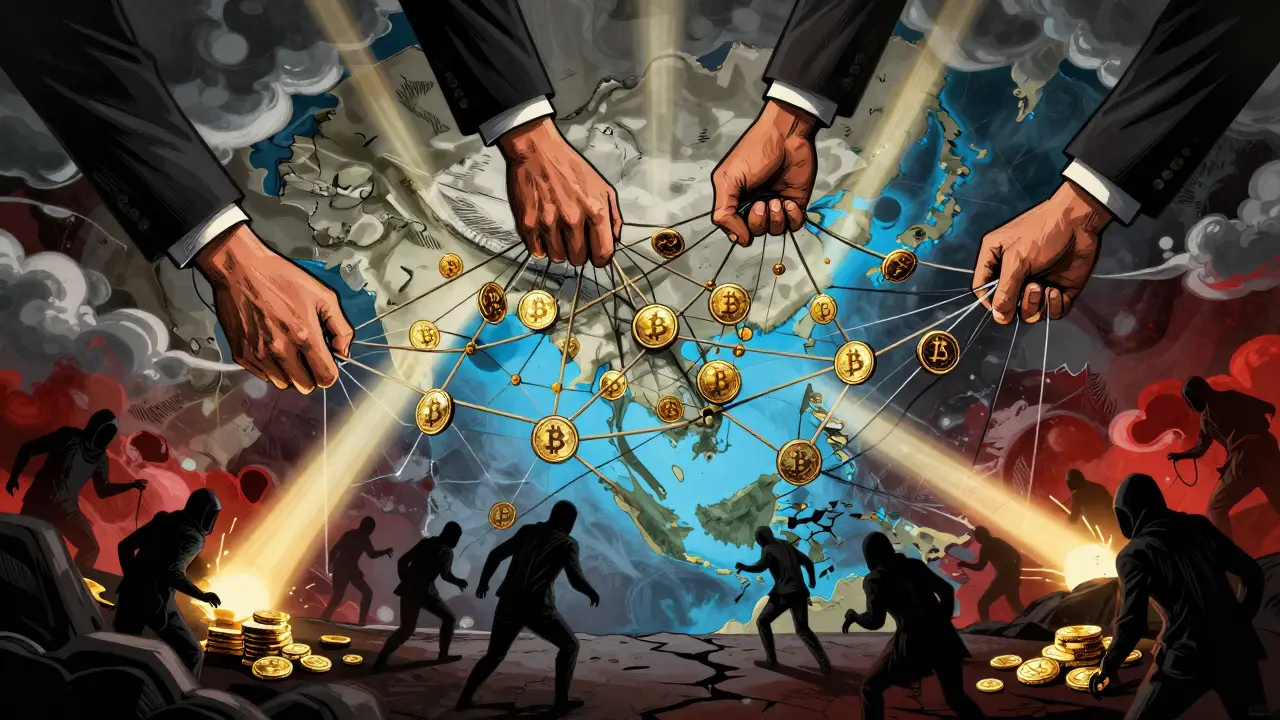
International Crackdowns and Recent Developments
For years, these operations operated with near impunity. But 2025 marked a turning point. The U.S. Department of Justice, in coordination with the U.K., launched one of the largest forfeiture actions in history. On October 14, 2025, they filed a civil complaint against the Prince Group, seizing approximately $15 billion in bitcoin. TRM Labs confirmed this as the largest forfeiture in U.S. history.
This wasn't just about taking back money; it was about dismantling the infrastructure. The DOJ complaint detailed how Prince Group used seemingly legitimate businesses-casinos, hotels, and retail outlets-to launder criminal proceeds. Internal communications revealed explicit references to "BTC laundering" and connections to "illegal banks and underground money houses."
Jeremy Douglas, chief of staff at the U.N. Office on Drugs and Crime, noted that thousands of people are working in these scam compounds, many trafficked into centers like those run by Prince Holding. The scale of the problem rivals the global drug trade in terms of gross profits, according to Jacob Sims, a visiting fellow at Harvard's Asia Center.
However, the crackdown hasn't eliminated the threat. Transactions with Huione continued to grow into 2025, suggesting these networks are adaptable. They are shifting tactics, using more decentralized methods and moving operations to other regions if pressure becomes too intense in Cambodia.
| Feature | Legitimate Exchanges (e.g., Vietnam, Thailand) | Underground Networks (Cambodia) |
|---|---|---|
| Regulatory Status | Licensed by national securities commissions | Operates in gray areas or exploits new licensing loopholes |
| AML Compliance | Strict KYC/AML protocols enforced | Uses mixing services and shell companies to evade detection |
| Business Model | Trading fees, spreads, staking rewards | Fraudulent investments, ransom payments, gambling proceeds |
| Human Element | Voluntary employment, standard labor laws | Forced labor, human trafficking, physical coercion |
| Transparency | Public audits, clear fee structures | Fake platforms, hidden ownership, opaque transactions |
Why Cambodia? The Perfect Storm
Why did this happen in Cambodia specifically? Several factors converged to create this environment. First, Cambodia is largely a cash-based economy with relatively weak financial regulation. It ranked 128th out of 180 countries in Transparency International's 2024 Corruption Perceptions Index. This lack of oversight makes it easier for illicit funds to enter and exit the formal banking system.
Second, its geographic location provides strategic advantages. Cambodia sits close to major cryptocurrency markets in South Korea and Southeast Asia. The proximity allowed for rapid movement of funds across borders. The 12.8 billion won in transfers from Korean exchanges highlights this connection. Criminals exploited the speed of crypto transactions to move money faster than regulators could track.
Third, the initial ban in 2019 didn't stop adoption; it just drove it underground. With 10.63% of the population still using crypto, there was a ready-made user base for scammers to exploit. They didn't need to educate people on how crypto worked; they just needed to trick them into trusting the wrong platform.
What Comes Next?
The future of underground crypto trading in Cambodia is uncertain. The $15 billion seizure sends a strong message: the world is watching. But criminal organizations are resilient. As Jacob Sims predicted, absent sustained multinational enforcement, these operations will continue to evolve.
We may see two diverging paths. One path leads to further decentralization. Criminals will likely move to more obscure blockchains or use advanced privacy coins to hide their tracks. They may also expand into neighboring countries with similar regulatory weaknesses, such as parts of Myanmar or Laos.
The other path involves gradual legitimization. The NBC’s exploration of a Central Bank Digital Currency (CBDC), announced in 2019, could eventually provide a safe alternative for citizens. If implemented well, a CBDC could reduce the demand for underground services by offering a regulated, accessible digital payment method. However, this transition will take years, and in the meantime, the black market will persist.
For individuals, the lesson is clear: if it sounds too good to be true, it is. Be wary of unsolicited investment advice, especially via messaging apps. Stick to well-known, regulated exchanges. And remember, no legitimate investment guarantees high returns with zero risk.
Is cryptocurrency illegal in Cambodia?
The status of cryptocurrency in Cambodia has changed. Initially, the National Bank of Cambodia (NBC) banned all crypto transactions in 2019 via Directive No. 1125. However, in late 2024, the NBC introduced Prakas B7-024-735 Prokor, which established a permission-based licensing system. This means crypto is no longer completely banned but is now subject to strict regulation. Despite this, underground and illicit activities remain widespread and are not covered by these licenses.
What is the Prince Group?
The Prince Group is a transnational criminal organization based in Cambodia, led by Chen Zhi. It operates large-scale scam compounds where trafficked workers are forced to commit cryptocurrency investment fraud. The group uses legitimate-looking businesses, such as casinos and hotels, to launder money. In October 2025, the U.S. Department of Justice filed a civil complaint against the Prince Group, leading to the seizure of approximately $15 billion in assets.
How does Huione Guarantee launder money?
Huione Guarantee (Huiwang Group) acts as a money laundering service provider for various criminal activities, including cyber theft, investment scams, and dark web transactions. It processes funds through multiple layers of transactions across different cryptocurrency exchanges to obscure the origin of the money. Chainalysis reports that Huione laundered at least $4 billion between August 2021 and January 2025. The group previously operated a 'one-stop crime platform' on Telegram before being blocked.
Can I recover money lost to a Cambodia crypto scam?
Recovering money lost to these scams is extremely difficult. Once funds are deposited into fraudulent platforms, they are quickly moved through complex laundering networks involving multiple wallets and exchanges. While international law enforcement agencies are seizing assets from major criminal groups like the Prince Group, individual victims rarely see direct restitution. It is crucial to report any suspected fraud to local authorities and financial crime units immediately, though expectations for recovery should be realistic.
Are scam compounds still operating in Cambodia?
Yes, despite recent crackdowns, scam compounds continue to operate. While the U.S. and other nations have seized significant assets and disrupted some operations, the underlying criminal networks are resilient. Reports from late 2025 indicate that transaction volumes with key laundering entities like Huione Guarantee continued to grow. These compounds often relocate or adapt to new encrypted communication channels to evade detection, maintaining their role in the global cybercrime ecosystem.
Terry Hyland
June 15, 2026 AT 12:54It is absolutely disgusting how these criminals treat human beings like cattle. The moral decay in society is reaching a critical point where people will sacrifice their own humanity for money. We need to wake up and realize that this evil thrives because we look the other way.
Monica Pathammavong
June 16, 2026 AT 14:47i mean if u really think about it the government is letting this happen on purpose they want us addicted to crypto so they can control our finances better its not just cambodia its everywhere the elites are laughing at us while we lose our savings
Tim Lefebvre
June 16, 2026 AT 19:46hey everyone i wanted to share some info on how to spot these fake exchanges first check if the website has a real physical address second see if they are registered with any financial authority third never trust unsolicited messages from strangers online hope this helps keep yall safe out there
Eric Scheinberg
June 18, 2026 AT 01:52The regulatory shift described herein represents a classic case of unintended consequences arising from policy volatility when authorities ban an asset class without addressing underlying demand they create black markets which subsequently become entrenched criminal infrastructure
pankaj chawla
June 19, 2026 AT 18:06We must work together to stop this global crime network It is not enough to just talk about it We need international cooperation and strong enforcement actions to dismantle these operations completely The time for action is now
Jessica Lane
June 21, 2026 AT 14:35I find it deeply troubling that individuals are being trafficked into these compounds Their suffering is often overlooked in discussions about financial loss We must prioritize the safety and dignity of these victims above all else
Charles Pawlikowski
June 22, 2026 AT 18:37This is why we need strict borders and no foreign influence in our financial systems these scammers come from overseas and ruin everything for honest hardworking americans we should ban all crypto until we can secure our own country first :/
Andrea Burd
June 24, 2026 AT 14:57another boring article about crypto scams everyone knows crypto is risky why do people keep falling for it its pathetic honestly
Akeem Whittaker
June 25, 2026 AT 09:47You need to understand that education is key here Many victims are not stupid they are manipulated by sophisticated psychological tactics designed to exploit human greed and fear We must teach critical thinking skills to protect ourselves
Manish Prajapat
June 25, 2026 AT 11:02The philosophical implication of digital currency is profound It challenges our very notion of value and trust When trust is broken as seen in these scams we must ask what gives money its worth in the first place
John Doe
June 27, 2026 AT 09:12I feel such intense anger when I read about the forced labor involved in these schemes These are not just numbers on a spreadsheet They are human lives destroyed by greed and violence It is heartbreaking to witness such cruelty
Mekz Wheoki
June 28, 2026 AT 15:14Oh great another post telling you how smart you are for not buying bitcoin meanwhile the guys running the scams are probably richer than your boss sarcasm aside this is a serious issue but dont expect much change anytime soon
Skm Shubham
June 29, 2026 AT 07:17The data presented regarding Huione Guarantee is flawed You fail to account for the legitimate transactions that may be misclassified as illicit This lack of nuance undermines the credibility of your entire argument
Rob Aronson
June 29, 2026 AT 11:30From a technical standpoint the use of mixing services and privacy coins makes tracing funds incredibly difficult 🔒 However blockchain analysis firms like Chainalysis are getting better at de-anonymizing these flows 📊 We need more adoption of KYC protocols across all exchanges 🛡️
Kwon Bill
June 30, 2026 AT 00:06In South Korea we have seen similar issues with transfers to offshore entities The cultural pressure to succeed financially sometimes drives people to take risks they should not take We must foster a culture of financial literacy and caution
Danna Charris
June 30, 2026 AT 17:38Clearly those who fall for these scams lack basic intelligence. One does not simply deposit large sums into unverified platforms without due diligence.
Fede Faith
June 30, 2026 AT 18:14Hey friends lets stay vigilant but not paranoid Its important to support each other if someone suspects fraud reach out to local authorities immediately Do not suffer in silence We are stronger together 💪
Josh Dodson
July 2, 2026 AT 07:57good news is awareness is growing ppl are starting to learn from mistakes keep spreading the word abt these scams so fewer get hurt next time
Suman Patil
July 3, 2026 AT 09:17Let's collaborate on solutions rather than just pointing fingers The tech community can help build better verification tools While regulators update laws We need a holistic approach involving all stakeholders
Kumaran sowkarpet
July 5, 2026 AT 03:32In India we also face cybercrime threats but our IT department is working hard to track these criminals 😊 Let us share knowledge and best practices to fight this global menace together 🤝
Mauricio Contreras Loredo
July 6, 2026 AT 04:12Sure let's all pretend that banning crypto solves anything lol Meanwhile the rich just move their money to Switzerland or offshore accounts typical double standards at play here
sreeja boora
July 7, 2026 AT 14:18The integrity of our nation's financial system must be protected at all costs Foreign interference through cryptocurrency poses a significant threat to national security We must remain vigilant against external threats
Grace Newman
July 8, 2026 AT 10:05It is evident that these events are part of a larger orchestrated plan to destabilize global economies The depth of conspiracy behind these scam compounds suggests state-level involvement which is rarely discussed openly
Abby Sivertsen
July 8, 2026 AT 13:44I've traveled through Southeast Asia and seen the impact of these operations firsthand It is chaotic and dangerous We need to respect the local cultures while demanding accountability from criminal networks operating there