


China officially banned cryptocurrency trading in 2021. Banks can’t touch it. Exchanges are shut down. Mining rigs are confiscated. Yet, in the shadows, Chinese traders moved $86.4 billion in crypto between July 2022 and June 2023. That’s more than all of Hong Kong’s legal crypto volume during the same period. How is this possible? And why does it keep growing?
The Ban That Didn’t Stick
The Chinese government didn’t just discourage crypto - it outlawed it. In 2013, banks were told not to process Bitcoin payments. By 2017, domestic exchanges like Huobi and OKEx were forced to shut down. Then in 2021, the People’s Bank of China (PBOC) issued a sweeping ban: no trading, no mining, no financial services tied to crypto. The message was clear: crypto has no place in China’s financial system. But here’s the twist: owning crypto is still technically legal. You won’t get arrested for holding Bitcoin in your wallet. Courts have even ruled that digital assets count as “legal property.” That loophole opened the door for a quiet, resilient underground market. People aren’t breaking the law by holding crypto. They’re breaking it when they trade it. And that’s where the real risk begins.How the Underground Market Works
You won’t find a Binance or Coinbase app on your phone in Shanghai. But you’ll find people trading crypto anyway - through a network of workarounds built over years of adaptation. Most traders rely on peer-to-peer (P2P) platforms. These aren’t centralized exchanges. They’re apps or Telegram groups where buyers and sellers match up directly. One person sends yuan to another’s bank account. The other sends Bitcoin or USDT to a wallet. Escrow services and reputation systems help reduce fraud, but there’s no government protection if someone disappears with your money. Virtual Private Networks (VPNs) are essential. Without them, you can’t access international exchanges like Kraken or Bybit. Traders use multiple layers - commercial VPNs, private proxies, even Hong Kong-based servers - to stay hidden from China’s Great Firewall. Some even use family members in Hong Kong to hold wallets and execute trades on their behalf. Stablecoins like USDT have become the backbone of this system. Because they’re pegged to the U.S. dollar, they’re easier to move across borders and less volatile than Bitcoin. Traders convert yuan to USDT, then trade USDT for other cryptos on offshore platforms. When they want cash back, they reverse the process - often through trusted OTC brokers who handle large sums quietly.
Who’s Really Trading?
This isn’t just hobbyists buying Dogecoin for fun. The data shows something more serious. Nearly 7% of transactions in China are between $10,000 and $1 million - nearly double the global average. These are not small-time players. They’re professionals, entrepreneurs, and high-net-worth individuals. Many use Hong Kong as a bridge. They open corporate bank accounts there, set up shell companies, and route trades through legal channels. Others rely on private banking relationships in Singapore or Macau. Retail traders, meanwhile, use social media groups and local OTC desks that operate out of apartments or coffee shops. The system is fragmented, but it’s efficient. The driving force? A collapsing stock market. China’s CSI 300 index dropped 35% over three years. Corporate earnings have missed forecasts for ten straight quarters. The government has pumped over 2 trillion yuan into markets to stabilize things, but trust is gone. People aren’t just looking for higher returns - they’re looking for a way out.The Hidden Risks
Just because you can trade crypto in China doesn’t mean it’s safe. Legal risk is the biggest. While holding crypto is tolerated, trading it violates PBOC rules. Authorities don’t go after every individual - but they do make examples. In 2024, a businessman in Guangzhou was fined over 1.2 million yuan and had his assets seized after using a P2P platform to buy Bitcoin. His crime? Facilitating trades for others. He wasn’t even a professional trader. Financial risk is just as real. If your OTC broker vanishes, you lose everything. If your VPN gets blocked, you’re locked out. If the yuan drops sharply and you need to convert crypto back to cash, you might have to pay a 20% premium to find someone willing to buy. And then there’s the psychological toll. Traders live in constant uncertainty. One day, a new regulation might declare even personal ownership illegal. Rumors in 2025 suggested that May 30 could be the cutoff date for holding crypto - but the government never confirmed it. That ambiguity is worse than a clear ban. It keeps people guessing, second-guessing, and paranoid.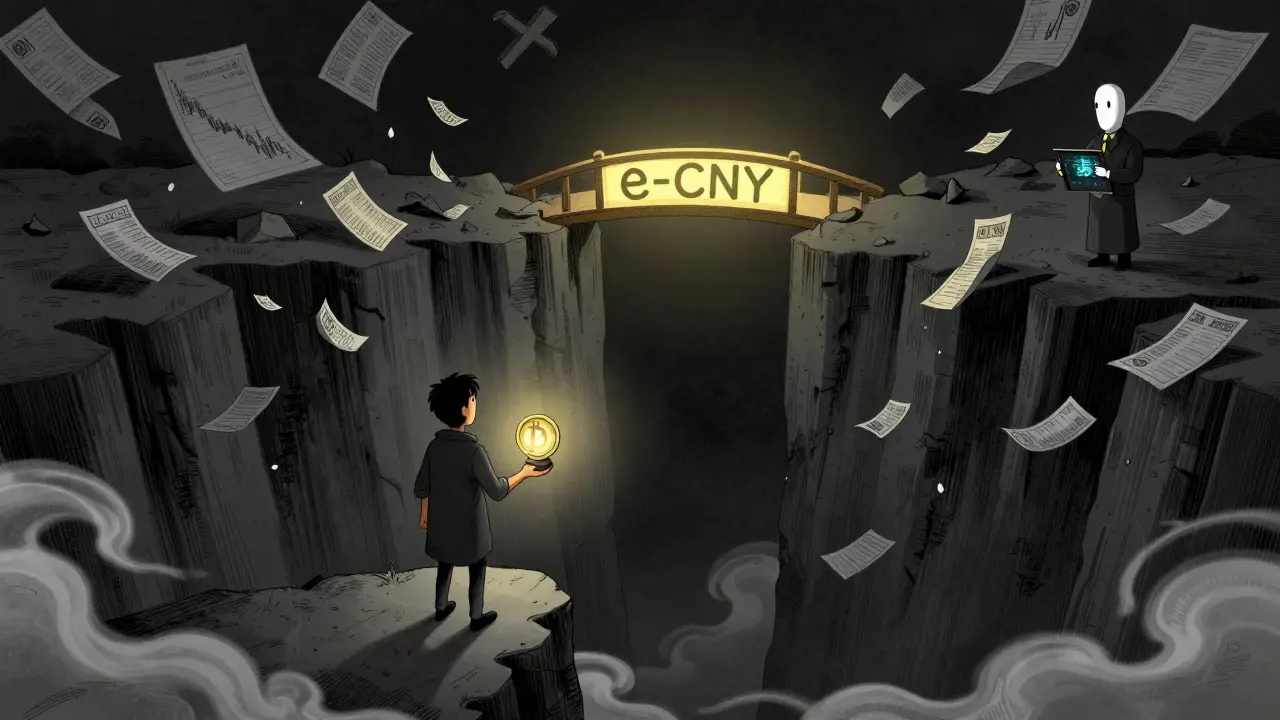
Why the Government Tolerates It - For Now
You’d think Beijing would crack down harder. But they haven’t. Why? Because they’re building something else: the digital yuan, or e-CNY. This isn’t Bitcoin. It’s a state-controlled digital currency with full traceability. Every transaction is logged. Every wallet is tied to an ID. The government wants to replace cash, not compete with crypto. The underground market doesn’t threaten the digital yuan - it proves why it’s needed. By letting crypto exist in the shadows, China avoids a mass exodus of capital. If they shut it down completely, millions might try to move money out through illegal channels - more dangerous than crypto. The underground market acts like a pressure valve. Shanghai regulators have started talking about regulating stablecoins. That’s a sign. They’re not trying to eliminate crypto - they’re trying to control it. Maybe one day, you’ll be able to trade USDT through a government-approved platform. But until then, the underground market survives because it fills a gap the system refuses to acknowledge.What Happens Next?
The underground crypto market in China isn’t going away. It’s too big, too embedded, and too necessary for too many people. As long as domestic investments keep underperforming and the digital yuan remains a tool of control rather than freedom, people will find ways to trade. But the risks are rising. Enforcement is becoming more targeted. Banks are monitoring suspicious transfers more closely. VPNs are being blocked faster. The cost of staying connected - in time, money, and stress - is growing. The future might not be about outlawing crypto entirely. It could be about creating a narrow, state-approved path for digital assets - one that looks like crypto but behaves like the digital yuan. That’s the real goal: not to ban innovation, but to own it. Until then, Chinese traders will keep using VPNs, stablecoins, and Hong Kong accounts. They’ll keep trading in silence. And the government will keep looking the other way - because sometimes, control means letting a little chaos live.Is it legal to own Bitcoin in China?
Yes, owning Bitcoin or other cryptocurrencies is not explicitly illegal in China. Courts have recognized digital assets as "legal property." But trading, exchanging, or facilitating crypto transactions is banned under PBOC rules. You can hold it, but you can’t legally buy or sell it through any official channel.
Can Chinese banks process crypto payments?
No. Since 2021, Chinese banks are strictly prohibited from handling any cryptocurrency-related transactions. This includes deposits, withdrawals, or even processing payments to crypto exchanges or OTC brokers. Any bank account flagged for crypto activity may be frozen or closed.
How do Chinese traders access international exchanges?
Most use VPNs to bypass the Great Firewall, often layering multiple services for security. Many also rely on Hong Kong-based bank accounts, trusted OTC brokers, or family members living abroad to execute trades. Some use decentralized platforms that don’t require KYC, but these carry higher counterparty risk.
Why are stablecoins so popular in China’s crypto underground?
Stablecoins like USDT act as a bridge between the yuan and global crypto markets. They’re easier to move across borders, less volatile than Bitcoin, and can be traded quickly without triggering bank scrutiny. For traders needing to preserve value while waiting for market moves, USDT is the most practical tool available.
What happens if you get caught trading crypto in China?
Penalties vary. Most individuals face asset freezes or fines if caught trading. In extreme cases - especially if involved in large-scale or commercial trading - authorities have pursued criminal charges. There’s no standard punishment, but enforcement has increased since 2023, with more cases going public as warnings to others.
Is the underground crypto market growing or shrinking?
It’s growing. Despite tighter enforcement, transaction volume hit $86.4 billion in 2022-2023, exceeding Hong Kong’s legal market. Demand remains high because traditional investments continue to underperform. As long as the digital yuan doesn’t offer real alternatives, people will find ways to trade crypto - even if it’s risky.
Could China ever legalize crypto again?
Not in the way the West understands it. China is unlikely to allow decentralized, permissionless crypto. But it may introduce state-approved digital assets - like regulated stablecoins - tied to the digital yuan. The goal isn’t freedom - it’s control. Any future crypto-like system will be monitored, restricted, and owned by the state.
Mandy McDonald Hodge
December 31, 2025 AT 16:04Bruce Morrison
December 31, 2025 AT 23:39Andrew Prince
January 1, 2026 AT 22:40Jordan Fowles
January 3, 2026 AT 08:20Steve Williams
January 4, 2026 AT 05:20nayan keshari
January 5, 2026 AT 18:55Johnny Delirious
January 5, 2026 AT 20:46Bianca Martins
January 6, 2026 AT 09:05alvin mislang
January 7, 2026 AT 15:38christopher charles
January 8, 2026 AT 08:56Vernon Hughes
January 8, 2026 AT 22:42Alison Hall
January 9, 2026 AT 07:23Amy Garrett
January 9, 2026 AT 16:16Mike Reynolds
January 10, 2026 AT 17:45dayna prest
January 12, 2026 AT 12:15Brooklyn Servin
January 13, 2026 AT 10:59Ryan Husain
January 15, 2026 AT 01:02Rajappa Manohar
January 15, 2026 AT 10:09Daniel Verreault
January 16, 2026 AT 19:22Jacky Baltes
January 18, 2026 AT 09:41prashant choudhari
January 19, 2026 AT 01:45Willis Shane
January 19, 2026 AT 02:55Josh Seeto
January 20, 2026 AT 09:32