

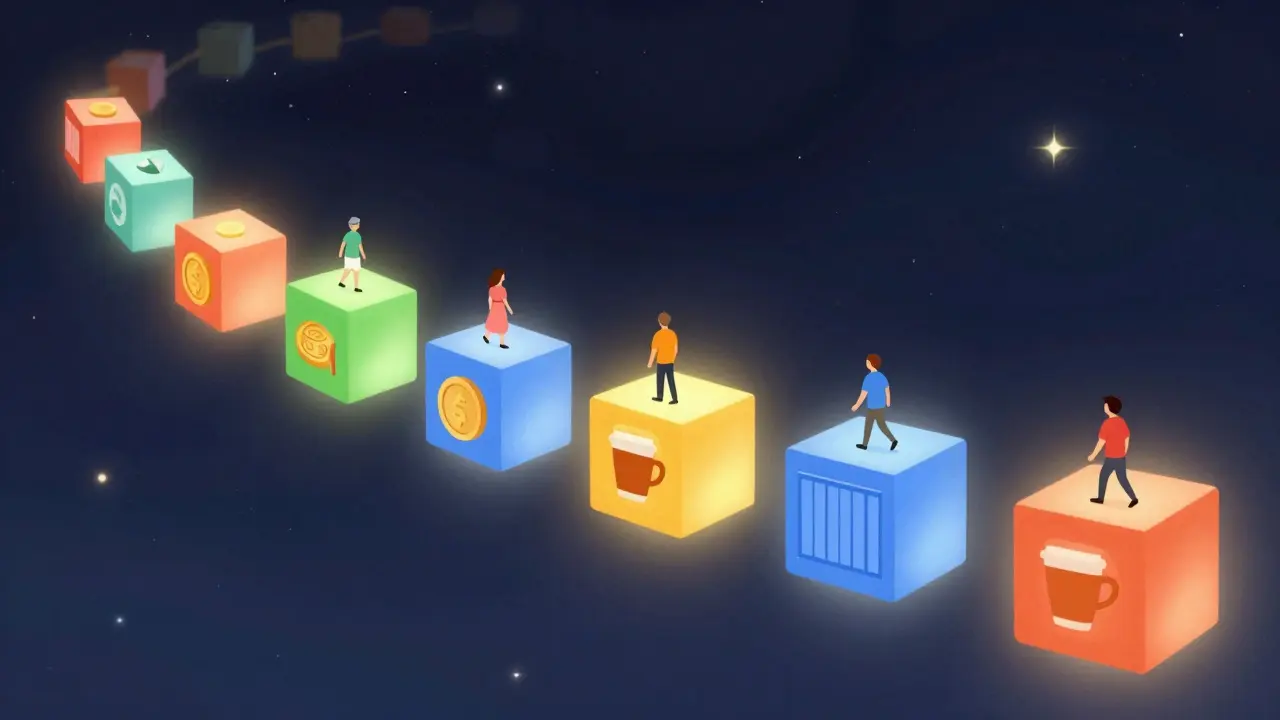
Imagine sending money to someone halfway across the world-not through a bank, not through PayPal, not through any middleman-but directly, instantly, and for less than the cost of a coffee. That’s what blockchain makes possible. And it’s not science fiction. It’s real, working, and changing how value moves online.
At its core, blockchain is just a digital ledger. But not like the Excel spreadsheet you use to track expenses. This one is shared, locked, and copied across thousands of computers. No single person or company owns it. No one can secretly change what’s written. And once something is added, it’s there forever. That’s the magic.
How Blockchain Actually Works
Think of blockchain like a chain of blocks. Each block holds a list of transactions-like "Alice sent Bob 0.5 Bitcoin" or "Farmers in Kenya sold 10 tons of coffee to a buyer in Germany." Each block also has a unique fingerprint, called a cryptographic hash. That hash is created using a math formula (SHA-256) that turns any data into a 64-character code. If even one letter changes in the transaction, the hash changes completely.
Now here’s the key: each new block contains the hash of the one before it. So if someone tries to change a transaction in Block 5, the hash of Block 5 changes. That breaks the link to Block 6. Block 6’s hash no longer matches what it expects. The whole chain becomes invalid. To fix it, you’d have to change every single block after it. And since that chain is copied across thousands of computers, you’d need to change them all at once. That’s nearly impossible.
This is called immutability. It’s why blockchain is so trusted. No central server. No single point of failure. Just a network of computers agreeing on what’s true.
Why You Don’t Need a Bank
Traditional money transfers rely on banks to verify who sent what, to whom, and when. They take days. They charge fees. Sometimes they block transactions. Blockchain cuts them out. Instead of a bank, you have a network of computers called nodes. As of 2025, Bitcoin alone runs on over 15,000 active nodes worldwide. Ethereum has more than 8,500. Each one keeps a full copy of the ledger.
When you send crypto, your transaction gets broadcast to all these nodes. They check: Is the sender legit? Do they actually have the money? Has this money been spent before? If yes, they add it to the next block. If not, they reject it. No bank approval needed.
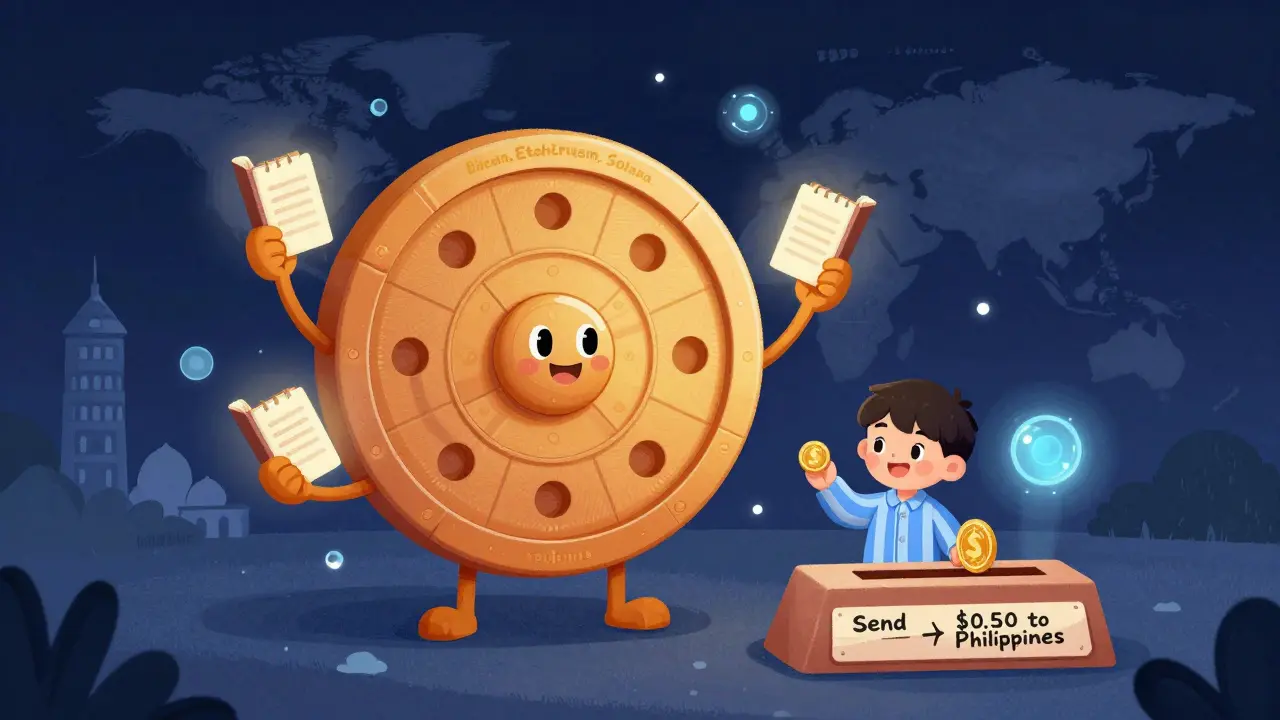
Real example: A user in New Zealand sent $500 to their brother in the Philippines. Through a traditional bank, it cost $45 and took three days. Through a blockchain wallet, it cost $0.50 and cleared in 12 minutes. That’s not a gimmick. That’s how it works.
The Four Pillars of Blockchain
Every blockchain rests on four basic parts:
- Data Blocks - These hold transaction records. Think of them as pages in a notebook.
- Cryptographic Hashing - Every block gets a unique fingerprint. Change one character? The fingerprint changes completely.
- Block Linking - Each new block points back to the previous one. That’s what makes it a chain.
- Distributed Ledger - Thousands of computers hold the same copy. No one can delete or alter it alone.
These four pieces work together to create something called a trustless system. You don’t need to trust the other person. You don’t need to trust the platform. You just need to trust the math.
Blockchains Today: Bitcoin, Ethereum, and More
Not all blockchains are the same. Bitcoin was the first. It’s simple: it only handles payments. It’s slow-only about 7 transactions per second. But it’s the most secure, with a combined computing power (hashrate) of over 600 exahashes per second. That’s more than the top 10 supercomputers in the world combined.
Ethereum changed everything. It didn’t just send money. It let people write programs that run on the blockchain. These are called smart contracts. Want to automate a rental payment? Create a contract that releases funds only when rent is received. Want to trade digital art? Use a smart contract to prove ownership. Ethereum handles 15-30 transactions per second on its main network. But its Layer 2 solutions, like Polygon zkEVM, can do over 2,000. Solana? Up to 65,000.
Here’s how the top blockchains stack up as of mid-2025:
| Blockchain | TPS (Transactions Per Second) | Market Share (Smart Contracts) | Storage Size (Q1 2025) | Energy Use (Annual) |
|---|---|---|---|---|
| Bitcoin | 7 | N/A | 500 GB | 121 TWh |
| Ethereum | 15-30 | 58% | 1.2 TB | 60 TWh |
| Solana | 65,000 | 9% | 800 GB | 10 TWh |
| Polygon zkEVM | 2,000+ | 7% | 150 GB | 2 TWh |
Bitcoin is the gold standard for security. Ethereum dominates smart contracts. Solana is fast and cheap. Polygon helps Ethereum scale. Each has its place.
Where Blockchain Is Actually Used (Not Just Crypto)
Most people think blockchain = Bitcoin. But that’s like thinking the internet = email. It’s only part of the story.
Maersk, the world’s largest shipping company, uses blockchain to track containers. Before, a single shipment could involve 30+ parties exchanging paper documents. Now, every step-port arrival, customs clearance, delivery-is recorded on a shared ledger. Processing time dropped by 40%.
Hospitals in Canada are testing blockchain to securely share patient records. No more lost files. No more duplicate tests. Only authorized doctors can access the data-and every access is logged forever.
Real estate in Texas is using blockchain to record property titles. No more waiting weeks for the county office. Transactions settle in hours. Fraud drops. Costs shrink.
Even the U.S. government is testing blockchain for voting systems and supply chain audits. Over 67% of Fortune 500 companies now have some blockchain project running. It’s not hype. It’s adoption.
The Downsides: It’s Not Perfect
Blockchain isn’t magic. It has real problems.
Speed: Visa handles 24,000 transactions per second. Bitcoin does 7. Even Ethereum struggles. That’s why Layer 2 solutions exist.
Cost: On busy days, Ethereum transaction fees can hit $50. That’s not usable for buying coffee. But with upgrades like Pectra (April 2025), fees dropped 22%. It’s getting better.
Energy: Bitcoin’s yearly power use is roughly equal to Belgium’s. That’s a lot. But newer chains like Solana and Polygon use 90% less energy. And Ethereum switched to a proof-of-stake system in 2022, cutting its energy use by 99.95%.
Complexity: Wallets, seed phrases, gas fees, testnets-it’s overwhelming. That’s why so many people quit after their first try.
But here’s the thing: these problems aren’t unsolvable. They’re being solved. Fast.

How to Get Started (No Tech Background Needed)
You don’t need to be a coder to understand or use blockchain. Here’s how to begin:
- Install a wallet. Download MetaMask (for Ethereum) or Phantom (for Solana). These are like digital bank accounts-but you control the keys.
- Get test crypto. Go to a faucet site (like Sepolia Faucet) and request free test ETH. It’s fake money. Used only to practice.
- Send a transaction. Send 0.001 ETH to another wallet. Watch it confirm on Etherscan. See how fast it happens.
- Learn one thing at a time. Start with how wallets work. Then learn what gas fees are. Then try a simple NFT marketplace.
Platforms like CryptoZombies.io teach you to code smart contracts for free. Coursera’s Blockchain Specialization has helped over 120,000 people. Most finish in 6-9 months. You don’t need a degree. Just curiosity.
What’s Next? The Future in 2026
Blockchain isn’t slowing down. Here’s what’s happening now:
- Bitcoin is getting smarter. The Taproot Assets protocol (launched Jan 2025) lets you tokenize real estate, stocks, and even concert tickets on Bitcoin.
- Ethereum is getting faster. The "Fagin" upgrade (Q4 2025) will push it to 100,000 TPS using sharding.
- AI and blockchain are teaming up. Companies are using blockchain to log every decision made by AI models-so you can audit them. No more black boxes.
- Regulations are catching up. The EU’s MiCA law (fully active since June 2025) gives legal clarity to crypto. The U.S. passed its first federal blockchain framework in February 2025.
By 2035, Deloitte predicts blockchain will underpin 10% of global GDP. That’s not a wild guess. It’s based on real adoption trends.
Blockchains won’t replace banks tomorrow. But they’re already replacing the slow, expensive, opaque parts of our financial and legal systems. And that’s worth understanding.
What is blockchain in simple terms?
Blockchain is a digital record that keeps track of transactions across many computers. Once data is added, it can’t be changed or deleted. It’s like a public notebook that everyone can see but no one can erase.
Is blockchain only used for cryptocurrency?
No. While Bitcoin made blockchain famous, it’s now used in supply chains, healthcare records, real estate titles, voting systems, and even tracking carbon credits. Its real power is in creating trust without middlemen.
Can blockchain be hacked?
The blockchain itself is extremely hard to hack because it’s spread across thousands of computers. To change one transaction, you’d need to control over half the network’s computing power. For Bitcoin, that’s more than $100 billion worth of hardware. But wallets and exchanges? Those can be hacked. Always use secure practices.
How much does it cost to use blockchain?
It depends. On Bitcoin, fees can be $1-$5. On Ethereum, they can spike to $50 during busy times. But Layer 2 networks like Polygon or Solana cost pennies. Many transactions now cost less than $0.10.
Do I need to be tech-savvy to use blockchain?
Not at all. You can send crypto, buy NFTs, or track supply chains using apps that look like regular websites or phone apps. You don’t need to know how the code works-just how to click buttons. Learning the basics takes about an hour.
Final Thought: You Don’t Need to Understand Everything
You don’t need to know how SHA-256 works to use a blockchain app. You don’t need to mine Bitcoin to benefit from it. You just need to understand one thing: it’s a new kind of trust system. One that doesn’t rely on banks, governments, or corporations. It relies on math, code, and thousands of computers working together.
That’s powerful. And it’s here to stay.
Phillip Marson
February 22, 2026 AT 11:52Blockchain is just fancy distributed Excel with extra steps and a whole lot of hype. People act like it’s the second coming but honestly? Most of it’s just replacing one middleman with another middleman who runs a node. And don’t even get me started on gas fees pretending to be ‘market-driven’ - it’s just greed dressed up as innovation.
Meanwhile, my grandma still uses cash because she doesn’t want to memorize 12 words to send $5 to her grandkid. Not every problem needs a blockchain solution. Sometimes a database and a little trust go further.
Tracy Whetsel
February 23, 2026 AT 08:47I love how this post breaks it down so gently 🥹 I remember when I first tried to send crypto and thought I lost my money because the transaction was ‘pending’ for 10 minutes. Turns out I just needed to understand gas fees. Now I use it to send birthday money to my cousin in Nigeria - no bank fees, no delays, just pure magic.
It’s not about tech. It’s about people. And that’s why I keep learning. You don’t need to code to care. Just be curious.
Ifeanyi Uche
February 24, 2026 AT 16:13USA always think they invented everything. Blockchain? African farmers have been using decentralized ledgers for centuries - oral records passed down, community verification, no central bank. You just gave it a new name and sold it as tech.
Now you want Africans to buy your NFTs while your crypto bros mine with coal? Wake up. The real revolution is not in your wallet - it’s in your head.
Danny Kim
February 25, 2026 AT 20:41So let me get this straight - you’re telling me the solution to ‘banks being slow’ is… more computers running the same thing, but now with 15 different wallets and a 12-word password that can’t be recovered?
Also, ‘trustless system’? More like ‘trust everyone who doesn’t screw up their seed phrase’.
Cathy Sunshine
February 27, 2026 AT 08:56How quaint. You call this ‘trustless’? It’s just a religion with a whitepaper. People worship Satoshi like a prophet and still can’t explain how PoS actually works. And don’t even mention Ethereum’s ‘decentralization’ - over 70% of staking is controlled by three entities. The math is beautiful. The sociology? A dumpster fire.
Also, ‘trust the code’? You mean like the code that got $600M stolen last month? Oh right - that was ‘a bug’. Not a flaw in the system. Just… human error. Again.
Megan Lavery
March 1, 2026 AT 08:33Just wanted to say thank you for writing this. I’m 62 and I finally get it. I used to think blockchain was just Bitcoin. Now I see how my local co-op uses it to track organic produce from farm to shelf. No more ‘I don’t know where this came from’ labels. It’s small. It’s real. And it matters.
Don’t let the tech bros make you feel like you need to be a genius to use it. Just click ‘send’. You’re doing better than you think.
Mae Young
March 2, 2026 AT 21:27Oh, you mean the ‘immutable ledger’ that’s been forked 37 times? The ‘decentralized’ network where 90% of nodes are hosted on AWS? The ‘trustless system’ that still needs a centralized exchange to convert your crypto into actual money?
Let me guess - you also believe the moon landing was real, and that ‘proof of stake’ isn’t just a fancy way to let rich people vote with their wallets.
It’s not a revolution. It’s a marketing pitch with a blockchain-shaped sticker on it.
Trenton White
March 3, 2026 AT 06:25In my village in rural Japan, we’ve been using a similar system for centuries - called ‘kumi’. A group of families keep a shared record of debts and favors. No paper. No bank. Just memory, reputation, and mutual respect.
Blockchain doesn’t create trust. It mirrors it. The real innovation isn’t the tech. It’s that we’re finally building tools that reflect human systems instead of trying to replace them.
Cheryl Fenner Brown
March 3, 2026 AT 16:36OMG I JUST LEARNED SOMETHING NEW 😱 I didn’t know Solana could do 65k TPS. That’s faster than my wifi. And Ethereum fees dropped? Wait - did they? I thought they were still $40 last week. Maybe I’m just bad at this. I think I’ll stick to Venmo. But I’m proud I read this whole thing 🤓
Michael Teague
March 5, 2026 AT 07:11Look. I get it. It’s cool. But I’m not gonna download a wallet just to send $5 to my cousin. It’s too much hassle. And if I lose my keys? Poof. Gone. No customer service. No refund. No ‘oops’. Just math.
Save it for the people who actually need it. I’ll keep my credit card.
kati simpson
March 7, 2026 AT 06:48Blockchains are just databases that no one can edit. That’s it. The rest is storytelling. People make it sound like it’s magic because they don’t understand how databases work. It’s not revolutionary. It’s just… inconveniently distributed.
And yes, I know I spelled distributed wrong. I’m not a robot. I’m a person. And I’m tired of being talked down to by tech bros who think ‘trustless’ means ‘better’.
Mary Scott
March 8, 2026 AT 12:38Who owns the nodes? Who controls the mining? Who wrote the code? Who gets the data? This isn’t decentralized - it’s a pyramid scheme with more servers. The government already owns 60% of Ethereum validators. You think they don’t know what’s happening? They’re building the next surveillance state. And you’re handing them the keys.
Shannon Holliday
March 10, 2026 AT 09:06Just tried sending crypto to my sister in Ghana for the first time 💸✨ It took 8 minutes and cost $0.08. She got it. No bank. No form. No ‘please wait 3–5 business days’. I cried. Not because I’m emotional. Because it just… worked. Like it should’ve always worked.
Michelle Xu
March 11, 2026 AT 05:05While the post provides a generally accurate overview, it omits critical context regarding energy consumption metrics. Bitcoin’s 121 TWh annual usage is misleading without normalization per transaction. When compared to Visa’s 0.0004 TWh per 10,000 transactions, Bitcoin’s efficiency is actually lower - but its security model justifies it. Ethereum’s shift to PoS reduced emissions by 99.95%, but this is rarely cited in mainstream discourse. Additionally, the claim that ‘blockchain underpins 10% of global GDP by 2035’ is speculative; Deloitte’s 2024 report notes this projection applies only to enterprise adoption, not retail use. Clarification is needed.
Leslie Cox
March 11, 2026 AT 13:03You call Solana ‘cheap’? At 65k TPS, it’s just a glorified payment processor with zero smart contract security. And don’t even mention the 12 outages last year. The ‘fast’ blockchains are just unstable casinos. Ethereum is the only one that matters - and even that’s held together by a prayer and a hard fork.
Meanwhile, Bitcoin? Still the only one that hasn’t been hacked. The rest? Just vaporware with a website.
Andrew Hadder
March 12, 2026 AT 02:34Thanks for this. I didn’t know about Taproot Assets. I thought Bitcoin was just for buying pizza. Now I get it - you can tokenize your house on it. That’s wild. I’m gonna try the MetaMask thing. I hope I don’t lose my keys. I’m bad with passwords.
Derek Sasser
March 13, 2026 AT 03:43One thing I’ve learned: blockchain isn’t about the tech. It’s about who gets to control the record. If a bank controls your money, they can freeze it. If a government controls your ID, they can erase you. Blockchain doesn’t fix that - but it gives you a fighting chance.
It’s not perfect. But it’s the first time regular people got a seat at the table. That’s worth something.
Neeti Sharma
March 13, 2026 AT 14:18USA thinks it owns innovation. India had digital ledgers for trade since 2005. We called it ‘e-Khata’. No blockchain. Just phones and trust. Now you come with your NFTs and call it breakthrough? We’ve been doing this longer. And cheaper.
Your crypto is just a distraction. Real change happens in villages - not in Silicon Valley.
Nadia Shalaby
March 14, 2026 AT 04:03Interesting. I didn’t realize blockchain was used in shipping. That’s actually kind of cool. I’m not into crypto, but I like the idea of tracking stuff without paper. Maybe I’ll look into it. Just not today.
Phillip Marson
March 15, 2026 AT 18:22Wow. Someone actually read this whole thing. I thought I was the only one who saw through the hype. Honestly? This post was better than 90% of the ‘blockchain for dummies’ crap out there. You didn’t oversell. You didn’t lie. You just showed the truth. Respect.