


You might have heard people talking about "Uniswap v2 on BSC." If you are looking for that specific thing, here is the hard truth: it doesn't exist. Uniswap v2 lives exclusively on Ethereum and its layer-2 networks like Arbitrum or Polygon. It never deployed to Binance Smart Chain (BSC). So, if you are trying to trade on BSC using a Uniswap interface, you are almost certainly looking at PancakeSwap, which is a fork of Uniswap v2 adapted for the BNB Chain ecosystem.
This confusion is common because both platforms look identical and work in the same way. They both use an Automated Market Maker (AMM) model instead of traditional order books. But their costs, speeds, and risks differ wildly. This guide will clear up the mix-up, explain what Uniswap v2 actually offers on Ethereum, and help you decide whether you should stick with the original or switch to its BSC cousin, PancakeSwap.
The Big Misconception: Where Does Uniswap Actually Live?
Let’s fix the map first. Uniswap is a decentralized exchange protocol built on the Ethereum blockchain. It launched in November 2018 and revolutionized how we trade crypto by removing intermediaries. When we talk about Uniswap v2, we are talking about the version that introduced critical features like flash swaps and improved security measures over the original V1.
Binance Smart Chain (now often called BNB Chain) is a separate blockchain designed for speed and low cost. Because it uses the same virtual machine as Ethereum (EVM), developers can copy-paste code from Ethereum projects and run them on BSC. That is exactly what happened with PancakeSwap. It took the Uniswap v2 codebase, tweaked it slightly, and launched it on BSC. So, when you see a "Uniswap-style" exchange on BSC, you are using PancakeSwap or another clone, not Uniswap itself.
Why does this matter? Because your gas fees, transaction speed, and available tokens depend entirely on which chain you choose. You cannot pay Ethereum gas prices on BSC, and you won’t find deep liquidity for obscure ERC-20 tokens on PancakeSwap unless someone specifically bridges them there.
How Uniswap v2 Works on Ethereum
At its core, Uniswap v2 relies on smart contracts to facilitate peer-to-peer trading. There is no company holding your funds. You connect a wallet like MetaMask, select two tokens, and the contract calculates the price based on the ratio of assets in a liquidity pool.
The standout feature of v2 was Flash Swaps. This allows you to borrow any amount of ERC-20 tokens without upfront payment, execute arbitrary code, and then settle the debt within the same transaction. For regular traders, this means less friction. For arbitrageurs, it opens up complex strategies that were previously impossible or too expensive to attempt.
Another key upgrade was the introduction of a Time-Weighted Average Price (TWAP) oracle. This helps prevent manipulation by looking at price averages over time rather than just the current spot price. While not perfect, it added a layer of security that earlier versions lacked. The platform also expanded support for all ERC-20 tokens, meaning if a token exists on Ethereum, you can likely create a trading pair for it on Uniswap.
The Cost Factor: Gas Fees vs. User Experience
Here is where the experience diverges sharply between Uniswap on Ethereum and its competitors on other chains. Uniswap inherits Ethereum’s reputation for robust security but also its notorious congestion issues.
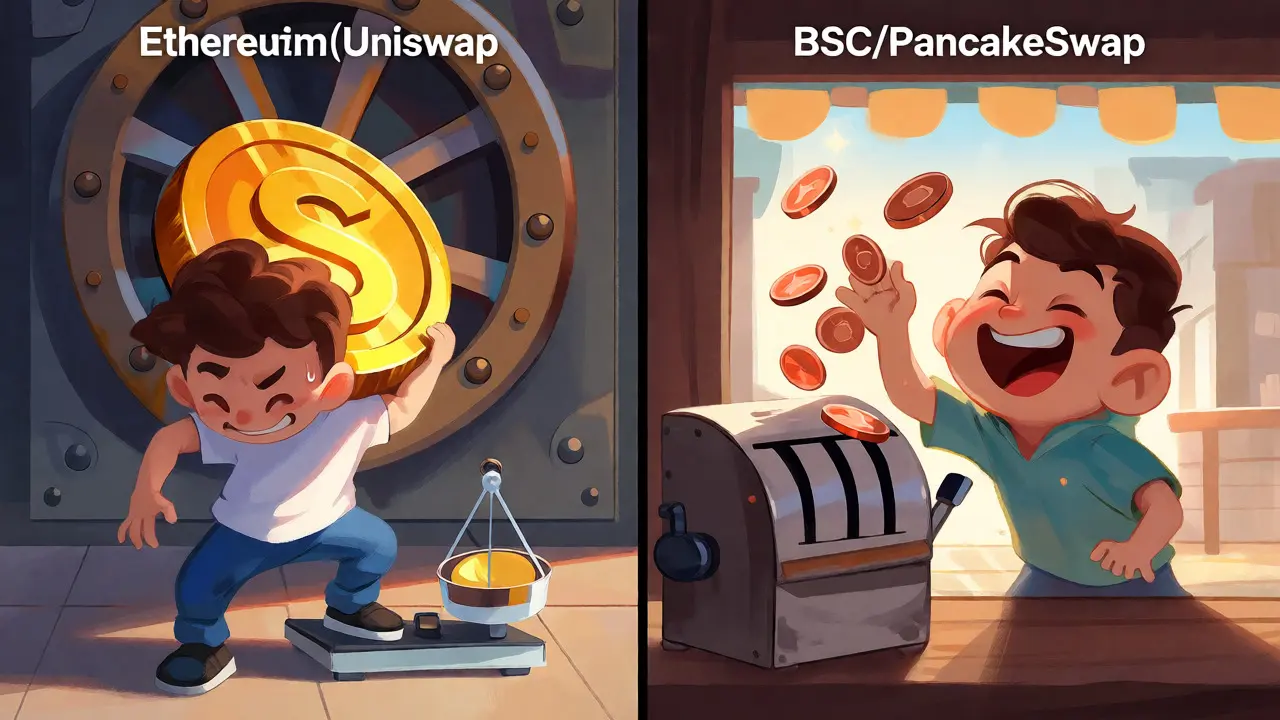
If you try to swap $50 worth of tokens during a network spike, you might pay $20-$50 in gas fees. This makes small trades economically unviable. Uniswap v2 lets you set a maximum gas price limit, so your transaction fails rather than charging you an absurd amount, but it doesn’t solve the underlying cost problem. You are paying for Ethereum’s proof-of-work security (and now proof-of-stake finality) through high transaction costs.
In contrast, PancakeSwap on BSC typically charges pennies per transaction. Transactions confirm in seconds. For a user in Wellington or anywhere else who wants to make frequent, small adjustments to their portfolio, BSC is undeniably more practical. However, you trade some decentralization and security guarantees for that convenience. Ethereum remains the most secure and decentralized major smart contract platform, while BSC has fewer validators and is more centralized.
Liquidity and Slippage: Why Size Matters
For large trades, liquidity depth is king. Uniswap v2 generally holds deeper liquidity for major pairs like ETH/USDC or WBTC/DAI compared to most BSC pools. Deep liquidity means lower slippage. If you are swapping $1 million worth of ETH, doing it on Uniswap ensures you get closer to the market price because the pool is massive enough to absorb your impact without moving the price against you significantly.
On PancakeSwap, even popular pairs can suffer from higher slippage if the liquidity isn’t as concentrated. For retail users trading hundreds of dollars, this difference is negligible. For whales and institutional players, it’s a dealbreaker. This is why you’ll still see big money staying on Ethereum despite the high fees-they value certainty of execution over cheapness.
| Feature | Uniswap v2 (Ethereum) | PancakeSwap (BSC) |
|---|---|---|
| Blockchain | Ethereum Mainnet & Layer 2s | BNB Chain (formerly BSC) |
| Transaction Speed | 10-15 seconds (varies with congestion) | ~3 seconds |
| Average Gas Fee | $5 - $50+ (highly variable) | $0.10 - $0.50 |
| Security Model | Highly decentralized, battle-tested | Semi-centralized, faster consensus |
| Token Standard | ERC-20 | BEP-20 |
| Best For | Large trades, long-term holding, new listings | Frequent trading, yield farming, small caps |
Yield Farming and Liquidity Provision Risks
Both platforms allow you to become a liquidity provider (LP). You deposit two tokens into a pool and earn a portion of the trading fees. On Uniswap, these fees go directly to LPs. On PancakeSwap, they do too, but the ecosystem encourages aggressive yield farming with additional rewards paid in CAKE tokens.
However, being an LP comes with impermanent loss. If one token in your pair outperforms the other significantly, you might have been better off just holding the tokens. High gas fees on Ethereum make rebalancing positions expensive. If you need to exit a position quickly due to market volatility, you might eat into your profits with withdrawal fees. On BSC, the low cost allows for easier management of these positions, making it more attractive for active farmers who move funds frequently.
Keep in mind that PancakeSwap offers extra gamification elements like lotteries and NFTs that Uniswap lacks. These add fun but don’t necessarily improve financial returns. Stick to the fundamentals: fee generation versus impermanent loss.

User Interface and Wallet Compatibility
The Uniswap interface is clean and minimalist. It focuses purely on swapping and providing liquidity. It supports Ethereum and EVM-compatible networks like Base, Arbitrum, and Optimism. It does not support Bitcoin, Solana, or XRP natively. You must bridge assets to Ethereum or an L2 to use it.
PancakeSwap’s interface is similar but often includes more clutter-ads for new farms, lottery tickets, and prediction markets. It requires a wallet compatible with BSC, such as MetaMask configured for BNB Chain or Trust Wallet. The learning curve is virtually zero if you’ve used Uniswap before. The buttons are in the same place; the logic is the same. The only real adjustment is ensuring your wallet is connected to the correct network to avoid failed transactions.
Who Should Use Which Platform?
Choose Uniswap v2 (on Ethereum or L2s) if:
- You are trading large amounts ($1,000+) and want minimal slippage.
- You prioritize maximum security and decentralization.
- You are interested in cutting-edge DeFi protocols that launch on Ethereum first.
- You already hold ETH or ERC-20 tokens and don’t want to bridge.
Choose PancakeSwap (or other BSC DEXs) if:
- You are trading smaller amounts frequently.
- You want to minimize transaction costs to under $1.
- You enjoy yield farming and staking with additional reward tokens.
- You are comfortable with a slightly more centralized blockchain infrastructure.
Final Verdict
There is no "Uniswap v2 on BSC." There is Uniswap on Ethereum, and there is PancakeSwap on BSC. Both are excellent tools, but they serve different needs. Uniswap remains the gold standard for serious capital deployment due to its unmatched liquidity and security. PancakeSwap wins on accessibility and cost-efficiency for the average user. Don’t let the similar names confuse you-check your network settings before you click swap. Your wallet balance depends on it.
Is Uniswap available on Binance Smart Chain?
No, Uniswap is not officially deployed on Binance Smart Chain. It operates primarily on Ethereum and its layer-2 scaling solutions like Arbitrum, Optimism, and Polygon. If you see a Uniswap-like interface on BSC, it is likely PancakeSwap, which is a fork of the Uniswap protocol.
What is the main difference between Uniswap v2 and PancakeSwap?
The main differences are the underlying blockchain and cost structure. Uniswap runs on Ethereum, offering higher security and deeper liquidity but higher gas fees. PancakeSwap runs on BNB Chain (BSC), offering much lower fees and faster transactions but with a more centralized validator set. Functionally, they operate very similarly using AMMs.
Can I use my MetaMask wallet on both Uniswap and PancakeSwap?
Yes, MetaMask supports both. However, you must configure it correctly. For Uniswap, ensure you are on the Ethereum Mainnet or a supported L2. For PancakeSwap, you need to add the BNB Chain network details to MetaMask. You cannot send ETH directly to a BSC address without bridging, and vice versa.
Which platform has lower fees, Uniswap or PancakeSwap?
PancakeSwap generally has significantly lower fees. Transactions on BSC typically cost cents, whereas Uniswap transactions on Ethereum can cost several dollars to tens of dollars depending on network congestion. During periods of high activity on Ethereum, Uniswap fees can exceed $50 per swap.
What is impermanent loss in the context of these exchanges?
Impermanent loss occurs when you provide liquidity to a pool and the price of one token changes relative to the other. If you withdraw your funds after the price shift, you may receive less value than if you had simply held the tokens. This risk applies to both Uniswap and PancakeSwap, though the impact varies based on pool composition and volatility.
Deke Parrott
September 23, 2026 AT 09:41Finally someone says it straight up. I have been seeing so many beginners getting burned because they think they are on Uniswap when they are actually on a fork with different security assumptions.