

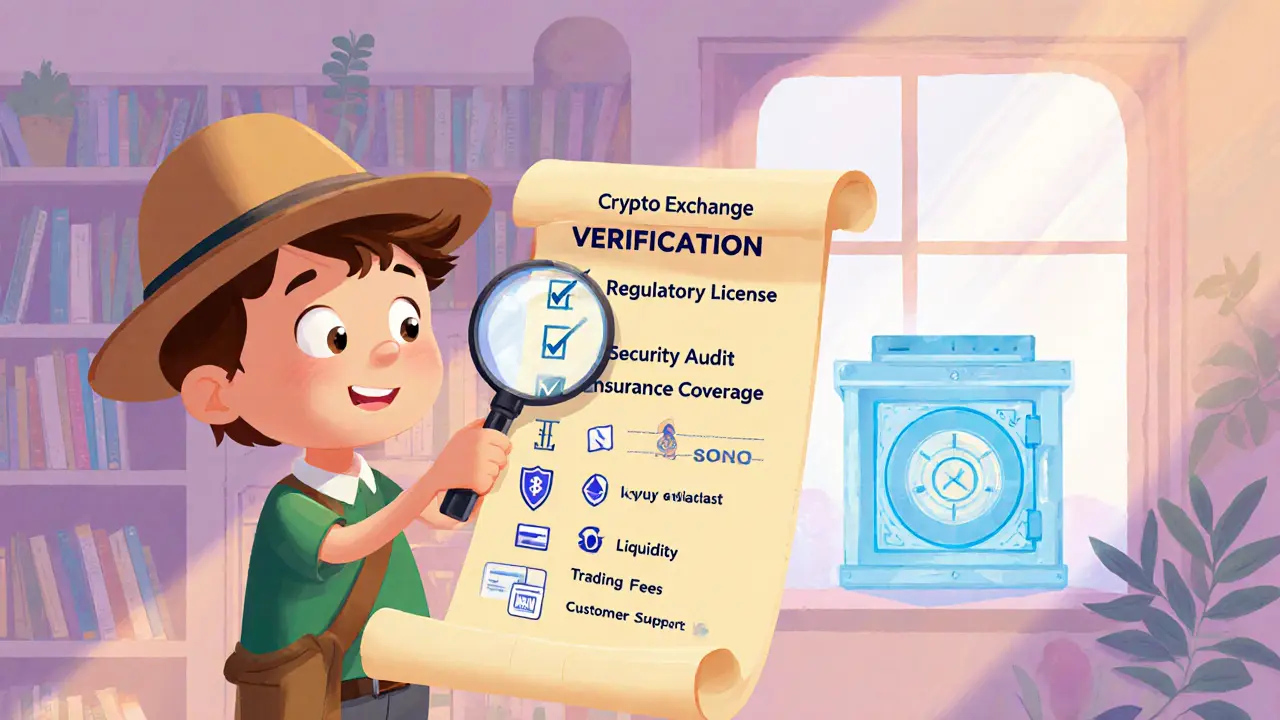
Crypto Exchange Verification Checker
Use this checklist to evaluate any crypto exchange before depositing funds:
- Regulatory License: Is the exchange licensed by a recognized financial authority?
- Security Audit: Has the platform undergone an independent security audit?
- Insurance Coverage: Does the exchange offer insurance for user funds?
- KYC Requirements: What identity verification process is required?
- Liquidity: Is there sufficient trading volume for your desired assets?
- Trading Fees: Are fees clearly disclosed and reasonable?
- Customer Support: Is there responsive support available?
UPXIDE exchange review
- There’s barely any public data on UPXIDE, so the review focuses on verification steps you should run yourself.
- Key factors to assess: licensing, security audits, fee structure, supported assets, liquidity, KYC, and customer support.
- We compare UPXIDE against two industry giants to highlight what a trusted exchange normally offers.
- Practical tips on staying safe if you decide to try a brand‑new platform.
What is UPXIDE?
UPXIDE is a crypto exchange that claims to provide low‑fee trading and a user‑friendly dashboard for retail investors. A quick search in major regulatory databases and crypto‑news outlets turns up virtually nothing, which raises the question: is it a brand‑new service, a regional niche platform, or perhaps a misspelling of a different project? The lack of a visible whitepaper, audit reports, or clear corporate address makes the first step of any review-verification-particularly important.
How to Verify Any Crypto Exchange
Before you deposit a single satoshi, you should confirm a handful of core attributes. Below are the most reliable checkpoints.
- Regulatory license is official permission from a financial authority (e.g., FCA, MAS, FinCEN) that allows the platform to operate legally. Look for registration numbers on the exchange’s “About” page and cross‑check them on the regulator’s website.
- Security audit is an independent code review that checks for vulnerabilities in the exchange’s smart contracts, API endpoints, and wallet architecture. Reputable exchanges publish audit reports from firms like CertiK or Quantstamp.
- Insurance coverage is a policy that compensates users in case of a hack or operational failure. Verify the insurer’s name and policy limits.
- KYC (Know Your Customer) is the identity verification process required by law to prevent money‑laundering. Understand which documents are needed and whether the process is fully automated or manual.
- Liquidity is the ability of the exchange to fill orders quickly without huge price slippage. Check 24‑hour trading volume on sites like CoinGecko or CryptoCompare.
- Trading fee is the percentage taken by the platform on each trade, often tiered by volume. Low fees are nice, but they must be paired with solid security.
- Customer support is the service channel (live chat, email, ticketing) that helps users resolve issues. Test response time with a simple query before trusting your funds.
Potential Red Flags Specific to UPXIDE
The most glaring issue is the near‑absence of verifiable information. Here’s what that could mean:
- It might be a brand‑new exchange that hasn’t yet indexed its pages in search engines.
- It could be operating under a different legal name, making licensing checks harder.
- It may be a regional startup with a limited marketing budget, which is not inherently bad but demands extra diligence.
- Possibly, the name is misspelled or the project has been discontinued.
Because no audit reports, no regulatory identifiers, and no reputable media coverage appear, treat UPXIDE as a high‑risk candidate until those gaps are filled.
Feature Checklist You Should Expect
Even without concrete data for UPXIDE, you can create a checklist and see which items the platform actually provides. Use this list when you explore the site or contact support.
- Clear list of supported cryptocurrencies (e.g., BTC, ETH, USDT) with market‑pair details.
- Transparent fee schedule that includes maker/taker rates, withdrawal fees, and any hidden costs.
- Information on withdrawal limits and processing times.
- Proof of security measures such as 2FA, cold‑storage percentages, and DDoS protection.
- Evidence of regulatory compliance (license numbers, jurisdiction).
- Details about insurance policies covering digital assets.
- Responsive customer support channels (live chat, email, phone).
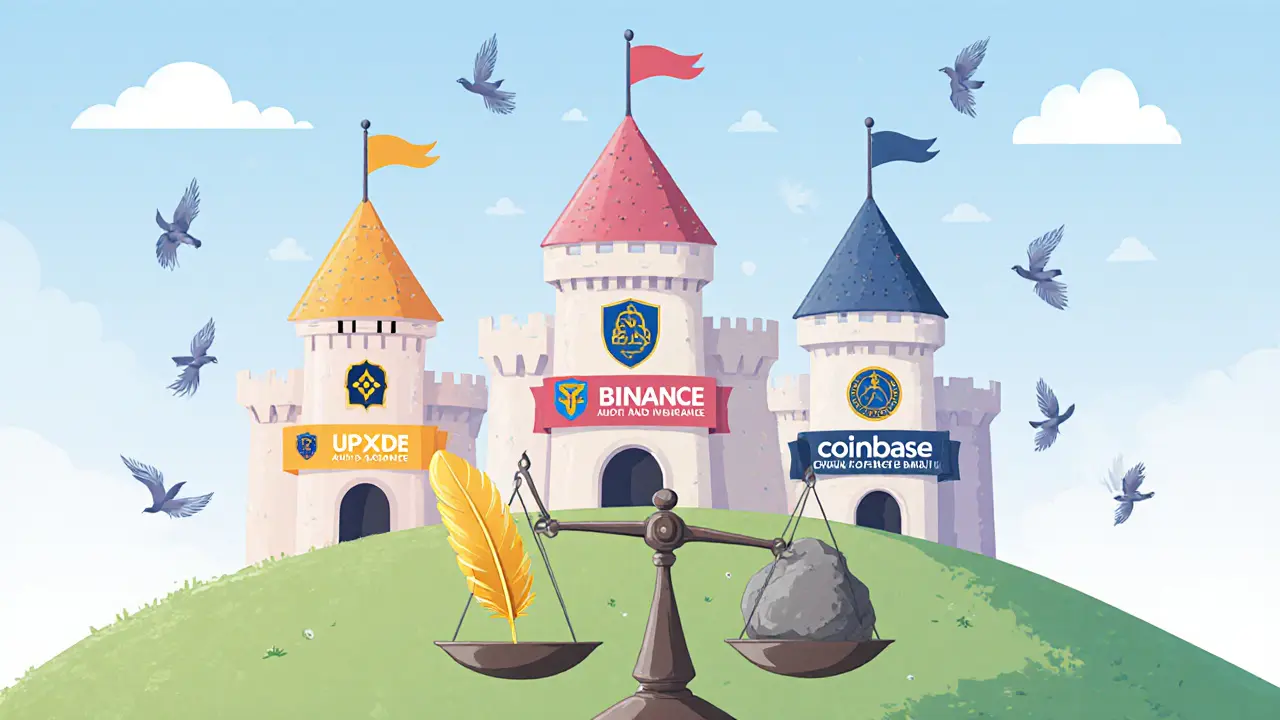
Side‑by‑Side Comparison: UPXIDE vs. Binance vs. Coinbase
| Attribute | UPXIDE | Binance | Coinbase |
|---|---|---|---|
| Regulatory License | Not publicly disclosed | Malta, Seychelles, Singapore (multiple) | US (Wyoming), UK (FCA) |
| Security Audit | None available | CertiK (2024), Quantstamp (2023) | Trail of Bits (2024) |
| Trading Fee (maker/taker) | Advertised 0.10% flat | 0.10%/0.10% (lower with BNB) | 0.50%/0.50% (lower for Coinbase Pro) |
| Supported Coins | Claimed 30+ (no list) | 300+ (including DeFi, NFT) | 250+ (focus on major tokens) |
| 24‑h Volume (USD) | ~$2M (unverified) | $32B | $5B |
| Insurance | None reported | $400M custodial insurance | $250M custodial insurance |
| KYC Requirement | Basic email verification (claimed) | Full ID + facial verification | Full ID + address proof |
| Customer Support | Email only (response time unknown) | Live chat, ticket, phone | Live chat, phone, community forums |
The table highlights where UPXIDE diverges from established players. The biggest gaps are regulatory transparency, audited security, and insurance-three pillars most seasoned traders won’t ignore.
How to Protect Yourself If You Still Want to Try UPXIDE
Risk can’t be eliminated, but you can contain it.
- Start with a tiny amount-no more than 0.01BTC or the equivalent in your local fiat.
- Enable every security feature the platform offers: strong password, two‑factor authentication, withdrawal whitelist.
- Withdraw profits daily to a personal wallet that you control (hardware wallet preferred).
- Keep a screenshot of the fee schedule and any email confirmations for future disputes.
- Monitor the exchange’s social media and community forums; sudden silence can be a warning sign.
Verdict: Proceed with Caution
Without verifiable licensing, audit reports, or an established user base, UPXIDE sits on the risky side of the crypto‑exchange spectrum. If you’re an experienced trader who can absorb a potential loss, a tiny test deposit might be acceptable. For newcomers or anyone safeguarding significant capital, it’s safer to stick with exchanges that openly publish their compliance documents, insurance policies, and security audits.
Frequently Asked Questions
Is UPXIDE a legit crypto exchange?
Legitimacy can’t be confirmed at this time because there are no public regulatory filings, security audit reports, or verifiable corporate details. Treat it as high risk until those gaps are filled.
What should I check before depositing funds?
Verify the exchange’s licensing authority, request a recent security audit, look for insurance coverage, confirm the fee schedule, and test customer support responsiveness.
How does UPXIDE’s fee structure compare to major exchanges?
UPXIDE claims a flat 0.10% maker/taker fee, which matches Binance’s baseline but is lower than Coinbase’s typical 0.50% fee. However, fee transparency matters less than security and regulation.
Can I withdraw to a hardware wallet?
If the platform supports external addresses, you can withdraw to a hardware wallet like Ledger or Trezor. Always double‑check the withdrawal address before confirming.
What are the signs of a phishing site pretending to be UPXIDE?
Look for misspelled URLs, missing SSL certificates (no padlock), poor grammar, and requests for private keys. Genuine exchanges never ask for seed phrases.
Marie Salcedo
June 14, 2025 AT 12:13Great overview of the verification checklist! It's refreshing to see a balanced take on the risks and practical steps. Even if a platform like UPXIDE is obscure, the advice here applies to any exchange. Keep the optimism alive and continue digging for those missing details. Stay safe and happy trading!
dennis shiner
June 15, 2025 AT 11:33Oh sure, because every unknown exchange is just waiting to hand you free Bitcoin, right? 😏
Mangal Chauhan
June 16, 2025 AT 10:53Dear community, I would like to extend my sincere gratitude for this meticulous article. 🙏 The systematic approach to due diligence is commendable and aligns perfectly with best practices. Please consider adding a brief note on how to verify SSL certificates, as it often reveals phishing attempts. 😊 Additionally, a reminder to cross‑check the exchange’s registration number on official regulator portals would be invaluable. Thank you for fostering a culture of informed investment.
Darius Needham
June 17, 2025 AT 10:13Honestly, the lack of any public audit is a red flag that should not be ignored. If you’re serious about security, demand a third‑party audit report before you even think about a deposit. The article nails the point about insurance – without it you’re basically gambling with your own capital. Keep pushing for transparency, it’s the only way we’ll get trustworthy platforms.
karyn brown
June 18, 2025 AT 09:33Wow, another "mystery" exchange that claims to be the next big thing. 🙈 Honestly, if they can’t even spell “regulatory” correctly on their page, I’m not interested. The whole vibe screams "shady startup". 🚨 Stay away unless you enjoy watching your money disappear into a black hole! 💥
Megan King
June 19, 2025 AT 08:53hey guys, loving the deep dive! i think its cool to keep an eye on stuff like liquidity and fees. if u wanna try it, start w/ a lil amount and pull out quick. also, keep an eye on their support response – that tells a lot. stay safe, y'all!
Rachel Kasdin
June 20, 2025 AT 08:13Listen up, fellow patriots! If you think any foreign crypto platform can out‑shine our home‑grown exchanges, think again. This UPXIDE nonsense is just another attempt to weaken our financial sovereignty. Stick with the ones that respect our laws and values. 🇺🇸
karsten wall
June 21, 2025 AT 07:33From a systemic perspective, the article elucidates the epistemic gaps inherent in nascent exchange architectures. The juxtaposition of liquidity metrics with regulatory opacity provides a nuanced heuristic for risk quantification. It would be advantageous to integrate a Bayesian inference model to probabilistically assess audit credibility. Nonetheless, the discourse remains an exemplar of methodical scrutiny in a volatile domain.
Keith Cotterill
June 22, 2025 AT 06:53One must, with impeccable discernment, acknowledge that the labyrinthine tapestry of modern cryptocurrency exchanges is not merely a constellation of arbitrary codes and transaction ledgers, but rather an intricate symphony of decentralization, regulatory edicts, and market psychology, each note resonating with profound implications for the sagacious investor. Indeed, the palpable absence of verifiable licensing for UPXIDE, when juxtaposed against the well‑documented statutory compliance of industry behemoths such as Binance and Coinbase, engenders a paradigm of risk that is neither negligible nor dismissible. Moreover, the conspicuous void of independent security audits-precisely the crucible wherein cryptographic fortifications are stress‑tested-renders any superficial confidence in the platform's robustness tantamount to hubris. The article astutely underscores the perils of conflating nominal fee structures with intrinsic security, a fallacy that, if unchallenged, could precipitate capital erosion on an unprecedented scale. By invoking the ontological principle that transparency begets trust, one is compelled to scrutinize the epistemic foundations upon which UPXIDE purports its legitimacy. In the absence of a disclosed insurance policy, the custodial exposure escalates, metamorphosing potential losses from speculative to existential. Consequently, a prudent investor must employ a multi‑faceted due‑diligence matrix, encompassing not only quantitative metrics such as 24‑hour volume and maker‑taker fees, but also qualitative assessments of corporate governance, jurisdictional oversight, and community reputation. To this end, the recommendation to initiate engagements with a minuscule fraction of one's portfolio-no more than 0.01 BTC-serves as a calibrated risk mitigation strategy, akin to a controlled laboratory experiment designed to isolate variables and gauge systemic resilience. Furthermore, the advocacy for hardware wallet withdrawals post‑profit realization is a salutary reminder of the immutable principle of self‑custody, wherein the user reclaims sovereign control over digital assets, thereby attenuating counterparty exposure. In summation, while the allure of a nascent platform promising low fees may stir the adventurous spirit, the empirical evidence delineated herein compels a circumspect stance: proceed with caution, demand verifiable documentation, and prioritize platforms whose operational ethos is anchored in regulatory compliance, audited security, and comprehensive insurance coverage. Only then can one navigate the cryptic currents of the digital economy with both confidence and composure.
Noel Lees
June 23, 2025 AT 06:13Hey folks! Love how thorough this review is – super helpful. 👍 If you’re still curious about UPXIDE, just remember to keep your deposits tiny and stay alert. Excited to see more transparent exchanges join the game! 😎
Adeoye Emmanuel
June 24, 2025 AT 05:33Esteemed readers, the discourse presented here is a clarion call to vigilance in the ever‑evolving crypto arena. The dramatic absence of publicly verifiable safeguards surrounding UPXIDE invokes a palpable tension that must be resolved through rigorous scrutiny. By embracing a disciplined approach-insisting upon regulatory disclosures, demanding audit transparency, and securing insurance coverage-you sculpt a fortress against potential calamities. Let us, therefore, march forward with both optimism and caution, ever mindful of the stakes involved.
CJ Williams
June 25, 2025 AT 04:53🔥💥 Wow, such an epic breakdown! 🎯 Remember, start small, use 2FA, and ALWAYS keep your keys offline. 🚀 Stay sharp, stay safe, and keep the crypto spirit alive! 💪😄
Kamva Ndamase
June 26, 2025 AT 04:13Listen up, everybody! If you think you can just throw money at any flash‑in‑the‑pan exchange and expect miracles, think again. This is why we need to fight for transparency and demand real accountability. No more blind trust – get the facts, protect your assets, and let’s keep the community strong! 💥🚀