


You might have heard whispers in the crypto community about a major shakeup coming to Europe. The USDT, the world's most popular stablecoin, is facing a hard stop on many European exchanges. This isn't just a minor policy tweak; it is a direct result of the Markets in Crypto-Assets Regulation (MiCA), the EU's new rulebook for digital assets. If you hold USDT or trade on platforms like Binance or Coinbase from within the EU, this change affects your portfolio directly.
Why is the EU cracking down on a token that dominates global trading volume? And more importantly, what should you do with your holdings before the deadlines hit? We are looking at August 2026, so the dust has settled somewhat, but the ripple effects of the July 2025 enforcement date are still reshaping how Europeans interact with digital dollars. Let’s break down exactly what happened, why Tether failed to comply, and which alternatives stepped up to fill the void.
What Is MiCA and Why Does It Matter?
To understand the USDT ban, you first need to grasp MiCA. This stands for Markets in Crypto-Assets, and it is the European Union’s first comprehensive legal framework for regulating crypto assets. Before MiCA, each country had its own patchwork of rules. France was strict, Germany was different, and others were laxer. MiCA unified this into one set of standards across all member states.
The law became official in June 2023, but the real teeth came later. Stablecoin-specific provisions kicked in on June 30, 2024, with full enforcement rolling out through December 2024. By July 1, 2025, non-compliant tokens like USDT faced mandatory delisting from authorized exchanges. Think of MiCA as a gatekeeper. It demands transparency, reserve backing, and clear operational rules. If a token issuer can’t prove they have the money to back every coin, they get shown the door.
| Requirement | Description | Status for USDT |
|---|---|---|
| Authorization | Must be licensed by a competent authority (e.g., ACPR in France). | Failed to obtain necessary EU registration. |
| Reserves | 1:1 backing with liquid assets, segregated from company funds. | Insufficient transparency on reserve composition. |
| Transparency | Mandatory white papers and regular independent audits. | Lacked real-time, verifiable audit trails required by EU. |
| AML/KYC | Strict Anti-Money Laundering and Know Your Customer procedures. | Cited as inadequate compared to EU banking standards. |
Why Did USDT Fail Compliance?
Tether Limited, the issuer behind USDT, didn’t just ignore the rules; they struggled to meet them. The core issue wasn’t that USDT was fake-most analysts agree the reserves exist-but rather how those reserves were managed and disclosed. MiCA requires Electronic Money Tokens (EMTs) to provide rigorous proof that every USDT is backed by a dollar equivalent, held in safe, liquid assets like cash or short-term government bonds.
Regulators pointed to several specific failures. First, Tether’s disclosure practices didn’t match the granularity demanded by European authorities. While Tether publishes quarterly attestations, these aren’t always independent, full-scope audits in the way MiCA envisions. Second, there were concerns about liquidity guarantees. If millions of users tried to redeem their USDT at once, could Tether pay out instantly? The EU wanted ironclad assurances, not just promises.
Additionally, Tether operates globally, often prioritizing markets with lighter regulations. Setting up the complex corporate infrastructure needed to satisfy EU regulators-such as local entities, specific risk management policies, and automated AML checks-took time they seemingly couldn’t afford given the tight deadline. Consequently, when the June 2024 deadline passed, Tether remained unlicensed in the bloc.
How Exchanges Handled the Delisting
If you use major exchanges, you’ve likely noticed the changes. Platforms had no choice but to remove non-compliant tokens to keep their licenses. Here is how the big players reacted:
- OKX: Was one of the first to act, completely phasing out USDT trading pairs for EU users well ahead of the final deadline.
- Coinbase: Announced in early 2025 that it would remove USDT from its European offerings. They urged customers to convert holdings to compliant alternatives like EURC or USDC.
- Binance: Took a phased approach. Initially, they switched USDT to "sell-only" mode, meaning you could sell existing USDT but not buy more. By March 2025, they fully delisted non-MiCA compliant stablecoins for EEA users.
This wasn’t just about removing a button. It meant forced conversions. Many users found themselves holding USDC or EURC instead of USDT, sometimes at less favorable exchange rates due to market volatility during the transition period. If you ignored the notifications, you might have faced frozen withdrawals until you converted your balance.
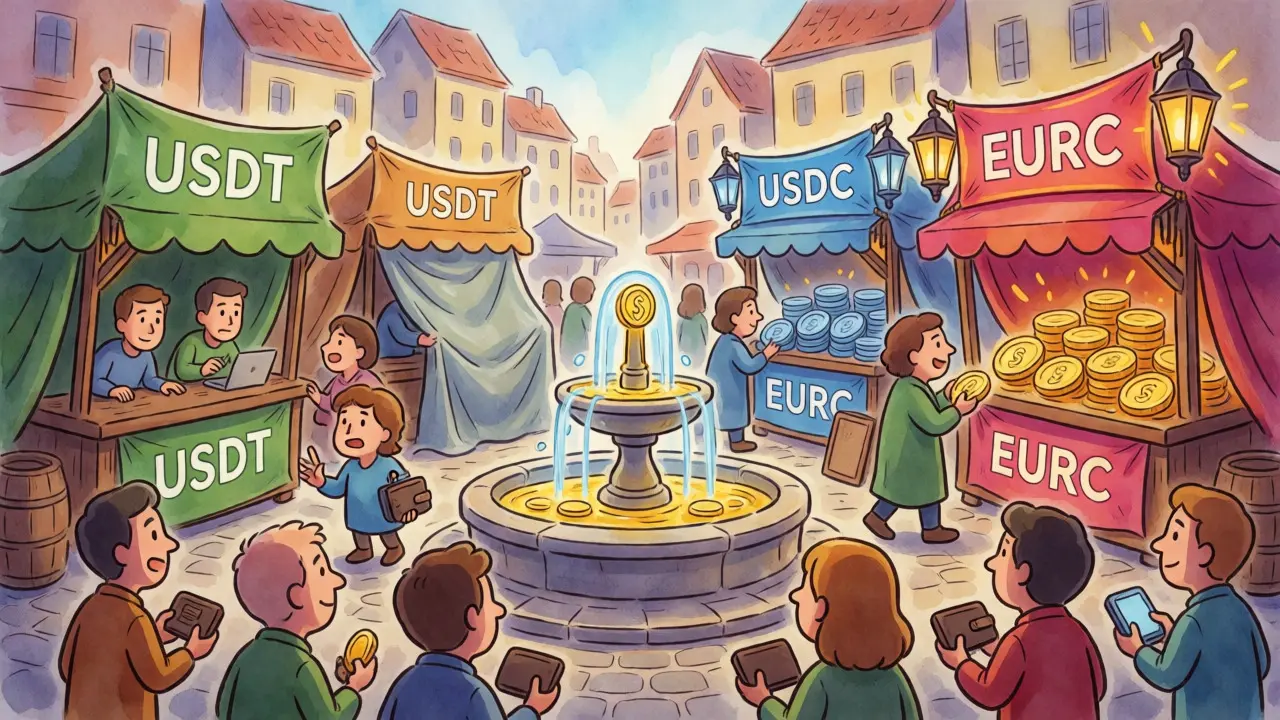
The Rise of Compliant Alternatives
Nature abhors a vacuum, and the crypto market is no exception. As USDT retreated from Europe, other stablecoins rushed to fill the gap. These tokens didn’t just appear; they had been preparing for MiCA compliance long before the ban took effect.
The primary winners have been tokens issued by entities that embraced the regulatory framework early. Circle’s USDC became a dominant force, leveraging its strong ties to U.S. and European financial institutions to secure necessary approvals. Similarly, Euro-denominated stablecoins like EURC saw massive adoption because they offered native currency exposure without the FX risk of holding USD-based tokens.
Other contenders include tokens from established financial firms. For instance, Paxos’ USDP and various bank-backed euro stablecoins gained traction. These issuers understood that in the EU, trust is built on regulation, not just blockchain code. They provided the transparent audits and segregated reserves that regulators demanded.
| Token | Issuer | Base Currency | Key Advantage |
|---|---|---|---|
| USDC | Circle | USD | High liquidity, strong institutional backing, widely accepted. |
| EURC | Circle | EUR | No currency conversion fees for EU users, fully MiCA compliant. |
| EURe | Monerium | EUR | Bank-backed, integrates with traditional IBAN payments. |
| VNX | VNX Group | Multi-currency | Swiss-regulated, offers tokenized assets beyond simple cash. |
Impact on Traders and Businesses
For the average trader, the shift means higher friction if you’re used to USDT. Liquidity pools moved. DeFi protocols had to update their smart contracts to accept new stablecoins. If you were running arbitrage bots between USDT and BTC, you had to reconfigure them for USDC/BTC pairs.
For businesses using crypto for cross-border payments, the impact was even sharper. Companies relying on USDT for international transfers faced banking hurdles. Some banks froze accounts associated with heavy USDT activity due to anti-money laundering (AML) concerns. Switching to MiCA-compliant tokens reduced this regulatory risk, making it easier to move money in and out of the crypto ecosystem via traditional banking rails.
There is also a cost factor. USDT was historically favored for its low transaction fees and deep liquidity. Compliant alternatives sometimes charge slightly higher fees or have lower initial liquidity, leading to wider spreads when trading large amounts. However, this premium buys peace of mind. You know your asset won’t be suddenly delisted because the issuer decided to skip an audit.

Is USDT Gone Forever in Europe?
Not necessarily. The ban applies to trading on regulated exchanges and services within the EU. You can still hold USDT in a self-custody wallet like MetaMask or Ledger. The restriction is on the service providers-exchanges, brokers, and payment processors-who must offer compliant products.
Furthermore, Tether hasn’t given up. They are actively working on establishing a foothold in the EU. Rumors persist about Tether setting up a subsidiary in Switzerland or seeking authorization in Malta or Luxembourg. If they eventually meet the MiCA standards, they could return. But for now, the message from Brussels is clear: play by our rules, or stay out.
It’s also worth noting that peer-to-peer (P2P) trades haven’t disappeared entirely, though they are harder to find and carry higher risks. Without an exchange intermediary, you lose consumer protections. If the counterparty scams you, MiCA doesn’t help you recover your funds.
Frequently Asked Questions
Can I still buy USDT in the European Union?
Generally, no. Major regulated exchanges have delisted USDT for EU residents. You cannot buy it directly on platforms like Coinbase or Binance under standard retail accounts. However, you might still find it on some P2P platforms or non-EU based exchanges that don't strictly enforce MiCA for individual accounts, though this carries regulatory and withdrawal risks.
What happens to my existing USDT holdings?
If your USDT is on an exchange, you were likely forced to convert it to a compliant stablecoin like USDC or EURC, or withdraw it to a personal wallet. If it is in a self-custody wallet, nothing happened automatically. You still own the token, but you may face difficulties selling it on regulated EU exchanges.
Which stablecoin is the best replacement for USDT in Europe?
USDC is the most common replacement due to its high liquidity and similar USD peg. For EU citizens wanting to avoid currency exchange fees, EURC (Euro Coin) is often the better choice as it matches the local fiat currency and is fully MiCA compliant.
Did Tether appeal the ban?
Tether did not file a formal legal appeal against the delisting itself, as the exchanges were complying with national regulators enforcing MiCA. Instead, Tether has focused on improving its transparency reports and exploring regulatory pathways to gain authorization in specific EU jurisdictions in the future.
Does MiCA apply to Bitcoin and Ethereum?
Yes, MiCA regulates crypto-assets broadly, but the strictest requirements regarding reserves and issuance apply specifically to stablecoins (Electronic Money Tokens and Asset-Referenced Tokens). Bitcoin and Ethereum are subject to rules for service providers (like exchanges needing licenses), but they do not have an "issuer" who needs to prove 1:1 cash reserves in the same way.
Next Steps for EU Crypto Users
If you are still navigating this landscape, here is a quick checklist to ensure you remain compliant and efficient:
- Audit your wallets: Check if you are holding significant amounts of USDT. Decide if you want to keep it for potential future appreciation or convert it for ease of use.
- Update your exchange preferences: Ensure your default trading pairs are set to USDC/EUR or EURC/EUR to avoid accidental slippage or liquidity issues.
- Review tax implications: Converting USDT to USDC is a taxable event in many EU countries. Keep records of the conversion dates and values.
- Monitor Tether news: Keep an eye on whether Tether secures a license in a major EU hub. If they do, USDT might become tradable again, potentially affecting price dynamics.
The ban on USDT isn't just a technicality; it's a signal that the "wild west" era of crypto in Europe is over. Regulators are demanding accountability. For users, this means safer assets but less convenience. Adapting to compliant stablecoins like USDC and EURC is the smartest move right now. It keeps your funds accessible, legally sound, and ready for whatever comes next in the evolving digital finance world.
Jarnail Singh
August 31, 2026 AT 00:17Look at this absolute mess of bureaucratic overreach that the EU has created here and I am genuinely furious about it because they think they can just dictate global finance with their little rulebooks when in reality America is still the engine driving every single innovation in this space 🇺🇸. Tether built something real while Europe was busy debating whether a banana should be curved or straight and now they are punishing users for the sins of regulators who don't understand technology at all. It is pathetic really how they try to protect consumers by taking away their choices and forcing them into inferior products like USDC which is basically just a corporate IOU from a company that loves freezing accounts more than anything else in the world. We need to stand firm against this nonsense because if we let Brussels push us around today they will come for our wallets tomorrow and then where will we be? 😤