


zkSync Era DEX Slippage Calculator
Estimate Trade Slippage
Calculate potential slippage when trading on different zkSync Era DEXs based on current liquidity volume.
Wagmi (zkSync Era) isn’t a crypto exchange like Binance or Coinbase. It’s not even close. If you’re looking for a place to buy Bitcoin with a credit card or trade Ethereum with low fees and fast order execution, you won’t find that here. Wagmi is a DeFi protocol built on zkSync Era - a Layer 2 blockchain that makes Ethereum transactions cheaper and faster. But here’s the real question: with only $119.49 in 24-hour trading volume, is Wagmi even usable yet?
What Wagmi Actually Does
Wagmi claims to be a one-stop shop for DeFi users. That means you can swap tokens, add liquidity, earn yield, and even access automated trading strategies - all without handing your keys to a central company. It’s designed to feel like a centralized exchange, but runs on smart contracts. No KYC. No withdrawal delays. No corporate middlemen.But that’s the theory. The reality? The numbers don’t lie. $119.49 in daily volume means maybe a dozen trades happened in a day. Compare that to Uniswap, which moves over $1 billion daily. Or even smaller DEXs on zkSync Era like SyncSwap or Mute.io, which regularly hit $5-10 million. Wagmi’s volume is so low, it’s barely registering on the radar.
Why zkSync Era Matters
Wagmi doesn’t exist in a vacuum. It’s riding on zkSync Era, one of the most technically advanced blockchains in DeFi. zkSync uses zero-knowledge rollups (ZK-Rollups), which bundle hundreds of transactions into a single cryptographic proof. This cuts fees to pennies and confirms trades in seconds - something Ethereum Layer 1 can’t do reliably.The zkSync Era ecosystem isn’t small. It has over $795 million bridged from Ethereum and $430 million locked in DeFi protocols. Big names like Sygnum Bank, Deutsche Bank, and UBS have funds on it. That’s institutional trust. But Wagmi? It hasn’t captured even a fraction of that activity. So why? Because the protocol hasn’t offered anything compelling enough to draw users away from established options.
What’s Missing? A Lot.
You can’t review a crypto project without knowing the basics. And Wagmi leaves too many gaps:- Fees: Are swaps free? Is there a small percentage fee? No public data.
- Trading Pairs: What tokens can you trade? ETH, USDC, maybe a few memecoins? We don’t know.
- Security: Has the code been audited? By whom? No audit reports are public.
- Team: Who built this? Are they anonymous? Do they have track records? Zero info.
- Liquidity: How much money is actually in the pools? TVL? Not listed anywhere.
- Token: Does Wagmi have a native token? Is it used for governance or rewards? Unclear.
Without answers to these, you’re investing in mystery. Not a product.
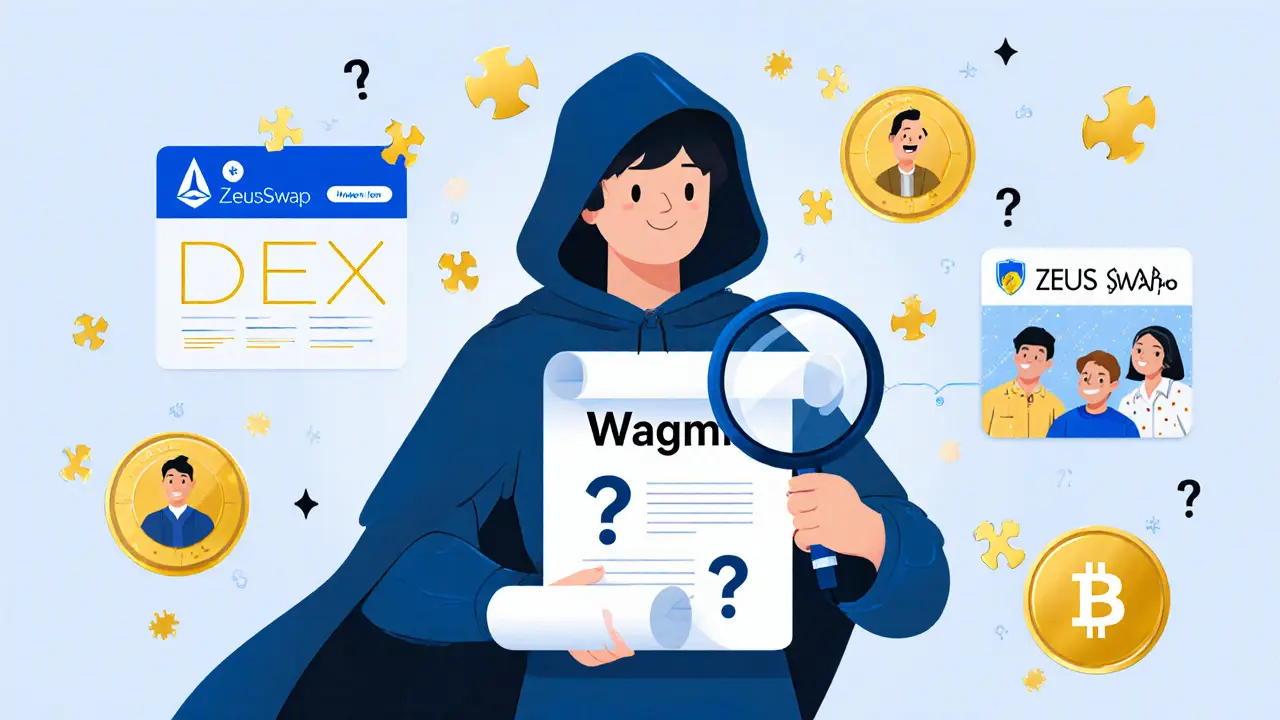
How It Compares to Other DEXs on zkSync Era
If you’re on zkSync Era and want to swap tokens, you have real options:| Protocol | 24h Volume | TVL | Audited? | Native Token? |
|---|---|---|---|---|
| Wagmi | $119.49 | Unknown | No public report | Unclear |
| SyncSwap | $8.2M | $124M | Yes (CertiK) | Yes (SSWAP) |
| Mute.io | $5.7M | $98M | Yes (PeckShield) | Yes (MUTE) |
| ZeusSwap | $3.1M | $67M | Yes (Hacken) | Yes (ZEUS) |
Wagmi doesn’t just trail behind - it’s in a different league. SyncSwap, Mute.io, and ZeusSwap have real teams, public audits, active communities, and proven track records. Wagmi has a website and a single data point: $119.49. That’s not a product. It’s a prototype.
Is Wagmi Worth Using?
If you’re a developer testing new DeFi tools, maybe. If you’re curious about how early-stage protocols behave, sure. But if you’re looking to trade, earn yield, or store value - skip it.There’s no incentive to use Wagmi. No rewards program. No liquidity mining. No token airdrop. No community. No support. No transparency. And with volume this low, slippage could be brutal. A $100 swap might cost you $5 in price impact alone.
The zkSync Era network is growing. It’s secure. It’s fast. It’s backed by real institutions. But Wagmi isn’t part of that growth. It’s floating alone in a sea of better alternatives.

What Could Change Everything
The team says Wagmi plans to expand to other chains via an “omni layer.” That sounds ambitious. But without traction on zkSync Era, why would anyone trust it on Solana or Arbitrum?Here’s what Wagmi needs to survive:
- Public audit reports - now.
- A clear fee structure - no guesswork.
- A native token with real utility - not just a meme.
- A liquidity incentive program - pay users to lock up funds.
- A public team - names, LinkedIns, past projects.
Until then, it’s a ghost town.
Bottom Line
Wagmi (zkSync Era) isn’t a crypto exchange. It’s a barely active DeFi prototype with no transparency, no users, and no clear path forward. The underlying zkSync Era network is promising. But Wagmi isn’t benefiting from it. It’s being left behind.If you’re new to DeFi, stick with SyncSwap or Mute.io. They’re proven, audited, and liquid. If you’re an early adopter looking to test the next big thing - fine. But don’t put money into Wagmi expecting returns. Put in a small amount to see how it works. Then walk away.
DeFi isn’t about hype. It’s about trust. And right now, Wagmi has none.
Is Wagmi (zkSync Era) a real crypto exchange?
No, Wagmi is not a centralized crypto exchange. It’s a decentralized finance (DeFi) protocol built on zkSync Era. You can swap tokens and provide liquidity, but there’s no order book, no customer support, and no way to buy crypto with fiat. It’s a DEX, not a platform like Binance or Kraken.
Why is Wagmi’s trading volume so low?
The $119.49 daily volume suggests minimal user adoption. It could be because the protocol is too new, lacks liquidity incentives, has no marketing, or doesn’t offer features better than existing DEXs like SyncSwap or Mute.io. Without a token, audits, or team transparency, users have no reason to trust or use it.
Can I earn rewards on Wagmi?
There’s no public information about yield farming, liquidity mining, or token rewards on Wagmi. Unlike other DEXs on zkSync Era that pay users in tokens for providing liquidity, Wagmi offers no incentive program. That’s a major red flag for anyone looking to earn.
Is Wagmi safe to use?
We don’t know. No security audit reports have been published. Without knowing who coded the smart contracts or whether they’ve been tested for exploits, using Wagmi carries high risk. Even if the zkSync Era network is secure, the protocol layer could have critical bugs.
Should I invest in Wagmi’s token?
There is no confirmed Wagmi token. Even if one exists, it’s not listed on any major DEX or CEX. Investing in an unnamed, un-audited token with zero trading volume is speculative gambling - not investing. Avoid it unless you’re prepared to lose everything.
What’s better than Wagmi on zkSync Era?
SyncSwap, Mute.io, and ZeusSwap are all proven DEXs on zkSync Era with millions in daily volume, public audits, native tokens, and active communities. They offer better liquidity, lower slippage, and real incentives for users. Wagmi doesn’t compete - it’s invisible in comparison.
Will Wagmi expand to other blockchains?
The team mentions plans for an “omni layer” to deploy on other chains, but there’s no timeline, roadmap, or technical details. Without fixing its problems on zkSync Era first, expansion is just a fantasy. Focus on what’s live, not what’s promised.
Caren Potgieter
November 23, 2025 AT 08:59Jennifer MacLeod
November 23, 2025 AT 22:22Jane A
November 25, 2025 AT 12:55stuart white
November 26, 2025 AT 05:16Omkar Rane
November 27, 2025 AT 14:08Tyler Boyle
November 27, 2025 AT 19:27Kathy Alexander
November 28, 2025 AT 14:48Linda English
November 29, 2025 AT 08:52Jennifer Morton-Riggs
November 30, 2025 AT 12:46Amanda Cheyne
November 30, 2025 AT 23:49Lisa Hubbard
December 1, 2025 AT 00:09Soham Kulkarni
December 2, 2025 AT 10:09Tejas Kansara
December 2, 2025 AT 21:33Emily Michaelson
December 3, 2025 AT 16:28preet kaur
December 3, 2025 AT 20:06David Hardy
December 5, 2025 AT 09:24Sky Sky Report blog
December 7, 2025 AT 00:41John Borwick
December 7, 2025 AT 23:23Matthew Prickett
December 8, 2025 AT 07:24Daryl Chew
December 8, 2025 AT 18:34Gus Mitchener
December 10, 2025 AT 18:00asher malik
December 10, 2025 AT 18:20Julissa Patino
December 11, 2025 AT 22:16Anne Jackson
December 12, 2025 AT 20:50jocelyn cortez
December 14, 2025 AT 12:42Rajesh pattnaik
December 16, 2025 AT 07:09