


APU Risk Calculator
Risk Level:
Potential Outcomes:
Apu (APU) is a meme cryptocurrency built on the Ethereum blockchain, launched in March 2024. It’s not a serious financial tool, nor is it backed by a company or real-world asset. Instead, it’s a community-driven project rooted in Finnish internet meme culture, named after the Apu Apustaja character - a cartoon frog often mistaken for Pepe the Frog but known locally as Peepo or Helper. Unlike Bitcoin or Ethereum, APU doesn’t solve a technical problem. It exists because people find it funny, share it online, and trade it hoping for quick gains. But beneath the humor, there’s real data - supply numbers, trading volumes, and community activity - that tell a more complicated story.
How Apu (APU) works: ERC-20 on Ethereum
Apu runs as an ERC-20 token on the Ethereum network. That means it uses Ethereum’s smart contracts to handle transfers, track ownership, and enforce rules. Its contract address is 0x594D...8b5bFa - a unique identifier you can verify on blockchain explorers like Etherscan. This is important because some websites falsely claim APU is on Solana, but all major platforms - CoinMarketCap, CoinGecko, Bitget - confirm it’s only on Ethereum.
Being on Ethereum gives APU security and compatibility with wallets like MetaMask and exchanges like PancakeSwap and Gate.io. But it also means users pay Ethereum gas fees to trade it, which can spike during high traffic. There’s no separate blockchain, no unique consensus mechanism, and no innovation in the code. Its entire value comes from perception and community.
Tokenomics: Supply, taxes, and transparency
Apu has a fixed maximum supply of 420.69 billion tokens. Around 82.8 billion were burned early on, bringing the circulating supply down to roughly 337.89 billion as of November 2024. That’s a lot of coins - but far less than Shiba Inu’s quadrillions or Dogecoin’s unlimited supply. The burn helped reduce inflation and gave the project a slight edge in perception.
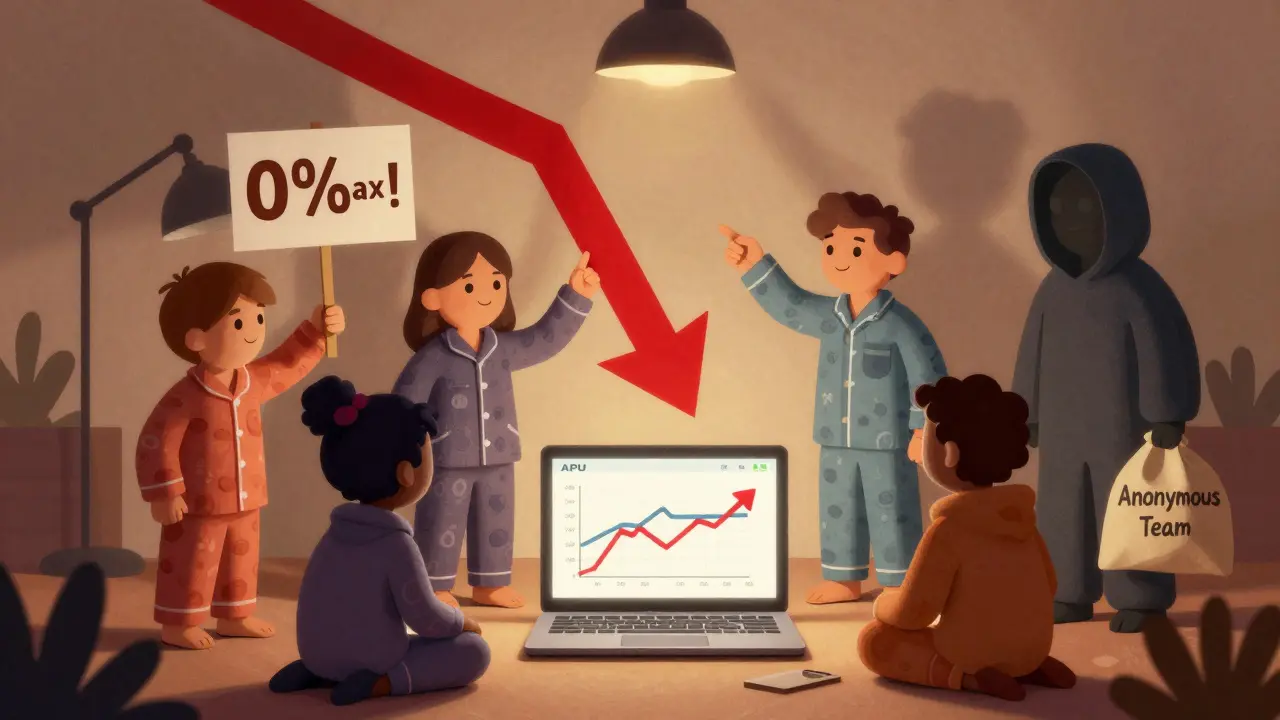
One of APU’s few standout features is its 0% buy and sell tax. Most meme coins charge 5-10% in fees when you trade, which goes to the team or liquidity pools. APU doesn’t take any cut. That’s rare. It makes trading cheaper and appeals to people tired of hidden fees. But there’s a catch: no tax doesn’t mean no risk. The price can still crash 80% overnight, and without team-controlled funds, there’s no safety net.
The team behind APU is anonymous. No names, no LinkedIn profiles, no public interviews. That’s common in meme coins, but APU claims to be “fairly launched” with no presale and no team allocation. That means no insiders got a head start. Swissborg and Mobee Academy both note this as a positive. Still, anonymity raises questions. If the team vanished tomorrow, who would fix bugs or launch new features? No one.
Price history and extreme volatility
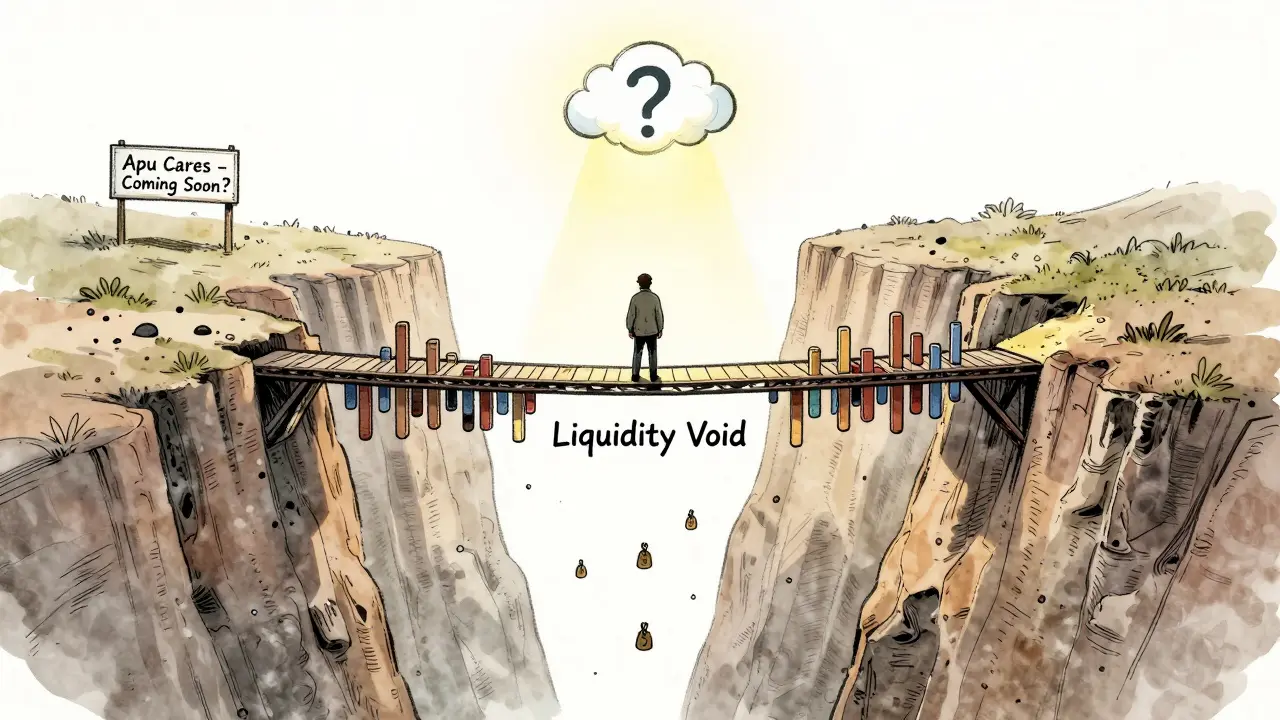
Apu’s price history is a rollercoaster. It hit its all-time high of $0.001467 on November 18, 2023 - exactly one year before this article was written. Since then, it’s lost over 96% of that value. As of late November 2024, prices varied wildly across platforms: CoinMarketCap showed $0.000049, CoinStats showed $0.000295, and Coinbase showed $0.00000015. Why the difference? Low liquidity. APU trades on small exchanges with thin order books. One big buy order can spike the price, and one big sell can crash it.
The 24-hour trading volume hovers around $1-3 million, which is tiny compared to Dogecoin’s $400 million or Shiba Inu’s $300 million. That means even small trades can move the market. Users report slippage of up to 15% during spikes - meaning if you try to sell $100 worth, you might only get $85 because there aren’t enough buyers at your price.
Market position and competition
Apu ranks around #260-#500 on crypto market lists. It’s nowhere near the top meme coins. Dogecoin sits at #10 with a $24 billion market cap. Shiba Inu is #40 with $11 billion. Even newer meme coins like PEPE are bigger, at #65 with a $5 billion cap. Apu’s market cap is around $16-100 million depending on the source - a drop in the ocean.
What sets Apu apart? Nothing concrete. It doesn’t have an NFT collection, a metaverse, or a DeFi protocol like Floki Inu. It doesn’t pay staking rewards like some competitors. Its only real claim is the 0% tax and a tight-knit Telegram group with about 12,500 members. That’s small compared to Dogecoin’s 1.8 million Discord members. Apu’s community is passionate but niche. It’s not growing fast.
Community sentiment: Hype vs. skepticism
Reddit threads on r/CryptoMoonShots show mixed feelings. About 62% of comments in November 2024 were bullish, praising the active community and zero tax. But 38% were outright skeptical. One user wrote: “Another meme coin with no purpose beyond rug pull potential.” That’s the core tension.
On CoinMarketCap, users gave APU a 3.7/5 rating. The top praise? “No transaction fees.” The top complaints? “Price manipulation” and “not enough transparency.” Even though the team says it’s fair, many traders feel the price is controlled by a few large wallets. On-chain data shows 10 wallets hold over 20% of the total supply. That’s a red flag for decentralization.
There’s no official customer support. If you have a problem with your trade, you’re on your own. Support comes from volunteers in Telegram or Twitter/X. Response times average 11 hours. That’s not a platform you’d trust with your life savings.
Can you make money with Apu?
Some people have. A few early buyers who got in at $0.000001 in March 2024 turned $100 into $1,000 during the November 2023 spike. But those are outliers. Most traders lose money. The average meme coin with a $10-20 million market cap fails within 18 months, according to CryptoCompare. Apu is already 20 months old - past the typical survival window.
Analysts are divided. DigitalCoinPrice predicts APU could hit $0.00154 by 2025 - a 110% gain from late 2024 levels. AMBCrypto thinks it might reach $0.0019 by 2030. But these are guesses based on past trends, not fundamentals. Mobee Academy warns: “Investing in crypto is always risky.” And for meme coins? It’s closer to gambling.
There’s no utility. No real-world use. No revenue. No product. Apu’s value is entirely based on what other people think it’s worth. If the hype dies, so does the price.
How to buy Apu (APU)
If you still want to try, here’s how:
- Get a wallet like MetaMask or Trust Wallet.
- Buy Ethereum (ETH) on Coinbase, Kraken, or another exchange.
- Send ETH to your wallet.
- Go to a decentralized exchange like PancakeSwap or Gate.io.
- Swap ETH for APU using the contract address: 0x594D...8b5bFa.
Gate.io is the easiest for beginners - it supports APU/USDT trading with a $1 minimum and basic KYC. But be warned: slippage is high, and liquidity is low. Set your slippage tolerance to 5-8% to avoid failed trades.
Regulatory risks and the future
The SEC has cracked down on 12 meme coins in 2024. One case, Ripple’s $4.4 billion settlement, set a precedent: if a token is sold as an investment with promise of profit, it’s a security. Apu fits that description. No utility, no team, no roadmap - just hype. That makes it a target.
The project announced “Apu Cares,” a charity initiative planned for Q1 2025. But as of now, there are no verified partnerships. No donations made. No public ledger. It’s a promise. In crypto, promises are cheap. Execution is rare.
The 2024 “Apu Rewards” staking program offers 3.2% APY - far below the 8.7% average for DeFi staking. It’s a token gesture, not a real incentive. Without real utility, it won’t attract serious users.
Bottom line: Apu is a gamble. It’s not an investment. It’s a bet on whether the next person will pay more than you did. The community is real. The price swings are real. The risk is very real. If you trade it, do it with money you can afford to lose. And never, ever believe the hype.
Is Apu (APU) a good investment?
No, Apu is not a good investment in the traditional sense. It has no underlying value, no revenue, no product, and no team accountability. It’s a meme coin driven purely by speculation and community hype. While some traders have made short-term gains, 78% of similar meme coins fail within 18 months. Only risk-tolerant individuals should consider trading it - and even then, only with money they can afford to lose.
Can Apu (APU) reach $1?
It’s extremely unlikely. For APU to reach $1, its market cap would need to hit $420 billion. That’s more than the entire cryptocurrency market was worth in 2021. Even Dogecoin, with 10 years of brand recognition and massive adoption, hasn’t reached that. APU’s current market cap is under $100 million. A $1 price would require a 4,200,000% increase - a level of growth no cryptocurrency has ever sustained.
Is Apu (APU) on Solana or Ethereum?
Apu is only on Ethereum as an ERC-20 token. Some websites falsely claim a Solana version, but CoinGecko, CoinMarketCap, and Bitget all confirm it’s Ethereum-based. The contract address 0x594D...8b5bFa is only valid on Ethereum. Any Solana listing is either a scam or a copycat token.
Why does Apu’s price vary so much between exchanges?
Apu has low trading volume and thin order books. On smaller exchanges like Gate.io or PancakeSwap, a few large trades can swing the price dramatically. Some exchanges show outdated or inaccurate data. CoinMarketCap, CoinGecko, and Coinbase often report different prices because they pull from different trading pairs and liquidity pools. Always check multiple sources and prioritize the most liquid markets.
Is Apu (APU) safe to trade?
Trading Apu is risky. The 0% tax is a plus, but the lack of team transparency, low liquidity, and high volatility make it dangerous. There’s no customer support, no official website, and no roadmap with deliverables. You’re trusting anonymous developers and a small community. Always use a hardware wallet for long-term holding, avoid putting in more than you can lose, and never invest based on social media hype.