


You spend thousands on your car. You drive it every day. Yet, you own none of the data it generates. Every mile, every battery charge, every brake check goes straight to the manufacturer or insurance companies. They profit from that information while you get nothing in return. What is DIMO (DIMO) crypto coin designed to fix this exact imbalance.
DIMO stands for Digital Infrastructure for Moving Objects. It is not just another speculative token; it is a protocol built to give vehicle owners control over their data. By connecting your car to the DIMO network, you can earn cryptocurrency for sharing telemetry data with third parties like insurers, repair shops, or researchers. This article breaks down how the technology works, why the $DIMO token matters, and whether this model actually holds value in 2026.
The Core Problem: Who Owns Your Car Data?
Modern vehicles are essentially computers on wheels. An average electric vehicle generates terabytes of data daily. Currently, this data flows into walled gardens controlled by automakers like Tesla or Ford. These companies use the data to improve their products, sell insights to advertisers, or offer subscription services. You pay for the car, but you cannot access, export, or sell your driving history easily.
This lack of ownership creates a significant economic gap. Insurance companies would pay millions for accurate, real-time driving behavior data to reduce fraud and set better premiums. Fleet managers need verified maintenance records. Right now, they have to buy this data at high markups from manufacturers. DIMO proposes a decentralized alternative where the driver becomes the data provider and gets paid directly.
How DIMO Works: From Hardware to Blockchain
The DIMO ecosystem relies on a bridge between physical hardware and digital ledgers. It does not rely solely on software claims. Instead, it uses cryptographic verification to ensure data authenticity.
Here is the step-by-step process:
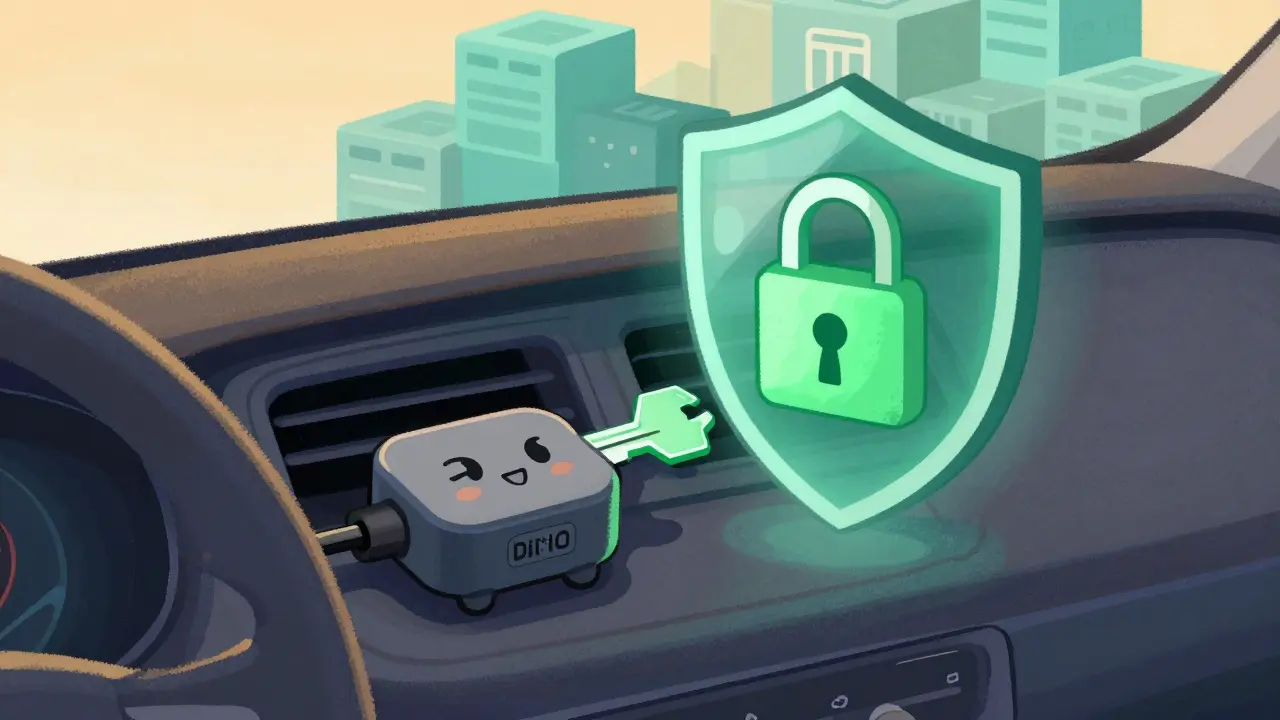
- Data Collection: You connect your vehicle using an approved hardware device, such as the DIMO Data Miner, or through official APIs if your car supports them (like Tesla’s API). This device reads telemetry data directly from the car’s onboard diagnostics.
- Cryptographic Signing: The hardware signs the data packet with a unique cryptographic key. This proves the data came from your specific vehicle and was not altered by a middleman.
- Blockchain Identity: The signed data is uploaded to the DIMO network. Each vehicle gets a unique Digital Object Identifier (DOI), acting as its blockchain-based identity. This DOI links all trips, maintenance records, and user credentials to one secure profile.
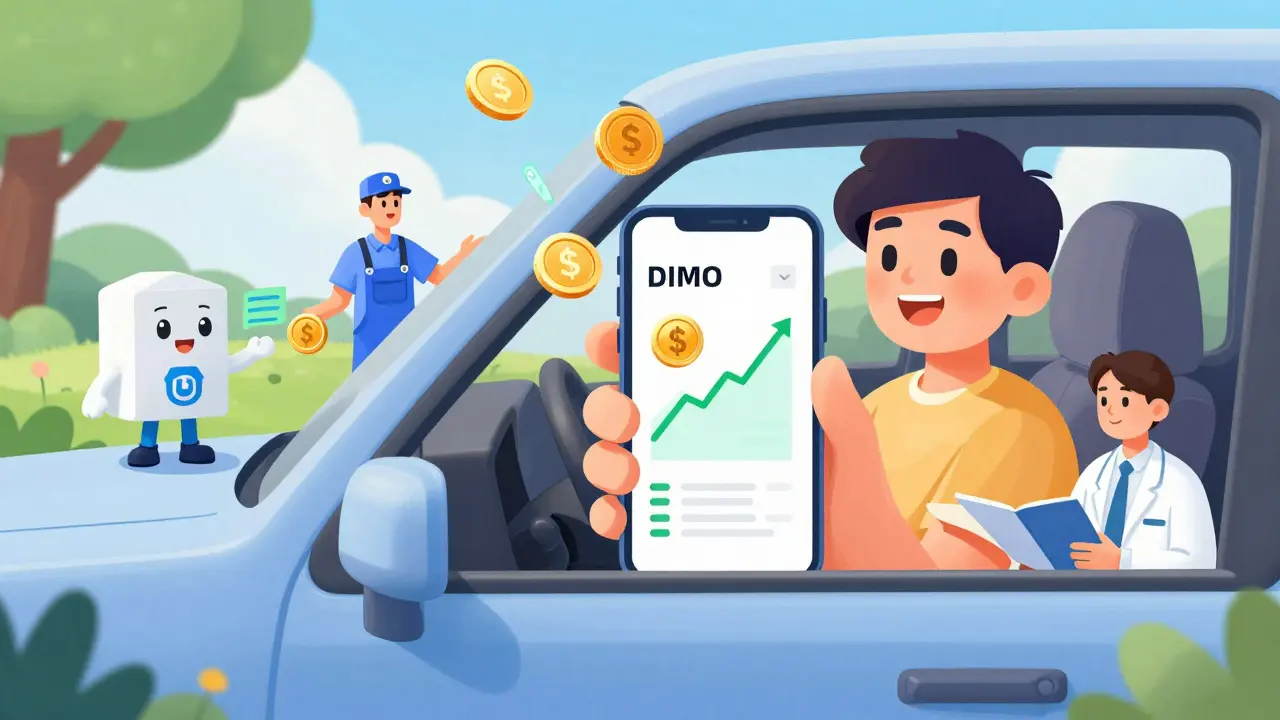
- Monetization: Third-party applications request access to this data. If you agree to share your driving habits with an insurance app, smart contracts automatically release the data and send you compensation in $DIMO tokens.
This architecture ensures privacy. You decide exactly which datasets to share and for how long. Unlike traditional telematics boxes installed by insurers, DIMO keeps the data custody with you.
The Role of the $DIMO Token
The $DIMO token is the fuel of this ecosystem. It serves two primary functions: payment and governance.
1. Payment for Data
When you share data, you are compensated in $DIMO. Companies looking to access high-quality vehicle data must hold $DIMO to pay for it. This creates a direct demand loop. More users connecting cars means more data supply, which attracts more buyers, increasing token velocity.
2. Governance Rights
As a holder of $DIMO, you participate in the DAO (Decentralized Autonomous Organization). You vote on protocol upgrades, fee structures, and new partnerships. This ensures no single corporation dictates the rules of the network.
3. Deflationary Mechanics
The protocol includes a burn mechanism. A small percentage of tokens used in transactions is permanently removed from circulation. Over time, this reduces the total supply, potentially increasing scarcity. The maximum supply is capped at 1 billion tokens. As of mid-2024, roughly 218 million tokens were in circulation, with ongoing vesting schedules for team and investor allocations.
Technical Architecture: Ethereum and Solana
DIMO’s technical foundation has evolved to balance security with speed. Initially, the project focused heavily on the Ethereum Virtual Machine (EVM) for creating non-fungible tokens (NFTs) that represent vehicle identities. EVM compatibility allows developers familiar with Solidity to build apps on the platform easily.
However, processing millions of daily trips requires high throughput and low fees. To address this, DIMO has integrated with Solana. Solana’s high-speed transaction capabilities make it ideal for handling the massive volume of micro-transactions involved in data sharing. This multi-chain approach ensures that storing a trip log costs fractions of a cent, making the economics viable for everyday drivers.
| Feature | Traditional Telematics | DIMO Protocol |
|---|---|---|
| Data Ownership | Company-owned | User-owned |
| Compensation | None (or minor discounts) | Cryptocurrency ($DIMO) |
| Privacy Control | Limited (contractual) | Full (user-defined permissions) |
| Interoperability | Siloed systems | Open standard across brands |
| Verification | Centralized servers | Blockchain-cryptographic proof |
Real-World Use Cases in 2026
Theoretical models are interesting, but practical application drives adoption. Here is how DIMO is being used right now:
- Usage-Based Insurance (UBI): Insurers can offer lower premiums to safe drivers. Instead of trusting self-reported mileage, they verify data directly from the blockchain. Drivers who prove they drive less than 500 miles a week can automatically qualify for discounts via smart contracts.
- EV Battery Health Monitoring: Electric vehicle owners often worry about battery degradation. DIMO allows battery manufacturers to monitor cell health anonymously. Owners can opt-in to share this data, earning tokens while helping manufacturers improve battery longevity algorithms.
- Used Car Verification: Buying a used car is risky. With DIMO, a seller can provide a cryptographically signed history of maintenance, accidents, and true mileage. This creates a trusted reputation system for individual vehicles, similar to credit scores but for cars.
- Fleet Management: Logistics companies can manage mixed-brand fleets without proprietary software. They access standardized data streams for route optimization and driver safety monitoring, paying only for the data they consume.
Risks and Challenges
No technology is without flaws. DIMO faces several hurdles that could impact its success.
Hardware Dependency: Not all cars support open APIs. For older vehicles or those with closed ecosystems, users must buy additional hardware like OBD-II dongles. This friction point limits mass adoption. If setting up the device is too complex, users will abandon it.
Regulatory Uncertainty: Data privacy laws like GDPR in Europe and CCPA in California are strict. While DIMO emphasizes privacy, regulatory bodies may scrutinize how data is stored on public blockchains. Ensuring compliance while maintaining decentralization is a complex legal challenge.
Token Volatility: Earning rewards in cryptocurrency introduces price risk. If the value of $DIMO drops significantly, users might feel their effort was wasted. Stablecoin integration or instant cash-out options may be necessary to retain mainstream users who do not want crypto exposure.
Market Position and Adoption
DIMO has gained traction among automotive tech enthusiasts and Web3 investors. Its listing on major exchanges like Coinbase and Bitget has improved liquidity, allowing easier entry and exit for traders. The partnership with major hardware providers and potential integrations with OEMs (Original Equipment Manufacturers) remain critical next steps.
The project ranks within the top 1,000 cryptocurrencies by market cap, indicating niche but growing interest. Its dominance in the broader crypto market is low, suggesting room for expansion if the automotive sector embraces open data standards. The key metric to watch is the number of active connected vehicles, not just the token price.
Is DIMO Worth Your Attention?
If you believe in the future of decentralized data ownership, DIMO offers a compelling narrative. It shifts power from corporations to individuals. For early adopters, connecting a car could yield passive income in $DIMO tokens while supporting a more transparent automotive industry.
However, treat it as an experimental investment. The utility depends on widespread adoption by both drivers and data consumers. Until major insurers or repair chains integrate DIMO natively, the immediate financial returns may be modest. Look at it as a bet on the infrastructure layer of the Internet of Things (IoT), rather than a quick flip.
Can I use DIMO with any car?
Not directly yet. Newer electric vehicles like Teslas can connect via API. Older cars require a compatible OBD-II hardware device like the DIMO Data Miner. Check the DIMO website for a list of supported hardware and vehicle models before purchasing.
How much can I earn with DIMO?
Earnings vary based on data demand and token price. Currently, earnings are modest, often amounting to a few dollars per month. The goal is to increase payouts as more data consumers join the network. Do not expect significant income replacement in the short term.
Is my private data safe on the blockchain?
Yes, DIMO uses zero-knowledge proofs and encryption. Only hashed data or anonymized metrics are stored on-chain. You control access keys, meaning no one can view your raw location or personal details without your explicit permission.
What happens if the DIMO company shuts down?
DIMO is an open-source protocol. Even if the founding team dissolves, the code and network continue to run. Community members can maintain the infrastructure, similar to how Bitcoin operates without a central company. However, development momentum might slow without core funding.
Do I need to hold $DIMO tokens to use the network?
No. You can connect your car and earn $DIMO without holding any initially. However, holding tokens grants voting rights in the DAO and may provide higher rewards tiers in the future. Gas fees for transactions are minimal due to Layer 2 solutions and Solana integration.