


ELCASH Investment Risk Calculator
Liquidity Risk
Daily volume: ~$7,700
Development Risk
Last update: Early 2022
Volatility Risk
30-day swing: 13%
Investment Analysis
Estimated Value: $40.00
Potential Loss: $60.00
Risk Level: High
Based on current market data, ELCASH has shown a sharp decline of 88% over the past year and has minimal trading volume.
The coin has no active development team and only two exchanges list it, making it difficult to trade or exit positions.
If you’ve ever scrolled through a list of obscure coins and wondered whether any of them could actually be used for everyday payments, you’re not alone. Electric Cash crypto promises instant, fee‑free transactions while letting holders vote on protocol upgrades - a mix that sounds great on paper but rings a few warning bells in practice. This guide cuts through the hype, explains the tech, lays out the numbers, and tells you exactly what you’d face if you tried to use or invest in ELCASH today.
Quick Takeaways
- ELCASH runs a Bitcoin‑style SHA‑256 proof‑of‑work chain with a hard‑capped 21million supply.
- It adds on‑chain governance and staking, but both features remain largely untested.
- Market cap hovers around $320K, daily volume under $8K, and price sits near $0.04.
- Liquidity is thin, exchanges few, and development activity has stalled since 2022.
What Is Electric Cash?
Electric Cash (ELCASH) is a cryptocurrency launched in late 2020 by founder Eyal Avramovich. It bills itself as the first proof‑of‑work coin with built‑in governance and staking, aiming to solve high fees and slow confirmation times that plague many older PoW networks.
Core Technology: SHA‑256 and Proof‑of‑Work
The network secures transactions using the SHA‑256 hashing algorithm, the exact same cryptographic function Bitcoin relies on. Because of this, existing ASIC miners can be repurposed for ELCASH mining without buying new hardware.
Consensus follows a classic Proof‑of‑Work (PoW) model: miners solve a computational puzzle, the winner adds a block, and the network rewards them with newly minted coins plus transaction fees (which are designed to be virtually zero for regular users).
Governance and Staking - The “Built‑In” Parts
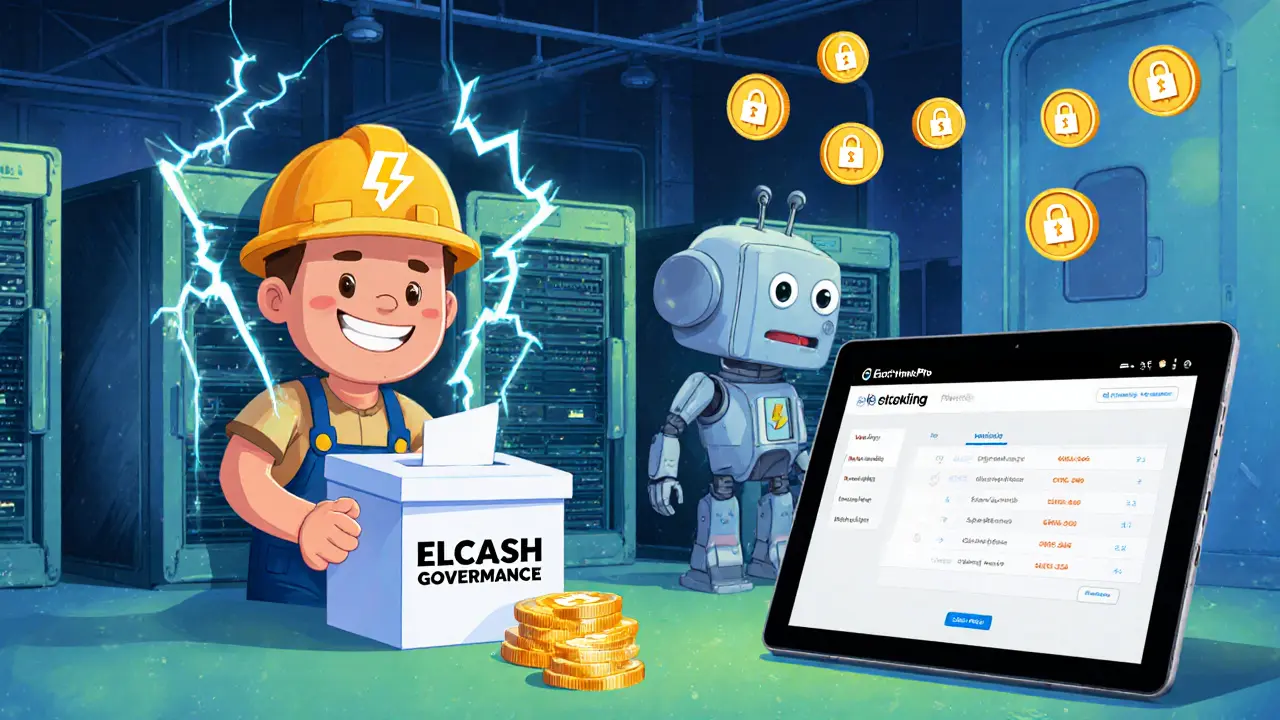
Unlike Bitcoin, ELCASH includes an on‑chain voting system. Token holders can submit improvement proposals and cast votes directly through the blockchain. This Governance layer is meant to keep the project community‑driven.
Staking is tied to governance: users who lock up a portion of their balance become eligible to vote and earn a share of transaction fees. In theory, staking should create a free‑transaction tier for participants, but real‑world data shows very few successful staking events and a high rate of failed attempts reported on community channels.
Tokenomics: Supply, Circulating Amount, and Market Data
ELCASH follows a fixed total supply of 21,000,000 coins, mirroring Bitcoin’s scarcity model. As of the latest snapshot, about 4,134,775 ELCASH are circulating, though some data providers list the circulating supply as “0,” indicating inconsistencies in reporting.
The coin’s price hovers around $0.04, giving a market capitalisation of roughly $319,400. Daily trading volume sits near $7,700, which is a fraction of the multi‑billion‑dollar crypto market. Price volatility remains high - a 30‑day swing of about 13% - but the long‑term trend is sharply downward, with a 38% monthly decline and an 88% drop over the past year.
Wallets, Wrapped Tokens, and Ecosystem Tools
Users interact with the chain primarily through the Electric Wallet Pro, a lightweight desktop and mobile app released in Q22021. The wallet claims to be “accessible and lightweight,” yet community feedback repeatedly mentions crashes on newer iOS versions and persistent sync failures.
In Q42021, the project introduced a wrapped version on the Binance Smart Chain called wELCASH. This BEP‑20 token lets users move ELCASH into DeFi ecosystems on BSC, but the bridge has seen almost no usage and the official documentation is sparse.
Market Performance and Community Sentiment
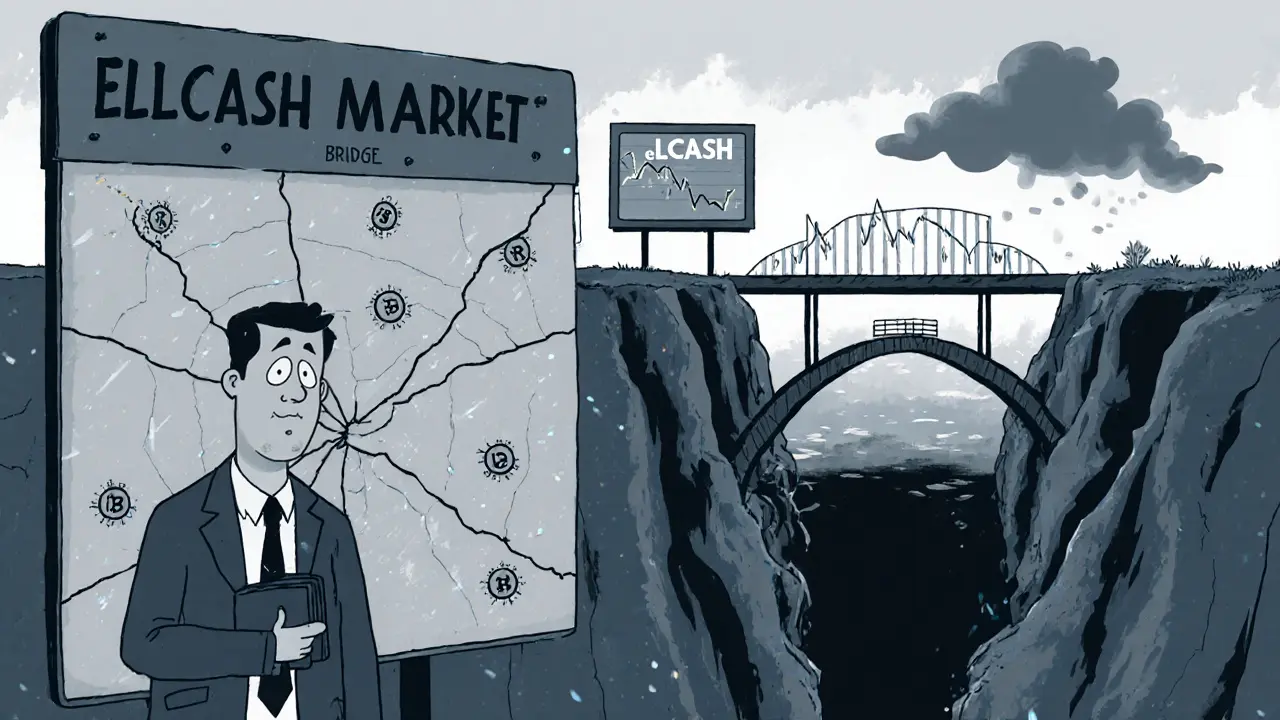
ELCASH’s all‑time high of $65.07 in May2021 has vanished, leaving the coin at less than $0.05 - a 99.9% loss. Analytical platforms flag the token as “bearish” with an RSI below 35, indicating oversold conditions but also a lack of buying pressure.
Community sentiment is largely negative. Trustpilot averages a 1.2/5 rating, Reddit threads recount unanswered support tickets, and the official Discord has dwindled to a few hundred idle members. Liquidity is thin - only two exchanges list the coin - making it hard to sell once you own it.
How to Get Started (If You Still Want To)
- Download the latest Electric Wallet Pro from the official site (desktop for Windows/macOS, or iOS/Android builds).
- Install and run the app. You’ll be prompted to create a new wallet; back up the seed phrase offline.
- Because the network uses SHA‑256, you’ll need a PoW‑compatible node if you plan to mine. Most miners repurpose Bitcoin ASICs, but mining profitability is negligible at current difficulty levels.
- To stake, deposit a minimum of 10ELCASH into the built‑in staking module. Expect a delay of several days for the lock‑up period, and be prepared for possible transaction failures.
- If you need to move funds off‑chain, look for the wELCASH bridge on Binance Smart Chain. Note that bridge fees and transaction confirmations can be slow, and the bridge’s UI is not regularly maintained.
Be aware that the official support email bounces, so troubleshooting often relies on community‑run Discord or Telegram groups, which may have outdated guides.
Comparison with Other Payment‑Focused Coins
| Coin | Consensus | Total Supply | Market Cap (≈2024) | Avg. Block Time | Governance |
|---|---|---|---|---|---|
| ELCASH | Proof‑of‑Work | 21M | $0.32M | ~10min | On‑chain voting, staking |
| Bitcoin Cash | Proof‑of‑Work | 21M | $10.5B | ~10min | Community‑driven (no formal on‑chain) |
| Litecoin | Proof‑of‑Work | 84M | $8.3B | 2.5min | None (protocol changes via BIP) |
The table shows that while ELCASH offers governance and staking on a PoW base, its market depth and adoption lag far behind the more established payment coins. Litecoin’s faster block time and Bitcoin Cash’s larger ecosystem make them far more practical for everyday transactions.

Why Most Experts Warn Against Buying ELCASH
Analysts point to three core red flags:
- Development stagnation: No code commits or roadmap updates since early 2022.
- Liquidity crunch: Only $7‑8K trades per day, meaning large orders slippage.
- Transparency gaps: Conflicting circulating‑supply numbers and an unresponsive support channel.
Even though the token’s price is low, the risk of being unable to sell or having funds stuck in a failing wallet outweighs potential upside. For most users, the safer play is to focus on better‑established payment cryptocurrencies.
Bottom Line
Electric Cash tries to blend Bitcoin‑style security with community governance and free‑transaction staking, but the execution falls short. Thin liquidity, a dormant development team, and a frail user experience make it a high‑risk speculative play rather than a viable everyday payment tool.
Frequently Asked Questions
Is Electric Cash still being developed?
No. The last public code push was in early 2022, and the roadmap has not been updated since then. Community channels report virtually no activity from the core team.
Can I mine ELCASH with my Bitcoin ASIC?
Yes, ELCASH uses the same SHA‑256 algorithm, so any Bitcoin‑compatible ASIC can mine it. However, current difficulty and low price make mining unprofitable for most users.
How do I stake ELCASH?
Staking is done through the Electric Wallet Pro. You need to lock at least 10ELCASH, wait for the confirmation period, and then you’ll start earning a share of transaction fees. In practice, many users report failed staking transactions.
Is there a wrapped version of ELCASH?
Yes, wELCASH is a BEP‑20 token on Binance Smart Chain. It allows ELCASH to be used in BSC‑based DeFi apps, but the bridge has seen almost no activity.
Should I buy ELCASH as an investment?
Most analysts advise against it due to stagnant development, poor liquidity, and opaque tokenomics. The potential upside is outweighed by the risk of being unable to exit the position.
debby martha
October 11, 2025 AT 08:26Sounds like another meme coin to me.
Lena Vega
October 15, 2025 AT 18:00The lack of development activity is a clear red flag.
Mureil Stueber
October 20, 2025 AT 14:40ELCASH’s SHA‑256 proof‑of‑work lets you mine with existing Bitcoin ASICs, but the current difficulty makes it unprofitable. Liquidity is thin, with daily volume under $8K, so large trades will slip. Governance and staking exist on‑chain, yet real‑world usage is negligible. The wallet app has frequent sync issues reported across platforms. In short, the tech is there, but the ecosystem is barren.
Emily Kondrk
October 24, 2025 AT 15:53Honestly, this whole “free‑transaction” hype feels like a smoke‑screen for a deeper scheme. They brag about on‑chain voting while the dev team vanished years ago, leaving a ghost project that can be pumped by insider circles. The wrapped wELCASH on BSC is barely used, suggesting the token is more of a data point than a real utility. If you look at the transaction graphs, most moves happen on obscure exchanges, a classic sign of wash‑trading. It’s as if the coin was built to siphon attention, not to serve any genuine payment purpose.
Leo McCloskey
October 29, 2025 AT 03:13ELCASH, with its purported “governance” and “staking,” simply re‑hashes Bitcoin’s PoW without any meaningful innovation,; the market cap sits at a pitiful $0.3 M; daily volume barely covers network fees; and the lack of code commits since 2022 makes any claim of progress-dubious at best.
arnab nath
November 2, 2025 AT 07:13No code updates since early 2022; that’s a death sentence for any crypto project.
Nathan Van Myall
November 6, 2025 AT 05:40Mining ELCASH with a Bitcoin ASIC is technically possible, but the ROI is negative given the current network difficulty and token price.
Ben Parker
November 10, 2025 AT 12:26🚀 Mining might be fun, but the profit? 📉 Not worth the electricity bill! 🔋
Daron Stenvold
November 15, 2025 AT 03:33When assessing the viability of Electric Cash, one must consider multiple vectors: technical foundation, market dynamics, and community robustness. First, the employment of SHA‑256 places ELCASH on a proven security framework, yet it also mirrors Bitcoin’s energy concerns without delivering comparable adoption. Second, the tokenomics, with a hard‑capped 21 million supply, appear attractive superficially, but the circulating supply is minuscule and inconsistently reported, eroding trust. Third, liquidity constraints, evidenced by a daily volume of roughly $7,700, render sizable transactions impractical and expose traders to severe slippage. Fourth, the governance model, while innovative on paper, suffers from an absent development team, resulting in stalled proposals and negligible on‑chain activity. Fifth, the wallet experience has been marred by synchronization failures, further diminishing user confidence. Moreover, the wELCASH bridge on Binance Smart Chain remains largely dormant, offering little in the way of DeFi integration. Collectively, these factors coalesce into a high‑risk profile that outweighs any speculative upside. Consequently, prudent investors would be wise to allocate capital toward more established, liquid assets.
hrishchika Kumar
November 19, 2025 AT 02:00From a global perspective, the promise of fee‑free payments sounds alluring, yet the reality on the ground is that few merchants accept ELCASH, and the community support is scattered across time zones, leading to fragmented assistance. The token’s journey illustrates how hype can travel across borders, but without solid infrastructure, it stalls.
Nina Hall
November 23, 2025 AT 06:00Even though ELCASH faces challenges, its low price point could invite newcomers to experiment with PoW mining and on‑chain governance, potentially revitalizing the ecosystem if the right developers step in.
Laura Myers
November 27, 2025 AT 15:33Okay, let’s get real – ELCASH is basically a ghost town with a few ASICs wandering around. The market cap is laughably tiny, the wallet crashes more than my old laptop, and the community is basically silent. If you were hoping for a “Bitcoin killer,” you’re in for a reality check.
Manas Patil
December 1, 2025 AT 16:46The concept of combining PoW security with on‑chain staking is theoretically sound; however, execution gaps have left ELCASH lagging behind peers. Should a dedicated dev squad revamp the roadmap, we might see a resurgence in liquidity and user adoption.
Annie McCullough
December 5, 2025 AT 15:13Everyone says it’s dead but maybe it’s just sleeping 🤔
Carol Fisher
December 9, 2025 AT 22:00Don’t trust foreign “crypto scams” – stick to real assets 🇺🇸💪
Melanie Birt
December 14, 2025 AT 10:20For anyone still curious, the staking module requires a minimum of 10 ELCASH and a lock‑up period; many users have reported failed attempts due to node sync issues, so double‑check your wallet health before committing.
Lady Celeste
December 18, 2025 AT 08:46Another overhyped flop.
Ethan Chambers
December 22, 2025 AT 10:00If you think ELCASH is just another meme, you miss the subtle nuance that its governance token model could inspire future hybrids, even if today it looks like a parking lot.
Philip Smart
December 26, 2025 AT 14:00Honestly, the whole thing is a textbook example of a crypto that never got past the hype phase; low volume, no devs, and a price stuck at pennies.
Jacob Moore
December 30, 2025 AT 23:33Let’s keep the conversation constructive – if anyone has tips on navigating the wallet issues, share them so we can help each other out.
Ted Lucas
January 3, 2026 AT 22:00🚨 Mining ELCASH might look cool, but the profit margins are practically zero – better invest that energy elsewhere! 💸
Orlando Lucas
January 9, 2026 AT 01:20When one peers into the volatile tapestry of low‑cap cryptocurrencies, a pattern emerges that speaks to the very nature of speculative desire. ELCASH, perched on the edge of obscurity, embodies a paradox: it offers the allure of Bitcoin’s security while promising democratic governance, yet it fails to materialize either promise in practice. The scarcity of active development since 2022 creates a void where trust should reside, prompting the rational mind to question the ethical underpinnings of investing in such a stagnant project. Moreover, the thin liquidity-daily volume barely surpassing a few thousand dollars-means that any attempt to liquidate a position will distort the market, a phenomenon that philosophers of economics have termed “price impact.” From a sociocultural angle, the fragmented community, dispersed across disparate platforms, illustrates how modern digital movements can fracture without a unifying leadership. The wELCASH bridge on Binance Smart Chain, while theoretically a gateway to DeFi, remains largely dormant, highlighting the gap between vision and execution. Yet, one might argue that the very existence of such projects expands the experimental frontier, offering lessons for future token designs. In this sense, even failure can be instructive, serving as a case study in the perils of overpromising and underdelivering. Investors, however, must weigh the intangible educational value against tangible financial risk, especially when the potential loss dwarfs any speculative upside. The stark reality, underscored by an 88 % price decline over the past year, suggests that ELCASH is more a cautionary tale than a viable asset. Consequently, a prudent strategy may involve allocating only a negligible fraction of one’s portfolio, if any, to such high‑risk tokens. Ultimately, the decision rests on individual risk tolerance, philosophical outlook on market dynamics, and the willingness to accept that some experiments simply fizzle out.