

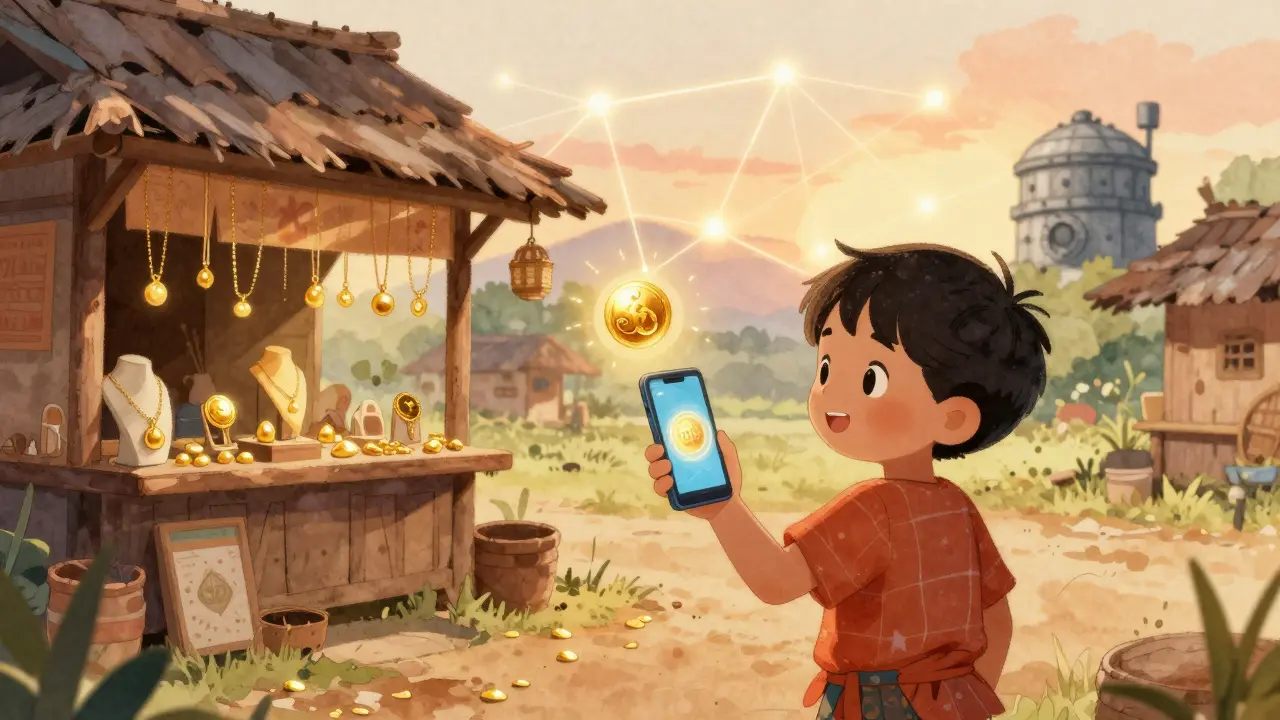
Gold Indonesia Republic, or GIDR, isn’t just another cryptocurrency. It’s a digital token that represents real, physical gold-exactly one gram per token. Launched in 2025, GIDR was created to turn Indonesia’s vast gold reserves into something anyone in the world can buy, sell, or hold with a smartphone. Unlike stocks or traditional gold savings accounts, GIDR works 24/7, moves instantly across borders, and doesn’t charge storage fees. It’s designed to remove the friction of buying physical gold-no trips to bullion dealers, no insurance costs, no waiting for business hours.
How GIDR Works: One Token, One Gram of Gold
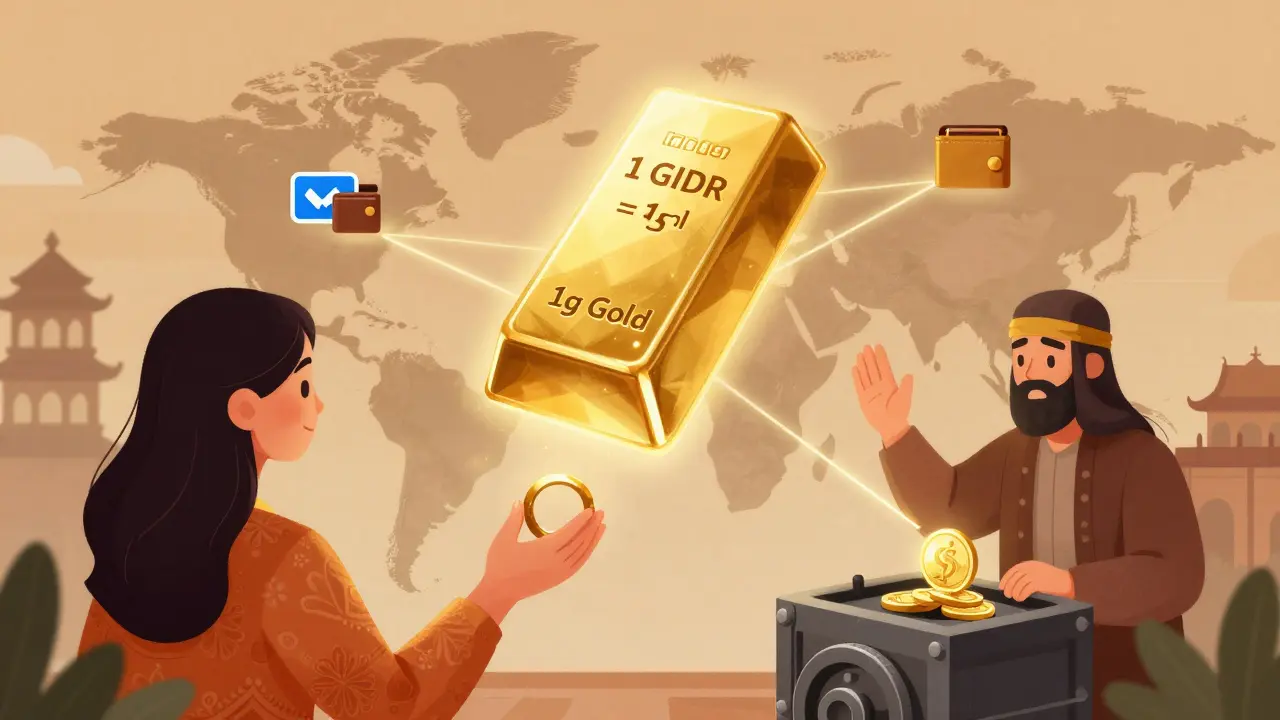
Every GIDR token is backed by one gram of physical gold stored in a licensed vault in Indonesia. This isn’t a promise or a claim-it’s a direct 1:1 link. The gold is held by a state-backed custodian, and every deposit, withdrawal, or transfer is recorded on the Polygon blockchain. That means you can check the exact amount of gold backing GIDR at any time using a public blockchain explorer. If you hold 10 GIDR tokens, you own 10 grams of gold. No middlemen. No hidden fees.
The system uses smart contracts to automate everything. When you buy GIDR on an exchange, the smart contract verifies that the gold is in the vault. When you redeem it for physical gold, the contract triggers the release. No one can create more tokens unless new gold is added. And if gold is taken out, the supply drops automatically. This keeps the system honest.
Why Polygon? Why Not Its Own Blockchain?
GIDR runs on Polygon, not a custom blockchain. That’s a smart move. Polygon is fast, cheap, and already used by millions of users worldwide. It’s built on Ethereum, so you can use any Ethereum wallet-MetaMask, Trust Wallet, Coinbase Wallet-to hold GIDR. You don’t need a special app. You don’t need to learn new software. Just send and receive GIDR like you would any other ERC-20 token.
Building a new blockchain from scratch would’ve meant higher costs, slower adoption, and more technical risk. By using Polygon, GIDR gets instant compatibility with wallets, exchanges, and DeFi tools. It also keeps transaction fees low-often under $0.10 per transfer. That’s a big deal when you’re dealing with small amounts of gold.
Buying and Redeeming GIDR: Real-World Use Cases
You can buy GIDR on several crypto exchanges, including Binance, Coinbase, WEEX, and Crypto.com. The minimum purchase is 0.0001 GIDR, which means you can start with less than a dollar. That’s huge. It lets students, small savers, or people in countries with unstable currencies get exposure to gold without needing thousands of dollars upfront.
But here’s where GIDR gets really interesting: you can turn physical gold into GIDR-and vice versa. If you have a gold bracelet, ring, or bar, you can take it to an authorized redemption center in Indonesia. They’ll weigh it, verify purity, and send you the equivalent GIDR tokens directly to your wallet. The reverse works too. Want physical gold? Order 100 GIDR through the wallet app, and they’ll ship you a 100-gram gold bar. No paperwork. No delays. Just blockchain verification.
This feature is especially powerful in Indonesia, where many people own gold jewelry but can’t easily sell it without losing value. GIDR turns pawned jewelry into liquid digital assets. It’s also a solution for rural communities where banks don’t reach, but mobile phones do.
Price Volatility and Market Confusion
As of March 2026, GIDR’s price varies wildly depending on where you look. On Binance, it’s around $127.72. On Crypto.com Singapore, it’s $164.22. WEEX lists it at $168.63. Liquidity Finder shows $111.95. That’s a difference of nearly $60 between the lowest and highest price.
Why? Because GIDR is still new. It’s not yet listed on every major exchange. Trading volumes are low. Some platforms might be using outdated data. Others might be dealing with thin liquidity-meaning few buyers and sellers. This creates price gaps. It’s not unusual for new assets to behave this way in their first year.
The total supply is roughly 4,750 tokens, but some platforms report a market cap of $0. That’s because they haven’t yet pulled in the trading data. Don’t assume $0 means it’s worthless. It just means the data isn’t fully synced across the ecosystem yet.
What You Can Do With GIDR Today
- Hold it as a digital store of value-like digital gold.
- Trade it on exchanges that list it.
- Redeem it for physical gold at partner outlets in Indonesia.
- Convert physical gold into GIDR tokens for easier transfer or sale.
- Use it in future NFT auctions where gold jewelry is tokenized and sold as digital collectibles.
There’s no staking, no yield farming, no lending-yet. The focus is purely on gold digitization. That’s intentional. GIDR isn’t trying to compete with Ethereum or Solana. It’s trying to compete with gold bullion dealers.
Is GIDR a Good Investment?
There’s no simple answer. If you believe gold will keep its value over time-and that digital access to gold will grow-then GIDR could be a smart way to own it. It’s cheaper than buying physical bars, more liquid than jewelry, and more transparent than gold ETFs.
But it’s not risk-free. The crypto market is volatile. Regulatory changes in Indonesia or globally could affect its legality. If the gold vault ever fails to prove its reserves, trust collapses. And if adoption stays low, liquidity stays thin, and price swings become wild.
Before buying, check the official whitepaper. Look up the team behind PT Indonesia Blockchain Persada. Verify the vault partner. Understand that this isn’t a get-rich-quick scheme. It’s a long-term play on digitizing one of the oldest forms of wealth.
What’s Next for GIDR?
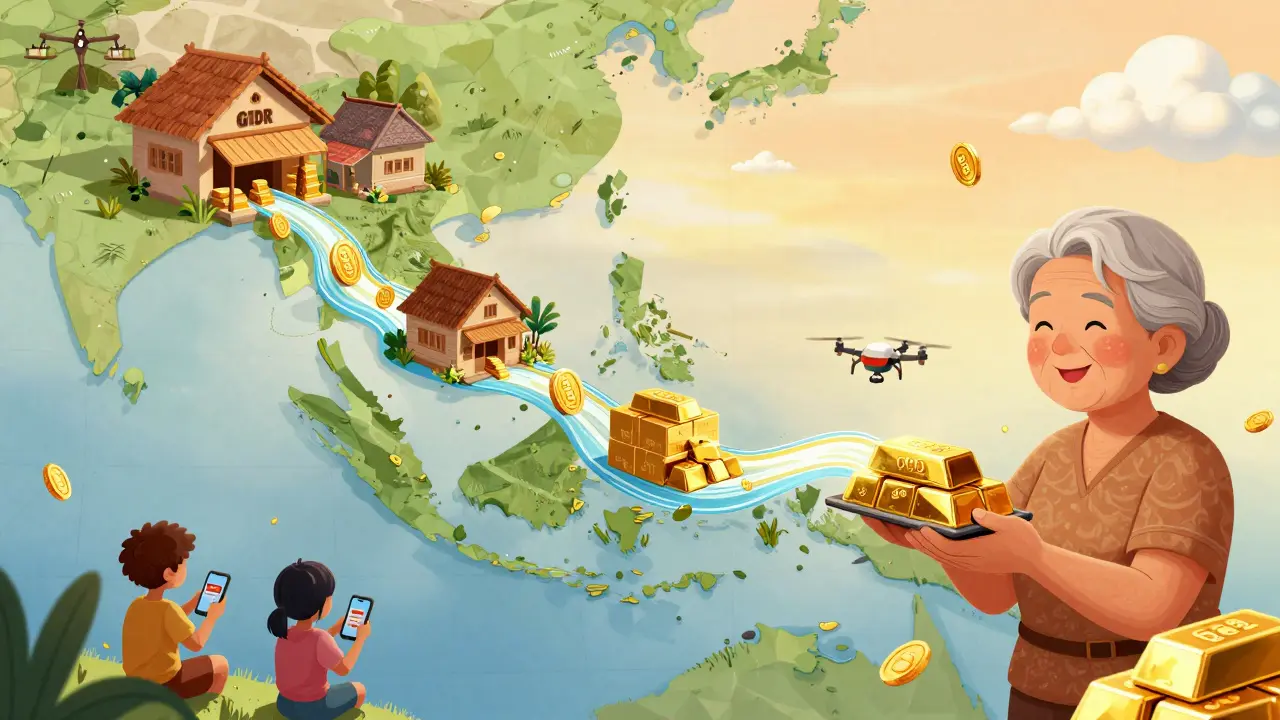
The team plans to expand GIDR’s use beyond gold. They’re working on converting GIDR into Indonesian Rupiah (IDR) via digital wallets-so you could pay bills or buy groceries with your gold-backed tokens. They’re also testing NFT auctions for pawned jewelry. Imagine selling your grandmother’s gold ring as an NFT, getting paid in GIDR, and letting someone else redeem it for physical gold. It’s a way to clear out bad loans from pawn shops while giving people access to capital.
They’re also planning partnerships with mobile payment apps in Southeast Asia. That means in the future, you might be able to top up your phone balance with GIDR at a local warung in Jakarta or Bali.
None of this is guaranteed. But the foundation is solid: real gold, transparent blockchain, low fees, and real-world redemption.
Final Thoughts
GIDR isn’t trying to replace Bitcoin. It’s trying to replace the gold bar in your drawer. It’s not a speculative gamble-it’s a tool for financial access. If you live in a country where banks don’t serve you well, or where inflation eats away at cash, GIDR gives you a way to hold wealth that’s been trusted for thousands of years-but now, with the speed and flexibility of crypto.
It’s early. It’s messy. But it’s real.
Ross McLeod
March 14, 2026 AT 19:21Let me be clear: this isn’t ‘digital gold.’ It’s a glorified IOU wrapped in blockchain glitter. You’re trusting a state-backed vault in Indonesia with zero international audit transparency to hold physical gold that no one outside Jakarta can verify independently. And you call this innovation? This is just feudalism with a QR code. If I can’t walk into a vault and see the bars myself, it’s not ownership-it’s a fantasy.
Also, Polygon? That’s like building a mansion on a rented lot. What happens when Polygon gets hacked? Or when Ethereum shifts its fee structure again? You’re not owning gold-you’re owning a token that depends on another fragile system. This feels like a Ponzi scheme with a gold-plated veneer.
rajan gupta
March 15, 2026 AT 05:47OMG I just cried reading this 💔😭
Imagine your grandma’s gold necklace turning into digital magic... I’m so emotional right now 🥹✨
Indonesia is finally doing something beautiful for the people 🇮🇩💛
God bless GIDR 🙏🙏🙏
Billy Karna
March 15, 2026 AT 10:21There’s a lot to unpack here, and honestly, most of the skepticism is misplaced. GIDR’s model is actually one of the most technically sound gold-backed systems I’ve seen. The 1:1 on-chain verification via Polygon is critical-unlike gold ETFs where you’re trusting a fund manager’s balance sheet, here you can verify every gram live on Etherscan.
The real innovation isn’t the blockchain-it’s the redemption infrastructure. Turning jewelry into tokens at authorized centers? That’s a massive leap for informal economies. In rural Java, a woman with a 50g wedding ring can now convert it into liquidity without being scammed by a pawnshop. That’s not crypto hype-that’s financial inclusion.
Yes, the price discrepancies across exchanges are ugly, but that’s because liquidity is still nascent. Once it hits Tier 1 exchanges like Binance.US and Coinbase, spreads will tighten. And the fact that you can buy 0.0001 GIDR for under a dollar? That’s revolutionary for micro-savers. This isn’t for traders. It’s for the unbanked.
Cheri Farnsworth
March 16, 2026 AT 10:36Gene Inoue
March 17, 2026 AT 02:23Wow. Just wow. Another ‘gold-backed crypto’ that’s going to collapse when the vault gets raided or the Indonesian government decides to nationalize it. You think this is secure? The vault is state-backed? That’s the *worst* possible thing. Governments steal gold. Look at history. Look at 1933. Look at Venezuela. This isn’t decentralization-it’s centralization with extra steps.
And don’t get me started on the price gaps. $111 to $168? That’s not market inefficiency-that’s a rug pull in slow motion. Anyone buying this is just feeding the pump. You’re not investing in gold. You’re investing in someone else’s exit strategy.
Ricky Fairlamb
March 18, 2026 AT 13:55Let’s be precise. The claim that ‘every GIDR token is backed by one gram of physical gold’ is only as valid as the audit trail. Yet the post provides zero independent verification-no third-party auditor, no public ledger of vault inventories, no chain-of-custody documentation. This is not transparency. This is performative transparency.
Furthermore, relying on Polygon-a Layer 2 solution built on Ethereum-is not ‘smart.’ It’s a dependency chain. If Ethereum’s base layer fails, or if Polygon’s validators are compromised, GIDR’s entire value proposition evaporates. You’re not owning gold. You’re owning a smart contract written by a private entity with no legal recourse.
And the ‘redemption’ process? ‘Take it to an authorized center in Indonesia’? That’s not accessibility. That’s exclusion. What about the 99% of the world who can’t fly to Jakarta? This isn’t financial innovation. It’s a gated luxury for the privileged few with passports and disposable income.
Arlene Miles
March 19, 2026 AT 14:17I love this. Seriously. I’ve spent years trying to help people understand that wealth isn’t about getting rich fast-it’s about holding value that survives collapse. Gold has done that for 5,000 years. This? This is the first time we’ve made it *accessible*. No more waiting until you have $5,000 to buy a bar. No more losing half your jewelry’s value at a pawn shop.
Yes, the prices are messy right now. Yes, there are risks. But this isn’t about speculation. It’s about dignity. Imagine a single mom in Bali who’s been saving gold bangles for her daughter’s wedding. Now she can convert them into tokens, send them to her sister in Manila, and let her redeem them when she needs medical care. That’s not crypto. That’s human connection.
Don’t let the trolls scare you. This is the quiet revolution. The ones who laugh now? They’ll be the ones begging to join in five years.
Jessica Beadle
March 21, 2026 AT 07:32Let’s not confuse tokenization with value creation. The fact that you can ‘redeem’ gold in Indonesia doesn’t make it liquid globally. It’s a regional silo wrapped in blockchain jargon. The ‘one gram per token’ claim is meaningless without audited proof of vault holdings. And yet, no proof is provided. Zero. Nada. Just a website and a whitepaper written by someone who clearly thinks ‘smart contract’ means ‘magic money.’
The price variance? That’s not ‘liquidity issue.’ That’s a market signaling that the asset is fundamentally untrustworthy. $111 vs $168? That’s not inefficiency-that’s fraud waiting to be exposed. And don’t get me started on the ‘convert jewelry’ feature. How do they verify purity? With a flashlight? A magnet? This isn’t innovation. It’s a regulatory loophole dressed up as empowerment.
Tony Weaver
March 22, 2026 AT 22:32It’s cute how people think this is ‘real gold.’ You’re not holding gold. You’re holding a digital receipt for gold that might or might not exist, stored in a country with zero legal recourse for foreign holders. And you’re trusting a private company to manage the vaults? PT Indonesia Blockchain Persada? Who even are they? No LinkedIn profiles. No public board members. Just a website and a promise.
The fact that you can buy it on Binance doesn’t make it safe. Binance lists hundreds of assets that are total garbage. This is just another ‘stablecoin’ with a gold label. And the redemption? ‘Order a 100g bar and they’ll ship it’? To where? The US? UK? Good luck with customs, import taxes, and customs officials who have never heard of GIDR.
This isn’t a financial tool. It’s a marketing gimmick for people who think blockchain = trust.
Patty Atima
March 24, 2026 AT 10:05Lucy de Gruchy
March 25, 2026 AT 23:31Oh, this is brilliant. A state-backed gold token in Indonesia. Let me guess-same people who run the national oil company? The same ones who ‘lost’ billions in mining contracts? This is just a new way for the elite to siphon wealth under the guise of ‘empowerment.’
And the blockchain? Please. If it’s on Polygon, then the ‘ownership’ is just a database entry. Anyone with access to the smart contract can alter it. The ‘public explorer’ is a mirage. There’s no such thing as immutable truth when a private entity controls the keys.
And don’t even get me started on ‘converting jewelry.’ That’s just a front for laundering stolen gold. This isn’t finance. It’s a money-laundering pipeline with a cute logo.
Lauren J. Walter
March 27, 2026 AT 13:47So… you’re telling me I can turn my grandma’s wedding ring into a QR code? And then… what? Send it to a stranger in Berlin? And they get a bar? That’s… beautiful. And also terrifying.
I don’t know whether to cry or laugh. Or both.
Also, I just realized-this means my gold earrings are now ‘digital assets.’ I’m a blockchain influencer now. 🤷♀️
Carol Lueneburg
March 28, 2026 AT 01:42This is so heartwarming. 💖
Imagine a little girl in Sumatra who saves her allowance in GIDR tokens instead of plastic toys. Ten years from now, she redeems them for a gold bracelet-not because she’s rich, but because she was smart.
This isn’t about crypto. It’s about legacy. It’s about giving people who’ve been ignored by banks a way to build something real.
I’m not a financial expert. But I know what hope looks like. And this? This is hope with a blockchain.
Brenda White
March 29, 2026 AT 11:07ok so i just read this and im confused-so if i have a gold chain and i turn it into gidr, then someone else can redeem it? like… what if i want it back? who owns it? the blockchain? or the person who redeems it? this feels like giving away your dog and then saying ‘but i still own the collar!’
also why polygon? why not solana? solana is faster lol
Tobias Wriedt
March 31, 2026 AT 06:51Gold-backed crypto? Yes please 🚀✨
Finally, something that actually makes sense!
Love this so much 💛💛💛
Let’s go GIDR!!
Ernestine La Baronne Orange
April 1, 2026 AT 02:24Let me tell you something-this isn’t innovation. It’s a psychological trap. You’re being sold the illusion of control. You think you ‘own’ gold? No. You own a line of code. A line of code that can be frozen, reversed, or altered by a private entity with no accountability.
The ‘redemption’ process? A trap. You think you can get physical gold? Try it. You’ll be asked for ID. Then taxes. Then proof of origin. Then a 3-month waiting period. And then-surprise-they’ll say the vault is ‘temporarily unavailable.’
This is the same scam that happened with silver certificates in the 1930s. Only now, they’ve added a blockchain to make it look modern. It’s not gold. It’s a psychological illusion wrapped in jargon. Don’t be fooled.
Manali Sovani
April 2, 2026 AT 07:17This concept is fundamentally flawed. Gold is not a currency. It is a store of value. To tokenize it is to commodify it beyond its natural function. The attempt to link physical gold to digital tokens introduces unnecessary systemic risk. The vaults may be state-backed, but the blockchain is not. The two systems operate on entirely different paradigms. One is ancient, tangible, and immutable. The other is digital, mutable, and dependent on infrastructure.
Furthermore, the price discrepancies across exchanges indicate a lack of market consensus. This is not a sign of growth. It is a sign of instability. To claim this as ‘financial access’ is to misunderstand the nature of both gold and finance.
Konakuze Christopher
April 4, 2026 AT 00:36S F
April 5, 2026 AT 14:55Indonesia thinks it’s cool to monetize its gold? Bro, the US has 8,000 tons. China has 2,000. Why are we letting a Southeast Asian country define the future of gold? This isn’t innovation-it’s nationalism wrapped in blockchain hype. If you want real digital gold, buy PAXG. Not this.
Angelica Stovall
April 5, 2026 AT 21:42They say ‘real gold.’ But where’s the proof? No photos. No audits. No third-party verification. Just a website and a promise. This is how scams start. You think you’re buying gold? You’re buying a dream. And dreams don’t pay bills.
Also, ‘redeem for physical gold’? In Indonesia? What if I live in Canada? Do I fly there? Pay $2,000 in airfare? For a 100g bar? That’s not access. That’s exploitation.
Taylor Holloman.
April 7, 2026 AT 01:35I’ve been reading this whole thing slowly. And honestly? I’m not sure if I’m impressed or scared.
On one hand-this is beautiful. A woman in Flores turns her daughter’s first gold bangle into tokens. Later, she uses those tokens to pay for her granddaughter’s school fees. That’s poetry.
On the other hand-what if the vault is empty? What if the smart contract has a bug? What if the Indonesian government changes its mind?
I don’t know. I think I’ll hold a little. Just to see. Not because I believe. But because I hope.
Bryan Roth
April 7, 2026 AT 03:51This is one of the most thoughtful approaches to digitizing tangible assets I’ve seen in years. The focus on redemption over speculation? That’s rare. Most crypto projects want you to flip. GIDR wants you to preserve.
The fact that it’s on Polygon? Smart. No need to reinvent the wheel. Ethereum wallets, low fees, global access-perfect.
And the jewelry-to-token feature? That’s not tech. That’s culture. It’s respecting the way people in Southeast Asia actually store wealth-through heirlooms, not bank accounts.
It’s not perfect. But it’s honest. And in crypto? That’s worth more than any whitepaper.
sai nikhil
April 7, 2026 AT 04:48Sahithi Reddy
April 7, 2026 AT 22:38George Hutchings
April 9, 2026 AT 21:04As someone who’s lived in both the US and rural Indonesia-I can tell you this matters.
Back home, my auntie keeps her gold in a tin box under her bed. She can’t sell it without being cheated. She can’t move it. She can’t use it. GIDR? It gives her a voice. A way to be part of the global economy without leaving her village.
This isn’t about tech. It’s about dignity. And honestly? More projects need to think like this.
Henrique Lyma
April 10, 2026 AT 21:40Let’s be brutally honest: this is a thinly veiled attempt to monetize Indonesia’s gold reserves under the banner of ‘decentralization.’ The blockchain is just window dressing. The real innovation is the legal framework that allows a private entity to act as a custodian for state-backed assets-with zero international oversight.
The price discrepancies? That’s not liquidity. That’s arbitrage waiting to be exploited. And the ‘redemption’? A fiction. You think a 100g gold bar is just going to be shipped to your door in Ohio? Please. Customs will seize it. Tax authorities will demand 30%.
This isn’t finance. It’s a geopolitical play dressed up as a crypto project.
Steph Andrews
April 12, 2026 AT 18:44Prakash Patel
April 14, 2026 AT 17:10Zachary N
April 16, 2026 AT 11:41There’s a lot of noise here, but let’s cut through it. GIDR isn’t perfect-but it’s one of the few crypto projects that actually solves a real problem: access to gold for people without capital or banking access.
The fact that you can buy 0.0001 GIDR? That’s not marketing. That’s radical inclusion.
The use of Polygon? That’s not lazy-it’s strategic. Building your own chain would’ve delayed adoption by years. Polygon gives you instant wallet compatibility, low fees, and global liquidity.
The redemption process? Yes, it’s limited to Indonesia. But that’s a starting point. Imagine if this model spreads to other gold-rich nations-Peru, Ghana, Australia. Suddenly, you have a global network of physical gold access points, all connected by blockchain.
This isn’t a currency. It’s a bridge. And bridges are built one step at a time.
Ross McLeod
April 17, 2026 AT 09:17That’s exactly the point I was trying to make. You’re building a bridge over a canyon with no anchor on the other side. If the redemption centers are only in Indonesia, then GIDR is just a regional currency with a gold label. It doesn’t solve global access-it creates a new dependency.
And if the vaults are only audited internally? Then the entire system is a trust exercise. Not a technical one. That’s not innovation. That’s theater.
Billy Karna
April 18, 2026 AT 20:24Good point about the redemption geography. But here’s the thing-Indonesia is the *starting point*, not the endpoint. The real innovation is the *system*: tokenization + blockchain verification + redemption infrastructure.
Once this model proves stable, it can be replicated. Imagine a GIDR-like token for Peruvian gold, backed by a vault in Lima, redeemable in Santiago. Or one for Ghanaian gold, redeemable in Accra. Each is local, but the protocol is global.
That’s how real infrastructure is built-not by launching a worldwide system overnight, but by proving one node works. GIDR is that node.
Arlene Miles
April 19, 2026 AT 17:26Exactly. This isn’t about one country. It’s about one idea: that your gold shouldn’t be locked in a drawer. It should be free. And freedom starts with one person, one token, one redemption center.
Don’t dismiss it because it’s not global yet. It’s not supposed to be. It’s supposed to be real.