


Imagine walking into a bank and asking for a loan. You don't have a house to mortgage or stocks to pledge. Instead, the bank looks at your business plan, your track record, and decides if you're trustworthy. That is how traditional finance works. Now, imagine doing that on the blockchain. Sounds impossible? It’s not. This is exactly what Goldfinch is a decentralized lending protocol that enables cryptocurrency loans without requiring crypto collateral.
If you’ve been in crypto long enough, you know the rule: to borrow, you must overcollateralize. Want $1,000 in stablecoins? Lock up $1,500 worth of Ethereum. If ETH crashes, you get liquidated. It’s safe for lenders, but it shuts out anyone who doesn’t already hold significant crypto wealth. Goldfinch flips this script. It brings real-world credit-loans backed by trust and data, not just tokens-onto the blockchain.
The Core Problem: Why Traditional DeFi Fails Most Borrowers
Most decentralized finance (DeFi) lending platforms like Aave or Compound operate on a simple mechanism: smart contracts enforce collateral ratios. This creates a closed loop. Only people with crypto can access credit. This excludes small businesses in emerging markets, freelancers, and individuals who need capital to grow but lack digital assets.
Goldfinch solves this by removing the requirement for crypto collateral. Instead of relying on an algorithmic oracle to check the price of ETH, Goldfinch relies on human judgment combined with community consensus. This concept is called "trust through consensus." It bridges the gap between institutional-grade private credit and retail investors.
How Goldfinch Works: The Trust Through Consensus Model
So, how does a decentralized network decide who gets a loan without collateral? It uses a system of pools and auditors. Here is the breakdown:
- Borrower Pools: Real-world entities (like micro-lending institutions in Kenya or Mexico) propose deals. They create a "Borrower Pool" where they request a specific amount of USDC (a stablecoin).
- Auditors: These are experienced analysts or firms who evaluate the borrower’s creditworthiness. They stake their own GFI tokens to signal confidence. If the borrower defaults, Auditors lose their staked tokens. This aligns incentives: Auditors only vote yes on good deals.
- Backers: Retail investors who believe in the deal can back it directly. They take on more risk but potentially earn higher returns.
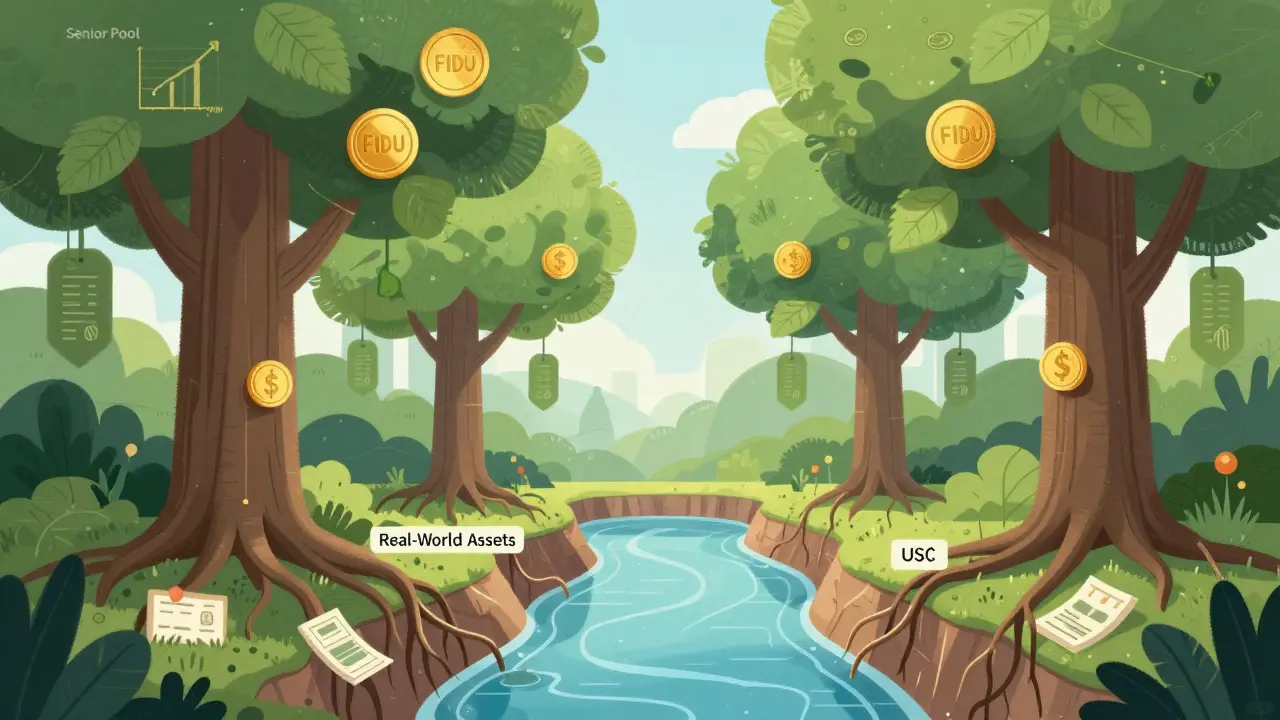
- Liquidity Providers: For those who want passive income, they supply capital to the "Senior Pool." Their funds are automatically distributed across various deals. In return, they receive FIDU is a token representing a Liquidity Provider's deposit to the Senior Pool. FIDU grows in value as interest is paid back.
When a borrower draws down USDC from their pool, they convert it to fiat currency (like USD or EUR) and lend it to end-users in their local market. Goldfinch handles the on-chain settlement, while the off-chain partner handles the actual loan origination and collection. This hybrid model leverages the efficiency of blockchain with the expertise of local financial institutions.
Understanding the Tokens: GFI vs. FIDU
Goldfinch operates with two distinct tokens, each serving a different purpose. Confusing them is a common mistake for new users.
| Feature | GFI (Governance Token) | FIDU (Liquidity Token) |
|---|---|---|
| Primary Function | Governance voting, Auditor staking, rewards | Represents share of Senior Pool capital |
| Value Driver | Market demand, utility, governance power | Net asset value of the Senior Pool + accrued interest |
| Risk Profile | High volatility (speculative asset) | Lower volatility (backed by debt repayments) |
| Redemption | Sold on exchanges | Redeemable for USDC minus a 0.5% fee |
GFI is the key to participation. You need GFI to become an Auditor or to stake on Backers. It also grants you voting rights in the DAO (Decentralized Autonomous Organization). Holding GFI allows you to influence protocol upgrades, reward distributions, and security parameters.
FIDU is strictly for yield seekers. When you provide liquidity to the Senior Pool, you get FIDU. As borrowers pay back their loans with interest, the value of FIDU increases relative to USDC. It’s similar to holding a bond that pays out periodically, but on-chain.

Real-World Assets (RWAs): The Strategic Edge
Goldfinch isn’t just another DeFi lending platform; it’s a pioneer in the Real-World Asset (RWA) sector. RWAs involve tokenizing physical or traditional financial assets-like real estate, invoices, or private credit-and bringing them on-chain.
Why does this matter? Because the total addressable market for private credit is massive. According to recent data, RWAs make up a significant portion of institutional investment opportunities. Goldfinch has integrated with platforms like NestCredit and partners with major financial institutions such as Ares, Apollo, and Golub. Through its Prime platform, Goldfinch aggregates these multi-billion dollar private credit funds into a single on-chain pool.
This means you, as a retail investor, can gain exposure to the same high-yield private credit deals that were previously reserved for hedge funds and wealthy individuals. The protocol specifically targets emerging markets, providing capital to regions that are underserved by traditional banks. This not only generates yield but also supports economic growth in developing economies.
Security and Identity: Preventing Sybil Attacks
In a system based on trust, identity is everything. How do you prevent one bad actor from creating 1,000 fake accounts to manipulate votes or launder money? Goldfinch addresses this with the Unique Entity Check (UEC).
Every participant-whether a Borrower, Backer, or Auditor-must verify their unique identity. Currently, this is done through Unique Identity (UID) is an NFT-based identity verification system. UID issues an NFT that proves you are a unique human entity without revealing sensitive personal data publicly. This prevents Sybil attacks, ensuring that the "consensus" in trust-through-consensus is genuine.
The governance DAO retains the ability to approve additional UEC providers in the future, allowing for flexibility as identity verification technology evolves.
Market Position and Performance (2026 Context)
As of early 2026, Goldfinch has established itself as a key player in the RWA narrative. The GFI token has seen significant volatility, which is typical for governance tokens in growing protocols. Price data from January 2026 showed GFI trading around $0.13-$0.14, with a circulating supply of approximately 86 million tokens. Its market cap fluctuated between $11 million and $72 million depending on valuation methods, placing it in the mid-tier among cryptocurrencies (rank ~860-876).
The 52-week price range highlighted extreme swings, from a low of $0.44 to a high of $6.13. This volatility reflects both market sentiment and the speculative nature of governance tokens. However, the underlying protocol continues to expand its Total Value Locked (TVL) through partnerships and increased adoption of its Prime platform.
Who Should Use Goldfinch?
Goldfinch isn’t for everyone. It serves three main groups:
- Yield Seekers: If you want steady, lower-risk yields, supplying USDC to the Senior Pool to earn FIDU is your best bet. You’re essentially acting as a bank, earning interest on loans.
- Active Investors: If you have time to research deals and are willing to take on higher risk for higher reward, becoming a Backer allows you to pick specific Borrower Pools.
- Protocol Participants: If you have expertise in credit analysis, you can become an Auditor. By staking GFI, you help secure the network and earn rewards for accurate assessments.
If you’re looking for quick, high-leverage trades or instant liquidity without due diligence, Goldfinch might be too complex. It requires understanding both DeFi mechanics and traditional credit risks.
Risks and Considerations
No investment is without risk. With Goldfinch, the primary risks include:
- Credit Risk: Since there is no crypto collateral, borrowers can default. While Auditors mitigate this, economic downturns can still lead to losses.
- Smart Contract Risk: Like any DeFi protocol, bugs in the code could lead to exploits. Goldfinch undergoes regular audits, but zero risk is impossible.
- Regulatory Risk: As governments scrutinize DeFi and RWAs, regulatory changes could impact operations. Goldfinch’s focus on compliance via UEC helps, but the landscape is shifting.
- Token Volatility: GFI’s price can swing wildly. Don’t confuse the token’s market price with the protocol’s health.
Getting Started with Goldfinch
To participate, you’ll need an Ethereum-compatible wallet like MetaMask. You can buy GFI on exchanges like MEXC or use services that allow purchases via credit card or PayPal. Once you have GFI and USDC, you can connect to the Goldfinch app.
Start by exploring the Senior Pool if you’re new. Supply USDC to receive FIDU. Monitor the performance of the pool and understand how interest accrues. If you’re more advanced, look into backing specific Borrower Pools or staking GFI as an Auditor. Always do your own research (DYOR) before committing funds.
Is Goldfinch safe to use?
Goldfinch employs robust security measures, including smart contract audits and the Unique Entity Check (UEC) to prevent fraud. However, like all DeFi protocols, it carries risks such as smart contract vulnerabilities and credit defaults. Never invest more than you can afford to lose.
What is the difference between GFI and FIDU?
GFI is the governance token used for voting, staking, and securing the network. Its value is driven by market demand. FIDU represents your share in the Senior Pool and grows in value as interest is earned from loans. FIDU is redeemable for USDC, while GFI is traded on exchanges.
Can I lose my money on Goldfinch?
Yes. If you back a Borrower Pool and the borrower defaults, you may lose part or all of your investment. Even in the Senior Pool, widespread defaults could impact returns. The "trust through consensus" model reduces risk but does not eliminate it entirely.
How do I become an Auditor on Goldfinch?
To become an Auditor, you need to hold GFI tokens and pass the Unique Entity Check (UEC). You then stake your GFI to signal confidence in deals. Accurate assessments earn you rewards, while poor judgments result in slashing your staked tokens.
Does Goldfinch require crypto collateral?
No. This is Goldfinch’s key differentiator. Borrowers do not need to lock up crypto assets. Instead, creditworthiness is determined by community consensus and auditor assessments, similar to traditional banking but decentralized.