

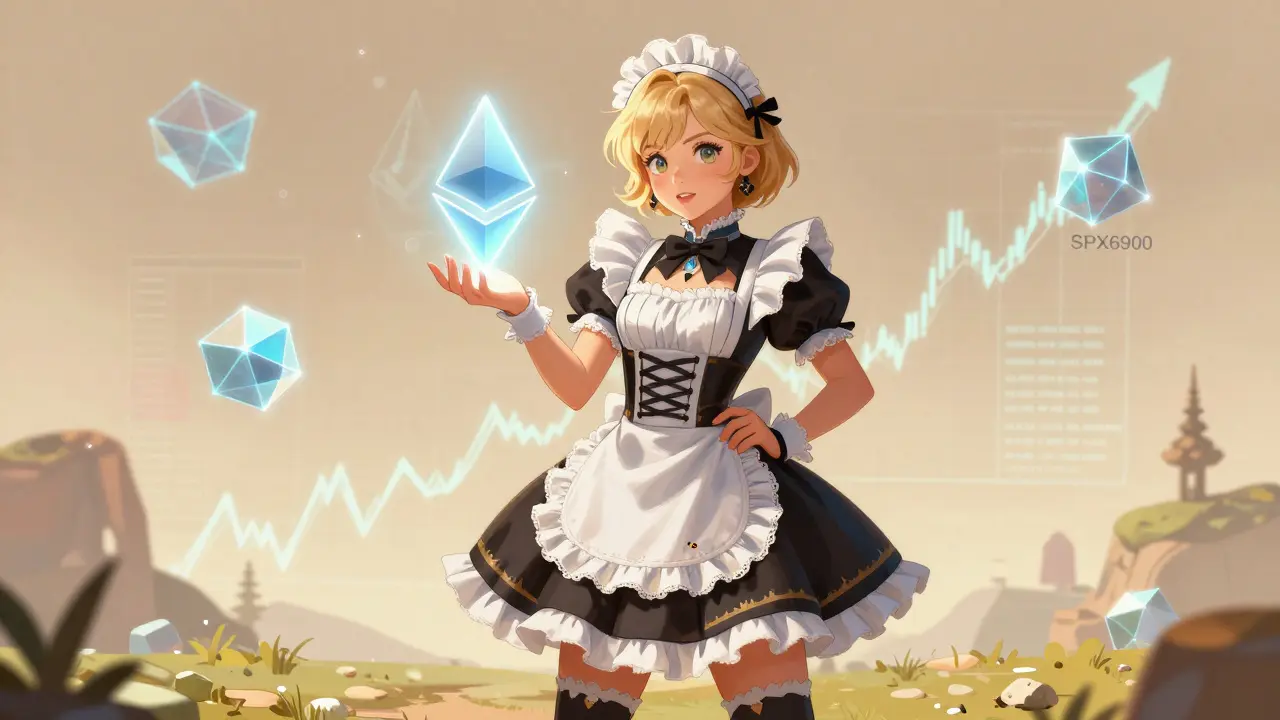
Have you ever scrolled through a list of cryptocurrencies and seen a name that sounds like a character from a video game or an anime, only to realize it’s actually a speculative asset on the blockchain? That is exactly what happens with Marie (ROSE). It is not a protocol for decentralized finance, nor is it a utility token powering a massive network. Instead, it sits squarely in the chaotic, high-risk world of meme coins, driven by internet culture, fandoms, and the specific narrative of the SPX6900 community.
If you are looking at this token because you saw it mentioned online, you likely have two immediate questions: What is it actually based on, and why are there so many different tickers and prices floating around? The short answer is that Marie (ROSE) is an Ethereum-based cryptocurrency launched in 2025, themed around Marie Rose, a character from the *Dead or Alive* fighting game series. However, the ecosystem is confusingly split between at least two distinct tokens-Marie (ROSE), which has an astronomically high supply, and Marie Rose (MARIE), which has a much smaller, fixed supply. Understanding the difference between these two is critical before you consider interacting with either.
The Origins: From Fighting Games to Financial Memes
To understand the value proposition of this coin, you have to look past the code and look at the branding. The token draws its identity from Marie Rose, a fictional character introduced in *Dead or Alive 5 Ultimate Arcade* back in 2013. In the game lore, she is a petite, blonde Swedish maid who serves Helena Douglas at DOATEC and utilizes the Russian martial art Systema. She is known for her Gothic Lolita fashion and a personality that mixes playfulness with fierce combat skills.
Crypto projects often borrow cultural icons to build instant recognition. In this case, the project positions Marie Rose as the "fearless mascot" of the SPX6900 community. SPX6900 is a well-known meme-stock narrative within crypto circles, suggesting a future where the S&P 500 index hits 6,900 points-a bullish signal often associated with retail investor euphoria. By aligning the token with this narrative, the creators are tapping into a community that views traditional finance with skepticism and prefers grassroots, community-driven assets. The marketing copy frequently uses phrases like "defying TradFi" and "flipping the stock market," making it clear that this is a sentiment-driven asset rather than a technology-driven one.
| Attribute | Marie (ROSE) | Marie Rose (MARIE) | Marie Rose AI |
|---|---|---|---|
| Blockchain | Ethereum | Ethereum | Solana (reported) |
| Total Supply | 420,000 Trillion (4.2×10^17) | 420,690,000 | Varies / Low Cap |
| Price Range (Mid-2026) | ~$0.0000000000000006 | $0.0003 - $0.0008 | ~$0.00005 |
| Market Cap Estimate | Micro-cap / Illiquid | ~$130k - $260k | <$10k |
| Primary Narrative | SPX6900 Mascot | Community Meme | AI-Managed Agent |
Tokenomics: The Confusion of Supply and Tickers
This is where most new investors get tripped up. When researching Marie (ROSE), you will encounter wildly different numbers depending on which data aggregator you check. This inconsistency stems from the existence of multiple tokens using similar names.
Marie (ROSE) is described as a highly inflationary token with a maximum supply of roughly 420,000 trillion tokens (4.2×10^17). To put that in perspective, that is hundreds of quadrillions of tokens. As of late 2025 and early 2026, some platforms listed the circulating supply as near zero or untradable, while others showed partial circulation. Because the supply is so massive, the price per token is infinitesimally small, trading in the range of $0.0000000000000006 USD. This structure is common in meme coins designed to make holders feel they own "billions" of tokens, even if the actual dollar value is negligible.
In contrast, Marie Rose (MARIE) operates with a fixed, capped supply of 420,690,000 tokens. This is a much more standard model for micro-cap meme coins. With a total supply of roughly 420 million, the price per token is higher, typically fluctuating between $0.0003 and $0.0008 USD in mid-2026. This token has a documented market capitalization ranging from $130,000 to $260,000, depending on daily volatility. It also reports having around 2,790 unique wallet holders, indicating a small but active community.
There is also a third variant, often referred to as Marie Rose AI, which claims to be managed by an AI agent. This token has shown extreme volatility, hitting an all-time high of $0.0046 in late 2024 and dropping to lows below $0.00006 by mid-2026. Its market cap hovers under $10,000, making it an ultra-micro-cap asset with very thin liquidity.
Technology and Security: Renounced Ownership Risks
From a technical standpoint, both Marie (ROSE) and Marie Rose (MARIE) operate on the Ethereum blockchain. This means they are likely implemented as ERC-20 smart contracts. However, unlike established projects that publish detailed whitepapers or undergo rigorous security audits, the Marie ecosystem relies heavily on transparency through "renounced ownership."
Renouncing ownership means the developer who created the contract has given up administrative privileges. On paper, this is a positive sign for decentralization; it prevents the creator from pausing transfers, minting new tokens, or blacklisting addresses. In practice, however, it carries significant risk. If there is a bug in the code, or if the contract is exploited, there is no one left to fix it. There are no public records of third-party security audits for these tokens, which is a major red flag for any serious investor. You are trusting the initial code deployment entirely.
Furthermore, the lack of technical innovation beyond standard meme coin mechanics limits its utility. There is no staking mechanism, no governance voting power, and no integration with major DeFi protocols like Uniswap or Aave as a primary reserve asset. Its primary function remains speculative trading and community signaling.
Market Performance and Liquidity Challenges
If you decide to trade these tokens, you need to be prepared for severe liquidity issues. Liquidity refers to how easily you can buy or sell an asset without affecting its price. For large coins like Bitcoin or Ethereum, you can sell millions of dollars worth instantly. For Marie (MARIE), the daily trading volume often fluctuates between $0 and $11,000 USD.
Consider this scenario: If you buy $1,000 worth of MARIE when the daily volume is only $2,000, you have just accounted for half of the day's entire market activity. Trying to sell that position later could cause the price to crash dramatically because there aren't enough buyers in the order book to absorb your sale. This is known as slippage, and in micro-cap meme coins, it can eat up 10% to 50% of your investment in a single transaction.
Price volatility is equally extreme. Historical data shows MARIE swinging from highs of $0.0008 to lows of $0.000016 within short periods. These double-digit percentage changes happen daily, driven by social media sentiment rather than fundamental developments. One day, a tweet from a prominent SPX6900 community member might spike the price; the next, silence might drain the liquidity pool entirely.
How to Buy and Interact with Marie Tokens
Because these tokens are not listed on major centralized exchanges like Coinbase or Binance, you cannot simply log in and click "buy." You must use decentralized finance (DeFi) tools. Here is the general process:
- Set up a Web3 Wallet: You will need an Ethereum-compatible wallet such as MetaMask or Trust Wallet. Ensure you have some ETH (Ether) in your wallet to pay for gas fees (transaction costs).
- Find the Correct Contract Address: This is the most critical step. Because there are multiple tokens with similar names, buying the wrong one is easy. Always verify the contract address on reputable tracking sites like Dextools or DexScreener. Do not trust links from random social media posts.
- Use a Decentralized Exchange (DEX): Connect your wallet to a DEX aggregator like ArkenSwap or a standard router like Uniswap. Paste the verified contract address for either ROSE or MARIE.
- Execute the Swap: Set your slippage tolerance appropriately (often 5-10% for volatile tokens) and confirm the transaction. Be aware that you are swapping ETH for the token directly from a liquidity pool.
Note that for Marie (ROSE), some major retail platforms explicitly state it is "not tradable yet," meaning you may find yourself unable to execute a swap on certain interfaces due to lack of liquidity or platform restrictions.

Is Marie (ROSE) a Good Investment?
We need to be brutally honest here. Marie (ROSE) and its sister token MARIE are not investments in the traditional sense. They do not generate revenue, they do not have a growing user base for a product, and they do not offer technological advantages. They are speculative assets driven purely by community hype and the broader meme coin cycle.
The risks are substantial:
- Rug Pull Potential: While ownership is renounced, liquidity pools can still be removed by whoever controls them, potentially trapping your funds.
- Liquidity Risk: You may buy in but find no buyers when you want to exit.
- Narrative Dependence: If the SPX6900 meme fades or the Dead or Alive gaming community loses interest, the token's value could drop to near zero permanently.
However, for those who understand these risks and treat it as entertainment money-similar to buying a lottery ticket-there is potential for outsized returns if the community momentum catches fire. But this should never be capital you cannot afford to lose completely.
Future Outlook: Community vs. Fundamentals
As we move further into 2026, the future of Marie (ROSE) depends entirely on its ability to maintain community engagement. Without a development team releasing regular updates, building partnerships, or expanding utility, the token relies on organic growth. The emergence of variants like Marie Rose AI suggests the brand is trying to pivot into trending narratives (AI + Gaming), but these efforts have resulted in extremely low market caps so far.
For the core MARIE token, survival hinges on retaining its current holder base and attracting new speculators during bull markets. If Ethereum gas fees remain high, it may struggle against competitors on cheaper chains like Solana or Base, despite its strong Ethereum roots. Ultimately, Marie (ROSE) remains a niche artifact of crypto culture-a digital collectible for fans of a specific video game character and a particular financial meme, rather than a foundational piece of the crypto economy.
What is the difference between Marie (ROSE) and Marie Rose (MARIE)?
They are two distinct tokens on the Ethereum blockchain. Marie (ROSE) has an astronomical supply of 420,000 trillion tokens and trades at a near-zero price. Marie Rose (MARIE) has a fixed supply of ~420 million tokens and trades at a slightly higher, though still micro-cap, price point. Always check the contract address to ensure you are buying the correct one.
Is Marie (ROSE) a safe investment?
No. It is a high-risk, speculative meme coin with no underlying utility, limited liquidity, and no security audits. It should only be purchased with funds you are willing to lose entirely.
Where can I buy Marie (ROSE) or MARIE?
These tokens are not available on major centralized exchanges. You must use decentralized exchanges (DEXs) like Uniswap or aggregators like ArkenSwap via a Web3 wallet such as MetaMask. You will need ETH to pay for transaction fees.
What is the SPX6900 connection?
SPX6900 is a popular meme-stock narrative predicting the S&P 500 will reach 6,900 points. Marie Rose is branded as the mascot for this community, linking the token to a broader culture of retail investors challenging traditional finance.
Does Marie (ROSE) have any real-world utility?
Currently, no. It does not offer staking rewards, governance rights, or payment functionality. Its value is derived solely from community sentiment and speculative trading activity.
Linda Hilliard
July 10, 2026 AT 04:02Oh, please. Another article dissecting the carcass of a dead meme coin like it’s some kind of high-art analysis. 🙄 You’re treating this like it has 'narrative' weight when it’s just digital confetti blowing in the wind. The SPX6900 crowd isn’t 'defying TradFi'; they’re just gambling addicts with a Twitter addiction and a lack of financial literacy. Marie Rose isn’t a mascot; she’s a warning label for your portfolio. Don’t pretend there’s depth here where there is only greed and stupidity.
DJ Maleko
July 10, 2026 AT 18:03lol Linda you sound like a broken record from 2017 😂📉
everyone knows these things are pure chaos energy but that’s the fun part right? 🎢💸
you can’t stop the people from buying based on vibes alone
the supply is huge yeah so what? it makes the numbers look cool on paper 📝✨
Russ Fincham
July 11, 2026 AT 18:28The technical distinction between ROSE and MARIE is actually quite significant for anyone trying to understand liquidity dynamics. Most retail investors fail to grasp that renounced ownership doesn't equal safety. It equals abandonment. If the contract has a bug, you are on your own. This is not a protocol; it is a casino with no house edge because the house left the building. Proceed with extreme caution if you must engage with such assets.
Tawny Holmes
July 12, 2026 AT 08:20Renounced ownership means zero recourse. Period. Check the code or don't buy. Simple as that.
Jessie Smith
July 13, 2026 AT 03:05its all just smoke and mirrors really
the whole crypto space is built on trust issues and bad code
people think theyre investing but theyre just donating to devs who already cashed out
marie rose is just another ghost town waiting to happen 👻
Andrew Schneider
July 13, 2026 AT 23:12Boring! 😴 Where is the drama? Where is the rug pull story? 🎪
This token is basically sleeping beauty except nobody is kissing her awake 💋
I miss the days when we had actual chaos not this sleepy micro-cap nonsense
Wake up Marie! Or dont I guess 🤷♂️🔥
Eric Braddock
July 15, 2026 AT 09:51Do you really think this is random? The SPX6900 narrative is clearly coordinated by shadowy entities trying to manipulate retail sentiment against traditional markets. They want you to believe it's just a game. It's not. It's a psyop. The AI variant is just a way to track who's biting. Stay woke. Don't let them harvest your liquidity for their algorithmic models. 🕵️♂️📉
Tracy Marshall
July 15, 2026 AT 16:39exactly eric
theyre watching us all through the blockchain
no privacy no safety just data collection disguised as entertainment
i refuse to participate in this surveillance capitalism circus 🎪
Drew M
July 17, 2026 AT 01:28You guys are missing the aesthetic appeal entirely. ✨ Marie Rose is cute. She represents a certain... vibe. A gothic lolita defiance against the drab world of finance. Is it a good investment? Probably not. But is it art? Absolutely. We are curating our portfolios with passion, not just spreadsheets. 🌹💅
Ella Collinson
July 18, 2026 AT 07:08Aesthetic appeal does not mitigate smart contract risk. The EVM execution environment remains hostile to un-audited deployments. Your 'vibe' will not save you from a reentrancy attack or a hidden mint function. Stop romanticizing financial negligence. It is inefficient and dangerous.
Kristine Lawson
July 18, 2026 AT 09:55I must disagree with the notion that this is merely 'entertainment.' There is a moral failing in promoting speculative assets to inexperienced users without adequate warnings. The article mentions risks, yes, but the tone is too permissive. We have a duty to protect the vulnerable from predatory narratives like SPX6900. It is irresponsible to treat this as a harmless hobby.
Guy Davis
July 20, 2026 AT 01:03u r preaching to the choir kristine
but people wont listen they just want free money
typical human nature i guess 🤦♂️
Autumn Story
July 21, 2026 AT 13:11oh my gosh!! i was so excited to read about marie rose because shes adorable in the games!! 😍💖
but wow this sounds super scary honestly??
i dont even know how to use metamask properly lol
maybe ill just stick to looking at fan art instead of risking my savings 🙈📚
Curtis Johnson
July 22, 2026 AT 06:17Hey Autumn totally get that feeling
it is super intimidating for sure
but hey its okay to just be a spectator sometimes
no need to jump into the deep end if ur not ready
stay safe out there friend 🌟
Deep Rahman
July 23, 2026 AT 23:36When we consider the philosophical implications of assigning value to fictional characters, we enter a realm of post-modern absurdity. The character of Marie Rose exists as a construct of code and pixels, yet we imbue her with economic significance. This reflects a broader societal shift towards valuing narrative over substance. It is a mirror held up to our collective desire for meaning in a chaotic digital landscape.
Anuj Kashyap
July 25, 2026 AT 22:53Deeply profound Deep. 🧘♂️
But also deeply stupid.
We are trading zeros for zeros.
The only meaning is the dopamine hit.
And maybe a nice dinner if you sell early enough. 🍜😂
Erika Pozzetto
July 27, 2026 AT 15:47It is imperative to note the discrepancies in supply mechanisms which create an asymmetry in market behavior. The inflationary nature of the ROSE token contrasts sharply with the fixed supply of MARIE leading to divergent price actions. Investors must meticulously verify contract addresses to avoid accidental acquisition of the incorrect asset class which could result in significant capital erosion due to illiquidity.
Josephine Finlayson
July 28, 2026 AT 16:00Thank you for clarifying that Erika! It is very easy to get confused with all these similar names. I always double-check everything now just to be safe. It is better to be cautious than sorry, wouldn't you agree? 😊
Tuan Nguyen
July 28, 2026 AT 21:59The liquidity crunch described in the article is typical of failed experiments in decentralized finance. These tokens are essentially vaporware wrapped in anime aesthetics. The lack of utility ensures eventual decay. Do not waste your time analyzing charts for assets that have no fundamental floor.
Johan Otto
July 29, 2026 AT 10:55Boring take Tuan.
Where is the excitement?
I bought in last week and lost half.
Now I'm up 200%.
Life is beautiful again. 🎢😎
Nick G
July 31, 2026 AT 02:31As someone who appreciates diverse cultural expressions, including gaming communities, I find the intersection of fandom and finance fascinating. However, we must respect boundaries. Not everyone wants to gamble. Let those who wish to participate do so responsibly, while allowing others to enjoy the media without financial pressure. Balance is key.
Nick Wengel
August 1, 2026 AT 13:10Nick G makes a fair point. It's just a game character. People should be able to support what they like without it being a financial obligation. Keep it simple.
KEITH WONG
August 3, 2026 AT 03:11LISTEN UP FOLKS 🗣️
this stuff is trash fire 🔥
unless u r a dev insider u r getting played
save ur self some pain and stay away
trust me on this one 🙅♂️💰
Natalie Lucas
August 5, 2026 AT 00:31Keith is loud today haha
but he might have a point
i almost bought rose last night
glad i waited to read this first
close call! 😅👀
Ray Arney
August 6, 2026 AT 09:30I think the article covers the basics well enough. Just remember to check Dextools before you swap. Slippage kills more wallets than rugs do in these micro-caps. Be careful out there.
Mark Tuason
August 6, 2026 AT 15:28Agreed Ray. Due diligence is essential. Always verify the contract address on multiple sources. It is a simple step that prevents many common errors.
Alicia Hull
August 6, 2026 AT 18:00I am curious why the SPX6900 community persists despite the obvious lack of fundamentals. Is it purely social signaling? I would argue that it creates a false sense of solidarity among retail traders. It is aggressive marketing disguised as community building. Wake up!
Winston Lacewing
August 8, 2026 AT 11:47Oh, Alicia, you're so naive. 🙄
It's not about solidarity, it's about ego.
People want to feel like they're part of something big.
Even if that 'something big' is a joke.
And honestly? I love it. It's entertaining to watch them dance. 💃🕺
Hazel Fruitman
August 9, 2026 AT 11:02im tired of seeing these coins everywhere
its just noise
real innovation doesnt come from meme coins
stop wasting ur time on this garbage 🗑️
Shay Thomson
August 10, 2026 AT 18:38Hazel is right. It's noise. Pure noise. The signal-to-noise ratio in crypto is abysmal right now. Focus on projects with actual revenue streams.
DJ Maleko
August 11, 2026 AT 08:46nah Hazel its not noise its music to my ears 🎶
as long as the pumps keep coming im happy
who cares about fundamentals when u can make 10x in a day? 🚀💎