


Imagine a cryptocurrency that promises to cure cancer. It sounds like the plot of a sci-fi movie, but it’s the pitch behind Oncology Network, known by its ticker symbol ONC. This project positions itself as a pioneer in Decentralized Science (DeSci), aiming to use blockchain technology to break down the walls between researchers, patients, and funding.
But does it actually work? Or is it just another speculative token with big dreams and empty pockets? If you’ve stumbled upon ONC on your screen, you’re probably wondering if this is the next big thing in medical tech or a red flag waving in the wind. Let’s look at the facts, the code, and the community sentiment to see what’s really going on under the hood.
The Promise: Decentralizing Cancer Research
To understand ONC, you first need to understand the problem it claims to solve. Traditional cancer research is often described as "siloed." Big pharmaceutical companies hold onto data, universities compete for grants, and patients are left waiting. The idea behind DeSci is to use blockchain to create a transparent, open-source ecosystem where anyone can contribute to or benefit from scientific progress.
Oncology Network was founded on this premise. According to its documentation from late 2025, the mission is to "dismantle barriers in cancer research" by connecting stakeholders through a decentralized platform. The token, ONC, is supposed to be the fuel for this engine-used to reward researchers, fund studies, and give patients access to trials.
It’s a noble goal. Everyone wants a world where science moves faster and more openly. However, there is a massive gap between writing a whitepaper about collaboration and actually building a platform that oncologists want to use. That gap is where we find most of the controversy surrounding ONC.
Technical Specs and Tokenomics
Let’s get into the nitty-gritty of how the token works. ONC operates as an ERC-20 token on the Ethereum blockchain. This means it uses the same infrastructure as thousands of other tokens. For those who know their way around a wallet, the contract address is 0xd821...cb9780.
Here is the breakdown of the supply:
- Total Supply: 1,000,000,000 ONC (fixed, no burn mechanism)
- Circulating Supply: 700,000,000 ONC (70% of total)
- Token Type: Utility/Speculative
The math here is straightforward. There are no complex inflation models or mysterious vesting schedules hidden in the fine print-at least not in the public metrics. But simplicity doesn’t equal safety. In fact, the lack of a burn mechanism means the supply will never decrease, which can put downward pressure on price if demand doesn’t skyrocket.
| Attribute | Value / Status | Implication |
|---|---|---|
| Blockchain | Ethereum (ERC-20) | High gas fees may deter small transactions |
| Liquidity | Extremely Low ($0 daily volume reported) | Hard to buy/sell without slippage |
| Development Activity | Inactive (No GitHub commits since Jan 2024) | Suggests stalled project progress |
| Team Transparency | Anonymous | High risk for accountability issues |
The Liquidity Problem: Can You Even Trade It?
If you try to buy ONC today, you might run into a wall. As of late 2025, major exchanges like Binance explicitly state they do not list the coin. You won’t find it on Coinbase or Kraken either. Instead, traders are forced to navigate obscure decentralized exchanges (DEXs) or smaller centralized platforms like Bybit or Tapbit.
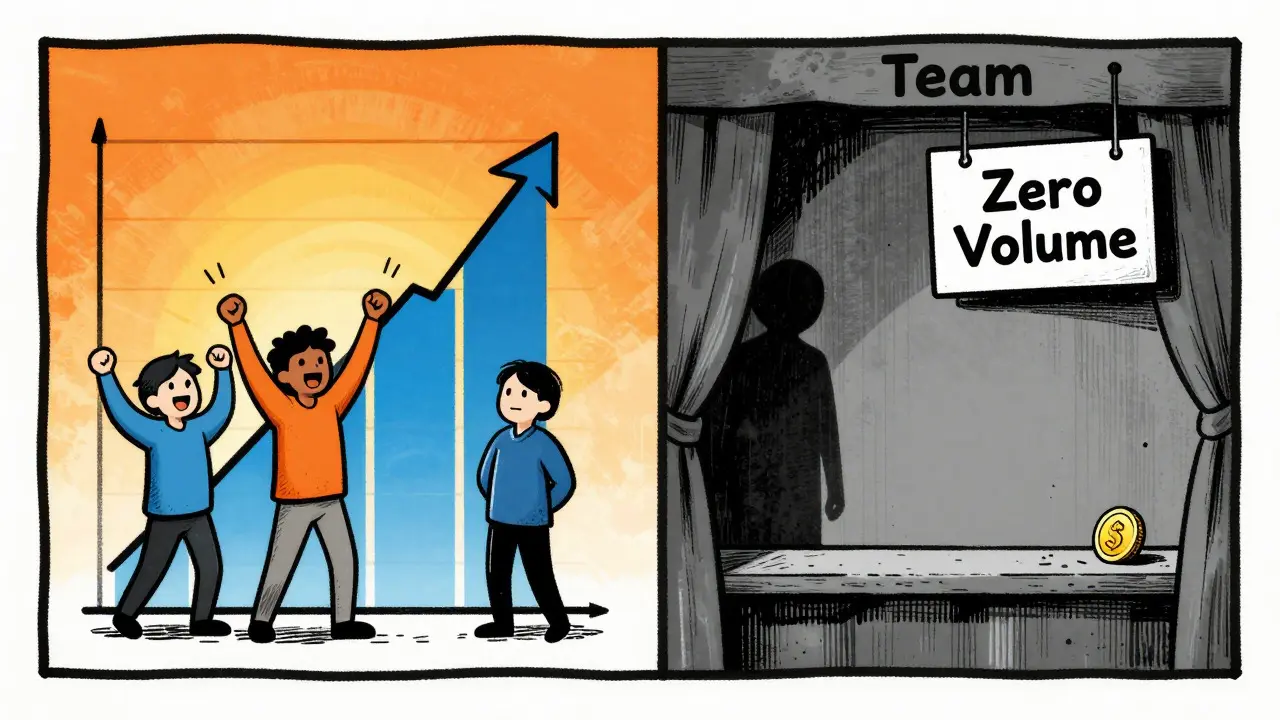
Here is the kicker: the 24-hour trading volume has been reported at $0 across multiple tracking platforms. What does that mean for you? It means there is almost no liquidity. If you manage to buy some ONC, selling it could result in massive "slippage." Slippage is the difference between the expected price of a trade and the price at which the trade is executed. With zero volume, a sell order could drop the price by 15-20% instantly, wiping out your value before you even cash out.
This isn’t just a minor inconvenience; it’s a structural flaw. A token needs buyers and sellers to have a real price. Without them, the price you see on CoinMarketCap is essentially a ghost number-it exists on paper but not in reality.
Community Sentiment and Expert Opinions
When the charts don’t tell the whole story, you look at the people. And right now, the crowd is skeptical. On Reddit, threads discussing ONC are filled with warnings. Users describe the official website as a "basic WordPress site with no functionality," noting that it hasn’t updated since launch. Trustpilot reviews average a dismal 1.2 out of 5 stars, with complaints ranging from "zero communication" to "classic rug pull signs."
Experts aren’t much kinder. Dr. Elena Rodriguez, a blockchain researcher at MIT Media Lab, noted in late 2025 that projects like ONC often lack the scientific infrastructure to deliver impact, calling them "speculative vehicles" rather than solutions. Meanwhile, CoinTelegraph analysts rated the project low due to the absence of verifiable partnerships with research institutions.
Is everyone against it? Not quite. A small group of holders believes in the long-term vision. One user, u/HodlForCure, argued that cancer research needs all the funding it can get, regardless of current execution flaws. But these voices are drowned out by the frustration of the majority who feel the project has stagnated.
Comparison: ONC vs. Established DeSci Tokens
To see where ONC stands, we have to compare it to the giants in the room. The DeSci sector is growing, valued at over $2 billion in 2025. But ONC holds less than 0.01% of that market cap. Let’s look at how it stacks up against more established players.
| Token | Focus Area | Market Cap Estimate | Active Development |
|---|---|---|---|
| ONC | Cancer Research | ~$180k | No (Stalled) |
| RNDR (Render) | Distributed Computing | $1.8 Billion+ | Yes (High Activity) |
| VET (VeChain) | Supply Chain/Healthcare | $1.5 Billion+ | Yes (Corporate Partnerships) |
| GMT (StepN) | Health/Fitness Web3 | $450 Million+ | Yes (Active User Base) |
The contrast is stark. While RNDR and VET have billions in market cap and active corporate partnerships, ONC struggles to find any verifiable institutional backing. Its GitHub repository, a key indicator of software development health, shows no new code commits since January 2024. In the fast-paced world of crypto, a year of silence is effectively a death sentence.

Regulatory Risks and Future Outlook
There is also the matter of regulation. The U.S. SEC has issued warnings about healthcare-themed tokens that make unverified scientific claims. Since ONC’s team is anonymous and its platform lacks demonstrable functionality, it sits in a gray area that regulators love to scrutinize. If the SEC decides that ONC is an unregistered security because it promises returns based on the efforts of others (the "team"), investors could face legal headaches.
Looking ahead, the outlook is cautious to pessimistic. Analysts predict that without a dramatic pivot-like securing a partnership with a major hospital or university-the token will likely continue to lose value. The roadmap items promised in 2024, such as "Clinical trial integration," never materialized. When a project misses its deadlines once, it’s a hiccup. When it misses them for two years straight, it’s a pattern.
Final Verdict: Proceed with Extreme Caution
So, what is Oncology Network? Technically, it’s an ERC-20 token on Ethereum aimed at decentralizing cancer research. Practically, it’s a high-risk asset with minimal liquidity, no active development, and a skeptical community.
If you are looking to invest in the future of medical technology, there are more robust options with actual working products and transparent teams. ONC remains a concept rather than a solution. Until you see active GitHub commits, verified hospital partnerships, or non-zero trading volumes, treat it as a speculative experiment rather than a serious investment.
Always do your own research. Check the contract address yourself. Look at the latest tweets. And remember: in crypto, if something sounds too good to be true-and especially if it involves curing cancer with magic internet money-it usually is.
Is Oncology Network (ONC) a scam?
While not legally defined as a scam yet, ONC exhibits many red flags associated with fraudulent projects. These include an anonymous team, a lack of functional product despite years passing, zero trading volume, and negative user reviews citing "rug pull" signs. Investors should exercise extreme caution.
Where can I buy ONC tokens?
ONC is not listed on major exchanges like Binance or Coinbase. It can only be found on smaller, obscure centralized exchanges or decentralized exchanges (DEXs). Due to extremely low liquidity, buying or selling large amounts can result in significant price slippage.
What is the purpose of the ONC token?
The stated purpose of ONC is to facilitate a decentralized ecosystem for cancer research. It aims to connect researchers, patients, and funders on a transparent blockchain platform. However, as of late 2025, there is no verifiable evidence that this platform is actively being used for research.
Has the ONC team released any updates recently?
No. The project’s social media channels and GitHub repository have shown little to no activity since early 2024. Roadmap milestones promised for 2024 and 2025, such as clinical trial integrations, have not been achieved.
How does ONC compare to other DeSci tokens?
Compared to leaders like Render (RNDR) or VeChain (VET), ONC lags significantly. It has a fraction of the market cap, no major institutional partnerships, and inactive development. It is considered a high-risk, low-reward asset within the DeSci sector.