

Have you ever seen a cryptocurrency price that makes no sense? One site says it’s worth six cents. Another says it’s worth less than a millionth of a cent. That is exactly the situation with Papparico Finance, also known by its ticker PPFT. This token sits at the intersection of decentralized finance (DeFi) and gaming mechanics on the Cronos blockchain ecosystem.
If you are looking for a quick answer: PPFT is a high-risk, micro-cap token designed for yield farming and gamified staking. It is not a mainstream asset like Bitcoin or Ethereum. In fact, as of May 2026, data discrepancies between major trackers suggest significant liquidity issues. Before you connect your wallet, you need to understand what this protocol actually does, why the prices look so different, and whether the risks are worth the potential rewards.
What Is Papparico Finance?
Papparico Finance is a decentralized platform that blends traditional DeFi staking with gaming-style incentives. Think of it as a hybrid between a savings account and a video game reward system. The core idea is simple: users lock up their assets to earn rewards, but the platform adds layers of "gamification" to make the process more engaging.
The protocol operates primarily on the Cronos blockchain, which is built by Crypto.com. Choosing Cronos over Ethereum was a strategic move. Ethereum transactions can be slow and expensive, often costing dollars in gas fees just to stake a small amount. Cronos offers faster settlement times and lower transaction costs, making it easier for users to interact frequently with the platform without eating into their profits with fees.
The main features include:
- Single Staking: You lock PPFT tokens to earn more PPFT.
- xPPFT Staking: A derivative token option for advanced yield strategies.
- Vault-Locking: A unique feature where locking assets for longer periods unlocks cashback rewards. This encourages long-term holding rather than quick trading.
- Launchpad: A mechanism to launch new projects within the ecosystem, allowing early investors to participate in new token offerings.
The Price Problem: Why Data Discrepancies Matter
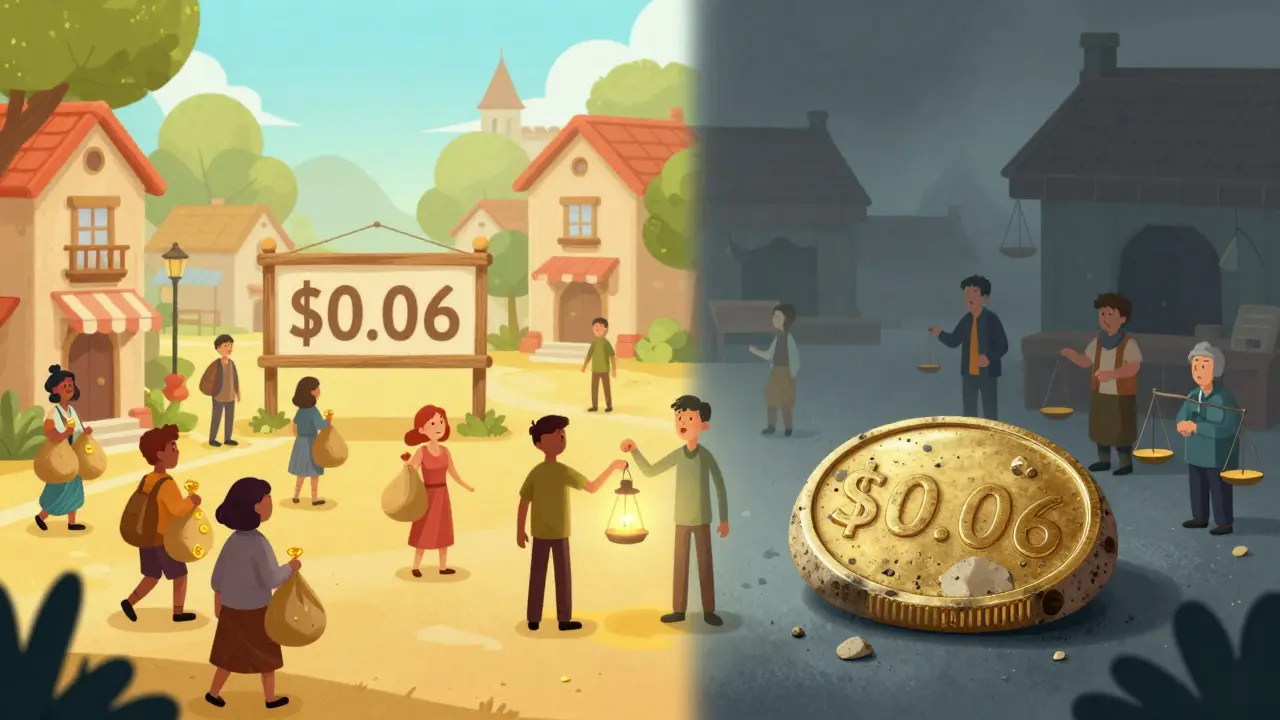
Here is where things get tricky. If you check CoinGecko, you might see PPFT trading around $0.062. But if you check CoinMarketCap, the price is listed at roughly $0.00000021. That is a difference of hundreds of thousands of percent. Which one is right?
In most cases with micro-cap tokens, neither aggregator is perfectly accurate because they rely on automated data feeds from exchanges. For PPFT, the primary trading venue is VVS Finance, a decentralized exchange (DEX) on Cronos. When liquidity is low-which means there aren’t many buyers and sellers-the price can swing wildly based on a single trade.
The CoinMarketCap figure likely reflects the actual spot market reality on VVS Finance, where the 24-hour volume is extremely thin (often under $50). The higher CoinGecko price might be an artifact of an older trade, a different trading pair, or a data error. As an investor, you cannot trust these aggregate numbers blindly. You must check the live order book on VVS Finance to see the real cost to buy or sell.
| Metric | CoinGecko Report | CoinMarketCap Report | Reality Check |
|---|---|---|---|
| Price | $0.0621 | $0.00000021 | Highly volatile; verify on DEX |
| 24h Volume | $2,957 | $24.90 | Extremely low liquidity |
| Market Cap | N/A | ~$104K | Micro-cap status |
| Holders | N/A | 536 | Small user base |
Tokenomics: Supply and Distribution
Understanding how many tokens exist is crucial for assessing value. PPFT has a complex supply structure that includes circulating, total, and maximum caps.
- Circulating Supply: Approximately 13.32 billion PPFT tokens are currently in circulation.
- Total Supply: Around 23.71 billion tokens have been created.
- Maximum Supply Cap: The hard limit is set at 73 billion PPFT tokens.
This means that nearly half of the maximum possible tokens have not yet been issued or are locked. This future issuance can create inflationary pressure. If the team releases more tokens into the market without a corresponding increase in demand, the price per token could drop. This is a common risk in DeFi projects that use token emissions to reward stakers.
The fully diluted valuation (FDV) is approximately $570,000 USD. While this sounds small compared to major cryptocurrencies, for a project with only 536 holders, it indicates a very concentrated ownership. A few large wallets could potentially manipulate the price significantly.
How to Use PPFT: Wallets and Staking
If you decide to proceed, you need specific tools. You cannot buy PPFT on major centralized exchanges like Binance or Coinbase. It is a decentralized asset.
Step 1: Get a Compatible Wallet You need a Web3 wallet that supports the Cronos network. The two primary options are:
- Crypto.com DeFi Wallet: Available on mobile and desktop, this is the native wallet for the Cronos ecosystem.
- MetaMask: The industry-standard browser extension. You must configure it to add the Cronos network manually.
Step 2: Acquire CRO Tokens Before you can buy PPFT, you need CRO (Crypto.com Coin). You will use CRO to pay for gas fees (transaction costs) on the Cronos blockchain and to swap for PPFT on the decentralized exchange.
Step 3: Trade on VVS Finance Connect your wallet to VVS Finance. Swap your CRO for PPFT. Be aware that due to low liquidity, you may experience "slippage," meaning the price you see might change slightly by the time your trade executes.
Step 4: Stake for Yield Once you have PPFT, you can stake it directly through the Papparico Finance interface. Choose between single staking or vault-locking depending on your risk tolerance and desired reward rate.
Risks and Red Flags
Let’s be clear: PPFT is a speculative asset. It is not a safe investment. Here are the specific risks you need to consider.
1. Liquidity Risk The biggest danger is getting stuck. With daily volumes sometimes under $50, selling a large amount of PPFT could crash the price. You might find that you simply cannot sell your tokens without losing most of their value.
2. Smart Contract Risk Like all DeFi protocols, Papparico Finance relies on smart contracts. If there is a bug in the code, hackers could drain the funds. Always check if the project has undergone a security audit by a reputable firm. If no audit is publicly available, the risk is exponentially higher.
3. Regulatory Uncertainty As of 2026, regulations around DeFi and gaming tokens are still evolving. PPFT operates in a gray area. Depending on your country, holding or staking these tokens could have tax implications or legal restrictions.
4. Project Viability With only 536 holders, the community is small. Small communities are vulnerable to "rug pulls" (where developers abandon the project) or pump-and-dump schemes. Look for active development updates, transparent team information, and consistent engagement on platforms like Discord or Telegram.
Is PPFT Worth It?
For experienced DeFi users who understand how to read charts, manage slippage, and assess smart contract risks, PPFT might offer an interesting niche play. The gamified staking model is innovative, and the Cronos integration provides a smooth user experience.
However, for beginners, this token is likely too risky. The price discrepancies, low liquidity, and small holder base are warning signs. If you are new to crypto, stick to established assets with deep liquidity and clear regulatory standing. If you do choose to invest in PPFT, treat it as venture capital money-capital you are willing to lose entirely.
Where can I buy Papparico Finance (PPFT)?
You cannot buy PPFT on centralized exchanges like Binance. You must use a decentralized exchange (DEX) called VVS Finance on the Cronos blockchain. You will need a Web3 wallet like MetaMask or Crypto.com DeFi Wallet and some CRO tokens to pay for gas fees.
Why is the PPFT price different on CoinGecko and CoinMarketCap?
The discrepancy is due to low liquidity and data aggregation errors. PPFT trades on a small DEX with minimal volume. Aggregators may pull data from different sources or outdated trades. Always check the live price on VVS Finance for the most accurate real-time value.
What is the maximum supply of PPFT?
The maximum supply cap for Papparico Finance is 73 billion PPFT tokens. As of May 2026, approximately 13.32 billion are in circulation, meaning a significant portion of the supply is yet to be released or is locked.
Is Papparico Finance safe to use?
No DeFi platform is 100% safe. PPFT carries high risks due to low liquidity, smart contract vulnerabilities, and a small user base. Only invest what you can afford to lose, and ensure you understand the risks of interacting with unverified smart contracts.
What blockchain does PPFT run on?
PPFT operates on the Cronos blockchain. This choice allows for faster transaction speeds and lower fees compared to Ethereum, making it more suitable for frequent staking and gaming interactions.