


When you hear "Liquidswap," you’re not just hearing the name of another crypto project. You’re hearing the most used decentralized exchange on the Aptos blockchain - and its governance token, LSD, is what gives users real control over its future. Unlike many tokens that are just speculative assets, LSD was built to power a functioning, real-world DeFi protocol that’s already handled over $1.3 billion in trades and served more than a million users. This isn’t a vaporware project. It’s live, growing, and governed by its community.
What is Pontem Liquidswap?
Pontem Liquidswap is the leading Automated Market Maker (AMM) on the Aptos blockchain. Think of it like Uniswap, but built for the Move programming language, which gives it faster transaction speeds, stronger security, and lower fees than older EVM-based DEXs. Since its launch, Liquidswap has processed over 14 million swaps and hit a peak Total Value Locked (TVL) of $60 million. That’s not a small number - it’s the most active DeFi app on Aptos by far.
The protocol doesn’t just let you swap tokens. It lets you add liquidity, earn trading fees, and participate in governance - all without a middleman. And that’s where LSD comes in.
What is the LSD token?
LSD is the native governance token of Liquidswap. It doesn’t pay dividends or earn interest on its own. Instead, it gives holders voting power to decide how the protocol evolves. Want to change the trading fee? Propose it. Want to fund a new liquidity pool for a new token? Vote on it. Want to shift funds from the treasury to support a new chain integration? That’s all up to LSD holders.
The token was launched with a total supply of 42 million LSD, minted at genesis. But here’s the key: there’s no hard cap. The DAO can mint more LSD over time if the community votes to do so. That means supply isn’t fixed - it’s dynamic, based on what the protocol needs to grow.
How was LSD distributed?
The distribution of LSD wasn’t handed out to insiders or big investors. It was designed to reward early users, liquidity providers, and community builders - the people who actually used the protocol before the token existed.
- 40% went to the community - split into multiple parts: a retroactive airdrop for early users, staking rewards, and future incentives.
- 5% (2.1 million tokens) was given out in a retroactive airdrop to users who added liquidity or traded on Liquidswap before the token launch.
- 15% (6.3 million tokens) was reserved for staking and future airdrops, with 5% of that (2.1 million) released immediately at TGE and the rest vested over four months.
- 8% (3.36 million tokens) was kept by the DAO for future airdrops and community incentives - meaning more tokens could still be distributed to users who help grow the protocol.
- 16% (6.72 million tokens) went to the treasury, vested over three years, to fund grants, partnerships, and ecosystem growth.
- 8% (3.36 million tokens) was allocated to professional market makers to ensure liquidity on major exchanges.
- 1% (420,000 tokens) was sold through an Initial Exchange Offering (IEO) on KuCoin at a discount to private sale prices, giving retail users a fair shot.
That’s not a typical token launch. Most projects give 20-30% to the team and investors. Here, over 70% of the supply was allocated to users and the community. That’s rare.

Who qualifies for LSD airdrops?
You didn’t need to buy LSD to get some. If you were active on Liquidswap before the token launch, you might’ve already been eligible. The airdrop criteria were based on real usage:
- Adding liquidity to Liquidswap pools - weighted by how long you kept it there.
- Trading volume on the DEX - even if you didn’t pay fees.
- Holding Pontem Community NFTs like Pontem Space Pirates, Dark Ages, or DooDoos OG.
- Using the meme tokens $DooDoo and $RETURD - yes, those were part of the eligibility.
- Referring others to the platform.
This wasn’t just a token giveaway. It was a recognition of contribution. If you helped build the protocol by using it, you got rewarded.
Where can you trade LSD?
LSD is listed on several exchanges, but trading volume varies wildly. As of March 1, 2026:
- KuCoin is the most active, with $111,026 in 24-hour volume on the LSD/USDT pair.
- MEXC and BingX also have decent liquidity.
- Binance lists LSD at $0.000107, down 3.59% in 24 hours.
- CoinMarketCap shows a price of $0.0000985, but with $0 in volume - meaning it’s likely not trading actively there.
- LBank reports a much higher price of $0.002051 - a sign of inconsistent pricing across platforms.
Price data is messy because LSD isn’t a top-100 coin. Liquidity is thin, and small trades can swing prices. CoinGecko uses a volume-weighted average across five exchanges, which gives the most accurate picture.
Price history and market performance
LSD hit an all-time high of BTC 0.00002044. Since then, it’s dropped over 82% from that peak. Over the past week, it fell 2.1%, but outperformed the broader crypto market, which only rose 0.9%. That’s a sign that LSD has its own momentum - even if it’s small.
Price predictions are all over the place. DigitalCoinPrice forecasts LSD could hit $0.68 in one year, $1.69 by 2030, and $6 by 2034. But these are speculative. The token’s real value won’t come from price charts - it’ll come from adoption. If Liquidswap becomes the go-to DEX across multiple blockchains, LSD’s value will follow.
What’s next for Liquidswap?
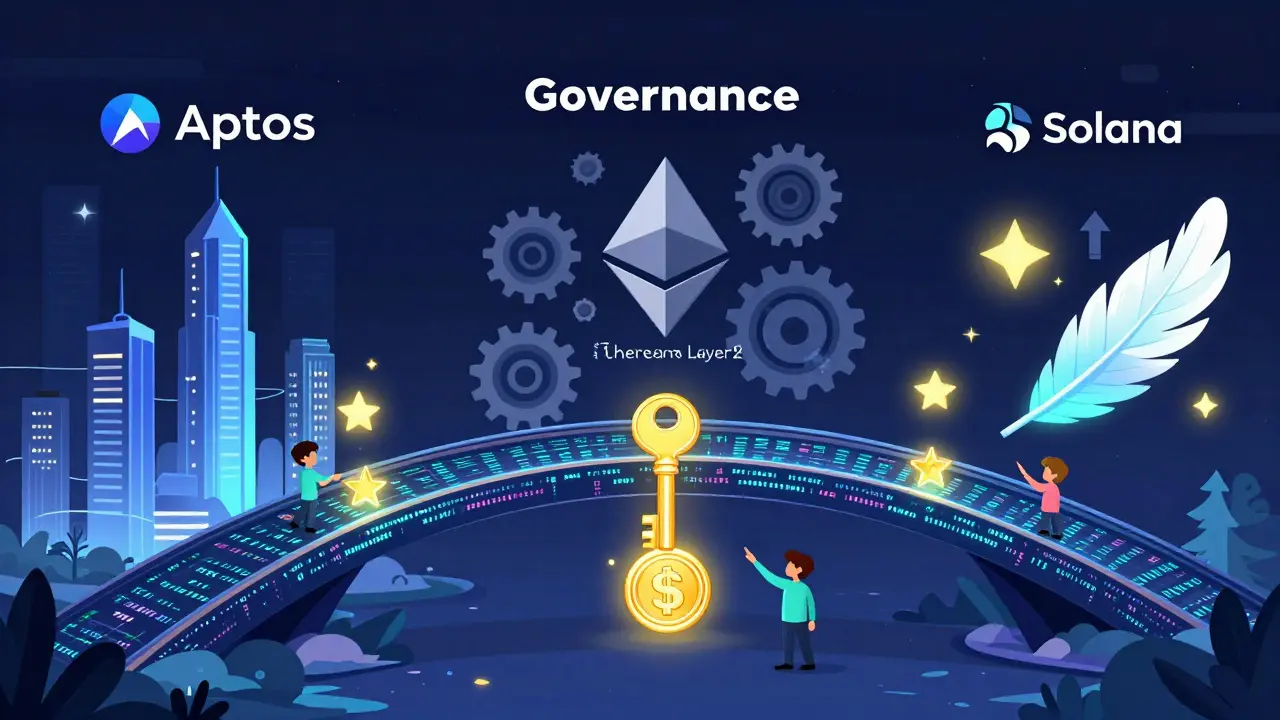
Pontem isn’t stopping at Aptos. The team has announced plans to expand Liquidswap to Ethereum Layer 2s like Movement and Lumio, and even to Solana and Ton. This isn’t just about copying the same model - it’s about bringing Move’s security and speed to other ecosystems.
If Liquidswap becomes a multi-chain AMM, LSD becomes more than an Aptos token. It becomes a cross-chain governance asset. That’s a big deal. Right now, most DEX tokens are tied to one chain. LSD could be one of the first to bridge multiple ecosystems under one governance system.
Why LSD matters
LSD isn’t a coin you buy hoping it’ll pump. It’s a tool. If you care about decentralized finance, if you believe users should own the protocols they use, then LSD gives you a voice. You don’t need millions of dollars to influence it. You just need to hold a few tokens and vote.
Most crypto projects are controlled by venture firms and insiders. Liquidswap was built differently. It gave power to the people who used it first. That’s why it’s not just another token - it’s a model for how DeFi should work.
Is LSD a good investment?
LSD isn’t a traditional investment. It doesn’t generate yield or have a fixed supply. Its value depends on whether Liquidswap grows as a cross-chain DEX. If it succeeds, LSD could gain utility and demand. If it doesn’t, the price may stay low or drop. Don’t buy it for speculation. Buy it if you want to help shape the future of decentralized trading.
Can I stake LSD for rewards?
Yes - but not directly on Liquidswap yet. LSD staking is being tested through voting-escrow mechanisms, where users lock up tokens to gain voting power and earn rewards. These systems are still in development. Keep an eye on official Pontem channels for updates on staking launches.
How do I get LSD?
You can buy LSD on exchanges like KuCoin, MEXC, and BingX using USDT or other stablecoins. If you used Liquidswap before March 2024, you might’ve been eligible for a retroactive airdrop - but that window has closed. Future airdrops may be announced by the DAO, so stay active in the ecosystem.
What makes LSD different from other DEX tokens like UNI or SUSHI?
UNI and SUSHI were launched with large allocations to teams and investors. LSD was designed with 70%+ going to users and community incentives. It’s more focused on rewarding real usage than raising capital. Also, LSD is tied to the Move language, which offers faster and more secure transactions than EVM-based DEXs.
Is LSD available on centralized exchanges?
Yes - LSD is listed on KuCoin, Binance, MEXC, BingX, and LBank. KuCoin was the first to list it through its Spotlight program, which helped bring visibility to Liquidswap’s dominance on Aptos. Always check the trading pair (e.g., LSD/USDT) and verify the exchange before trading.
Can I use LSD to vote on protocol changes?
Yes - that’s its primary purpose. LSD holders can propose and vote on changes like fee structures, treasury spending, new chain integrations, and emission schedules. You need to hold LSD and connect your wallet to the Liquidswap DAO interface to participate. Voting power is proportional to your holdings.
Why does LSD have no fixed supply cap?
The DAO can mint more LSD if needed to fund growth - like incentivizing liquidity on new chains or rewarding new users. This flexibility lets the protocol adapt without hardcoding supply limits. It’s not inflationary by design - it’s responsive. Any new emissions must be approved by token holders.
What happens if Liquidswap fails?
If Liquidswap loses usage, LSD loses its utility. Without trading volume, governance participation, or ecosystem growth, the token has no real-world value. It’s not a store of value like Bitcoin. It’s a governance tool. Its worth is tied directly to the success of the protocol it governs.
Dana Sikand
March 1, 2026 AT 11:10Jessica Carvajal montiel
March 2, 2026 AT 18:25maya keta
March 3, 2026 AT 14:11precious Ncube
March 5, 2026 AT 10:01Amita Pandey
March 6, 2026 AT 03:44Jan Czuchaj
March 6, 2026 AT 05:03George Suggs
March 7, 2026 AT 19:22Dianna Bethea
March 9, 2026 AT 09:31KingDesigners &Co
March 9, 2026 AT 19:51Felicia Eriksson
March 11, 2026 AT 15:15aaron marp
March 11, 2026 AT 15:25Patrick Streeb
March 13, 2026 AT 11:11Phillip Marson
March 13, 2026 AT 16:04Tracy Whetsel
March 14, 2026 AT 08:49Alyssa Herndon
March 14, 2026 AT 15:34Ifeanyi Uche
March 15, 2026 AT 19:03Jeff French
March 16, 2026 AT 13:43Elana Vorspan
March 17, 2026 AT 10:50Kenneth Genodiala
March 18, 2026 AT 17:17Michael Rozputniy
March 19, 2026 AT 02:00Danny Kim
March 20, 2026 AT 12:03Cathy Sunshine
March 20, 2026 AT 22:46Shannon Black
March 21, 2026 AT 02:16Richard Cooper
March 21, 2026 AT 20:43Dee Resin
March 22, 2026 AT 22:39Tanvi Atal
March 24, 2026 AT 10:57Dana Sikand
March 26, 2026 AT 03:22