

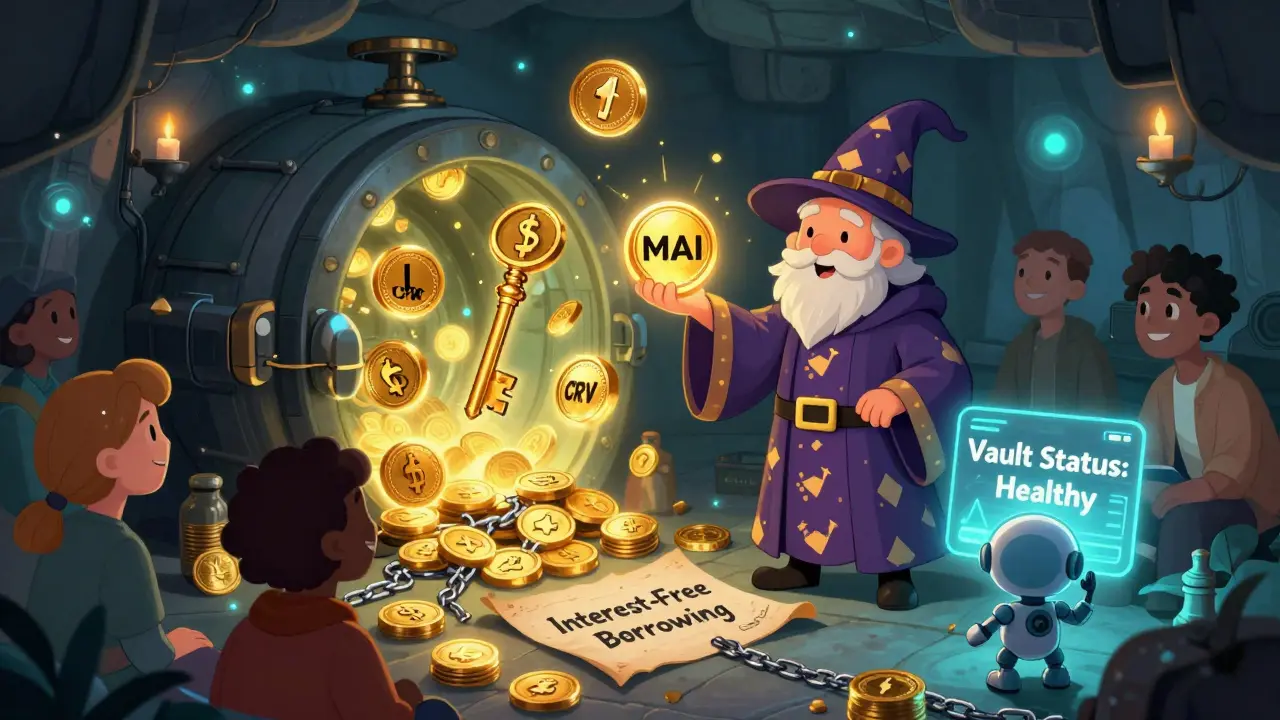
The QiDAO protocol isn't just another crypto project-it's a working, live system that lets people borrow interest-free stablecoins using their crypto as collateral. At the heart of it all is the QI token, which doesn't mine or stake like Bitcoin or Ethereum. Instead, it runs the whole system. If you've ever wondered how someone can borrow $1,000 in stablecoins without paying a single cent in interest, QiDAO is one of the few places that actually makes it happen.
What Exactly Is QiDAO?
QiDAO is a decentralized finance (DeFi) protocol launched in 2021. It started on the Polygon network and later expanded to zkEVM, a scaling solution that cuts transaction costs and speeds up trades. Its main goal? Let users borrow a stablecoin called MAI-pegged to the U.S. dollar-without paying interest. You lock up your crypto, like LINK or CRV, and get MAI in return. You keep your original assets. No loans. No monthly payments. Just a one-time fee when you pay back the loan.
This isn't theoretical. Thousands of people use it daily. The protocol is non-custodial, meaning you never give up control of your crypto. The system runs on smart contracts, not banks or middlemen. If your collateral drops too far in value, the system automatically sells part of it to cover the loan. That’s called liquidation. It’s how QiDAO avoids collapse if prices crash.
The QI Token: More Than Just a Coin
The QI token is the backbone of QiDAO. It’s not a currency you spend at stores. It’s a governance tool. Think of it like voting shares in a company-but instead of a boardroom, the votes happen on-chain.
There are 200 million QI tokens total. Only 5% went to early investors and partners, with those tokens locked and released slowly over 18 months. Another 10% is reserved for keepers-people who run automated bots that manage vaults and keep the system running. The remaining 85%? All for the community.
To vote on changes to QiDAO, you don’t just hold QI. You lock it. Lock QI for a year? You get eQI tokens. Lock it for four years? You get even more voting power and a bigger share of the protocol’s fees. This system rewards long-term believers. It also stops short-term traders from flipping the vote every week.
Anyone can propose a change-like adding a new type of collateral or changing the fee structure. But only those with staked QI (called xQi) can vote on it. The more QI you lock and the longer you lock it, the heavier your vote counts. This keeps control in the hands of those who’ve shown real commitment.
How MAI Stablecoin Works
MAI is the product QiDAO is built around. It’s a stablecoin, meaning its value stays close to $1. But unlike USDT or USDC, which are backed by cash or reserves, MAI is backed only by crypto. If you lock $2,000 worth of ETH, you can borrow up to $1,000 in MAI. That’s a 2:1 collateralization ratio. If ETH’s price drops and your collateral falls below $1,200, your vault gets liquidated.
What makes MAI different? You don’t pay interest. You pay a one-time fee when you repay the loan. That fee goes into the QiDAO Treasury, which is controlled by QI holders. The Treasury uses that money to pay for development, audits, marketing, and other needs. It’s like a community fund you help run.
On March 20, 2024, QiDAO added something huge: the Peg Stability Module (PSM). This lets users deposit other stablecoins-like USDbC-and mint MAI at a 1:1 ratio. Or, they can burn MAI to get back those stablecoins. The PSM acts like a buffer. If MAI starts trading below $1, people rush to swap it for USDbC in the PSM, which pulls MAI’s price back up. If MAI goes above $1, people mint new MAI from USDbC, flooding the market and bringing the price down. It’s a self-correcting system.

Collateral Options: More Than Just Bitcoin and Ethereum
QiDAO doesn’t just accept ETH or BTC. It lets you lock up a wide range of assets:
- Static tokens: LINK, CRV, UNI, AAVE
- Yield-generating tokens: aTokens from Aave, yVaults from Yearn, Beefy strategies
This is where QiDAO gets clever. If you lock up aToken (which earns interest), you’re not just borrowing MAI-you’re also earning yield on your collateral. So you get paid to borrow. That’s rare in DeFi. Most platforms make you pay to borrow. QiDAO turns borrowing into a way to earn.
For example, you deposit 100 AAVE into a vault. You get 50 MAI. While you hold that vault, your AAVE keeps earning interest from Aave’s lending pool. You can use that MAI to buy more crypto, pay bills, or hold as a hedge. Meanwhile, your AAVE grows. That’s capital efficiency at work.
Market Performance and Price Volatility
QI’s price has been wild. Its all-time high was $6.09. Today, prices vary wildly depending on the exchange: LBank says $0.0075, DefiLlama says $0.016, and Binance lists it at $0.000106. Why the gap? Different trading volumes, liquidity pools, and market depth. QI trades on smaller exchanges more than giants like Coinbase.
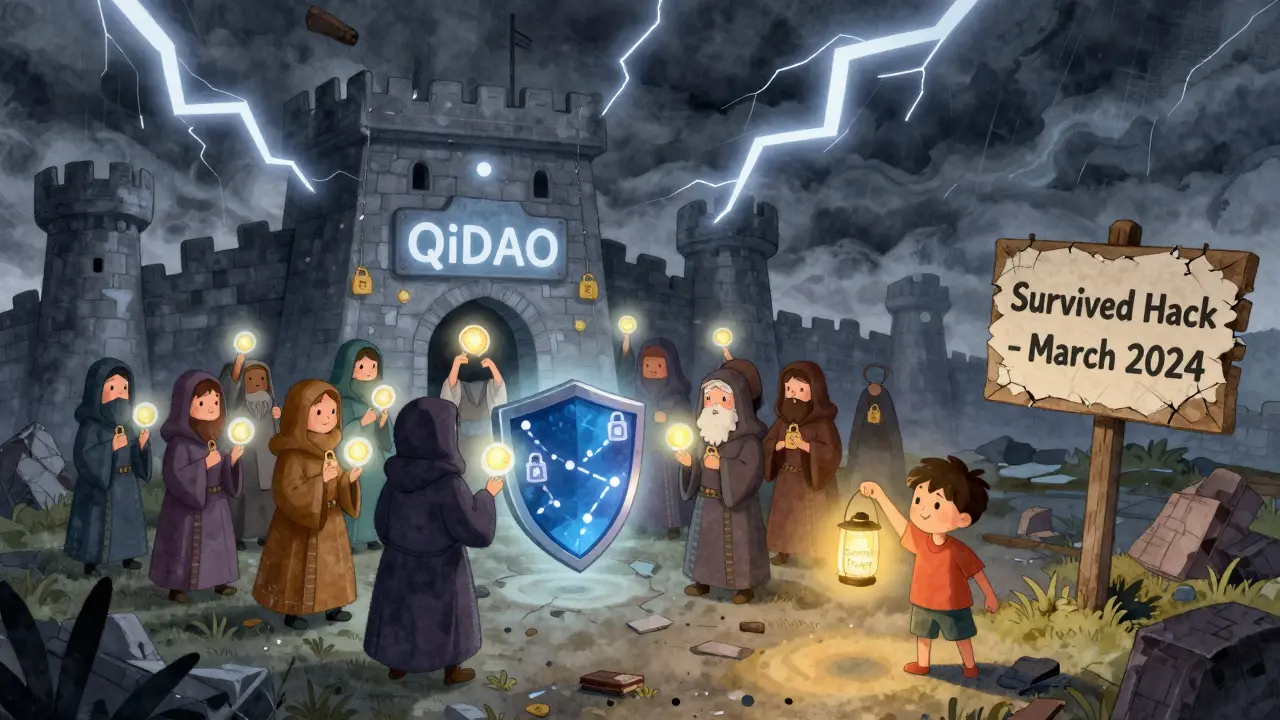
In early 2024, QiDAO suffered a major hack. Team-vested tokens were stolen, triggering a 65% price crash. But the protocol didn’t shut down. The community voted to continue operations, and the price slowly recovered. That’s rare. Most projects collapse after a hack. QiDAO didn’t. It proved its governance model works-even under pressure.
As of March 2026, QiDAO’s treasury holds $2.69 million. Most of it is in other crypto assets ($2.61 million), with $891,200 in major coins and $74,275 in stablecoins. Daily trading volume hovers around $30 million. That’s small compared to Uniswap or Aave, but it’s steady.
How to Use QI: Beyond Voting
QI isn’t just for voting. You can:
- Trade it: Buy low and sell high on LBank, Gate.io, or other spot markets. QI moves fast.
- Earn yield: Stake QI on LBank Earn or similar platforms to earn interest.
- Send it: Use QI like any other token. Send it to friends, pay for services, or use it in QiDAO’s own ecosystem.
- Buy things: Some vendors accept QI for digital goods, NFTs, or even physical products.
QiDAO’s Universal Router lets you swap crypto and NFTs in one transaction. That means you can sell an NFT and use the proceeds to buy QI-all in one click, with lower gas fees. It’s a small feature, but it shows the team is building for real users, not just speculators.
Why QiDAO Matters
Most DeFi protocols are about earning yield or swapping tokens. QiDAO is different. It’s about freedom. It lets you borrow without interest. It lets you earn yield on your collateral. It gives you real control over your money.
It’s not perfect. The price is volatile. The ecosystem is small. But it’s real. It’s been running for over five years. It’s survived a hack. It’s adapted. It’s community-run. And it’s still growing.
If you’re tired of paying interest on loans or being locked into rigid systems, QiDAO offers a different path. One where your crypto works harder for you-not the other way around.
Is QI coin a good investment?
QI isn’t a traditional investment like Bitcoin. It’s a governance token with high volatility. Its value depends on the health of the QiDAO protocol, not speculation. If you believe in decentralized borrowing and community control, holding QI gives you a voice in that system. But don’t expect steady growth. Price swings are normal. Only invest what you can afford to lose.
Can I borrow MAI without locking up my crypto?
No. QiDAO requires overcollateralization. You must lock crypto assets like ETH, LINK, or aTokens to borrow MAI. There’s no credit check, no identity verification-just crypto as collateral. If you don’t have crypto to lock, you can’t borrow.
How does the Peg Stability Module (PSM) keep MAI at $1?
The PSM acts like a buffer. If MAI drops below $1, users can deposit stablecoins like USDbC into the PSM and mint MAI at a 1:1 rate. This increases MAI supply and pushes its price back up. If MAI rises above $1, users can burn MAI to withdraw USDbC, reducing supply and lowering the price. This automatic balancing keeps MAI tightly pegged.
Do I earn interest on my collateral in QiDAO?
Yes-if you use yield-generating assets. If you lock aTokens (from Aave), yVaults (from Yearn), or Beefy strategies, you keep earning the underlying yield. That means you borrow MAI interest-free and still get paid for holding your collateral. This is one of QiDAO’s biggest advantages over other DeFi platforms.
What happens if my collateral value drops too much?
If your collateral falls below the required loan-to-value ratio (usually 150-200%), your vault gets liquidated. Part of your collateral is sold to repay the MAI loan, and you lose the rest. This protects the system from defaults. You’ll get a warning before liquidation, but it’s automatic. Always monitor your vault.
Can I use QiDAO on mobile?
Yes, but not through a native app. You need a Web3 wallet like MetaMask or Trust Wallet connected to the QiDAO website. The interface works on mobile browsers, but managing vaults and voting is easier on desktop. Always use a secure wallet and never share your private key.
Prakash Patel
March 15, 2026 AT 13:56Zachary N
March 16, 2026 AT 22:55Elizabeth Kurtz
March 17, 2026 AT 00:34john peter
March 18, 2026 AT 04:17Marc Morgan
March 18, 2026 AT 15:58Anastasia Thyroff
March 20, 2026 AT 12:26Kira Dreamland
March 22, 2026 AT 06:37Shreya Baid
March 22, 2026 AT 11:56Christopher Hoar
March 24, 2026 AT 10:51Robert Kunze
March 25, 2026 AT 08:59Sarah Zakareckis
March 25, 2026 AT 15:06Ann Liu
March 25, 2026 AT 16:07Dionne van Diepenbeek
March 26, 2026 AT 01:49Graham Smith
March 28, 2026 AT 01:10Jerry Panson
March 28, 2026 AT 16:00Katrina Smith
March 30, 2026 AT 00:39Anastasia Danavath
March 31, 2026 AT 23:03Jessica Beadle
April 2, 2026 AT 22:09Zachary N
April 4, 2026 AT 19:34